What Is Prospect Research and Why B2B Teams Use It
What is prospect research? It is the process of finding, qualifying and ranking B2B buyers before outreach, with the evidence behind each decision.
Prospect research is the structured process of finding potential B2B buyers, checking each one against a written ideal customer profile, and recording the evidence for why that account and contact deserve outreach now. Three spam complaints on 1,000 delivered emails is a 0.3% rate, and that is enough to put a sending domain on the wrong side of a mailbox provider's line.
You warmed the domains, loaded the sequence, and set the first send for morning. The export looks full. Titles are a year old, two addresses bounce, and a VP who left in March gets a note about a hiring plan the company already filled. The copy didn't fail. The row never had to survive a live campaign.
A usable record names the account, the person, the role, the evidence, the date of the check, and the reason this message should go now. Anything thinner is a list that looks busy in the CRM and then shows up as complaints.
What Prospect Research Means for B2B Outbound
Prospect research is the structured process of identifying, evaluating, and prioritizing potential supporters or buyers using information from public records, internal databases, and third-party sources. In fundraising it grew as three stages: identification, qualification, and relationship management. Researchers judged capacity, affinity, and propensity before anyone asked for a gift. B2B outbound uses the same judgment, only the fields change to company size, industry, geography, role seniority, tools in use, hiring, funding or leadership changes, and signs of the problem the offer solves.
A scout studies a team before the match. A list buyer only collects the roster. The roster tells you a name exists. It doesn't tell you the account fits, the contact can decide, or the timing is real.
From donor logic to a sendable row
Those three nonprofit stages map onto commercial work as target definition, identification, qualification, enrichment with verification, and prioritization with handoff. Qualification still means the same three judgments: capacity to buy, affinity for the problem, and propensity to act now.
A research record draws from three places.
- Public records and company websites: legal name, city, leadership titles, recent announcements.
- Internal databases: CRM history, replies, bounces, and past deals.
- Third-party providers: emails, firmographics, and role data that still need a check.
Social Media Today cites industry reporting that more than 60% of businesses rely on prospect data that may be up to 40% inaccurate or incomplete, while more than 85% report CRM or database records that are 10% to 40% bad. Data accuracy was a top priority for 66% of surveyed respondents. Volume doesn't fix that.
Practical rule: If you can't write why this account, why this contact, and why this message now, you have a list, not research.
Say one row holds only an email. The next holds a named VP of Sales, a job post for two account executives, and a source date. Only the second row can support a send decision.
The Five Stages From Target Market to Handoff
Each stage answers one question and hands a specific output forward. Skip a stage and the next one inherits the gap.
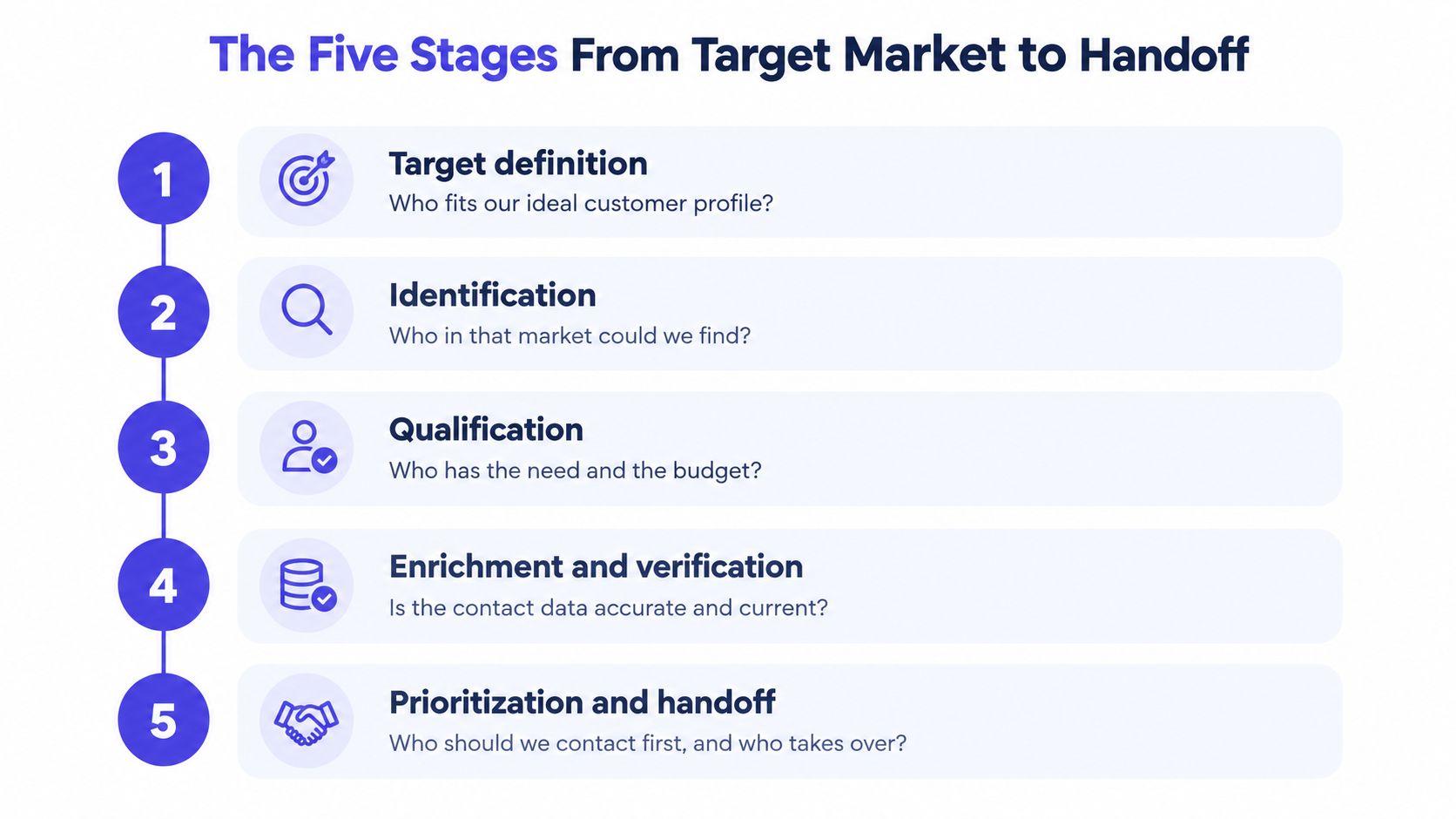
| Stage | Question it answers | Typical inputs | Output passed forward |
|---|---|---|---|
| Target definition | Which market and offer are we researching? | Offer, deal size, current customers, exclusions | Written ideal customer profile with inclusion and exclusion rules |
| Identification | Which accounts and contacts fit the profile? | Firmographic filters, job titles, technographic signals | Account list with candidate contacts |
| Qualification | Does each account show need, authority and timing? | Hiring activity, tools in use, role seniority, trigger events | Accepted or rejected record with evidence and a rejection reason |
| Enrichment and verification | Is the contact data current and correct? | Email validation, role confirmation, source timestamps | Verified record with a confidence level per field |
| Prioritization and handoff | Which records go into outreach first? | Qualification strength, sending capacity, segment | Ranked list ready for sequencing or CRM entry |
Where a vague target breaks the rest
A fuzzy definition produces an oversized identification list. Qualification then either rejects most of it or accepts it with blank evidence. Enrichment spends money confirming people who should never have been pulled. Prioritization becomes "whoever has an email," and the handoff dumps noise on whoever owns the inbox.
The record that should travel through all five stages carries the account name, contact name and role, each qualification field marked yes, no, or unknown, the evidence source, a source date, a confidence level, and a rejection reason when criteria fail. Rejection reasons are data. A pile of "no estimator on staff" tells you the definition was too loose, or the source can't see that role.
A large list can still fail every stage downstream. Size doesn't create fit, and a full export doesn't create timing.
Find the stage your process skips most often. It's usually the written definition or verification before a major send. If definition is a sentence in someone's head, write the inclusion and exclusion rules before the next pull. If verification is "we bought this last quarter," timestamp the fields and treat anything unchecked as unknown.
Where the Evidence Comes From
Every qualification field needs a source, and sources don't share one reliability profile. Treat a field as unproven until the source and the date sit on the row, because that row is what a live sequence will read back to the prospect.
Company sites and filings confirm legal name, headquarters city, leadership titles, and recent releases. When a profile scrape and the company site disagree, the site wins until you prove otherwise. Record which source produced each field, since a title pulled from a scraped profile and a title confirmed on the site carry different weight once the campaign goes live.
Job posts show open roles and team growth. Two account executive postings count as a hiring signal only when the posting date sits next to the observation. A post from last year is a closed chapter, not a trigger.
Technographic detection shows the software an account runs. Log the detection date, because stacks change. An old detection written into a first line becomes a false personalization the moment the prospect replies to correct it.
What your own sends already know
Internal history is the source outbound teams underuse. Replies, bounces, closed deals, and unsubscribes are qualification evidence gathered under real sending conditions. Review them after every send. A segment with zero replies across two sends is a fit problem, not only a copy problem.
Whatever the source, each row gets a timestamp and a confidence level. That pairing shows what is current, what was inherited from an old import, and what will embarrass the campaign once it reaches the inbox.
Qualification Criteria That Decide Who Gets Contacted
Five criteria decide who gets contacted: ideal customer profile fit, need, decision authority, capacity, and timing. An account passes only when the required criteria carry evidence on the row. Unknown counts as a fail, so a blank budget field keeps the account out of the send until someone documents it.
An account becomes sales-ready when each criterion has a source and a date behind it. A verified email alone qualifies no one; it only confirms the address accepts mail. That standard stops outreach from chasing reachable contacts with no commercial problem.
Turn a segment into rules
"Commercial contractors" is not a profile. Build the rules before you pull a contact.
- Located in the target metro areas.
- Crew size inside a defined band.
- Commercial work, not residential only.
- An estimator or operations manager on staff.
- A recent bid, expansion, or hiring signal.
Technographic readiness belongs in the same pass. A contractor already on a field service tool, with no follow-up or sales tracking, has an operational base and a visible gap. A contractor with no tools at all may lack the base to use what they buy. The first is a candidate. The second is often a reject, even if the crew size matches.
Each criterion also needs a source that can prove it, plus a defined pass threshold. Map them before the list exists:
| Criterion | Source that can prove it | What counts as a pass |
|---|---|---|
| ICP fit | Company site, filings, firmographic fields | Industry, metro, and crew size all inside the defined bands |
| Need | Technographic detection, internal send history | A dated detection showing the gap, or a prior engaged reply |
| Decision authority | Leadership page, confirmed role data | A named estimator or operations manager whose title was checked |
| Capacity | Job postings, bid or expansion signals | A dated signal from the current period, stored with its date |
| Timing | Recent trigger events, reply recency | Activity inside the window your offer actually fits |
Write at least five inclusion rules and five exclusion rules before a single contact is pulled. Rules written after the list exists tend to fit the list, and weak rules carry a deliverability cost: every unqualified row that survives into a sequence is a send spent on someone likely to ignore it or report it. A record that fails the table never reaches the campaign.
Why Prospect Records Go Stale and How to Verify Them
Records decay even when the first pass was careful. Independent benchmarking reported by Allston Labs puts B2B enrichment accuracy from roughly 60% to above 95% by attribute, with U.S. coverage often outperforming EMEA and APAC coverage. The same analysis estimates that a list reused after six months may see a 15 to 30 percentage-point decline in email and role accuracy.
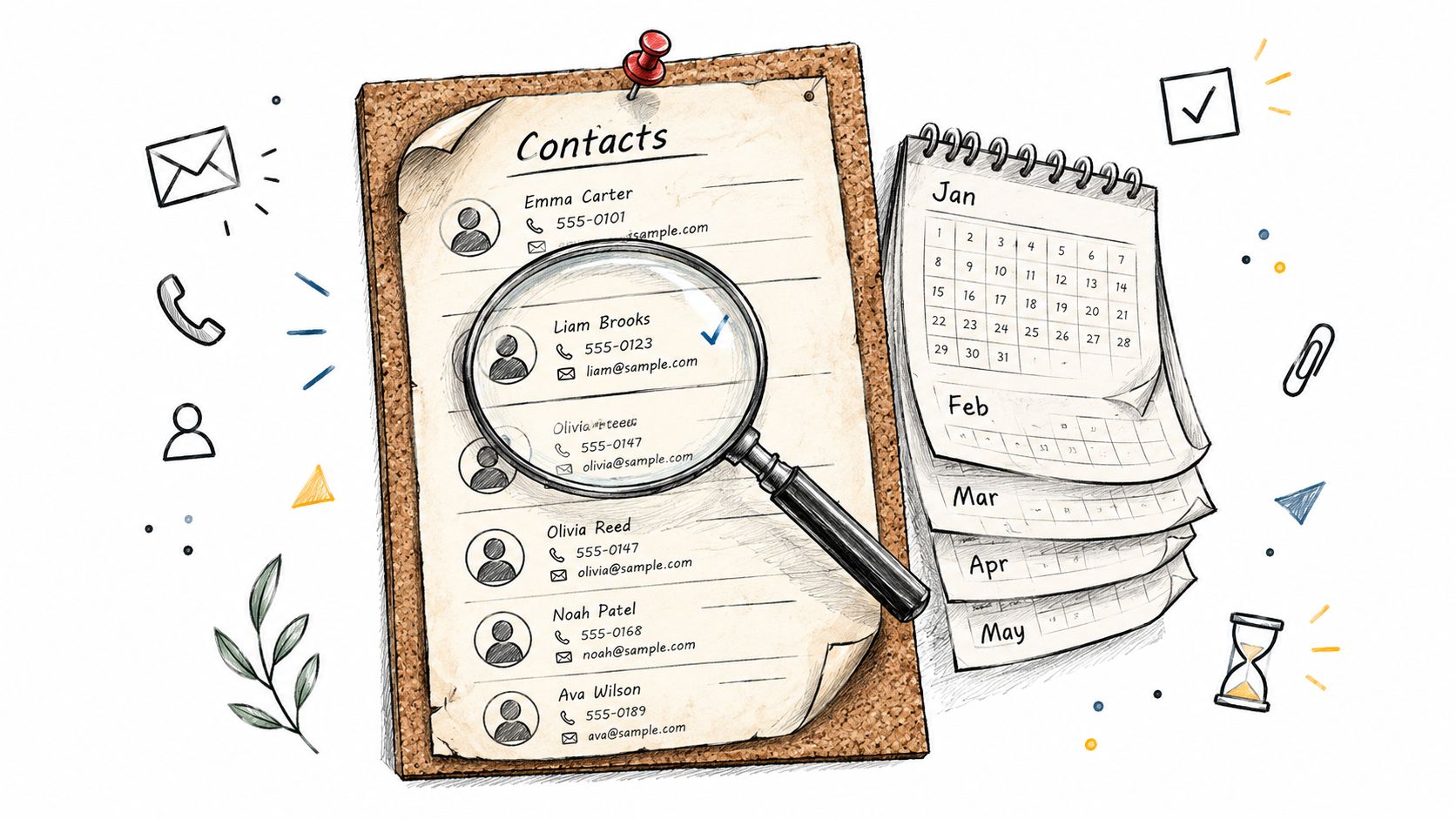
People change jobs. Companies change direction. Addresses go inactive. An offer that matched last spring no longer matches the account. Stale or weakly verified rows raise invalid contacts, misdirected messages, and irrelevant personalization. A first name plus an outdated title looks worse than a plain note, because the reader can see you didn't check.
A verification pass before the campaign
- Validate email deliverability.
- Confirm current job title and employment.
- Normalize company identity so duplicates merge.
- Append firmographic and technographic fields the rules use.
- Timestamp each observation with its source.
- Re-verify before every major campaign.
Waterfall enrichment checks several sources and keeps the highest-confidence value per attribute. Apply it to expensive or high-value accounts, not to every row. A 400-person mid-market account with a real trigger justifies the lookups. A scraped long tail doesn't.
Set a minimum confidence threshold for sending, and keep a suppression list that every sequence reads. Any list older than six months gets re-verified before it is used. Acceptance of a lead should rest on documented profile fit and current evidence, not on whether someone once replied.
How Research Quality Shows Up in the Inbox
Bad research becomes a delivery problem. A prospect who never fit the list marks the message as spam, and mailbox providers measure spam complaints. A strong open rate won't offset the complaint rate a weak segment earns.
Starting February 2024, senders delivering to Gmail must authenticate with at least SPF or DKIM, avoid unwanted or unsolicited messages, and offer an easy unsubscribe. Google's sender guidelines set the complaint ceiling and the consequence for crossing it: keep the user-reported spam rate below 0.1%, never let it reach 0.3%, and bulk senders above that line lose access to delivery support or mitigation until they hold below 0.3% for seven consecutive days. Spam data is calculated daily in Postmaster Tools.
Campaign-wide averages hide the segment that caused the complaints.
Complaint math runs on delivered volume. Four complaints on 5,000 delivered emails is 0.08%, which reads as safe. Two complaints on the 400 emails delivered to one weak segment is 0.5%, well above the threshold, even while the blended rate looks calm. Calculate the rate per segment and per sending domain rather than once for the whole campaign.
Volume and alignment
Gmail's bulk sender requirements add a split at 5,000 or more messages a day: senders at that volume need SPF, DKIM, and DMARC together, plus an easy unsubscribe. Senders below that volume still need at least SPF or DKIM and the same complaint ceiling. Splitting volume across domains doesn't dilute the requirement. Each domain carries its own reputation.
Microsoft's high-volume Outlook requirements require the visible From domain to align with the domain used for SPF or DKIM signing. A message can pass authentication and still get filtered when the From domain doesn't match. The identity stored in campaign data, the From address the prospect sees, and the DNS records behind it have to work as one system.
List quality, suppression discipline, and reply handling keep you under the 0.1% line. A first line that invents a trigger the record doesn't hold is how a clean domain picks up complaints. If the row can prove the trigger, the opening line you send can use it. If the row can't, that record wasn't ready to reach the campaign.
Privacy Lines, Campaign Limits and Buyer Research
A prospect record earns every field by surviving a live send. Extra columns create false confidence, raise compliance exposure, and tempt copy built on inferred intent rather than a verified problem. Keep the fields your qualification rules actually use, and for each one store the source, permission status, verified date, retention limit, and the suppression rule that removes it when consent or relevance ends.
For U.S. commercial email, the CAN-SPAM compliance guide sets the mechanics the data has to support: accurate From, To, Reply-To, routing and originating domain details; a subject line that matches the message; a clear opt-out explanation with a working reply address or one web page; no fee, no extra data beyond the email address, no added steps; a mechanism that stays live for at least 30 days; and opt-out honored within 10 business days. In practice, write that SLA into suppression: when prospect 417 clicks unsubscribe at 14:02 Tuesday, the row carries opt_out_at, source_campaign, sequence_id, and a block flag that every later step checks before queueing, so the day-7 follow-up cannot send even if the first email already left.
What the buyer already saw
Responsive's Inside the B2B Buyer's Mind 2025 reports that 90% of B2B buyers conduct research before first contact, almost two-thirds use generative AI as much as or more than traditional search, 58% of surveyed B2B buyers were using or experimenting with tools such as ChatGPT to summarize or compare vendor content, and original research was the most important trust-building element for 70% of respondents.
Before a send, search your company name next to the target role in two AI tools and note whether the answer describes you accurately. If it does not, a generic email can land after the shortlist has already formed. A usable record then decides what the email may claim: source checked, role current, problem verified, and a public story the buyer can confirm.
Audit Your Prospect List Before Your Next Send
Run this before the next sequence, not after the complaint spike.
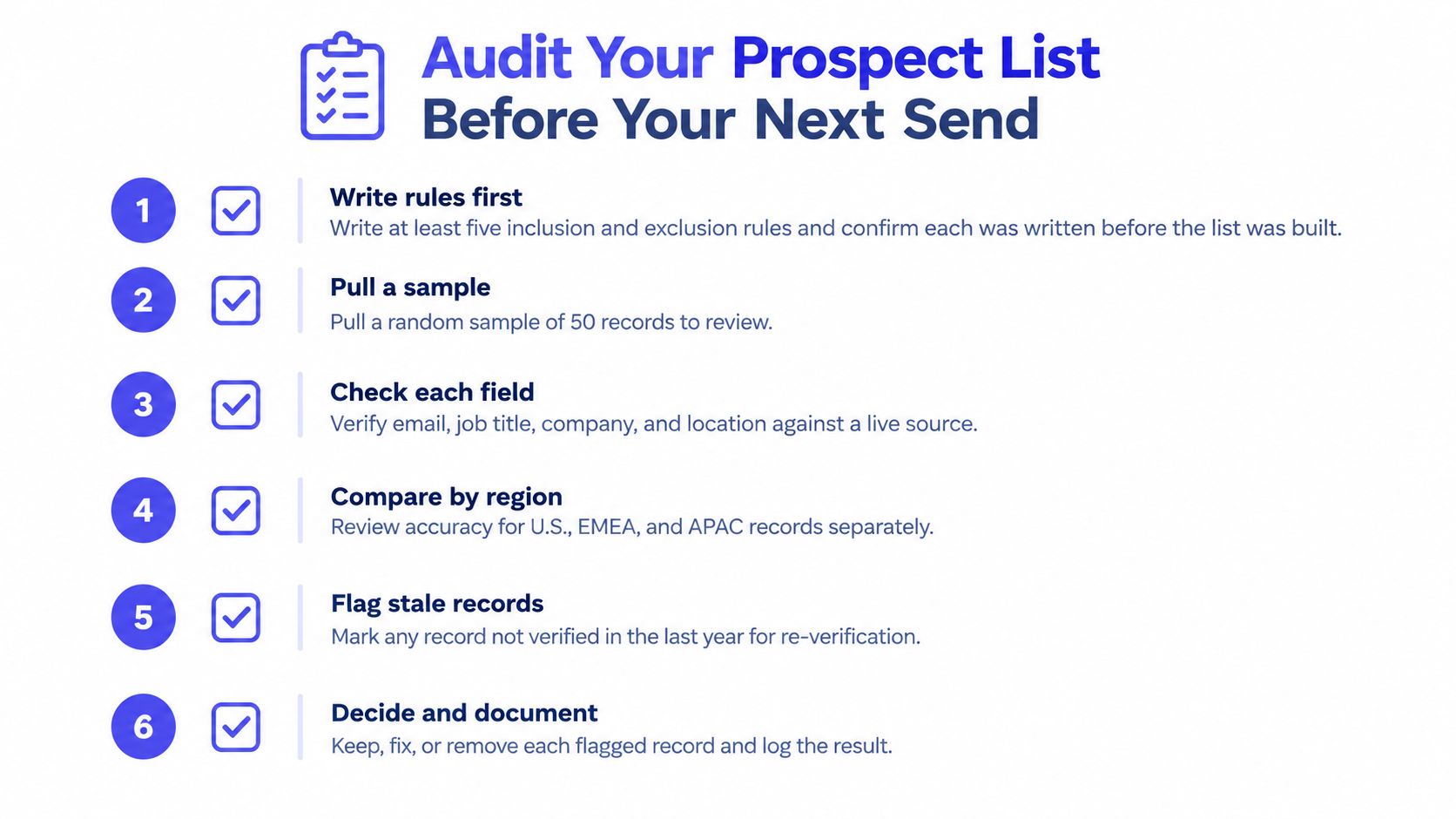
- Write the rules first. At least five inclusion rules and five exclusion rules, confirmed as written before the list was built.
- Sample 50 records. Each accepted row needs a source and a verification date on every qualification field.
- Re-verify age. Emails and roles on any list older than six months get a fresh check before they enter a sequence.
- Apply suppression to follow-ups. An opt-out at step one must stop every later step, so suppression has to travel with the record through the whole sequence.
- Check authentication alignment. SPF, DKIM, and DMARC in place, and the From domain aligned with the signing domain.
- Track complaints by segment. Stop at 0.3%, and aim below 0.1%.
If more than 5 of the 50 sampled rows fail, rebuild the rules before sending. A faster send on a weak list only moves the problem into the inbox. The sales email templates you load next won't rescue a row that failed the sample.
A managed service works best when it inherits a clean audit. IronPeak Marketing analyzes the prospect's current situation, target market, and offer to decide whether its cold email system fits their growth goals, and it turns away engagements where the fit is missing. If your audit shows a sound market and clean rules, a discovery call is the next step. If it shows stale dates and thin evidence, fix the rules first.
IronPeak Marketing runs managed B2B outreach that starts with prospect records built to survive a live send, including enrichment, dedicated infrastructure, and follow-up that respects qualification rules. If your list can already answer why this account, why this contact, and why now, the next move is a fit check rather than another unverified export. Visit IronPeak Marketing to book the discovery call and see whether the system matches your market and offer.
Crafted with Outrank