Lead Generation vs Prospecting: Differences and Funnel Fit
Lead generation vs prospecting explained: how each fits the sales funnel, the metrics that judge each, and when outbound prospecting beats demand capture.
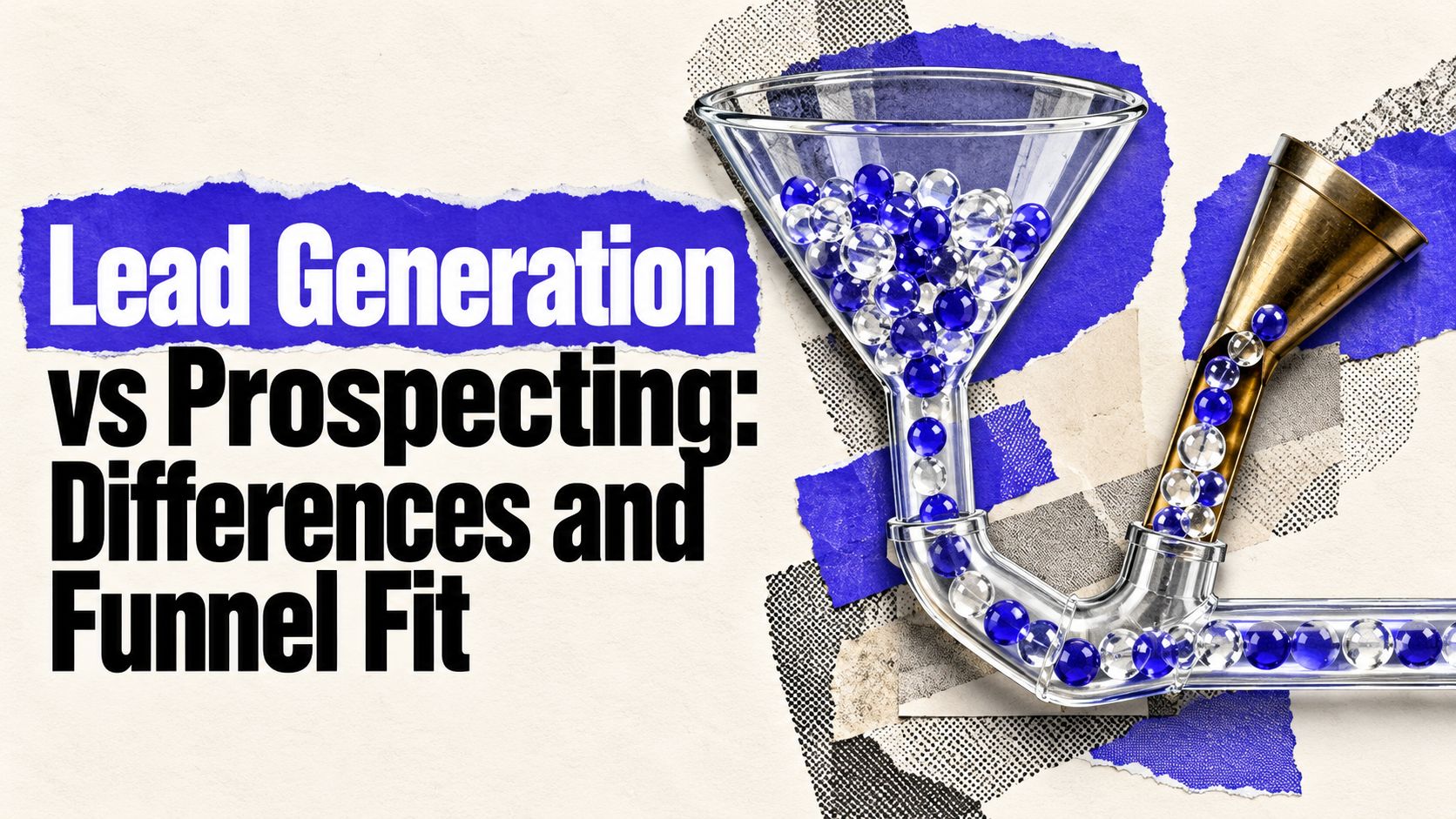
The popular advice is to pick a side. Build inbound and wait, or blast outbound and chase replies. Both versions fail for the same reason. They treat lead generation vs prospecting as competing channels instead of two functions with different jobs, different failure modes, and different denominators.
Lead generation fails when contacts pile up and never qualify. Prospecting fails when a message reaches a plausible person at the wrong moment, with the wrong context. Judging either one by raw volume hides that difference, and that's where budget gets wasted.
Lead Generation and Prospecting at a Glance
Lead generation captures demand that buyers create or find themselves. Prospecting selects specific accounts and contacts and starts a conversation with them. That's the whole distinction. Everything else, budget, staffing, metrics, follows from who initiates contact and what the output is supposed to be.
| Dimension | Lead generation | Prospecting |
|---|---|---|
| Core question | How do buyers find us? | Which accounts should we contact, and when? |
| Starting point | Demand that buyers already create | A defined list of target accounts or contacts |
| Main activities | Content, search, referrals, events, digital self-service | Research, enrichment, outreach sequences, follow-up |
| Who initiates | The buyer, often before any seller contact | The seller |
| Output | Captured demand that enters the funnel | Conversations with selected prospects |
| Success measure | Lead volume and stage conversion | Accounts touched, positive replies, meetings booked |
| Typical failure | Many contacts that never qualify | Irrelevant outreach that buyers avoid |
| Best fit | Long-term discoverability and credibility | Faster pipeline in a defined market |
The table looks cleaner than real operations. Both functions feed one pipeline, and a single campaign can contain both. A webinar promoted to a named account list is prospecting on the invitation side and lead generation on the registration side. The useful question isn't which label a campaign carries. It's which function each activity inside it belongs to.
Two concrete examples
Say a consultancy publishes a case study library. A finance director finds it through search, reads two cases, and lands on a pricing page. No seller chose that person. The buyer created the demand and the company captured it. That's lead generation, and it's judged by how many of those visitors become leads, then qualified leads, then opportunities.
Now say the same consultancy builds a list of 300 finance directors at mid-size manufacturers, enriches each record, and sends a three-step sequence tied to a visible trigger at each company. The seller chose every name and initiated every touch. That's prospecting, and it's judged by coverage, positive replies, and meetings held, not by traffic.
Why the label changes the budget
A team that treats the two as identical makes one of two errors. It buys volume that never qualifies, then blames sales for not closing contacts who never had the problem. Or it sends outreach to accounts with no identifiable fit, then blames the channel when buyers ignore it.
Budget test: Every line of acquisition spend sits in one column or the other. If a team can't say which one, it can't say what success looks like either.
Before reading further, it's worth placing current spend in a column. Content, search, and referral programs belong on the left. List building, enrichment, sending infrastructure, and sequence management belong on the right. A review often shows funding for one column reported with the other column's metrics.
Where Each Fits in the Sales Funnel
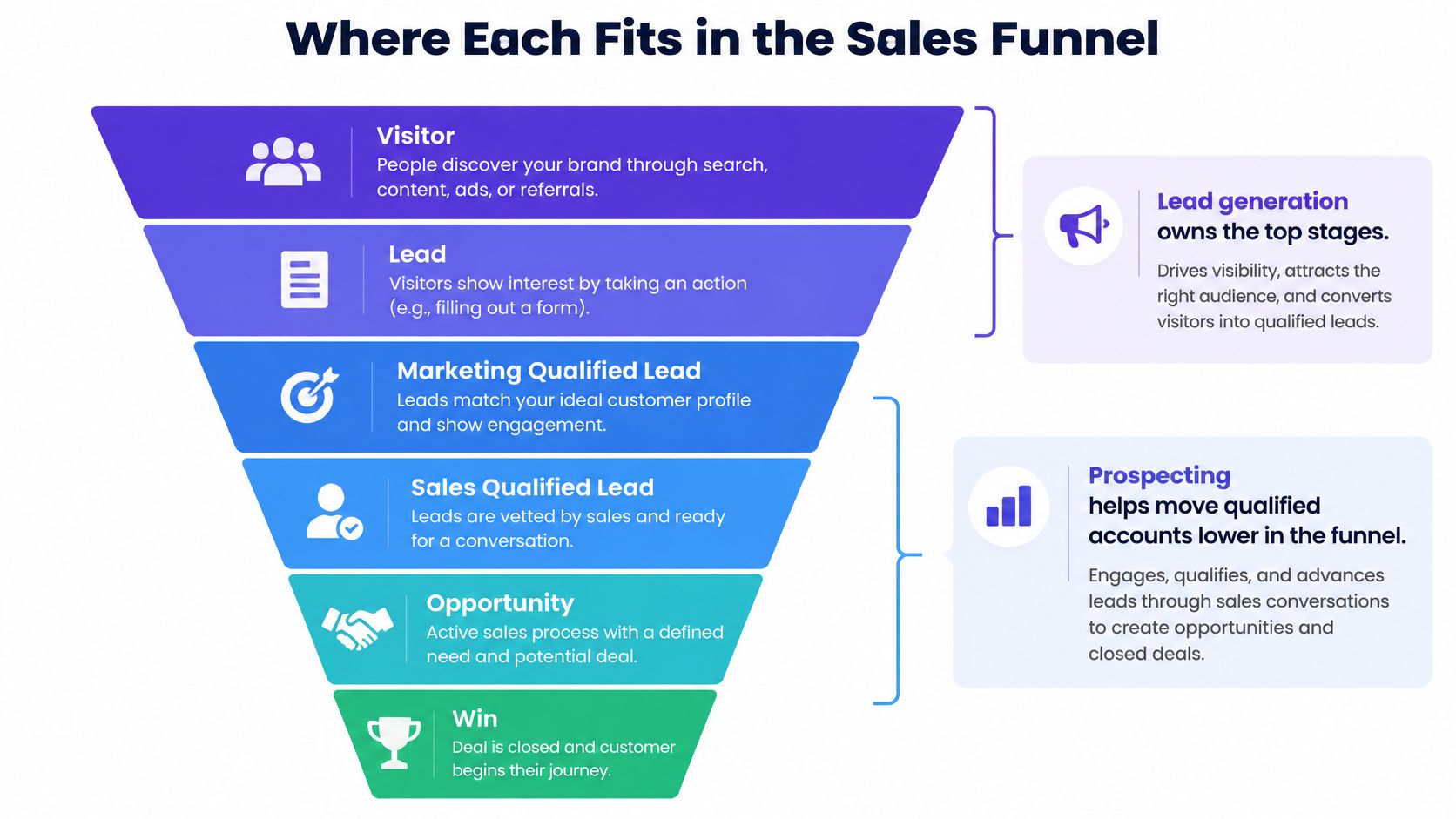
The funnel runs in a fixed order: visitor, lead, marketing qualified lead, sales qualified lead, opportunity, win. Lead generation owns the top of that sequence. Prospecting enters where the inbound flow stops, because it goes after accounts that haven't raised a hand.
Priorities reflect that split. In 2025, 91% of B2B marketers ranked lead generation as their top priority, according to Demand Gen Report data cited by Resourceful Selling. That's a top-of-funnel concern. It says nothing about whether the right named accounts are being contacted directly.
The funnel visual below shows where each function does its work.
Stage by stage placement
- Visitor to lead: Lead generation makes the company discoverable through content, search, referrals, events, and self-service pages, then captures contact details.
- Lead to marketing qualified lead: Lead generation scores fit and engagement against written criteria.
- Marketing qualified lead to sales qualified lead: This is the shared handoff. Prospecting also enters here, contacting accounts that match the profile but never visited.
- Sales qualified lead to opportunity: Sales confirms need, authority, and timing regardless of which function sourced the contact.
- Opportunity to win: Neither function owns this stage. Both get judged by whether their output survives it.
The buyer context that breaks a linear funnel
Buyers don't move down those stages in order just because a diagram says so. Gartner's 2025 sales survey press release reported that 61% of B2B buyers preferred a rep-free buying experience, and 73% actively avoided suppliers that sent irrelevant outreach. A buyer can self-educate, shortlist vendors, and ignore every email before ever submitting a form.
That creates a gap on both sides. Capture alone misses buyers who never search for the category by name. Prospecting that ignores the buyer's own research path gets filtered out as irrelevant. The opening for a seller is narrow and specific. It's the moment a buyer needs help judging whether an offering fits their company's situation.
For example, 1,000 targeted cold emails at a 5.8% reply rate produce about 58 replies. Those 58 replies aren't opportunities. They're raw responses that still have to pass qualification before any of them earn a funnel stage.
If the buyer initiated contact, the activity is lead generation. If the company initiated it, the activity is prospecting. Both must hand off to the same stage definitions, or the funnel numbers stop meaning anything.
Measuring Each Function Against Its Own Denominator
Most reporting arguments between marketing and sales are denominator arguments. One team divides by visitors. The other divides by accounts contacted. Both claim the other side's rate looks weak, and both are right, because they're measuring different machines.
Lead generation is measured by stage conversion. Visitor to lead, MQL to SQL, SQL to opportunity, opportunity to win. Each rate answers whether captured demand survives the next filter. Prospecting is measured by coverage, engagement, and timing. Accounts touched, touches per account, positive replies, meetings booked and held. A prospecting campaign can hit every activity target and still produce nothing, because the contact landed before the buyer had a reason to care or with a message that ignored what the buyer was already researching.
Benchmarks with their denominators attached
Published B2B benchmarks place visitor-to-lead conversion broadly around 1% to 5%, MQL-to-SQL conversion near 13% at the median, and SQL-to-opportunity conversion around 40% to 48%, according to the eLearning Industry B2B lead generation benchmarks guide. The same guide puts outbound booked meetings at roughly 0.5% to 2.5% of engaged prospects. Note the denominator. The rate is calculated on engaged prospects only, the subset that interacted, which makes it look far stronger than a per-contact figure would.
| Stage or metric | Benchmark or counting rule | Measured by |
|---|---|---|
| Visitor to lead | roughly 1% to 5% | Lead generation |
| MQL to SQL | near 13% at the median | Lead generation |
| SQL to opportunity | roughly 40% to 48% | Lead generation |
| Outbound meeting booked | roughly 0.5% to 2.5% of engaged prospects | Prospecting |
| Cold email replies | count positive replies separately from objections and opt-outs | Prospecting |
| Cold call outcomes | count meetings held, rather than dials or connects | Prospecting |
Reply counts require similar skepticism. A reply could be an objection, an out-of-office message, or a polite no. Using reply rate as proof of pipeline success is a common mistake in outbound efforts, and it obscures the key question: whether the contact reached the right account at a time when the offer was relevant.
Why volume metrics flatter both functions
In 2025, organizations generated an average of 1,877 leads per month, while 80% of those leads reportedly never converted into customers, according to figures cited by Cirrus Insight. A monthly lead count can look healthy while most of it goes nowhere. That is the lead generation failure mode: volume that never qualifies. Prospecting has its own version, a high touch count against accounts that had no trigger to act this quarter.
A worked formula makes the point. Say a campaign contacts 10,000 people and returns 60 accepted leads. The accepted-lead rate is 0.6%. That one number tells an operator more than the reply count, because it already includes targeting accuracy, message relevance, and the client's own acceptance rule.
Targets need the same treatment. A lead-volume target is only checkable when "qualified" has a written definition and each stage reports its own denominator. Pay-per-qualified-lead pricing makes this concrete: the acceptance rule becomes the denominator, and a lead the client rejects never enters the count.
Reporting split: Inbox health, delivery, touches, and replies diagnose prospecting execution. Accepted leads, held meetings, opportunities, and revenue determine whether any of it was worth paying for.
Qualification as the Bridge Between Volume and Revenue
Qualification is where lead generation vs prospecting stops being a vocabulary question and becomes a money question. Roughly 15% to 35% of B2B leads may meet qualification criteria, while properly qualified leads convert at approximately 40% compared with about 11% for unqualified leads, according to the Rox guide to B2B sales prospecting. At that spread, list precision is worth more than send volume.
The timing problem is just as stark. In 2025, only 27% of B2B leads were sales-ready when first generated, according to a lead-generation statistics compilation published by BookYourData. Most contacts need a reason, a trigger, or more time before a sales conversation makes sense.
Six criteria, each with a pass and fail rule
| Criterion | Question to answer | Passes when | Fails when |
|---|---|---|---|
| Company fit | Does the account match the ICP? | Industry, size and location match the written rule | Account is outside the target segment |
| Role authority | Can this contact buy or route the purchase? | Contact owns budget or sits in the buying group | Contact has no influence over the decision |
| Use-case relevance | Does the offer solve a problem they have now? | Visible evidence of the problem | No evidence the problem exists |
| Timing | Is there a trigger to act now? | A recent hiring, expansion or tool signal | No trigger found |
| Access | Can a sales call be booked? | Valid address and reachable calendar | Address bounces or cannot be reached |
| Response class | How did they reply? | Positive interest or referral | Disqualification or opt-out |
Each criterion needs its rule written before the first send. Company fit means an industry and size band, not a vibe. Role authority means a job level that controls budget or sits in the buying group. Timing means a visible trigger, such as a hiring push, a new location, or a tool purchase. Structured prospect research is what supplies that evidence instead of leaving it to guesswork.
Replies then get classified into positive interest, referral, timing delay, objection, disqualification, and non-response. Each class links forward to held meetings, SQLs, and opportunities. A referral to the right colleague can be worth more than a vague positive reply from the wrong person.
ICP match is not sales-readiness
A contact can match the profile perfectly and still not be a lead. Job title and company size say nothing about business need, authority, or timing. That's why the acceptance rule has to cover all six criteria, and why it belongs in the contract. If a lead is not qualified, the client can reject it and does not pay for it. That clause only works when both sides agreed in writing on what counts before any email went out.
Data quality sits underneath all of it. Wrong job titles, stale company records, and invented personalization lines push contacts into the wrong criteria and read as irrelevant outreach. Every enriched field should be verified against a second source before a contact enters a sequence, and every personalization line should tie to a verifiable trigger. AI-assisted prospect data is a source to be scored against the criteria above, not proof of fit by itself.
One operational rule protects the whole system. Every follow-up step checks the suppression list before sending, so a contact who opted out between steps never gets reached again.
Infrastructure That Outbound Prospecting Requires
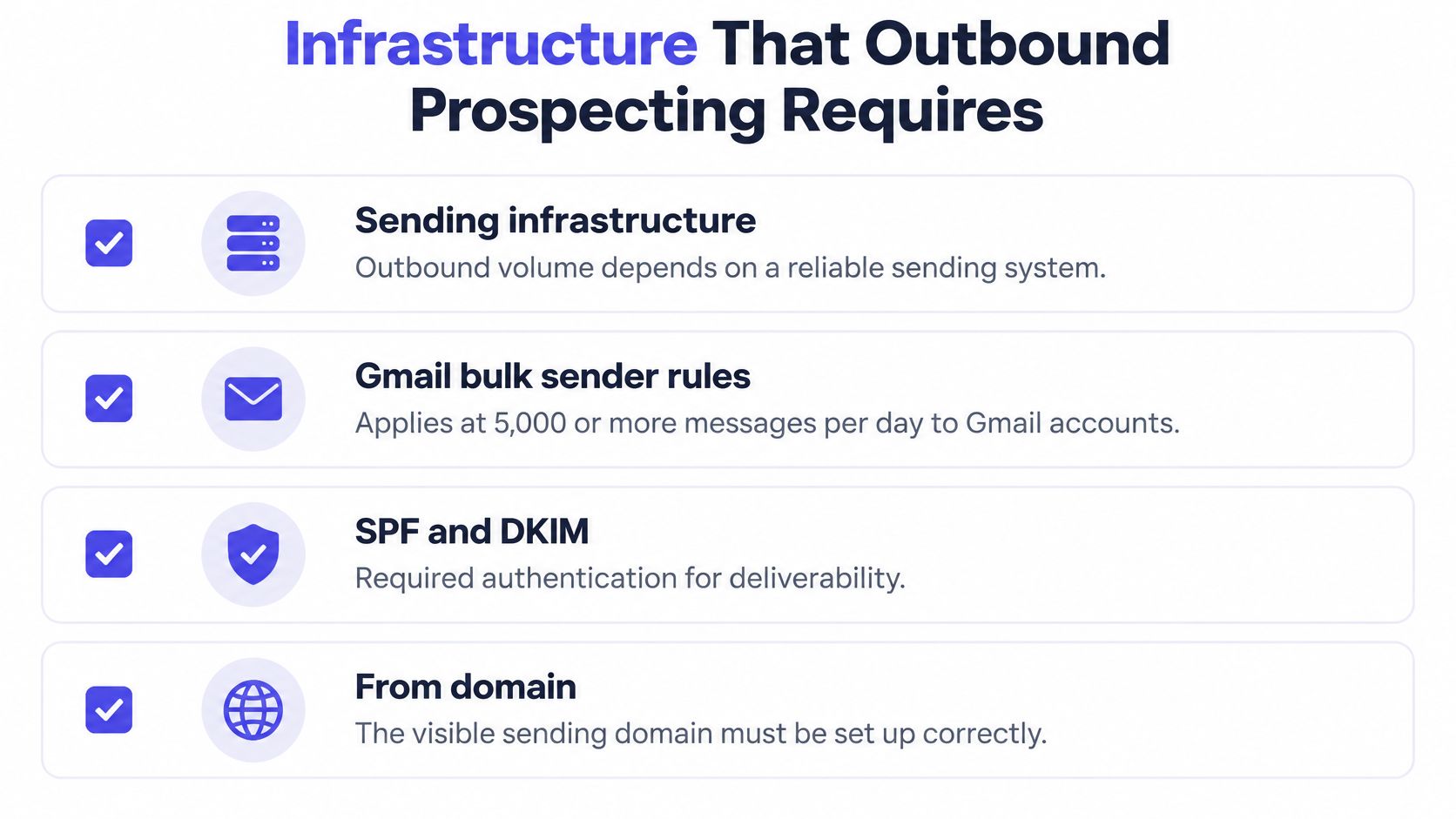
Prospecting volume isn't a copywriting decision. It's an infrastructure decision. Domains, inboxes, authentication, and suppression logic determine how much a team can send before mailbox providers start routing messages to spam.
The checklist below summarizes the core requirements before the provider rules get specific.
Provider thresholds that set the rules
Since February 2024, senders delivering 5,000 or more messages per day to Gmail accounts must authenticate outgoing email, and Gmail requires both SPF and DKIM for bulk senders, according to Google's email sender guidelines for administrators. The From domain must align with either the SPF or DKIM organizational domain. Senders should keep the spam rate below 0.1 percent, and a rate of 0.3 percent or higher removes access to certain delivery mitigations. At 5,000 messages a day, just 15 spam complaints hits that 0.3 percent line. List quality is a deliverability input, not a nice-to-have.
Unsubscribe mechanics are equally specific. Gmail requires bulk marketing messages to support one-click unsubscribe through List-Unsubscribe headers that comply with RFC 8058, plus a clearly visible unsubscribe link in the message body, per Gmail's bulk sender requirements. The click must remove the recipient. A landing page that asks them to reply doesn't comply.
For US recipients, a sender must honor an opt-out request within 10 business days, and the opt-out method must remain capable of processing requests for at least 30 days after the message is sent, according to the FTC CAN-SPAM Act compliance guide. Outlook adds its own layer. Domains sending more than 5,000 emails per day to Outlook.com consumer mailboxes need SPF, DKIM, and DMARC compliance, and non-compliant messages are routed to Junk first, per Microsoft's Outlook high-volume sender announcement. Authentication gets checked per domain, per provider. Passing at one provider proves nothing about the other.
The setup sequence
- Register custom domains: Keep cold outreach off the primary domain so prospecting risk doesn't touch normal business email.
- Create dedicated inboxes: Spread volume across inboxes built only for outbound.
- Configure tracking: Set up reply handling and campaign reporting before the first send, not after.
- Run authentication checks: Verify SPF, DKIM, and DMARC alignment for each domain at each mailbox provider, using actual test sends.
- Warm each inbox: Raise volume gradually and judge readiness by inbox placement and complaint rates, not by a fixed number of days.
Sequence copy matters only after those five steps hold. Even strong B2B sales email templates can't rescue mail that never reaches the inbox. IronPeak Marketing's partnership includes custom domain and inbox setup, and after setup it handles the daily inbox management and follow-ups, which is the operational weight most small teams underestimate.
Use Cases for Each Approach
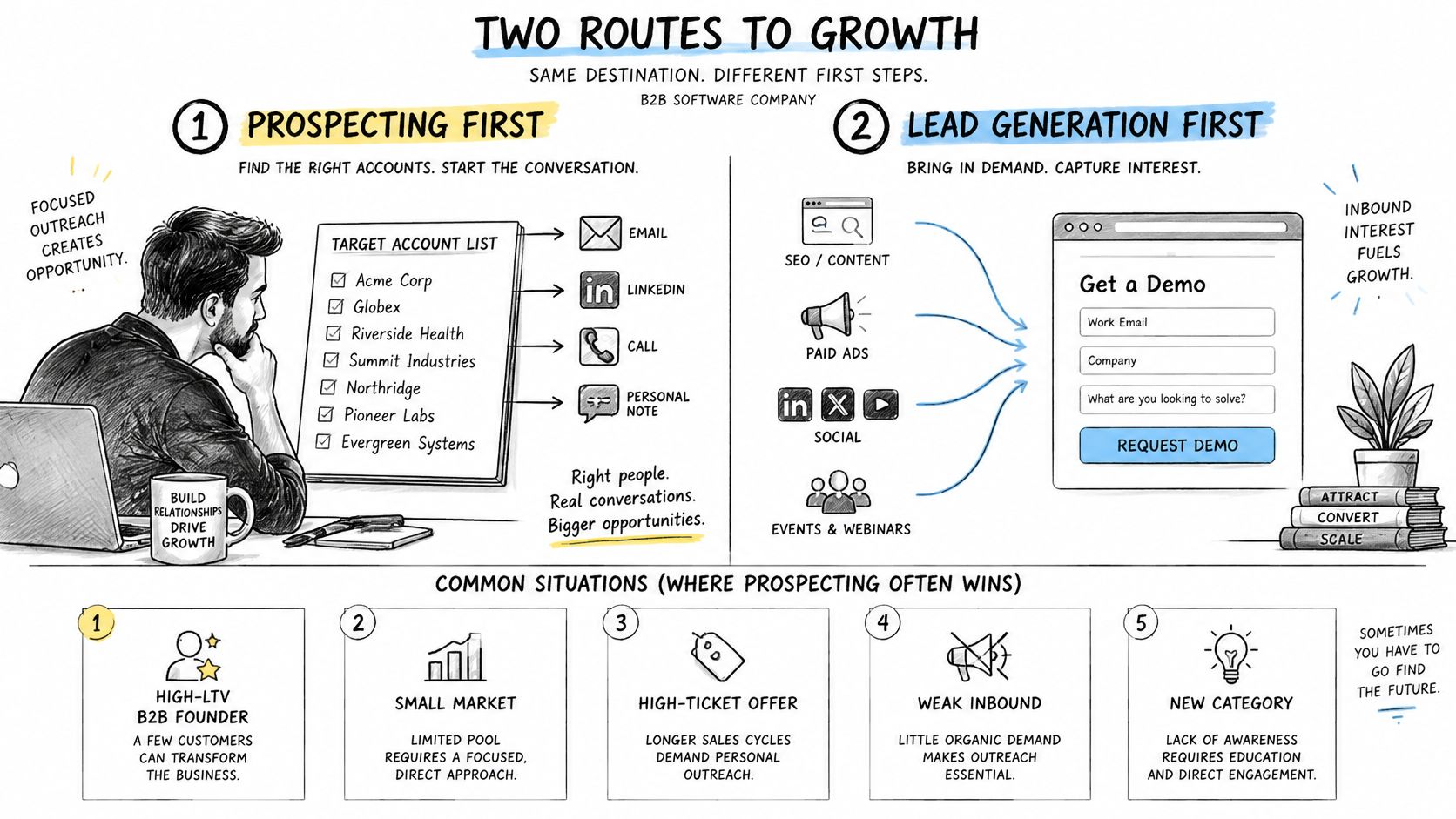
The right first move depends on how defined the buyer is. A tight account universe argues for prospecting first. Strong existing search demand argues for lead generation first. Five situations cover most of the ground a B2B team will run into.
The image below contrasts the two growth paths side by side.
Five situations and their first function
B2B software founders with a defined offer and high customer lifetime value usually need prospecting first. A small, precise account list produces conversations they can close. The metric to watch is meetings held per account touched. A list built on company size alone, with no use-case trigger, reaches people who were never going to buy.
Recruitment and staffing firms pursuing employer clients run prospecting alongside referrals, because referrals alone are unpredictable. The metric is qualified employer conversations per month. A job posting signals activity rather than fit, so hiring volume and internal recruiting capacity decide whether the account belongs on the list.
Marketing agencies selling their own services face the same logic. The offer defines the ICP, and prospecting fills the calendar. Message relevance does the heavy lifting here, starting with the email opening sentence, which has to reference the prospect's situation rather than the agency's services. A generic service menu sent to every business in a city produces deletes, not calls.
Construction and trade businesses targeting commercial accounts work from a defined, often local account universe. That favors prospecting. The metric is site visits or estimate requests from target accounts. Broad advertising spends the budget on residential inquiries the crew was never staffed to serve.
High-ticket consultants with strong search demand may need lead generation first. Buyers already look for their category, so discoverability pays. Prospecting then adds named accounts that inbound missed. Content with no capture mechanism builds an audience rather than a pipeline.
The short video below walks through how the two paths differ in practice.
The cost lens
Per-lead prices vary enormously across industries and channels, and a range that wide means the headline number tells a buyer almost nothing. A per-lead price only makes sense against the qualified-lead definition behind it.
A pay-per-qualified-lead arrangement moves the risk of unqualified contacts from the buyer to the provider. The provider absorbs the cost of bad lists, weak targeting, and rejected leads, and earns only on contacts that survive the definition. The model still fails when the offer itself is unclear or the ICP keeps changing, because no pricing structure fixes a moving definition of qualified.
Choosing the Right Mix and Booking a Discovery Call
The verdict by situation is straightforward. Run lead generation first when buyers already search for the category and the constraint is demand volume. Run prospecting first when the ICP is defined, the account universe is known, and pipeline is needed in a defined market within weeks. Run both when a written qualified-lead definition exists and each function reports against its own denominator.
Four steps before any spend
- Write the ICP and acceptance rule: Use the qualification criteria defined earlier, each with a pass and fail condition.
- Pick each denominator: Stage conversion for lead generation, coverage and positive replies for prospecting, accepted-lead rate over both.
- Confirm the infrastructure: Authenticated domains, warmed inboxes, one-click unsubscribe, and a suppression check before every follow-up.
- Pilot one segment: Review the accepted-lead rate before scaling volume or adding segments.
A weak accepted-lead rate in that pilot signals the definition or the list needs work before more volume helps. Replies that arrive but never convert point to timing and relevance, which is a prospecting problem with a different fix.
A managed provider should start the same way. IronPeak Marketing opens with a free strategy session or discovery call, with no credit card required and no commitment.
The practical action is to book that discovery call with the ICP and acceptance rule already written. If those two documents don't exist yet, writing them comes first. No provider, in-house or external, can deliver qualified leads against a definition nobody has set.
IronPeak Marketing builds the prospecting side of this system as a managed service, covering custom domains, dedicated inboxes, prospect research, cold email sequences, and daily inbox management, with payment tied to qualified leads the client accepts. For B2B founders and high-ticket service providers who know their ICP but lack the infrastructure or hours to run outbound properly, that's the gap the service fills. Visit IronPeak Marketing to book a free discovery call and pressure-test whether the model fits the offer.
Created with Outrank tool