Lead Generation for Manufacturing Outbound Guide
Lead generation for manufacturing that survives the inbox: account scoring, domain warming, and qualification fields for technical calls.
The usual advice says to write a sharper first line, add a fourth follow-up, and buy a bigger manufacturing list. That advice fails before a plant ever reads the note. Lead generation for manufacturing breaks on two gates: the account cannot use the offer, or the email never lands. Copy cannot fix either one.
A plant manager, a distributor buyer, a procurement lead, and an engineer do not share one inbox or one decision step. Many of them already have specs, lead times, and a shortlist before they will take a call. Treating a form fill or a polite reply as the start of demand fills a CRM with people who were never in market, or with people who already moved on.
The workable path is narrower. Pick one motion, score accounts before a send, keep complaint rates inside a hard ceiling, and stop the sequence the moment the record says stop. A fast technical reply is the conversion step after a real signal, not a separate demand program.
Pick the Manufacturing Outreach Motion
| Motion | Buyer it reaches | Signal worth tracking | What kills it |
|---|---|---|---|
| Named-account cold email | Plant, procurement, engineering, distributor contacts | Inbox placement, account-fit rate, technically qualified meetings | Spam complaints or a shared, unenriched list |
| Distributor and channel outreach | Firms that already resell into plants | Territory fit and partner meetings | Vague geography or a line the distributor already carries |
| Self-serve website intent | Anonymous researchers using price, lead time, or configuration tools | Quote-tool use, spec-page depth, repeat visits on one account | Counting every session as a lead |
| Technical proof buyers can verify | Engineers and procurement checking specs and standards | Spec-page engagement and later direct inquiries | Pages that only promote and never state limits |
| Human technical reply after a signal | Accounts already showing evaluation | Speed from signal to a competent reply | Slow or generic follow-up after the buyer has moved on |
Lead generation for manufacturing is a routing problem, not a copy contest. Named-account cold email is the default only when the offer is specific and the list can be enriched past a shared database. Measure inbox placement, account-fit rate, and technically qualified meetings. Raw replies hide both bad fit and bad placement. The motion dies when the complaint rate climbs, or when every contact is a title scraped from the same public file.
Distributor outreach fits when the economic buyer already purchases through a channel partner. Track territory fit and partner meetings. The program dies on a vague map, or on a line the distributor already stocks from someone else.
Self-serve website intent fits a supplier that can show price logic, lead time, or a configuration path without forcing a form. Track quote-tool use, spec-page depth, and repeat visits tied to one account. It dies the day every session is logged as a lead.
Technical proof supports the other rows because industrial buyers check claims before they talk. Spec-page engagement and a later direct inquiry are the signals. Proof dies if the page will not state where the product fails, which inputs it needs, or which standard it does not hold.
A human technical reply is not a fifth demand engine. It is the conversion step once a signal exists. Speed from that signal to a competent answer is the metric. Slow or generic follow-up loses the account after the buyer has already chosen a path. The split between finding accounts and working them is the same distinction covered in lead generation versus prospecting.
45-day rule: Run one primary motion, one segment, and one offer. A second motion starts only after the first has a clean fit rate and a stable inbox.
How Industrial Buyers Research Before They Talk
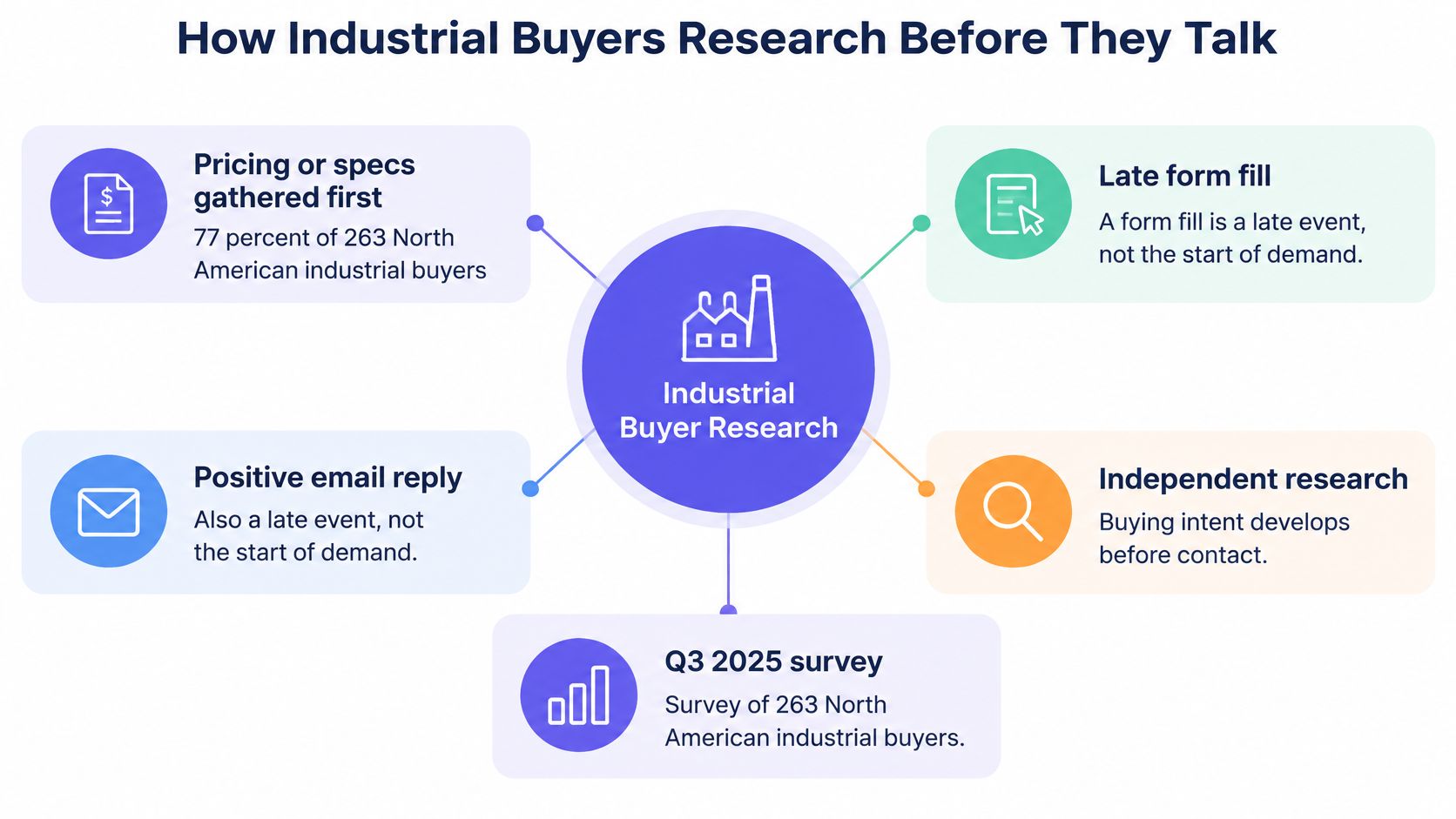
In a Q3 2025 survey of 263 North American industrial buyers, 77% said they had obtained pricing or lead-time information through a supplier's digital tool without speaking to sales, and supplier websites remained the leading starting point for research, according to the Kula Partners Industrial Buyer Pulse report. The quiet part of the evaluation is often finished before your first email lands, which is why outbound fails on account fit and inbox placement long before copy gets a chance. A program that only measures booked meetings is blind to accounts already comparing suppliers while they stay anonymous.
Three roles on one account
One account is three people with different jobs.
The engineer checks tolerances, required inputs, and where the product fails. This person reads your documentation the way a machinist reads a drawing, hunting for the limit that disqualifies you.
The procurement evaluator compares supplier risk, certifications, and lead time across vendors. This person is building a shortlist and a reason to reject each name on it.
The authorized buyer is the only person who can place the order. That role may never touch the site until the other two have a shortlist. Sequencing every anonymous session as if it were this person trains the wrong contacts to ignore the domain and inflates a pipeline sales cannot use.
Attach behavior before anyone is mailed
Match high-intent behavior to an enriched account in the CRM before a sequence starts. The traces worth acting on sit in one list: product or configuration depth, a spec or drawing download, a lead-time or quote request, and a return visit on the same product family from the same company domain. Those signals map back to the roles above, so the engineering researcher, the procurement evaluator, and the authorized buyer are three records, not three leads from one click.
Time a short human note to evidence of active evaluation, and name the application you think they are checking. If the only evidence is a single page view, leave the account alone. Making technical and commercial facts available without a forced conversion creates the signal. Volume of meetings does not.
Score Accounts Before You Send
The score protects the domain and the rep's calendar. A broad manufacturing list spends inbox capacity on plants that cannot buy the offer, and every wasted send is a complaint risk the domain pays for later.
| Scoring variable | What it predicts | Drop the account when |
|---|---|---|
| Installed equipment or process capability | Whether your part or service can run in their process | No process match to the offer |
| Tolerances or certifications | Whether you can pass their quality gate | Required standard is outside what you hold |
| Industry and end market | Which spec and risk language to use | End market is outside the offer |
| Facility geography | Service territory, freight, and plant coverage | Site sits outside the territory you can support |
| Employee count and likely production volume | Deal size and whether volume is real | Volume is below the minimum you will quote |
| Procurement role of the contact | Whether this person can sponsor a supplier change | Contact cannot influence the buy |
| Expansion or capacity signals | Why the conversation should happen now | No timing signal and no incumbent pain |
| Incumbent supplier if known | Switching friction and the redundancy angle | Contract term blocks a change this cycle |
Read the table as two gates. Installed equipment and a match to your tolerances or certifications are the hard filters: a plant that cannot run your process, or one whose required standard you do not hold, never enters a sequence no matter how warm the contact looks. Industry, end market, geography, headcount, and likely volume set the deal size and the spec language the copy will need. Procurement role decides whether the person on the record can sponsor a supplier change. Expansion signals and the incumbent decide timing: a new line or an added shift is a reason the note exists now, and a locked contract term is a reason it does not. Building those fields is the work of structured prospect research, not a download of every firm with a matching industry code.
McKinsey's guidance for industrial companies is to use data to find accounts with limited current revenue and real growth potential instead of running unfocused campaigns, and its research on sellers who support buyers across journey stages reports up to a 20% increase in leads and up to 20% less time from qualified lead to close.
Those gains assume the account was worth entering. The score is what decides that.
Message only after the account passes
Capacity relief goes to a plant under demand strain, where your process can take overflow the incumbent cannot.
Supply redundancy goes to a procurement lead sitting on a single supplier, with a contract that can move this cycle.
Custom engineering goes to an R&D contact whose spec does not match a catalog part, and only if you hold the standard they require.
Reply rate is a deliverability and copy check. Success is account-fit rate, technically qualified meetings, opportunities created, sales-cycle length, and revenue per targeted account. When the meetings are technically qualified and the cycle is shortening, the score is doing its job.
Build Inbox Infrastructure That Holds Volume
Authentication and complaint rate gate every campaign.
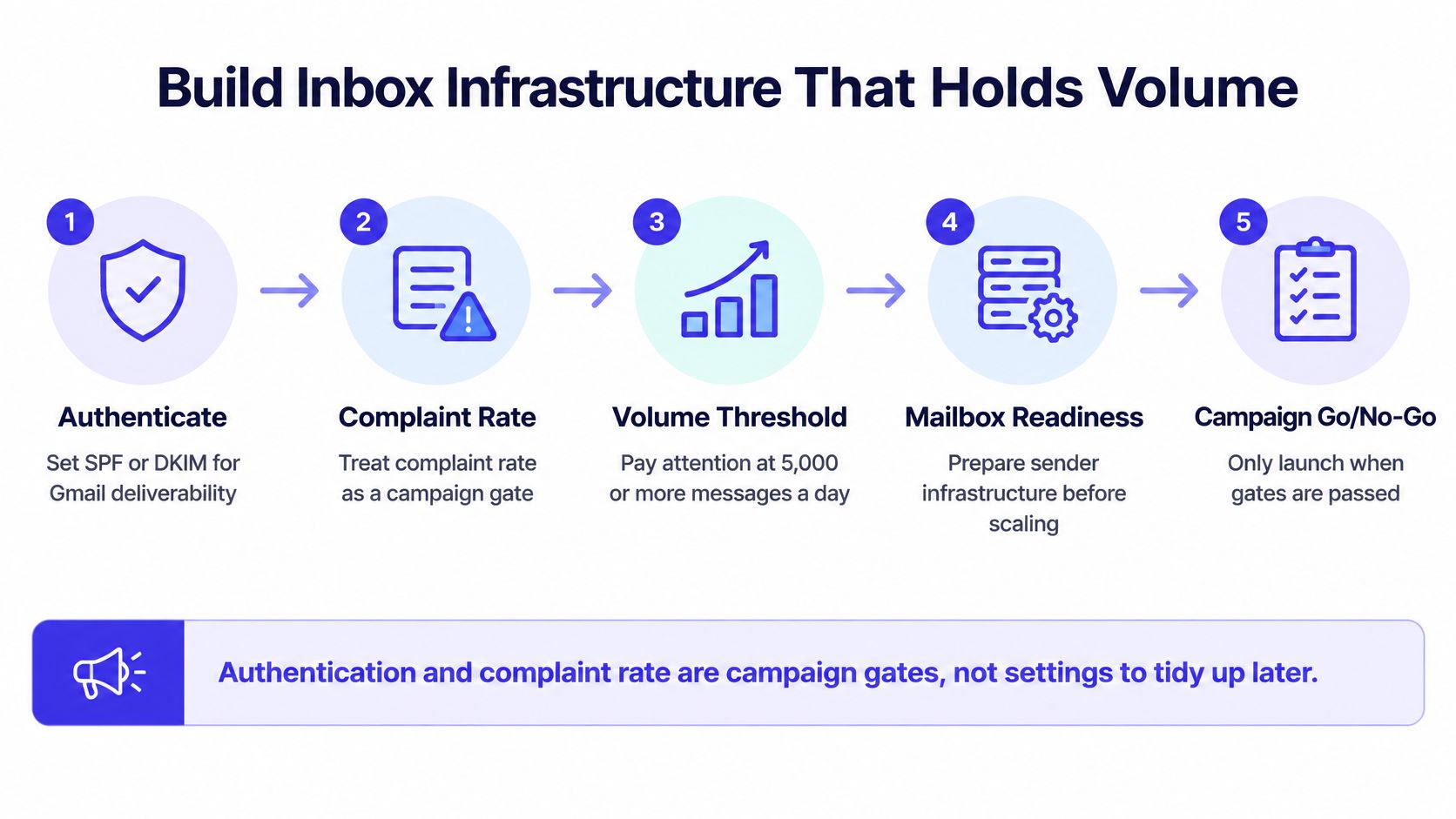
Google's sender requirements set the floor for anyone mailing Gmail accounts: every sender configures at least SPF or DKIM, senders at 5,000 or more messages a day configure both, publish a DMARC policy, and align the domain, and the user-reported spam rate in Postmaster Tools stays below 0.1% and never reaches 0.3%. On a day of 10,000 messages, 30 spam complaints is that 0.3% line. Google states that senders above it can lose delivery support or mitigation eligibility.
A buyer who will not take a call still reads specs. None of that anonymous research matters if the note lands in spam.
The morning math
Check the previous day's volume against complaints before anyone raises the cap.
Under the target: 9 complaints on 10,000 messages is 0.09%, still below 0.1%.
On the ceiling: 10 complaints on 10,000 is 0.1%. Hold volume. Do not step up.
Past the line: 31 complaints on 10,000 is 0.31%. Pause the domain. Rewriting the first line and sending the same volume again does not repair placement.
Layout an operator can actually run
Cold email goes from secondary domains, so a complaint spike does not take down the company domain that receives customer mail. Each sending domain gets its own inboxes, a real from-name, and tracking that is not a fresh naked redirect.
Warm before volume. Start with low daily sends to engaged or highly fitted accounts, watch placement and complaints, and increase only while the rate stays under 0.1%. A public ramp that ignores your own complaint data is how a new domain dies in week two.
Plant-gate addresses and retired buyers bounce hard. Pull them from the sending pool the same day, because a manufacturing list full of dead inboxes burns a domain faster than weak copy will. If placement drops, pause that domain. Do not “fix” it by adding more mailboxes on the same name and hoping the rate averages out.
Nine complaints is a watch item. Thirty is a stop. Run the check every morning; a weekly report reads it after placement is gone.
Run the Sequence and the Suppression Rules
By the time a sequence runs, the biggest decisions are already made. Account fit and inbox placement determine whether the mail is read at all. What the sequence controls is narrower: a short technical conversation, a preset cadence, and stop rules nobody overrides.
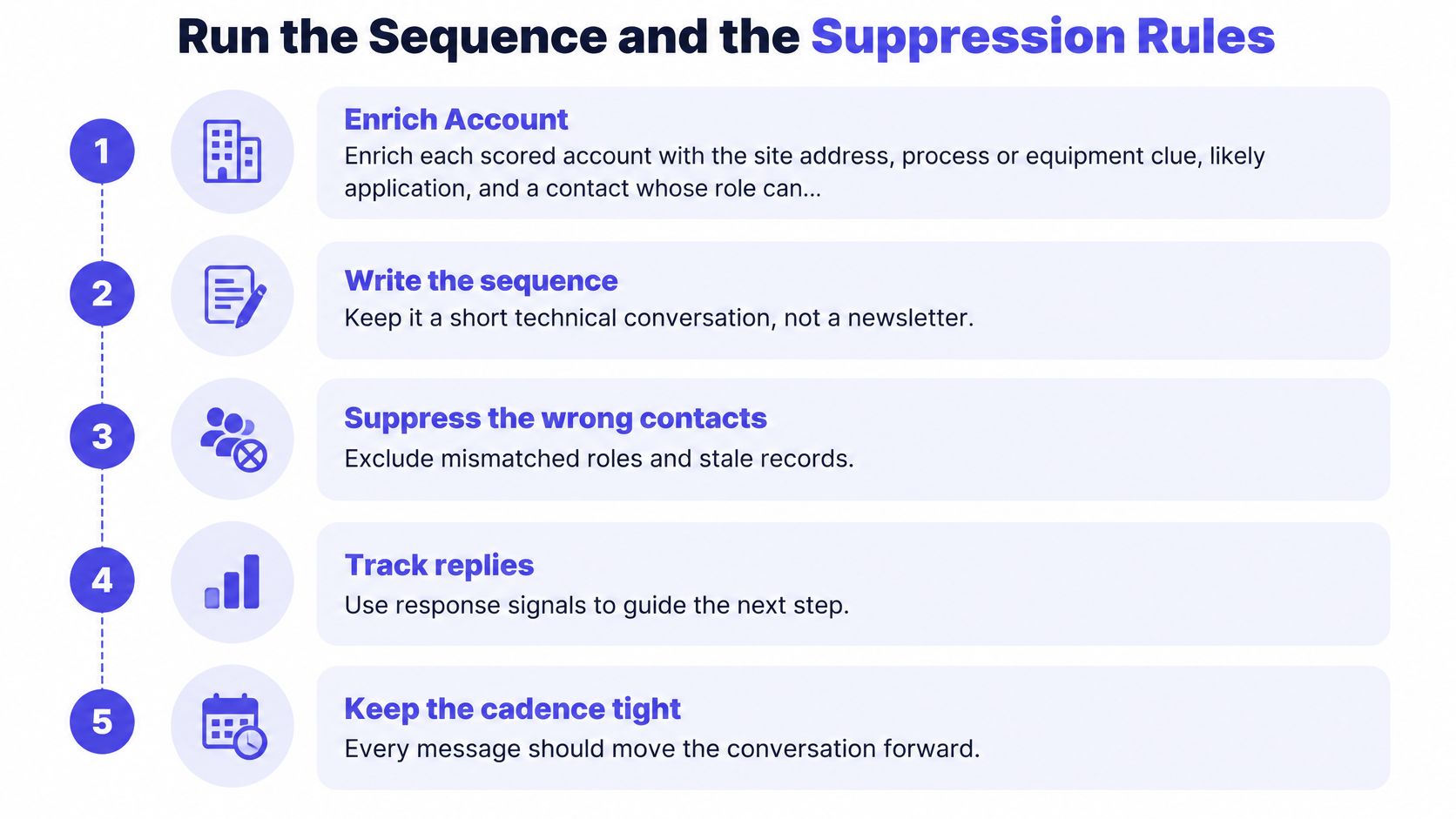
- Enrich the scored account with site address, a process or equipment clue, the likely application, and a contact whose role can sponsor a supplier review. A title with no plant context is not ready to mail.
- Send a first note that names the plant or distributor context, the specific constraint you solve, and one ask for a technical call. From-name, reply-to, and subject stay truthful. Shape is closer to a B2B sales email that states a constraint than to a product brochure.
- Follow up on a preset cadence with a new fact, such as a tolerance, a lead-time limit, or a certification. “Checking in” adds no fact and trains recipients to mark the thread.
- Stop the contact and the company domain on an opt-out or a clear “not the buyer.” Do not rotate that address onto a lookalike domain. A redirect to the right person at the same plant is a reroute: update the contact and continue the thread.
- Hand a positive reply to a human the same day, with the enrichment fields attached: site address, the process clue, and the application named in the first note. The call starts where the email ended, on the constraint the reply already confirmed.
Expect a fitted account to stay quiet for a while. Many real buyers research specs anonymously before they will take a call, so silence on its own changes nothing: the cadence continues and the stop rules end it.
What the law forces into the record
The FTC's CAN-SPAM guide applies to commercial email sent one at a time, not only to blasts. Each duty is a field the sequence must keep.
Identity. From, To, Reply-To, and routing information must be accurate. A friendly alias that does not match the sending domain fails this test.
Subject. The line must describe the message. A fake reply thread or a subject about a meeting that was never booked does not.
Commercial nature and address. The message must be identifiable as advertising and must include a valid physical postal address.
Opt-out. Every message needs a working way to opt out. Honor the request promptly, and share that suppression across every domain and campaign. A second domain is not fresh permission.
Automation that keeps mailing after an opt-out is a suppression failure, and it is illegal to continue.
A Worked Campaign for One Plant Segment
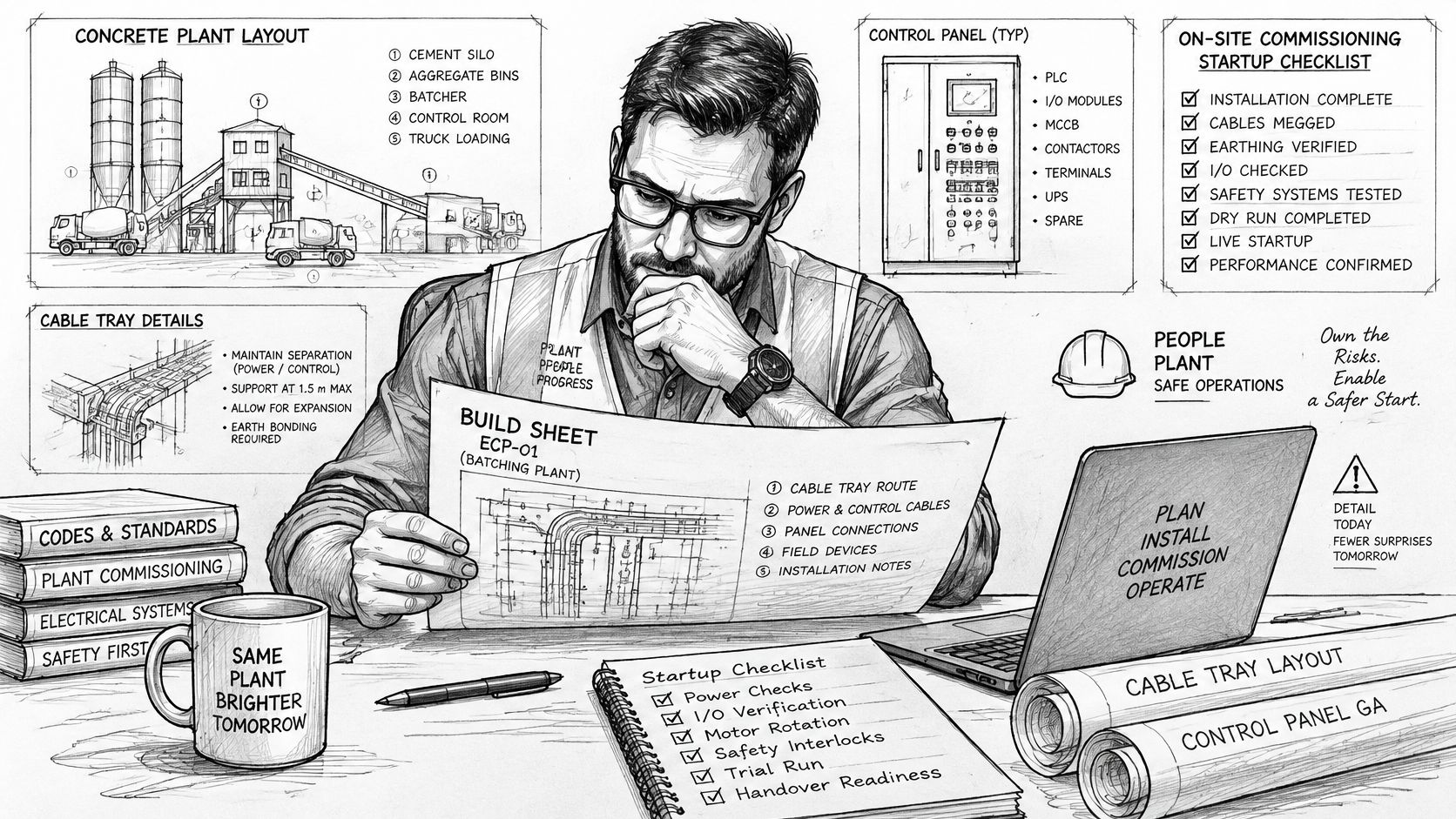
Take on-site electrical commissioning for concrete plants as the offer. Treat what follows as an operating plan. The buyer is the plant or corporate engineer who owns startup risk. Procurement enters after technical fit is clear.
List rules
Build the list from plants with batching or mixing operations inside the states a crew can cover. Skip the temptation to start from every construction company in a database; account fit decides whether the copy gets read. Enrich for plant address, process type, a recent expansion or outage clue, and an incumbent contractor named on public work. Drop sites outside the crew radius before the first send.
Three touches, then stop
Open on commissioning risk at a live plant: startup window, voltage class, and the cost of a missed date. The follow-up states one disqualifier plainly, such as a travel limit or a capacity ceiling. The third touch asks for the startup window and closes the sequence. Extra mail after that teaches the inbox to ignore you.
When a reply becomes a lead
A reply counts only when application, required volume or number of sites, production location, incumbent if any, purchasing timeline, and the walk-away constraint are captured. Those fields separate an urgent plant with a real startup date from a courteous engineer doing anonymous spec research.
Keep the page identical to the note
Before the first send, audit the live spec page against the email. The same tolerance, lead-time limit, certification, and process constraint must appear in both places. Buyers often check specs before they answer, so a mismatch between the note and the page turns a warm reply into doubt.
In a McKinsey survey of more than 1,000 B2B buyers across four countries, 76% said speaking with a salesperson was helpful when researching a new product or service, 46% said they would buy from a supplier's website if the process were available and efficient, and only 10% had made an online B2B purchase. The same research points to distributor preference when manufacturer response lags. Close the loop with a same-day technical reply while the plant context is still attached.
Choose Managed Outbound or an Internal Desk
The choice comes down to who owns the system every morning. In most plants, the honest answer is nobody.
Keep outbound in house only if all four of these are already true.
- Secondary domains exist and are warmed, separate from the domain that receives customer mail.
- A named person reviews complaint rates every morning and has authority to pause a domain the same day.
- Every account has a score and enrichment fields before it enters a sequence.
- A seller commits to same-day replies on technical questions, with the plant context already attached.
Assign that operator before you buy more data. The desk fails when complaint review and inbox clearing become a second job squeezed into the evening, and a part-time owner produces part-time deliverability.
Hand the system to a managed partner if the offer is defined, the customer value supports a sales call, and the team will not warm domains, enrich plants, or clear the inbox each morning. Fail two or more items on the checklist and the managed route is the next step, not a bigger internal hire that still has no daily complaint check.
IronPeak Marketing starts with a fit review of the current situation, the target market, and the offer, and only then decides whether cold email matches the growth goal. If that review says the market will not answer, do not fund infrastructure to force it. When the fit is real, custom domains, dedicated inboxes, copy, data enrichment, and tracking go in under 15 days. After setup the partner runs daily inbox management and follow-ups, so the client's remaining job is attending the sales calls booked on the calendar. In the scoping call, get the timeline, the commercial terms, and the lead qualification standard in writing. Reject any lead that lacks application, location, timeline, or a real technical constraint.
IronPeak Marketing runs managed cold email for B2B companies, agencies, and high-ticket service providers that need account fit and a stable inbox at volume. The engagement is pay-per-result, with a target of 60–90 qualified leads in 45 days, and you can reject leads that miss your standard. If the plant segment and the offer are already defined, review the fit at IronPeak Marketing.