Lead Generation Strategy for High-Ticket B2B
A lead generation strategy for outbound operators: lock deliverability, data, and accepted-lead rules before you scale cold email.
The usual lead generation advice is to find more contacts, personalize the copy, and send more follow-ups. That approach skips the controls that determine whether outbound produces useful sales conversations. More volume won't fix an unverified account list, broken authentication, or a sales team that counts every friendly reply as a qualified lead.
A stronger lead generation strategy uses hard gates. Each gate decides whether an account can enter a campaign, whether a domain can send, and whether a reply deserves sales time. When accepted leads stop increasing, the measurement sheet should identify which gate needs attention before anyone raises volume.
What a Lead Generation Strategy Covers
A lead generation strategy decides who gets contacted, from which domains, with what offer, and which replies count as qualified leads. It also assigns responsibility for what happens after a prospect responds. Without those decisions, a campaign is just a sending schedule.
The operating plan has four phases:
- Plan. Define an offer a buyer can refuse, the account filter, the current business trigger, the relevant role, and the disqualifiers.
- Execute. Prepare dedicated sending infrastructure, validate authentication, and release a narrow segment only after the launch checks pass.
- Qualify. Assess replies against a written acceptance standard rather than forwarding every positive response to a calendar.
- Measure. Connect domain health, account relevance, acceptance, response speed, and opportunity creation in the same reporting system.
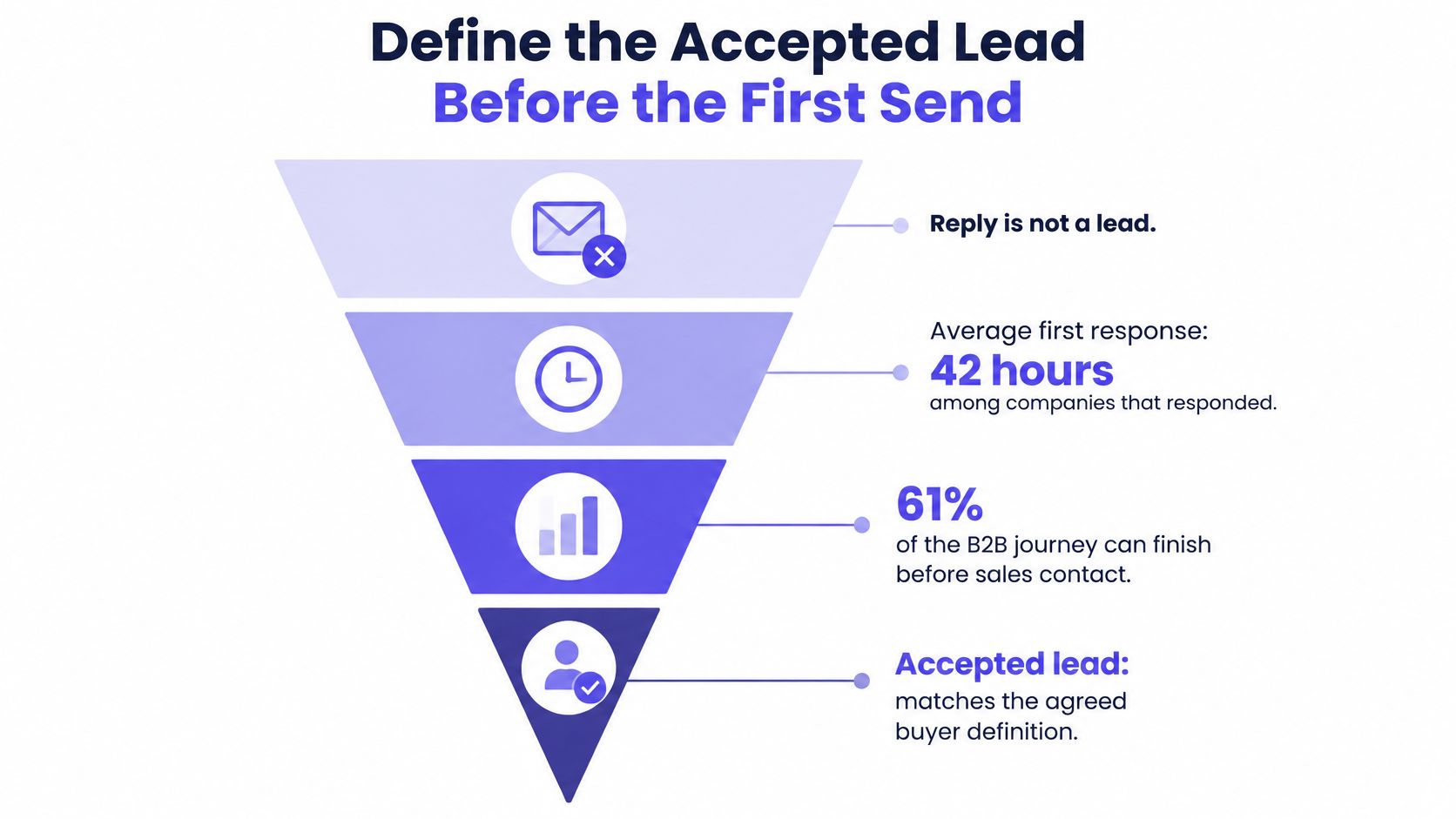
Outbound isn't the entire buying process. McKinsey's B2B purchasing research found that the average number of sales channels used across the purchasing journey rose from five in 2016 to ten in 2022. A prospect may read an email, inspect the website, and consult colleagues before agreeing to speak.
Separate prospecting from the operating system
The distinction between lead generation and prospecting matters here. Finding suitable contacts is an input. Generating accepted leads also requires credible supporting information, reliable delivery, reply handling, and a usable handoff.
A shared database and a persuasive sequence don't establish those controls. The launch owner needs a named person responsible for each phase and permission to stop sending when a gate fails.
Planning gate: No campaign advances until the offer, target account, sending owner, and accepted-lead definition are written down.
How to Plan the Account and Data Layer
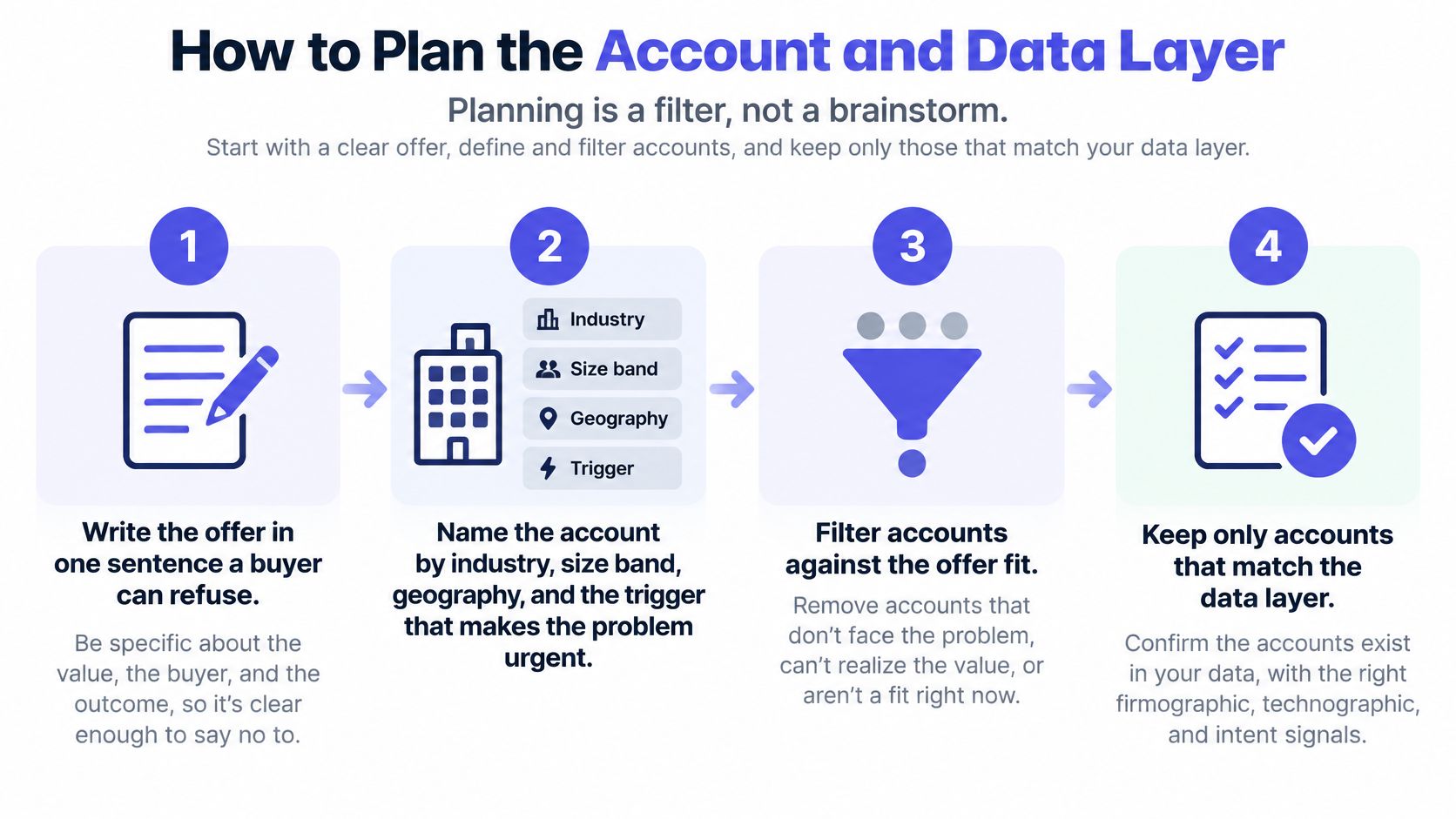
Planning works best as a filter, not a brainstorming exercise. A researcher should be able to reject an account without asking the founder whether it looks promising.
Build the account filter
- Write the offer in a sentence a buyer can refuse. For a specialist consultancy, that might be an assessment of scheduling bottlenecks for commercial maintenance operators opening another location. Operational consulting for growing businesses is too broad to guide research.
- Specify the account and trigger. Record industry, size band, geography, and evidence that the problem is current. A location announcement, relevant hiring activity, or ownership change can justify investigation. None automatically proves buying intent.
- Choose the role and exclusions. Identify who owns the problem, not the most senior person available. Exclude businesses that can't implement the work, don't serve the intended market, or already have the requirement covered.
- Enrich against the hypothesis. Combine business websites, public announcements, professional records, and relevant directories. Store the evidence behind the trigger, its observation date, and the contact's connection to the problem.
- Remove unverifiable records. An email verifier can assess an address, but it can't establish commercial relevance. Missing account evidence is a qualification failure, not a reason to manufacture personalization.
- Test whether email fits. If the intended buyer can't recognize the business condition in a short note, change the offer or acquisition path before buying more data.
Refresh evidence rather than recycling exports
The Census Bureau business-application notes record 431,246 seasonally adjusted applications in June 2024, including 138,678 high-propensity applications and 45,668 with planned wages; the supplied series also records 448,758 applications in November and 457,544 in December. These are filings for Employer Identification Numbers, not confirmed operating businesses or available buyers.
Their practical value is as a reminder to refresh account evidence. High-propensity and planned-wage classifications can inform investigation into firms that may hire or invest, but they shouldn't replace offer-specific checks.
A usable lead generation list preserves provenance alongside contact details. Researchers should distinguish a directly observed trigger from an inference, and a current role from an old database entry.
The researcher's handoff should contain:
- Offer sentence: The specific work and intended buyer.
- Must-have trigger: Evidence that makes outreach relevant now.
- Responsible role: The person connected to the problem.
- Disqualifiers: Conditions that block entry.
- Source record: Supporting evidence beyond a shared database.
Data gate: Accounts without verifiable fit stay out of the send file.
Define the Accepted Lead Before the First Send
A lead is a reply that meets every written acceptance condition. A request for information, a referral, or a polite acknowledgment may be a useful conversation, but it should enter the sales handoff only when it meets the agreed standard.
Make qualification a written agreement
Before sending, the person responsible for sales calls should approve the acceptance conditions:
- Buyer role: Responsibility for the problem or a credible route to the decision-maker.
- Problem urgency: A stated issue that warrants investigation.
- Commercial fit: An account capable of buying and implementing the work.
- Trigger event: Evidence connecting the offer to the account.
- Timing: A buying or evaluation window compatible with the sales process.
- Disqualifiers: Explicit reasons the lead should not proceed.
Keep unknowns marked as unknown. Enthusiasm alone does not establish budget or urgency.
Preserve the reason for acceptance
Record the account, role, trigger, stated problem, timing, and reason for passing or failing in each handoff note. The inbox operator can request clarification when a reply leaves a condition unresolved. The sales owner then validates need, authority, timing, and solution fit during discovery.
Track rejected-lead reasons in a form that can guide changes. Wrong buyer responsibility points to a role-filter issue; no current need points to a trigger or message issue. Sales remains responsible for discovery and closing.
Acceptance gate: The sales owner approves the written standard and has capacity to handle replies that meet it.
Constraints to Lock Before You Send
Inbox placement depends on authentication, complaint rates, and list hygiene. Before approving copy, the launch owner should set measurable gates and define what action follows if one fails.
Launch gates for a cold email lead system
| Gate | Lock before launch | Stop or change when |
|---|---|---|
| Authentication | Configure SPF and DKIM, align DMARC, and validate forward and reverse DNS on each sending domain | Alignment breaks, or DKIM and DMARC success falls below the expected level |
| Spam complaints | Keep the working ceiling below 0.1 percent. Treat the provider ceiling of 0.3 percent as a limit, not a target | A segment approaches 0.1 percent, so pause it |
| List quality | Use current, verified, enriched, and segmented records | Stale roles, unsupported triggers, duplicates, or previously excluded contacts remain in the send file |
| First message | State one current business condition that makes the offer relevant | Replies indicate the offer does not fit the account |
| Opt-out | Apply one suppression list across domains, inboxes, sequences, and CRM exports | An opted-out address can still enter a send |
| Accepted lead | Document role, problem, timing, commercial fit, and disqualifiers in advance | A positive reply fails the written acceptance standard |
The complaint limits reflect Google's sender guidance: spam rates should stay below 0.3 percent, with a recommendation to remain below 0.1 percent. Google also states that correctly configured senders commonly achieve at least 95 percent DKIM and DMARC success, and specifies authentication and valid forward and reverse DNS requirements.
Use the lower working limit to leave room for intervention. Poor targeting, unsuitable records, and excessive follow-up can drive complaints; copy edits alone will not correct those causes.
Read each gate as a stop rule
Check authentication on messages sent through each production domain. A successful test from another mailbox does not verify the live sending path. Recheck after changes to tracking or routing, since those can affect message handling.
Review results by domain. A campaign-wide average can hide a failing sender behind healthier ones. Missing complaint data provides no assurance that a domain has a clean reputation.
Consolidate list-quality rules here: remove stale roles, unsupported triggers, duplicates, and contacts excluded by campaign history. Verify addresses, but remember that a deliverable address does not establish that the account is suitable.
The first-message review asks whether the opening gives a specific business reason for contacting that account. Personal details do not replace a relevant business condition.
Test suppression across the full workflow. Confirm that an excluded address cannot re-enter through another export, inbox, or sequence.
The accepted-lead row must reflect the agreed standard: role, problem, timing, commercial fit, and disqualifiers. “Interested decision-maker” is too vague to guide a consistent handoff.
Launch gate: Keep sending volume at zero if authentication alignment fails, complaint signals become unsafe, or suppression is broken. A subject-line change does not resolve those failures.
How to Run Domains Inboxes and Sequences
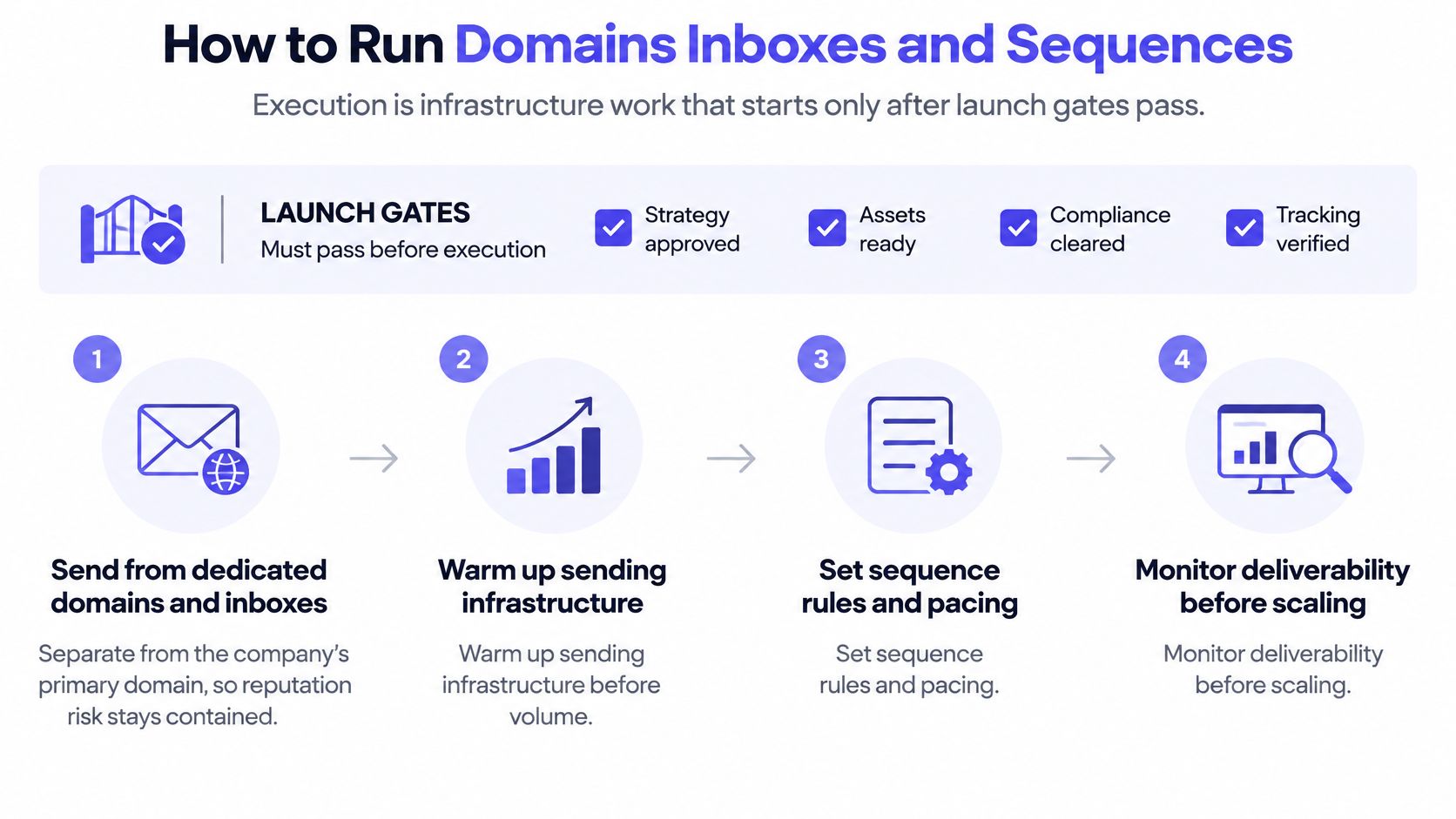
Execution starts after the launch checks pass. Dedicated domains and inboxes should be separate from the company's primary correspondence infrastructure, with clear business identification. That separation limits exposure; it doesn't justify disposable domains or misleading sender identities.
Ramp against evidence
- Warm gradually: Begin conservatively and inspect authentication, provider feedback, bounces, and complaint reporting by domain each day during the ramp. Warming isn't a guarantee of inbox placement.
- Control sequence exits: Stop automated follow-ups on any reply, bounce, or opt-out. Route replies for classification rather than allowing automation to continue through an active conversation.
- Choose pacing from segment behavior: Follow-ups should add useful context. Repeated reminders don't repair a weak reason for contacting the account.
Yahoo's sender requirements specify a DMARC policy of at least p=none, passing DMARC, one-click List-Unsubscribe support for applicable marketing messages, a bulk-sender spam rate below 0.3%, and unsubscribe handling within two days. Operationally, explicit removal requests should enter suppression the same day.
Keep compliance attached to execution
The FTC's CAN-SPAM compliance guide requires accurate headers and routing, non-deceptive subjects, advertising identification, a valid physical postal address, and clear opt-out handling that remains functional for at least 30 days and honors requests within 10 business days. Outsourcing doesn't remove the advertiser's responsibility.
A durable suppression record must cover every sending route. Deleting a contact from the active sequence alone leaves reimport and cross-mailbox risks.
A library of B2B sales email templates can support message drafting, but production approval belongs to the operator checking delivery, exits, and reply handling.
Execution gate: Volume increases only while the same sending domains remain healthy and every exit rule works.
How to Measure the Program
The reporting sheet should explain why accepted leads changed, not merely show activity. During an outbound run, the operator reads infrastructure signals daily and reviews account quality separately from sending health.
Program measurement sheet
| Metric | Calculation | Read | Action when off track |
|---|---|---|---|
| Authentication pass rate | DKIM and DMARC passes divided by sent messages, per domain | Daily during ramp | Stop scaling the domain when alignment breaks |
| Spam complaint rate | Postmaster spam rate per sending domain | Daily during ramp | Pause the segment as it approaches the working complaint ceiling |
| Reply rate by segment | Replies divided by delivered messages | Weekly | Diagnostic only, read beside accepted-lead rate |
| Accepted-lead rate | Replies passing the written standard divided by contacted accounts | Weekly | Stop scaling if flat while volume rises |
| Rejected-lead reasons | Count of rejections by reason and segment | Weekly | Edit the data layer or first line of copy |
| Speed to first human response | Hours from accepted reply to first human touch | Daily | Reassign ownership when the agreed response window is missed |
| Lead-to-opportunity conversion | Opportunities divided by accepted leads | Monthly | Audit qualification and discovery against the launch baseline |
| Meeting attendance | Attended meetings divided by booked meetings | Weekly | Check booking delay, confirmation, and buyer intent |
| Pipeline created | Value of opportunities sourced from accepted leads | Monthly | Review opportunity value and progression against the agreed commercial target |
Authentication reporting should preserve separate DKIM and DMARC results rather than blending them into a reassuring average. Where a provider supplies its own denominator, the sheet should label that denominator instead of implying direct comparability.
Diagnose before increasing volume
The team sets response windows and commercial targets from its own sales capacity before launch. There isn't a defensible universal target for every offer.
- Healthy delivery, weak acceptance: Inspect account fit and rejection reasons.
- Good acceptance, slow response: Fix staffing and routing.
- Attended calls, weak opportunities: Review discovery and the acceptance agreement.
Measurement gate: No expansion without a named explanation for the weakest stage and an owner for the correction.
A 45 Day Outbound Operating Example
Consider a specialist consultancy selling scheduling-process assessments to commercial maintenance operators opening new locations. This is a mechanics example, not a client result. It carries no revenue claim, reply-rate claim, or booked-meeting outcome.

Days 1 to 15 establish permission to launch
Days 1 to 3: The campaign owner and consultant taking calls agree on the offer, expansion trigger, responsible role, and rejection rules. An operator without an announced expansion doesn't qualify merely because its industry matches. A company seeking software installation rather than process advice also fails this offer's filter.
If those decisions remain vague, domain purchases wait. Infrastructure shouldn't be built around an unresolved market hypothesis.
Days 4 to 15: The operator prepares separate domains and inboxes, configures SPF, DKIM, and DMARC, checks alignment, and begins a conservative warming process. Meanwhile, researchers verify expansion evidence and identify the person responsible for scheduling.
No selling outcome is claimed during this window. Readiness means stable authentication, no unresolved complaint warning, functioning suppression, and a verified initial segment. The calendar doesn't force a launch if those checks fail.
Days 16 to 30 test the account hypothesis
The first message addresses a specific operational question: whether opening another location requires changes to scheduling ownership or workflow. It doesn't assert that the recipient has a problem the researcher hasn't verified.
Follow-ups add context about the assessment and stop when the recipient replies, bounces, or opts out. Inbox handling happens daily, and removal requests reach the shared suppression record the same day.
Exception rule: A scheduled send never outranks a failed operating check.
Suppose complaints rise while the message remains unchanged. The operator pauses the segment and examines source quality, stale contacts, role accuracy, and follow-up exposure. Rewriting the pitch without investigating the list would leave the likely cause unresolved.
Days 31 to 45 test the handoff
Accepted replies reach the calendar with the account, role, trigger, stated problem, timing, and acceptance reason attached. Qualification begins with the earliest replies, not only during this final window. The later review tests whether those decisions remain consistent.
A second failure looks different: recipients respond politely but have no responsibility for scheduling decisions. That pattern points to the role filter, not the closer's performance. Researchers correct the data layer before another segment is added.
The final operating check is straightforward:
- Infrastructure stable: No unresolved authentication or reputation issue.
- Suppression shared: Removed contacts remain excluded across sending routes.
- Acceptance consistent: The same commercial standard applies at the end as at launch.
Expansion gate: More volume waits until the team can explain rejected replies and demonstrate reliable handoff.
Choose In House or Managed Outbound
A lead generation strategy needs a named owner for daily controls: domains, inboxes, suppression, qualification, and handoff. Both in-house and managed outbound also require a clear offer and a sales owner who can handle accepted replies.
| Operating choice | Best fit | Cost and trade-off |
|---|---|---|
| In house | A team staffed to manage domains, warming, enrichment, inboxes, suppression, and qualification | Salaries, tools, supervision, and learning time. The team keeps direct control and takes on the operating work |
| Managed outbound | A founder who wants execution handled externally while keeping sales conversations and closing in-house | Payment for delivery, with less direct control over daily sending decisions |
Confirm readiness before choosing
Neither model can compensate for an unclear offer. Write the accepted-lead standard first, then assign someone to respond within the window on the measurement sheet.
IronPeak Marketing offers 60–90 qualified leads in 45 days on a pay-per-result basis, with custom domains, dedicated inboxes, copywriting, data enrichment, tracking, and setup in under 15 days. The offer does not change the acceptance rules: clients pay per qualified lead, not for every response.
Before committing, review domain authentication results, complaint reporting, the shared suppression process, and written accepted-lead rules. Ask to see a sample report that includes rejected-lead reasons as well as positive responses.
Selection gate: Hold a working session after drafting the acceptance standard. Use it to agree on operating responsibilities, reporting, and lead handoff.
IronPeak Marketing provides managed cold email lead generation on a qualified pay-per-result basis, combining prospect research and sending infrastructure with lead handoff. Founders with a written offer and acceptance standard can book a free strategy session or discovery call through IronPeak Marketing, with no credit card required and no commitment. The session assesses whether the market fits cold email and which operating gates need attention before launch.