B2B Sales Prospecting: How the Process Works in 2026
B2B Sales Prospecting explained step by step: define buyers, enrich and score accounts, protect deliverability, and qualify replies before handoff.
The campaign is running, the inboxes are sending, and the sales calendar still has gaps. Someone suggests changing the subject line. Someone else wants more contacts. Neither fix helps if the list contains outdated roles, the sending domain fails authentication, or the opening line describes a company event that never happened.
B2B sales prospecting is a chain of checks, from buyer definition through qualified handoff. A mistake can enter that chain long before anyone notices weak replies. The operator's job is to locate the failed check, not compensate for it with more volume.
The Prospecting Process at a Glance
| Stage | Decision Made | Output Passed Forward | Metric to Watch |
|---|---|---|---|
| Define the buyer | Who fits, which offer, who is excluded | Written profile and disqualifier list | Share of list a reviewer rates as fit |
| Build the account list | Which sources and filters to use | Accounts with firmographic and tool data | Accounts passing verification per filter |
| Enrich and score | Which contacts and scores rank first | Ranked contacts with fit and timing scores | Bounce rate after verification |
| Map the buying group | Which roles must be reached | Three to five contacts per account, each with a role | Accounts with two or more engaged contacts |
| Launch sequences | Message, timing and daily volume | Authenticated sends and a reply stream | Spam complaint rate and positive reply rate |
| Qualify and hand off | Which replies become opportunities | CRM record and booked meeting | Qualified meetings per 100 accounts contacted |
The contact counts in this operating template are planning choices, not performance benchmarks. A smaller account might combine buying roles, while a complex account might require additional stakeholders. The important output is a usable role map, not a quota of names.
Errors travel forward. A loosely defined buyer profile produces a broad list; the list builder then fills missing context with assumptions, and the copywriter turns those assumptions into messages. Weeks later, low replies appear to be a copy problem even though the original failure was targeting.
The same reasoning applies to infrastructure. An accepted send isn't proof of inbox placement, and a booked meeting isn't proof of commercial fit. Each owner needs evidence that the next person can use, rather than a completed task in a project board.
Set the acceptance standard early
A qualified reply is an interested response that states a problem the offer solves and comes from someone who can act or introduce the budget owner. That definition gives the team a consistent starting point for judging list quality, scoring rules and message relevance.
Keep positive replies separate from qualified replies. A polite request for information can justify follow-up without justifying an opportunity.
Operating rule: A stage starts only after the previous stage's output passes its check.
When a check fails, return the record to its owner. Sending an incomplete record downstream doesn't save work. It transfers the correction to someone with less context.
Define the Buyer Before You Build a List
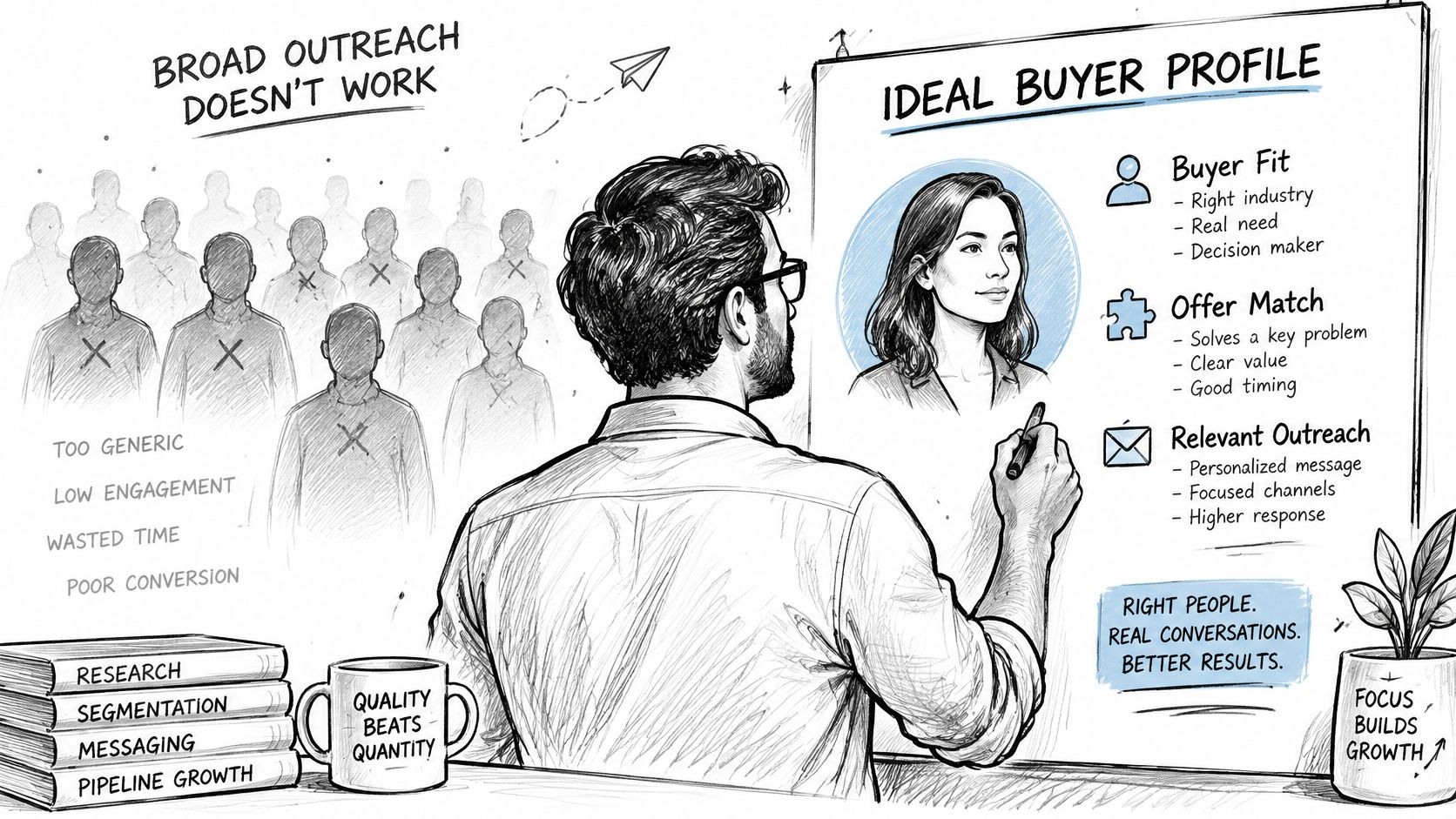
Generic targeting fails before copywriting begins. In Gartner's 2025 survey of 632 B2B buyers, 73% actively avoided suppliers sending irrelevant outreach, and 61% preferred an overall rep-free buying experience. Buyers nevertheless preferred seller input when judging whether an offer fit their organization.
That makes the first filter the offer and buyer situation, not an available database category. The profile should explain why the account could need the offer and what useful judgment a seller can contribute.
Turn the offer into executable filters
Consider a hypothetical software company selling onboarding tooling to firms with 50 to 300 staff. Its profile could read: business software companies operating in the seller's supported territory, within the seller's documented revenue band, with distributed onboarding and a dated expansion or migration event. Accounts are excluded when an installed competitor is unsuitable for displacement, procurement is frozen, or required functionality falls outside the product.
The list builder needs rules that don't require guessing:
- Industry and size: Business software companies within the example's headcount band, confirmed against current company information.
- Revenue: Inside the seller's written revenue band; unknown revenue goes to review rather than receiving an invented estimate.
- Geography: Headquarters and intended users fall within supported markets.
- Trigger: Funding, another location or a platform migration has a dated, traceable source.
- Disqualifiers: Exclude confirmed procurement freezes, unsupported requirements and competitor installations ruled out by the offer strategy.
A competitor installation isn't automatically negative. For a replacement offer, it can be the reason to make contact. The profile must settle that distinction before sourcing begins.
Check whether the profile supports a conversation
IronPeak Marketing begins by analyzing the prospect's current situation, target market and offer to determine whether its cold email system fits their growth goals. It specializes in B2B companies, agencies and high-ticket service providers.
The same profiling discipline applies to staffing firms pursuing employers, trade businesses targeting commercial accounts, and specialist consultants selling substantial engagements. Their filters differ, but each needs an observable reason for contact.
As a practical acceptance test, a rep should be able to draft a relevant opening within a minute using information already on file. If that requires fresh detective work for every account, the profile is too broad or the record is incomplete.
Source, Enrich and Score Accounts for Fit and Timing
A shared database is a starting point, not a sourcing strategy. Searching the same broad filters leaves a seller competing for attention from the same visible accounts. Public directories, company announcements, trade association listings and job pages can expose accounts that standard categories miss.
Discovery can combine permitted public-source scraping, enrichment services, custom API access and AI agents that locate relevant pages. Respect access restrictions and applicable privacy rules. An agent should return a source, extraction date and supporting text, not just a confident-looking answer.
McKinsey's personalization-at-scale framework combines traditional and behavioral data with analytics and propensity scoring. The practical lesson is to assemble reliable inputs before ranking accounts.
Keep fit separate from timing
Fit answers whether the company belongs in the market. Timing answers whether a current event makes outreach useful now. A strong trigger shouldn't rescue an account that the seller cannot serve.
| Signal | Type | How to Verify | Used For |
|---|---|---|---|
| Industry and headcount | Fit | Company registry, company website, current company profile | Matching the profile filter |
| Installed tools | Fit | Integration pages, job posts that name the tool | Technical fit score |
| Geography | Fit | Registered address, published service area | Territory and time zone |
| Hiring for the role supported | Timing | Open job posts, dated and rechecked weekly | Priority tier |
| New funding, location or leadership change | Timing | Press release, filing or dated news source | Outreach trigger |
| Prior engagement with the brand | Timing | CRM record, attributable site visit or event attendance | Warm sequence |
Store fit and timing in separate columns. Also record confidence: a current job post naming software is stronger evidence than an old directory entry. An account-level site visit doesn't establish which individual visited or whether that person wants contact.
Work the batch before expanding it
In a hypothetical batch of 1,000 raw accounts, firmographic filters leave 340. Of those, 90 carry a dated trigger, and the highest-priority 40 enter the initial outreach batch. These are illustrative planning numbers, not expected conversion rates.
The smaller first batch creates room for manual inspection. Reviewers can check source accuracy, contact roles and whether the proposed message follows from the evidence.
Before release:
- Verify addresses: Remove invalid results and suppress addresses that fail verification.
- Hold uncertain records: Put catch-all results into a later, smaller test rather than treating them as verified.
- Expire triggers: Set an event-specific validity window and recheck triggers weekly.
- Preserve provenance: Keep source and date fields attached through export and CRM import.
A usable lead generation list carries those working fields, not just names and email addresses. After each batch, calibrate scores against accepted leads, meetings held and opportunities created. Opens don't establish that the account was worth contacting.
Map the Buying Group Before the First Email
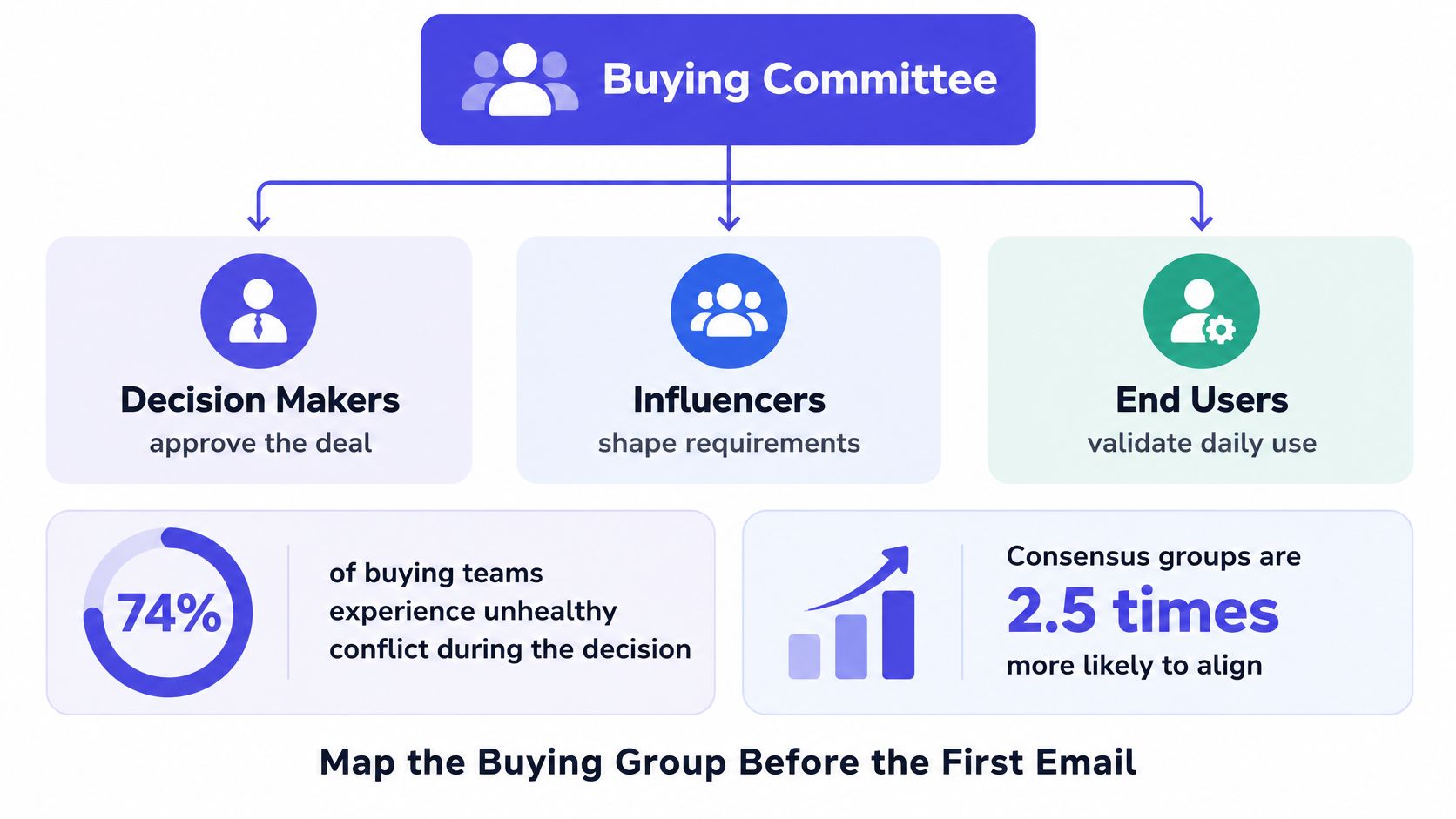
An interested contact can still lose the internal argument. In Gartner's survey of 632 B2B buyers, 74% of buying teams experienced unhealthy conflict, while groups reaching consensus were 2.5 times more likely to report a high-quality deal.
The prospecting record therefore needs more than a senior title. It needs the people who approve spending, operate the service, evaluate implementation and control contractual risk. One unmapped stakeholder is a weak link, and the deal breaks in a meeting your contact never attended.
Build a role map around the purchase
A staffing firm pursuing a new employer client needs a role map before the first email. Titles alone won't establish buying authority, so the working map below gives the researcher specific questions to resolve.
| Role | Example Stakeholder | Likely Objection | Evidence to Prepare |
|---|---|---|---|
| Economic buyer | CFO | Agency fees aren't justified | Fee structure and a transparent cost comparison |
| Operational user | HR director | Candidate screening will create more work | Screening criteria and a sample submission format |
| Technical evaluator | Operations lead | Hiring coordination won't fit existing processes | Workflow map, system compatibility and escalation process |
| Blocker | Procurement | Supplier terms introduce unacceptable risk | Insurance documentation, contract terms and supplier requirements |
The economic buyer owns budget and outcome. The operational user experiences the problem daily. The technical evaluator checks integration, data handling and implementation, while a blocker can stop the purchase without having any interest in using the service.
These roles are hypotheses until verified. Another employer might assign technical review to IT or make the HR director the budget owner. Confirm each role through org charts, role descriptions and early replies before writing the sequence.
Keep the business case consistent
The shared case could be reliable hiring capacity without uncontrolled internal coordination costs. HR receives evidence about screening, finance receives cost assumptions, operations receives the workflow, and procurement receives contractual safeguards. Each stakeholder gets a different view of the same proposed engagement.
Role-specific outreach should help stakeholders agree on the purchase, not give each stakeholder a different version of what the seller delivers.
Measure account progression through multiple engaged contacts, meetings involving different functions and opportunities with an agreed internal decision path. Simultaneous, disconnected sequences let colleagues compare inconsistent claims, so coordinate timing across the group.
Check each link before sending: verified roles, evidence matched to each objection, one consistent offer. A missed stakeholder or a mismatched claim ends the deal weeks before a reply would have arrived.
Set Up Sending Infrastructure That Reaches the Inbox
Treat domain configuration as a campaign mechanic that is checked before every send. A sequencer can report successful sending while receiving providers route the messages to Junk. Authentication, reputation and recipient response each form a separate link in the chain; a failure at any one can invalidate the rest.
Twelve mailboxes sending 400 messages each produce 4,800 daily messages; adding two more produces 5,600. That capacity calculation shows aggregate traffic, rather than a safe per-mailbox rate. Under Google's bulk-sender guidance, the threshold is 5,000 or more daily messages to personal Gmail accounts, with traffic assessed across the same primary domain rather than independently per mailbox.
Verify authentication from actual sends
SPF identifies authorized sending hosts. DKIM signs messages so recipients can validate integrity and domain authenticity. DMARC checks alignment between the visible From domain and authenticated SPF or DKIM identity.
Inspect headers from the actual campaign inboxes. A correctly configured administrative account can pass while another sending service fails. Before increasing volume, check the authentication results, signing domain and visible From alignment for the system that will send production email.
Microsoft's high-volume sender announcement specifies passing SPF and DKIM plus aligned DMARC at p=none or stricter for domains sending more than 5,000 daily emails to Outlook, and states that noncompliant messages initially go to Junk.
Use provider rules as operating limits
Google's sender guidelines advise keeping the spam rate below 0.1% and preventing it from reaching 0.3% or higher. Monitor complaints daily during a gradual ramp over several weeks. Domain warming gives no permission to send unwanted messages, and artificial warm-up activity does not prove production inbox placement.
The FTC's CAN-SPAM compliance guide requires an opt-out mechanism that works for at least 30 days after sending, with requests honored within 10 business days.
| Rule or Provider | Volume Trigger | Authentication Required | Complaint or Opt-Out Rule |
|---|---|---|---|
| Gmail bulk senders | Daily traffic at or above Google's bulk threshold | SPF, DKIM and aligned DMARC | Keep complaints within Google's limits; provide easy unsubscribe |
| Outlook high-volume senders | Daily traffic above Microsoft's high-volume threshold | Passing SPF and DKIM; aligned DMARC | Maintain list hygiene and functional unsubscribe |
| CAN-SPAM, US commercial email | No volume threshold | Accurate From, To, Reply-To and routing information | Follow the processing and availability deadlines described above |
Before each production increase, check provider-level delivery errors, complaint reports and placement in controlled recipient accounts. Pause increases when signals deteriorate, then inspect the affected list segment before sending again. Rotating domains to evade the problem leaves the bad data or targeting in place.
Suppress bounced, invalid and opted-out addresses before sending. US commercial email also needs advertising identification and the other required disclosures. UK and EU contacts require a separate legal assessment of consent, lawful outreach and opt-out obligations before launch.
Write Sequences Buyers Can Verify
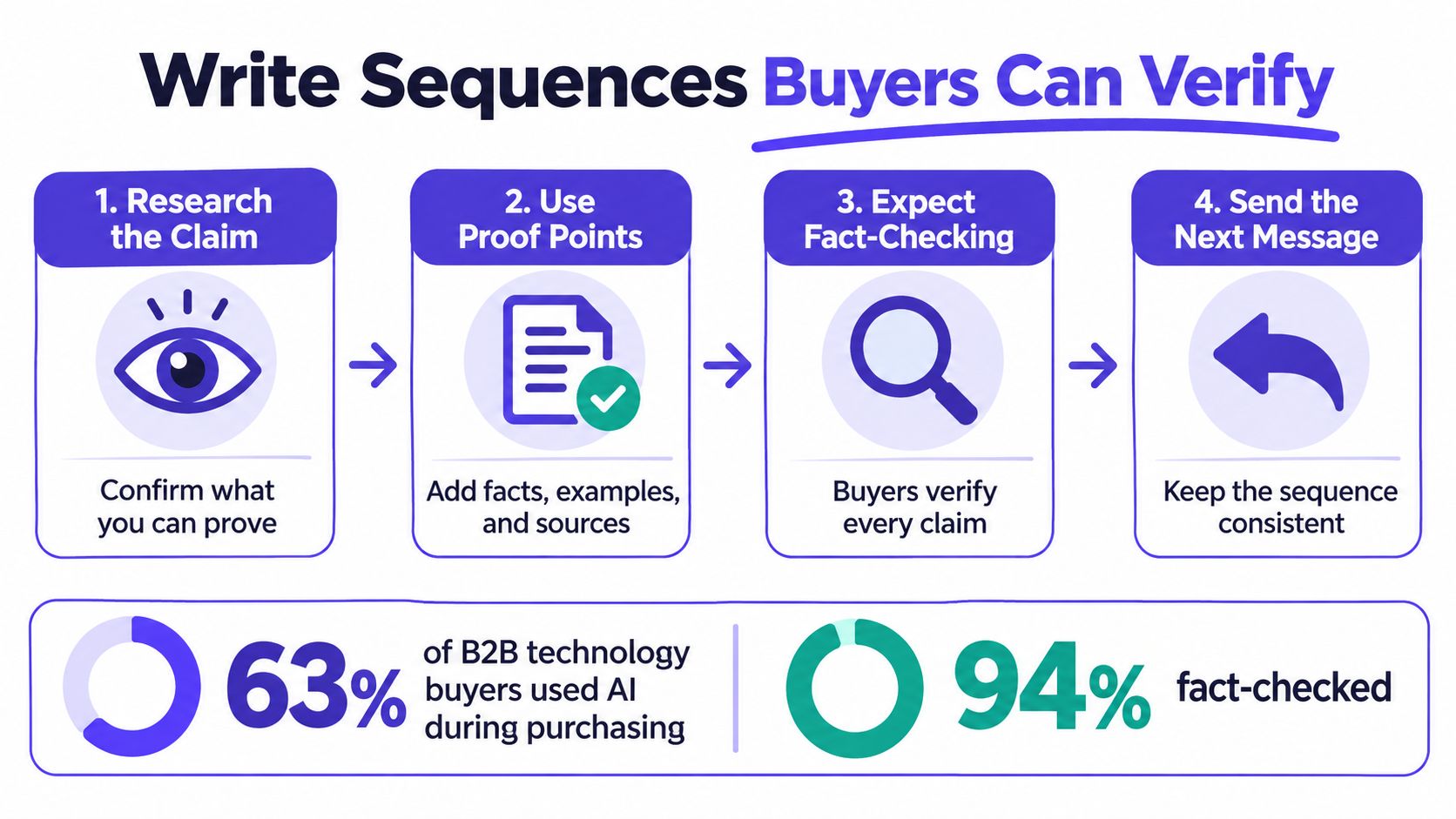
Personalization earns its place only when the recipient can check it. An unsupported detail gives the reader a reason to distrust the entire message, even when the offer is relevant.
TrustRadius buyer research reports that 63% of B2B technology buyers used AI during purchasing, while 94% fact-checked AI-generated information at least sometimes and 72% did so always or very often. Buyers are already running verification passes on inbound claims. A personalized line is one link in that chain: if it breaks under a two-minute search, every link after it never gets read.
Approve the inference, not just the fact
A second-site opening in Leeds makes a usable first line when the source carries a date. "Noticed the company opened a second site in Leeds last month, which may create additional onboarding work" splits into two parts: the location and date need a source, and the workload implication stays a possibility until the buyer confirms it.
Compare that with "Noticed the company is scaling fast." That line supplies no verifiable reason for contact, and it invites the writer to invent urgency later in the email.
The working file should carry the source, publication date, extracted fact and proposed sentence for every opening line. A reviewer can then see exactly what the company announced versus what the seller inferred, which is the checkpoint where weak copy usually fails.
- Require human approval: Any claim about company priorities needs review before launch.
- Exclude untraceable intent: A score without supporting evidence doesn't belong in copy.
- Separate fact from possibility: An expansion can justify a question, not a claim that operations are struggling.
- Keep website promises consistent: The email shouldn't offer capabilities or terms the seller cannot substantiate.
Make follow-ups add information
A practical test cadence uses four touches over about two weeks, then gets tuned against reply and complaint rates. That is a starting design, not a universal response formula.
| Touch | Purpose | New Information |
|---|---|---|
| Relevant opening | Connect a verified event to a plausible problem | Source-backed context and a narrow question |
| Context follow-up | Help the contact evaluate fit | A workflow explanation or relevant limitation |
| Additional stakeholder | Address another buying role | Evidence useful to that function |
| Closing note | End active pursuit without pressure | A clear route to respond later |
The B2B sales email templates work best as structures for evidence, not containers for manufactured familiarity. Each follow-up needs a reason to exist beyond the absence of a reply, or the sequence becomes volume the sender's complaint rate will eventually pay for.
Apply the opt-out list before every touch, including already scheduled messages. When a recipient flags a false claim, pull the record, correct the underlying source and log whether other accounts received the same error. One bad data point in an enrichment file rarely stays confined to one email.
Automation should reduce research effort without removing accountability for what gets sent.
Track trust-adjusted pipeline as qualified opportunities minus opportunities lost to inaccurate research. Keep the raw error count alongside it, because a damaged account may never reply at all, so the loss never surfaces in reply metrics. Faster drafting isn't an improvement if the team cannot explain why each sentence is true.
Qualify Replies and Hand Off Only Real Opportunities
A warm reply can still be a dead end. The qualification stage is the last link in the chain, and it should catch weak authority, stale timing and poor fit before a seller spends calendar time on them.
Sort replies into working queues with a clear next action:
- Interested with a timeline: Confirm the remaining acceptance checks and arrange the next step.
- Interested without budget authority: Establish whether the contact can introduce the budget owner.
- Referred elsewhere: Create a new contact on the same account and retain the referral context.
- Not now: Record the reason and an appropriate revisit condition.
- Unsubscribe or hostile: Suppress further marketing and stop the active sequence.
Only the interested categories enter opportunity consideration. Treat a referral as a new contact path that still has to establish demand. Route an unsubscribe to suppression and sequence operations as a system event.
Apply the full qualification test
Before handoff, confirm these acceptance checks:
- Problem: The buyer states a problem the offer solves.
- Authority path: The budget owner is identified or demonstrably reachable.
- Timing: The buying window falls inside the seller's predefined acceptance window.
- Account fit: The company matches the profile, and the timing evidence remains current.
- Commitment: The contact accepts a call with a relevant purpose.
Count an interested contact without authority only when the route to the buyer is concrete: a named introduction, shared context and a reason that person should engage. Settle those rules, edge cases and the final rejection owner on the client onboarding call, then apply the same standard every week.
Send context, then learn from rejection
The CRM handoff should contain the account, contact role, trigger source, exact reply text and next-step date. Add the stated problem, authority path and unresolved questions. The seller should open the record and see enough to run the call.
| Rejection code | Usually caused by | Stage to fix |
|---|---|---|
| Wrong role | Contact sits outside the buying group | Map the buying group, stage 4 |
| Outside profile | Filter applied too loosely | Build the account list, stage 2 |
| Stale trigger | Trigger older than the window set | Enrich and score, stage 3 |
| No budget | Economic buyer never identified | Map the buying group, stage 4 |
| Unsubscribed | Opt-out not applied before a touch | Write sequences, stage 6 |
Use the unsubscribed code for a suppression failure that reached the recipient. Keep ordinary opt-outs in a separate preference category so recipient choice stays distinct from a system defect.
Review rejection codes weekly. A growing category points to one upstream stage that needs correction before another batch uses the same rules.
Decide Whether to Run Prospecting In-House or Outsource It
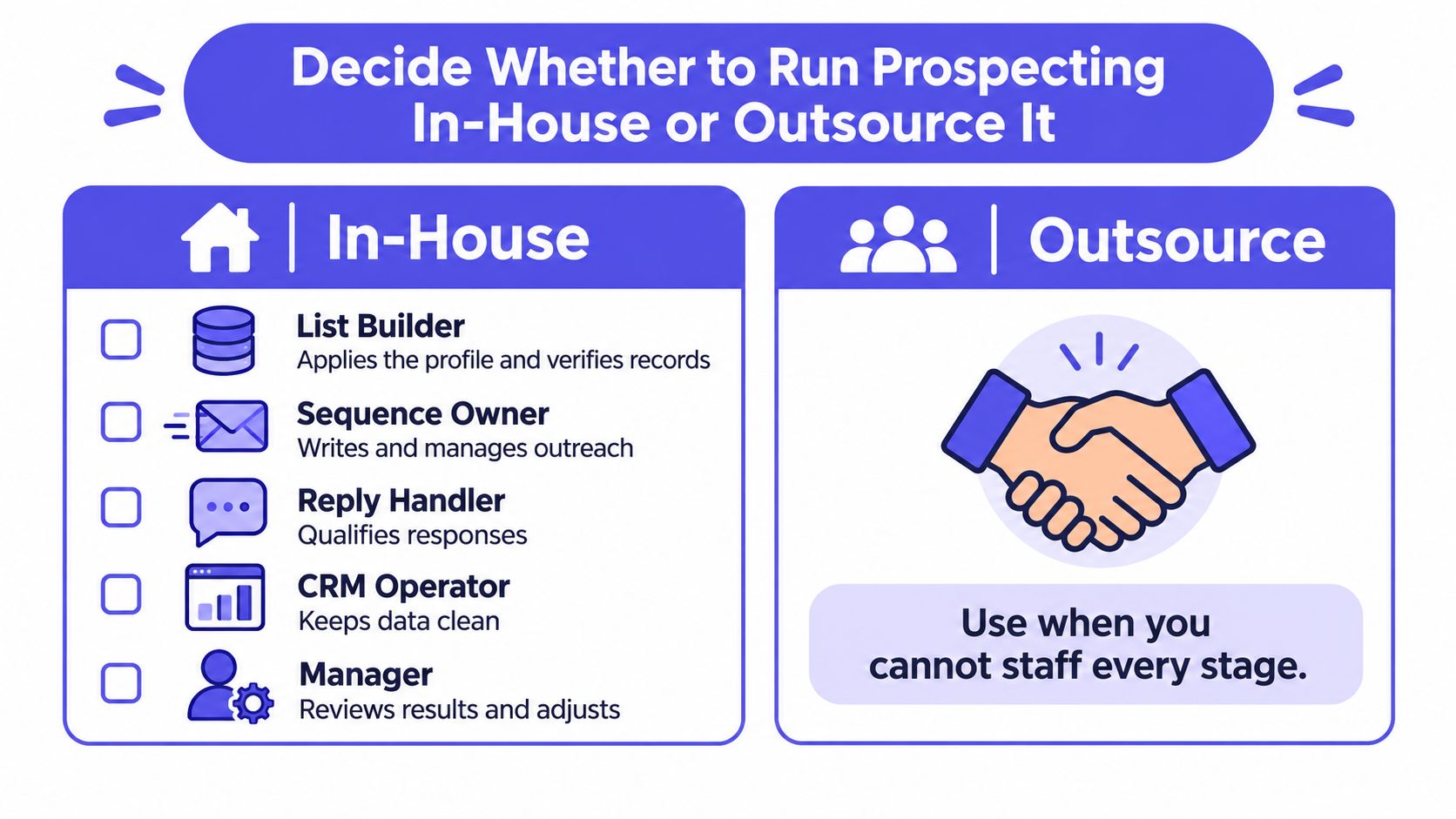
Run prospecting in-house when the business can assign competent owners to every stage: list verification, authentication and complaint monitoring, evidence-based copy, CRM hygiene and reply triage within a working day. Several responsibilities can sit with one person. None should stay unowned, because an unowned stage is the link that breaks, weeks before anyone notices replies have stopped.
Check operational readiness
A practical readiness checklist is:
- Written profile: Sourceable filters and explicit exclusions.
- Acceptance criteria: Agreed definitions for accepted and rejected leads.
- Deliverability owner: A named person responsible for sending health.
- Suppression control: Opt-outs checked before every send.
- Review cadence: Rejection reasons inspected weekly.
Three or more missing items should trigger a preparation phase rather than an immediate start. Outsourcing adds capacity, but an unclear offer must be defined before launch.
When evaluating a B2B lead generation agency, compare commercial terms against those operating requirements. Pay-per-result pricing, where clients pay per qualified lead rather than a fixed retainer, shifts the cost risk. It does not replace written acceptance criteria. Confirm who decides rejection, how disputed leads are handled, and whether the engagement runs month to month with the option to cancel.
Write the profile and rejection codes this week. Then run a 200-account pilot under either operating model and measure qualified meetings per 100 accounts contacted. For an outsourced run, score the handoff against the same checklist: rejected leads should carry usable codes, opt-outs should clear before each send, and the weekly review should happen on schedule.