Sample Sale Proposal: 7 Structures for Cold Email Outbound
Seven sample sale proposal structures for cold email outbound, with the key sections, deliverability terms and tailoring steps to use with a prospect.
The most popular advice about a sample sale proposal is to start with a polished template and make the price easy to find. For cold email outbound, that puts formatting ahead of the terms that determine whether the engagement works.
A founder may approve the fee while assuming that a qualified lead means an attended sales meeting. The provider may mean a positive reply. Both can sign the same document and disagree when the first invoice arrives.
The expensive gaps usually sit elsewhere: who owns replies, when setup ends, how rejected leads are handled, and whether the prospect list can support the promised volume. A proposal needs to settle those questions before either side compares prices.
Practical rule: A proposal should let the client and provider score the same opportunity independently and reach the same billing decision.
The right structure depends on what the buyer needs to purchase:
- Accepted opportunities: Use qualified-lead terms.
- Evidence of market fit: Use a defined pilot.
- Execution capacity: Use managed outbound.
- Technical or targeting repairs: Separate infrastructure from prospect research.
- Resale or specialist delivery: Use white-label or industry-specific terms.
These structures can share appendices, but each needs a clear primary deliverable. Otherwise, a narrow test can become an undefined promise to build the client's entire sales function.
1. Pay-Per-Qualified-Lead Proposal
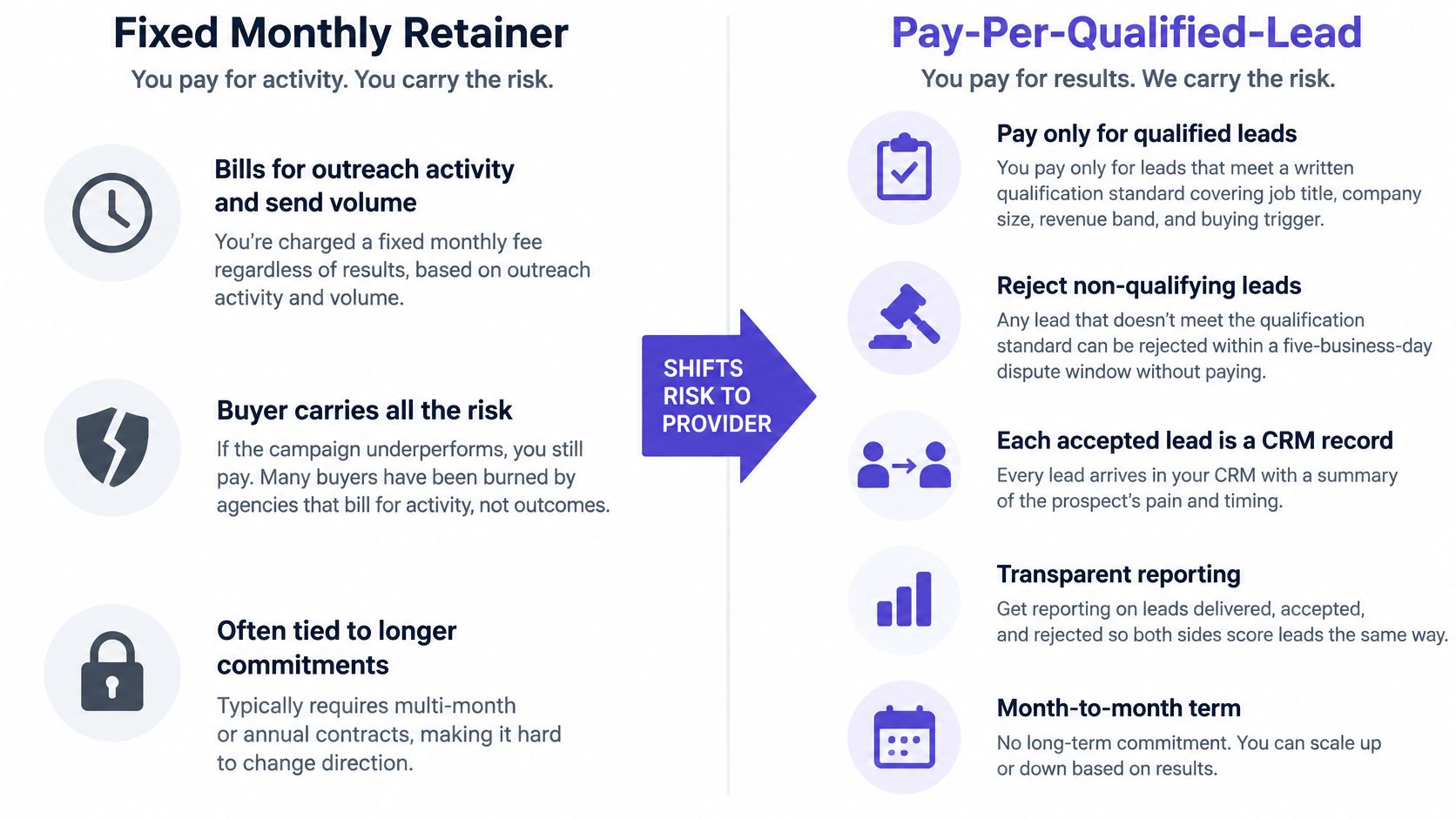
A pay-per-qualified-lead proposal replaces a fixed retainer with a fee for opportunities that meet an agreed standard. The buyer isn't purchasing sends, opens, or research hours. The buyer is purchasing a defined commercial outcome.
The most important term is accepted qualified lead. A positive reply, booked meeting, attended meeting, and sales-qualified opportunity are different events. The proposal must select one and state what evidence proves it occurred.
Sections That Control Acceptance
The document needs qualification criteria, exclusions, evidence requirements, unit fee, rejection process, and billing reconciliation. The qualification appendix should be signed before launch, not negotiated after delivery.
For an illustrative software campaign, the definition might require a VP of Operations at a company with 100 to 500 employees who confirms an active budget line for the relevant problem. A proposed five-business-day rejection window gives the client time to review the record while keeping reconciliation bounded.
Tailoring requires more than changing the job title. A B2B lead generation agency proposal should translate the prospect's sales requirements into fields that campaign operators can verify.
- Qualification evidence: Preserve the reply confirming need, authority, or budget.
- Rejection reasons: Distinguish incorrect targeting from a buyer changing priorities.
- Economic comparison: Calculate total campaign cost divided by accepted opportunities, not replies.
The failure point is subjective rejection. A client shouldn't reject an otherwise qualifying opportunity merely because the sales call didn't close. Equally, the provider shouldn't invoice a friendly reply that contains no agreed buying signal.
Reviewing rejected records regularly during the opening campaign period helps refine targeting without changing the signed acceptance standard.
2. Pilot Campaign Proposal With a Defined Test Window
A pilot is useful when the offer is established but its fit with cold email remains uncertain. It should answer a bounded question, such as whether a specific buyer segment responds to a specific commercial offer.
It shouldn't become an inexpensive trial of unlimited targeting, copy changes, and infrastructure work.
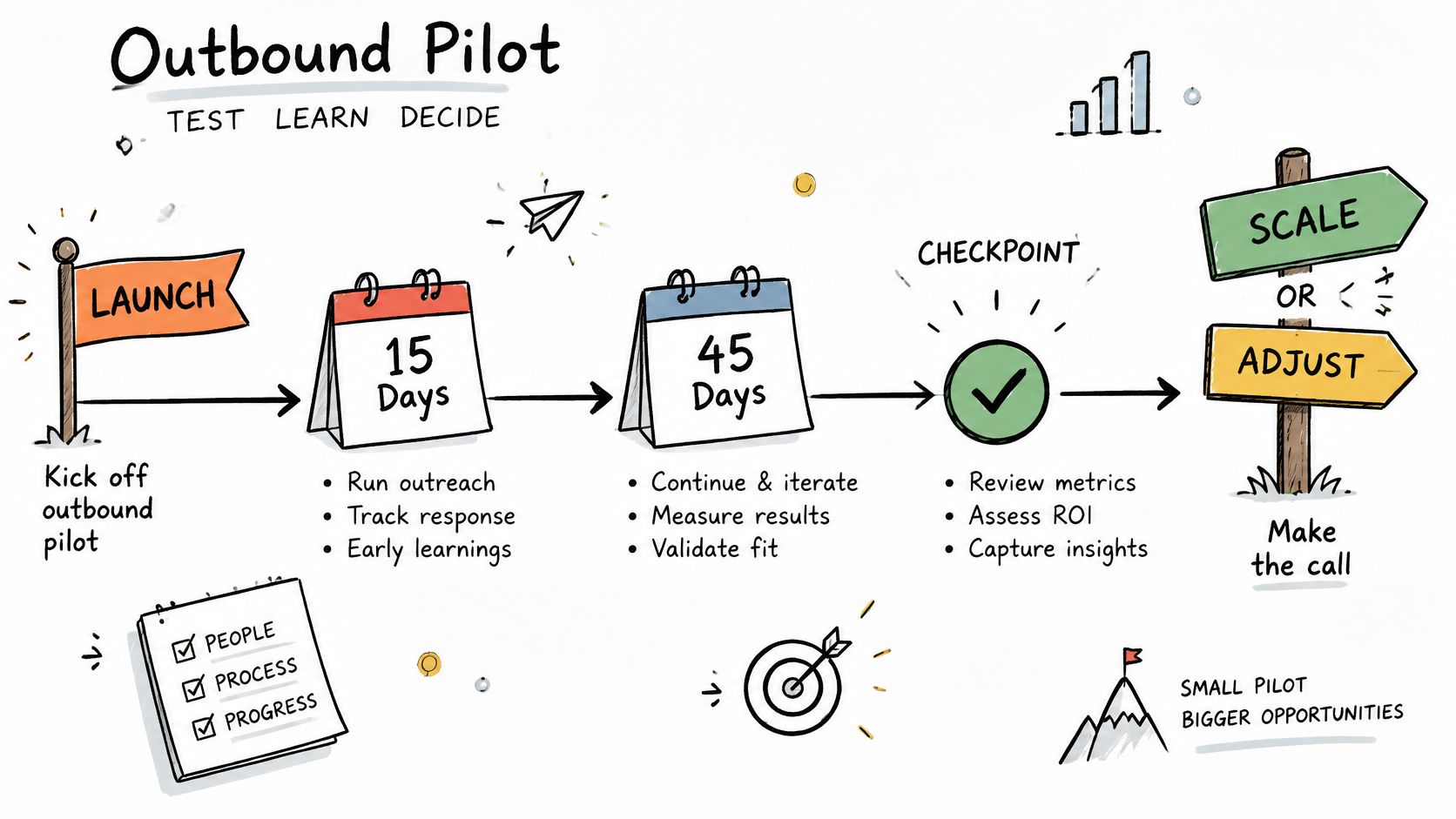
IronPeak Marketing's published pilot structure provides a concrete reference: approximately 15 days of setup followed by a 45-day campaign window, with a headline target of 60–90 qualified leads on a pay-per-result basis. That target belongs beside the qualification definition and campaign assumptions, not in place of them.
Separate Setup From the Measurement Window
The named sections should be test hypothesis, setup deliverables, live campaign window, success threshold, review points, and continuation decision. Setup acceptance should cover authenticated inboxes, approved copy, reviewed prospect records, suppression imports, and working CRM handoff.
In an illustrative agency pilot, outreach targets agency owners in a single vertical. A proposed mid-campaign review on day 25 examines replies and qualification failures, while the final decision occurs at the end of the agreed live window.
- Tailor the hypothesis: Test a defined offer and buyer group, not every service the agency sells.
- Control changes: Record whether a new segment changes the test or requires additional research.
- Define the exit: State who retains domains, inboxes, records, and campaign documentation.
The dispute point is the clock. A client may count from signature while the provider counts from the first live send. Approval delays, paused sending, and missing calendar access also need explicit treatment.
A pilot should finish with a decision to continue, revise, or stop. It shouldn't roll into another billing period merely because nobody defined the decision process.
3. Done-For-You Managed Outbound Proposal
Consider a specialist consultant who can handle sales calls but has no capacity to research prospects or manage replies. A managed outbound proposal should describe an operating service, not a software subscription with an optimistic campaign forecast.
In an illustrative scope, the provider runs five follow-up touches over three weeks, reviews inboxes daily, and routes pricing requests to the consultant within one business day. Those are proposed service commitments, not universal performance benchmarks.
The document needs named sections for campaign production, inbox management, response handling, meeting handoff, client obligations, and escalation. Each section should identify an owner and the evidence that the work happened.

Put Reply Ownership in Writing
A responsibility appendix can use separate provider and client headings without burying ownership in prose. The provider might classify replies, stop sequences, and coordinate meetings. The client supplies approved commercial answers, attends calls, and owns closing.
Tailoring starts with past sales-call notes and objection logs. Those records reveal which questions an operator can answer safely and which require the consultant's judgment.
For U.S. commercial email, the FTC's CAN-SPAM compliance guide requires accurate sender information, a valid postal address, a clear opt-out mechanism, and honoring opt-outs within 10 business days. A managed proposal should assign suppression handling explicitly rather than treating it as a footer-writing task.
An interested reply needs an owner. An opt-out needs a suppression action, not another follow-up.
The failure point is the handoff gap. A provider may mark a reply as delivered while the client expects a booked appointment. The proposal must state whether delivery means CRM entry, calendar booking, attendance, or another agreed event, including how reschedules and no-shows are handled.
4. Infrastructure and Deliverability Proposal
An infrastructure proposal sells a functioning sending system. Its deliverables are domains, inboxes, authentication, routing, monitoring, and controlled sending, not guaranteed inbox placement.
The named sections should be asset ownership, DNS configuration, inbox provisioning, volume ramp, monitoring, incident response, and maintenance fees. Domain and mailbox access should remain documented so the client isn't dependent on an undocumented administrator account.
For high-volume Outlook senders exceeding 5,000 emails daily, Microsoft's sender requirements call for SPF, DKIM, and DMARC, with at least a p=none DMARC policy and alignment through SPF or DKIM. The proposal should include test messages and authentication-header checks, not merely confirmation that DNS records were entered.
Define Warming as a Controlled Ramp
An illustrative staffing proposal can allocate roughly two weeks to gradually increasing legitimate sending while checking bounce patterns, complaint signals, and mailbox restrictions. That schedule is a proposed operating plan, not a promise that every domain becomes ready on a fixed date.
- Authentication: Verify SPF authorization, DKIM signatures, and DMARC alignment.
- Monitoring: Inspect provider errors, bounces, complaints, and placement diagnostics.
- Pause conditions: Reduce or stop sending when signals deteriorate.
- Recovery: Investigate the cause before resuming or replacing assets.
Google advises keeping user-reported Gmail spam rates below 0.1% and preventing them from reaching 0.3% or higher in its bulk-sender guidance. Complaint monitoring therefore belongs in daily operations.
A poor lead generation list can undermine properly authenticated infrastructure. Warming doesn't repair irrelevant targeting, and replacing domains shouldn't become a way to evade recipient feedback.
The failure point is an inbox-placement guarantee without a measurement method. Seed tests provide diagnostics, not proof of every recipient's placement. Separate setup fees from outcome fees and state exactly which maintenance tasks continue after launch.
5. Prospect Research and Enrichment Proposal
The buyer should inspect sample records before approving campaign copy. Incorrect companies and stale roles won't become relevant because the opening sentence sounds personalized.
A research proposal needs addressable-market definition, source selection, enrichment schema, verification rules, sample approval, refresh cadence, and replacement terms. It should distinguish company fit from contactability. A verified email address proves neither decision-making authority nor demand.

An illustrative construction-services proposal might present 50 commercial property-manager records for approval. Each includes property type, service geography, recent permit activity, source location, and verification status. The client's corrections become targeting rules before the production list is built.
Make Every Field Earn Its Place
Useful prospect research ties enrichment fields to a targeting decision, qualification rule, or email claim.
- Property type: Determines whether the contractor's service fits the building.
- Permit activity: Supplies a potential project trigger, not proof of purchasing intent.
- Service geography: Excludes accounts the field team can't serve.
- Source timestamp: Helps operators decide when the record needs refreshing.
Scraping, custom API access, and AI-assisted research should produce traceable records. AI-generated summaries need underlying source references, especially when campaign copy mentions projects, hiring, or operational changes.
Tailor the refresh schedule to the field. A company's industry may remain stable while an open project changes quickly. A proposed monthly refresh can suit some records, but time-sensitive triggers need checking closer to the send.
The failure point is billing for usable-looking but unusable data. Define duplicates, existing accounts, missing fields, invalid addresses, and replacement eligibility. Estimate the reachable market before committing to lead volume, because a narrow territory can run out of suitable buyers even when the research is accurate.
6. Agency White-Label Outbound Partner Proposal
White-label outbound has separate buyers and operators. The agency owns the client relationship, while the delivery partner runs infrastructure and campaigns under agreed branding.
A direct-client proposal won't cover that arrangement adequately. The document needs account boundaries, commercial settlement, brand permissions, reporting, escalation, client access, and termination handover.
An illustrative agency sells a monthly outbound service under its own brand. The delivery partner invoices the agency for accepted qualified leads, while the agency sets its end-client price. Each client receives a separate domain and inbox set, although separation alone doesn't eliminate every shared-platform risk.
Show the Margin and the Escalation Path
The margin calculation should remain visible:
Commercial control: Agency gross margin equals collected client revenue minus accepted-lead charges and any separately agreed delivery costs.
A worked settlement can show the agency starting with the client's collected monthly payment, subtracting accepted-lead fees, then deducting mailbox and reporting charges where applicable. Rejected records stay outside the accepted-lead subtotal until resolved. The agency should understand the margin before adding account-management work.
Tailoring depends on how much contact the agency wants the partner to have with end clients.
- Client communication: Name who explains pauses, targeting changes, and missed expectations.
- Reporting: Produce a branded report with stable definitions and no confidential cross-client data.
- Approval rights: State who signs off on copy, qualification rules, and list changes.
- Access control: Separate client workspaces, credentials, and suppression records.
The FTC's CAN-SPAM implementation document explains that outsourcing email doesn't remove the sender's responsibility. Contractual responsibility should therefore complement operational controls, not replace them.
The failure point is conflicting acceptance decisions. If the agency accepts a lead but its client rejects it later, the partner's invoice can become disputed. Use a shared qualification appendix and define whose acceptance starts billing.
7. Industry-Specific Outbound Proposals for Staffing, Recruitment, and Commercial Trade Services
Industry-specific proposals should change the qualification logic, not just the vocabulary. Staffing firms need employer demand. Commercial contractors need a serviceable project, maintenance requirement, or procurement path.
The named sections should be buyer role, trigger evidence, service fit, qualification event, handoff context, and delivery capacity. A hiring advertisement or permit record starts research. It doesn't automatically establish a qualified opportunity.
Match the Trigger to the Buying Process
In an illustrative healthcare-staffing campaign, the target list contains hospital operations leaders at facilities advertising multiple nursing openings within the past 30 days. Qualification requires a relevant leader to confirm an open staffing need within the next quarter, rather than merely acknowledging the email.
For an electrical contractor, recent commercial permit activity may identify a property worth investigating. The qualified lead could be a property manager who confirms a maintenance or retrofit need and provides a project timeline.
- Staffing handoff: Include role requirements, location, urgency, and the employer's stated need.
- Trade handoff: Include site details, scope, timeline, buyer role, and procurement requirements.
- Signal refresh: Recheck hiring and project evidence before sending.
- Capacity alignment: Limit campaign scope to work the recruiting or estimating team can handle.
Tailoring also requires checking whether the client can fulfill the opportunity. Trade firms may need appropriate licensing, insurance documentation, and vendor registration before a buyer can proceed. Staffing firms need capacity to recruit for the roles being pursued.
A relevant trigger earns an outreach attempt. The buyer's confirmed need determines qualification.
The failure point is confusing a trigger with demand. An old vacancy may already be filled, and permit activity may relate to work already awarded. Qualification should capture the buyer's own statement.
Commercial campaigns should also track lead-to-bid and bid-to-award progression. A booked walkthrough is a useful milestone, but it isn't an awarded contract or collected revenue.
How the seven sample sale proposal structures differ on billing, fit, and constraints
| Item | Billing basis | Best for | Main constraint |
|---|---|---|---|
| Pay-Per-Qualified-Lead Proposal | Fee per accepted qualified lead | Buyers seeking outcome-based pricing | Requires tightly defined qualification and dispute rules |
| Pilot Campaign Proposal With a Defined Test Window | Time-boxed campaign with an agreed success threshold | Testing outbound before a longer commitment | Short test windows can produce noisy results |
| Done-For-You Managed Outbound Proposal | Managed service; pricing structure not specified | Clients who want outbound handled without running an internal team | Client still needs to respond quickly to interested leads |
| Infrastructure and Deliverability Proposal | Setup and ongoing infrastructure costs; specific pricing not stated | Clients needing cold-email infrastructure and deliverability support | Setup takes time, and inbox placement cannot be guaranteed |
| Prospect Research and Enrichment Proposal | Research and enrichment service; pricing structure not specified | Teams needing targeted, verified prospect lists | Data can become inaccurate and requires ongoing refresh |
| Agency White-Label Outbound Partner Proposal | Provider bills the agency per accepted lead; agency sets client pricing | Agencies adding branded outbound services | Agency margins depend on workable per-lead economics |
| Industry-Specific Outbound Proposals for Staffing, Recruitment, and Commercial Trade Services | Industry-specific; may use pay-per-lead, but pricing is not specified | Staffing, recruitment, and commercial trade businesses | Lead volume and timing depend on market size, triggers, and delivery capacity |
Turn the Proposal Into a Signed, Measurable Test
A strong sample sale proposal makes the operating agreement visible before the price becomes the focus. It identifies the buyer, defines the outcome, assigns responsibility, and explains what happens when delivery falls outside the agreed standard.
The structure should match the buying decision. Qualified-lead terms suit buyers evaluating accepted opportunities. A pilot suits buyers testing a market, while infrastructure and research proposals isolate problems that shouldn't be hidden inside a broad lead-generation promise.
A combined engagement can still work. It needs separate acceptance criteria for setup, data, campaign execution, and qualified outcomes. Otherwise, a technical delay can become a lead-volume dispute, or an approved list can be mistaken for a promise of demand.
Resolve the Terms That Change the Invoice
Before signature, the client and provider should be able to answer the following:
- Qualification: Which recorded facts make an opportunity billable?
- Measurement: When does the live campaign window begin, and what pauses it?
- Ownership: Who handles replies, meetings, opt-outs, and CRM updates?
- Exceptions: How are duplicates, existing opportunities, no-shows, and rejected records treated?
- Exit: Which assets and records remain available after cancellation?
The success threshold belongs beside those definitions. A lead target without a qualification standard encourages arguments about quantity. A strict qualification standard without a reachable market can make the target impractical.
Reporting should preserve the path from researched prospect to accepted opportunity. Delivery status, replies, qualification evidence, meeting status, and rejection reasons help both parties identify what needs changing. Open rates alone can't explain whether the campaign is producing commercially useful conversations.
IronPeak Marketing begins by assessing the prospect's current situation, target market, and offer to determine whether its cold email system fits the growth goal. That assessment is the appropriate point to examine market size, sales capacity, and qualification requirements before committing to campaign scope.
A free strategy session or discovery call, with no credit card required and no commitment, provides a low-risk way to define that scope. Bringing the offer, target geography, exclusion list, and current sales process makes the discussion specific enough to produce a measurable proposal rather than another generic document.
IronPeak Marketing provides managed B2B cold email outreach, prospect data collection, and dedicated email infrastructure on a qualified pay-per-lead basis. Visit IronPeak Marketing to book a free strategy session and scope a proposal around the target market, qualification standard, and sales capacity.