B2B Lead Generation Agency: How It Works and What to Check
How a B2B lead generation agency works, what it delivers, the deliverability and qualification rules that matter, and the checks to run before you sign.
The referral pipeline has gone quiet, the founder's calendar has gaps, and an outbound proposal promises enough meetings to fix both. The proposal looks straightforward until the sales team asks what counts as a qualified lead and who's responsible if the sending domains stop reaching inboxes.
Those are the questions that matter. A B2B lead generation agency should be judged by the pipeline the client accepts and the sending reputation it preserves, not by how many replies appear in a dashboard. The engagement needs two written agreements: a lead definition and a deliverability ceiling.
What a B2B Lead Generation Agency Actually Delivers
A B2B lead generation agency runs outbound prospecting for a client. It sources and enriches contacts, sends sequences from dedicated infrastructure, handles replies, and passes records into the client's CRM. The client still owns the sales conversation, closes deals, and delivers the service.
For a founder whose new business mostly comes from referrals, the agency provides a managed prospecting operation rather than another list to work through manually.
The word lead hides several different deliverables. A contact record, an interested reply, and an accepted sales opportunity aren't interchangeable, even when a proposal puts them under the same label.
Outputs an Agency Can Sell and Who Qualifies Them
| Output | What the client receives | Who decides it counts | Typical billing basis |
|---|---|---|---|
| Raw list | Names and emails matching a filter | Nobody yet | Per record or list-building project |
| Enriched list | Adds role, company size, tech stack, and verified email | Agency checks fields against the brief | Per enriched record or research project |
| Engaged prospect | A contact who replied to a sequence | Agency reads the reply | Managed campaign fee or per engaged prospect |
| Qualified lead | A contact that passes the written schema and reason-coded review | Agency and client agree on the schema | Per accepted lead |
| Booked call | A meeting placed on the client calendar | Client attends and judges fit | Per meeting or per qualified lead |
The billed output determines the incentive. A per-meeting fee rewards calendar placement unless the contract also requires fit, attendance, and buying relevance. A per-accepted-lead fee ties payment to qualification, but only if the client can reject records against objective criteria.
The Work Behind the Deliverable
Managed delivery should follow a clear operational order:
- Prospect sourcing and enrichment: Find suitable accounts, identify relevant contacts, and verify the fields used for targeting.
- Infrastructure and messaging: Prepare sending domains and mailboxes, write cold email copy, and build automated follow-up sequences.
- Daily operation and handoff: Monitor inboxes, interpret responses, stop inappropriate follow-ups, and transfer qualified conversations into the CRM.
The distinction between lead generation and prospecting matters because sourcing is an input, not the finished commercial result.
The first proposal question should therefore be precise: which output is billed, and who decides whether a record counts?
How a Campaign Moves From Kickoff to Booked Calls
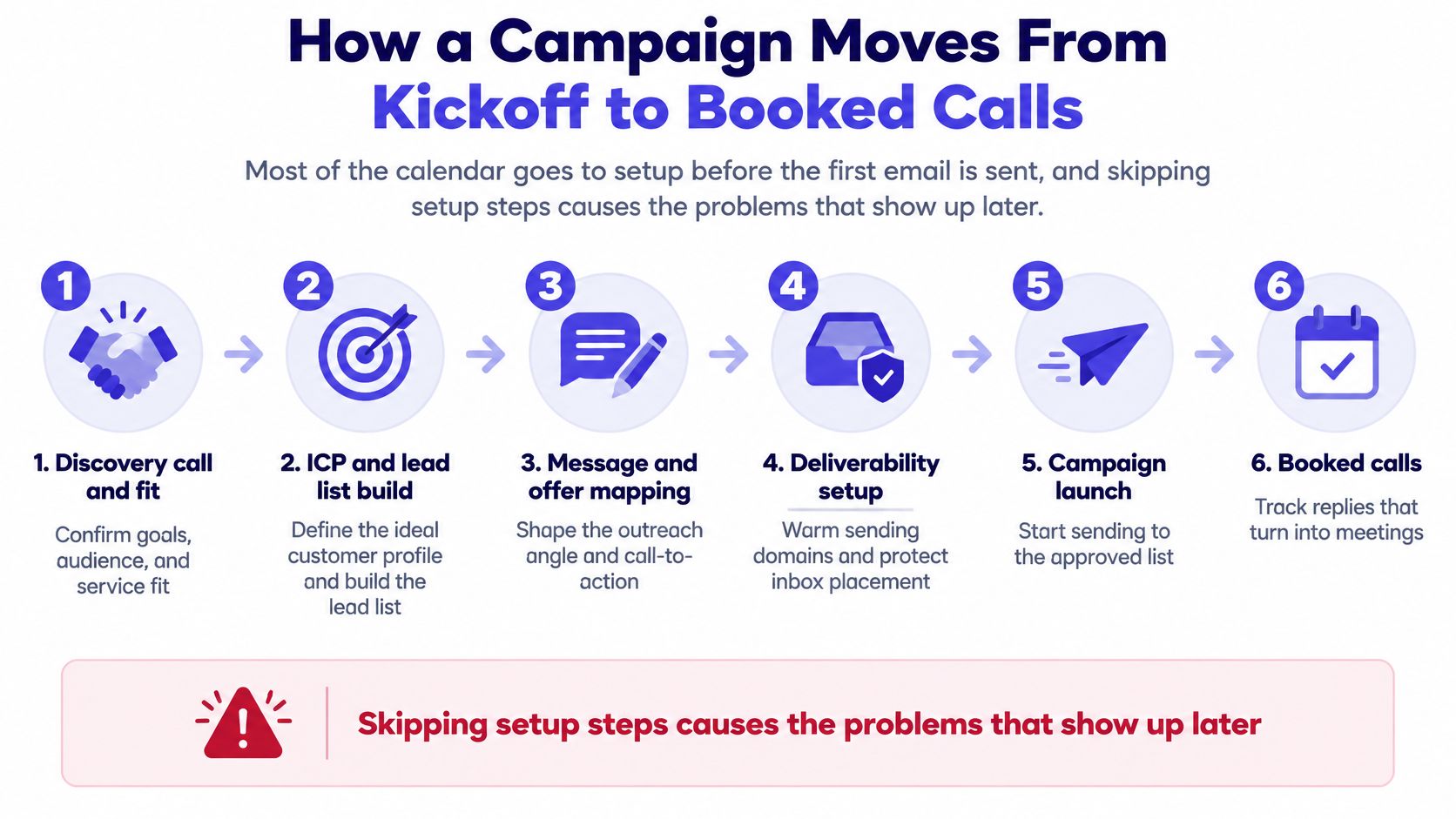
A campaign can be technically ready to launch while its audience, qualification rules, or reply process still need work. The setup period establishes the operating system; the sequence that follows determines whether booked calls become accepted pipeline.
One managed option is IronPeak Marketing, which provides cold email outreach, prospect data collection, dedicated email infrastructure, and lead handoff. Its setup includes custom domains, dedicated inboxes, copy, enrichment, and tracking in under 15 days. After setup, leads flow automatically while the agency manages inboxes and follow-ups.
The Launch Sequence
Discovery call and fit assessment. Review the offer, target market, deal economics, sales cycle, and capacity to take calls. If the offer does not fit cold email or the team cannot handle new conversations, outreach is unlikely to produce useful pipeline.
Written qualification schema. Define account fit, contact role, buying signals, exclusions, and the evidence required for acceptance before building the list. Otherwise, the agency and sales team may classify the same conversation differently.
Infrastructure build. Set up sending domains separate from the primary company domain, dedicated mailboxes, SPF, DKIM, DMARC, and tracking. Begin warming alongside setup, with clear ownership for monitoring and remediation.
Prospect sourcing and enrichment. Build the approved segment, remove duplicates, apply suppression lists, and check contact details before sending. This keeps existing customers, invalid addresses, and excluded accounts out of the sequence.
Copy for a specific offer and segment. State the problem, why the prospect is being contacted, and a reasonable next step. Test meaningful variations; broad messaging makes it harder to identify whether the audience, offer, or wording needs work.
Controlled ramp-up. Begin with low daily activity per mailbox and increase only while delivery signals remain healthy. A volume target alone provides no evidence that the infrastructure or data can support more sending.
Daily reply handling and follow-up. Sort positive responses, objections, referrals, absences, and opt-outs, and record rejection reasons consistently. Human review helps prevent follow-ups after a refusal and catches referrals to the relevant buyer.
CRM handoff and weekly acceptance review. Transfer each conversation with its qualification evidence, then compare accepted leads with the written schema. The measure of progress is accepted pipeline, not reply volume.
Warming Builds Readiness, Not Guaranteed Placement
Warming supports gradual, legitimate mailbox use. It does not guarantee inbox placement: a mailbox can pass technical checks and still reach spam if recipients do not welcome the message.
Launch rule: Increase activity only while the audience and infrastructure support it. The setup timeline is a readiness target, not a reason to send at unrestricted volume.
Assign someone to respond when the usual operator is unavailable. An interested reply left unattended can stall before a call is booked.
Deliverability Limits That Decide Whether Email Lands
A campaign can generate replies and still fail if the messages reach spam or the sales team rejects the leads. Judge performance by accepted pipeline and sending reputation, not reply volume alone. The lead definition sets what counts as a result; authentication, recipient reaction, and suppression handling set the ceiling on sustainable sending.
Sending Thresholds and Compliance Rules for Outbound Email
Google's email sender guidelines require SPF or DKIM for Gmail-bound senders. Senders delivering 5,000 or more messages per day to Gmail accounts must use SPF, DKIM, and DMARC. Google recommends keeping the user-reported spam rate below 0.1% and avoiding 0.3% or higher. Unsubscribes should be processed within two days.
| Control | Threshold or rule | Source | Operating action |
|---|---|---|---|
| Bulk sender volume to Gmail | 5,000 or more messages per day | Google email sender guidelines | Implement SPF, DKIM, and DMARC |
| Gmail sender authentication | SPF or DKIM required | Google email sender guidelines | Authenticate every sending domain before the first send |
| User-reported spam rate target | Keep below 0.1% | Google email sender guidelines | Reduce volume as the trend approaches 0.1% |
| User-reported spam rate ceiling | 0.3% or higher | Google email sender guidelines | Treat rising spam-folder placement and rejection as delivery risks |
| High-volume senders to Outlook | More than 5,000 messages per day | Microsoft sender requirements | Pass SPF and DKIM, and publish DMARC at p=none or stricter with alignment |
| Opt-out handling for US recipients | Honor within 10 business days; opt-out works for at least 30 days after send | FTC CAN-SPAM compliance guide | Suppress the contact in every active sequence |
| Unsubscribe processing time | Within two days | Google email sender guidelines | Automate suppression across all sequences |
The FTC's CAN-SPAM compliance guide requires US commercial-email opt-outs to be honored within 10 business days, with the opt-out mechanism working for at least 30 days after sending. It also prohibits misleading headers and deceptive subject lines, and requires a valid physical postal address, a clear opt-out, and advertising identification where applicable.
The legal deadline and the mailbox provider's deadline differ. Set suppression rules to meet the stricter applicable requirement, rather than waiting for the longest permitted interval.
Domain Separation Limits Exposure, Not Responsibility
Separate sending domains and mailboxes reduce direct exposure of the primary company domain to campaign problems. They do not isolate the sender's reputation completely. Recipients still recognize the company, and confusing domain choices can undermine trust.
Use infrastructure with transparent ownership, a recognizable sender identity, and a documented recovery process. Replacing a damaged domain without correcting the audience or sequence repeats the same failure on different infrastructure.
Monitor three areas:
- Domain-level health: Authentication alignment, available reputation reporting, delivery errors, and complaint trends.
- Mailbox activity: Bounces, replies, changes in sending activity, and available complaint signals. Providers do not all expose mailbox-level complaint data.
- Suppression performance: Time from opt-out to removal across active campaigns, pending follow-ups, and future imports.
Google's bulk commercial-email rules also require one-click unsubscribe. Build that mechanism into the campaign infrastructure, then verify that it updates suppression across sequences.
Before approving a campaign, identify who monitors reputation reporting, what action follows a rising complaint trend, and how unsubscribes sync across systems. Check that the sending template displays the required postal address and a clear opt-out.
Where Prospect Data Comes From and Why It Goes Stale
A prospect list is a dated view of a changing market. Contacts change jobs, businesses close, companies secure funding, and new registrations create accounts that an older database may not contain.
The US Census Bureau's Business Formation Statistics reported 420,802 seasonally adjusted business applications in July 2024 and 28,834 projected business formations within four quarters in December 2024, seasonally adjusted. These measures concern applications and projected employer formations, not confirmed buyers for a particular service.
They support a refresh process, not an assumption that every newly registered entity belongs in a campaign.
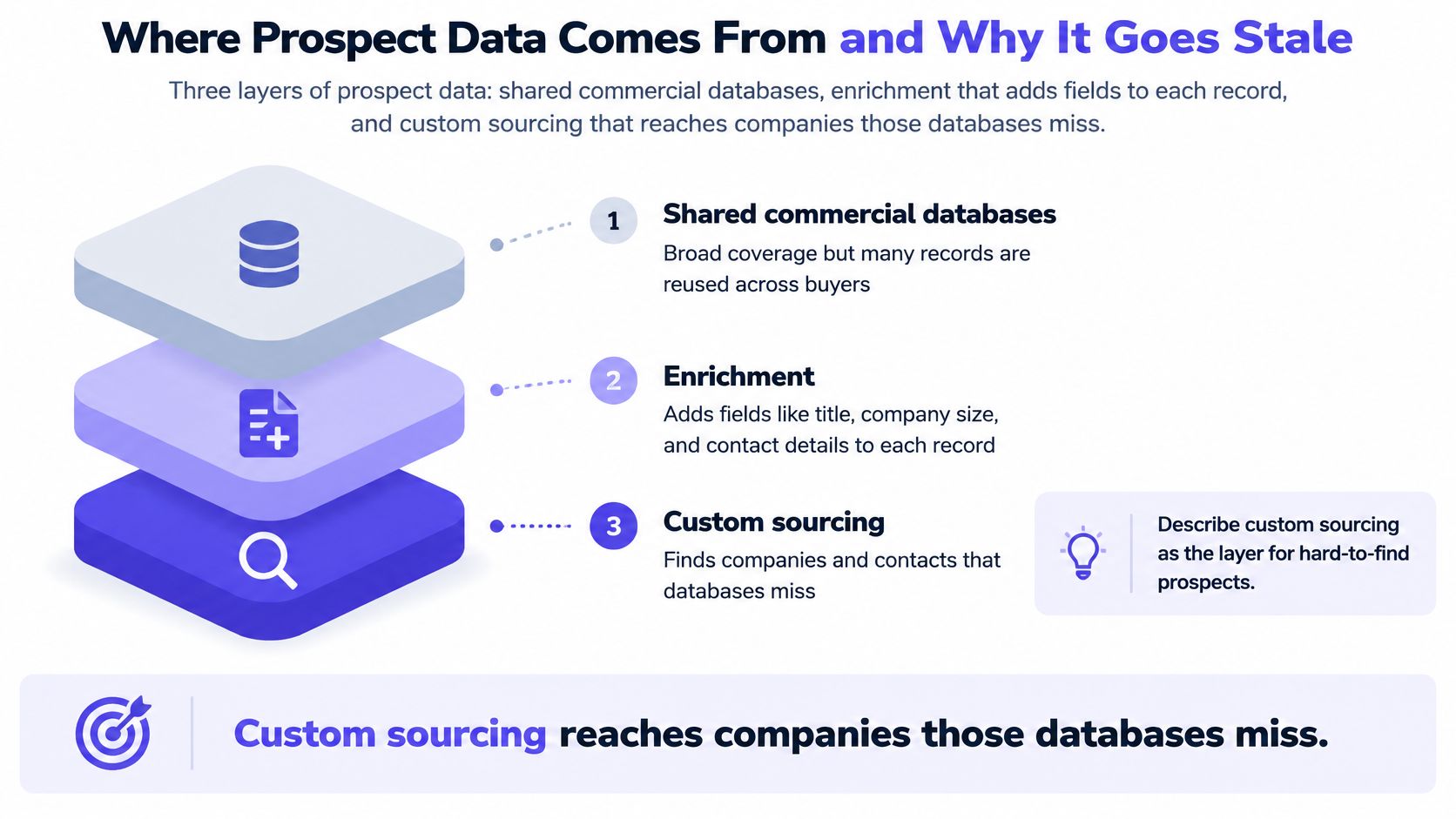
The Layers Serve Different Purposes
Shared commercial databases provide broad account and contact coverage. Their weakness is overlap: other senders may be buying access to the same records, and the available fields may not explain why the account needs the offer.
Enrichment adds decision-useful information. A job title helps route a message, while hiring activity, company characteristics, or a relevant operational change can help establish fit. A verified address doesn't prove that the person has purchasing authority.
Custom sourcing finds accounts outside the usual filters. It can combine API access, public company information, and AI-assisted research, provided collection respects applicable restrictions and each important field retains supporting evidence.
IronPeak Marketing uses custom API keys and AI agents to scrape data and reach prospects who don't receive cold emails. That sourcing approach still requires record-level validation; an agent-generated summary isn't sufficient evidence of a buying need.
What a Usable Record Must Retain
A reliable lead generation list should support inspection rather than require trust in a database label.
- Record origin: The source that supports the account, contact, and targeting signal.
- Enrichment timestamp: When the role, company details, and relevant trigger were checked.
- Suppression status: Whether the record matches previous contacts, current customers, open opportunities, or opt-outs.
- Verification coverage: The share of proposed recipients checked before sending, with risky or uncertain addresses identified separately.
- Refresh cadence: When stale records are rechecked and which changes trigger immediate removal.
Custom sourcing costs more effort than exporting a familiar filter. It earns that effort when it finds relevant accounts, not merely addresses that another database missed.
Defining a Qualified Lead Before You Pay for One
A general lead has a plausible chance of becoming a customer. A qualified opportunity requires stronger validation, including purchasing authority and budget, as HubSpot's explanation of lead-to-opportunity criteria distinguishes.
The contract should specify which stage the agency sells. Requiring confirmed budget at initial contact may reduce volume and exclude viable early conversations, but billing those conversations as sales-ready opportunities creates a different problem.
Write the schema before prospecting starts. A definition written after replies arrive is too easy to reshape around whatever the campaign produced.
Schema Fields for a Qualified Lead
| Field | Failure it prevents | Example (illustrative) |
|---|---|---|
| Company and industry fit | Poor-fit accounts reach the calendar | Software company selling to logistics operators |
| Geography | Out-of-market prospects | Headquarters in the client's served countries |
| Employee or revenue band | Accounts too small or too large for the contract | 50 to 500 employees |
| Decision-maker role | Contacts with no buying authority | VP of Sales or Head of Revenue Operations |
| Relevant pain | Messaging that doesn't match the problem | Hiring sales development reps to fix manual CRM work |
| Buying timeframe | Conversations that cannot progress this quarter | Budget decision within 6 months |
| Budget signal | Interest with no funding behind it | Approved budget line or recent funding round |
| Explicit next step | Replies that never become a meeting | Prospect agrees to a 20 minute call |
These examples aren't universal acceptance criteria. A funding round is a budget signal, not proof that funding is allocated to the proposed purchase. Similarly, a hiring signal needs follow-up before anyone treats it as evidence of a specific operational problem.
Good prospect research separates observed evidence from assumptions that still require a conversation.
A Worked Acceptance Funnel
Consider a hypothetical campaign with 100 replies, 40 marked interested, 18 passing the schema, and 11 accepted by the client after review. Those are illustrative counts, not an expected performance benchmark.
The difference between the interested replies and accepted leads is where qualification earns its cost. Some contacts may want information without matching the account criteria; others may lack authority or reject the proposed next step.
For that same hypothetical funnel:
| Cost measure | Calculation |
|---|---|
| Cost per interested reply | Total monthly campaign fee ÷ 40 |
| Effective cost per accepted lead | Total monthly campaign fee ÷ 11 |
| Contract comparison | Compare the accepted-lead calculation with the contracted per-lead price |
No monetary fee is assumed. The actual invoice should include applicable setup, data, infrastructure, and delivery charges so the comparison reflects total spend rather than the advertised unit price.
An interested reply is evidence to inspect, not an invoiceable outcome by default.
Every rejection should carry a standardized reason code. Every acceptance should retain its source, enrichment timestamp, campaign variant, conversation transcript, and handoff status, so the next targeting decision follows evidence rather than a disagreement over labels.
Vetting Checklist for Choosing an Agency
A proposal can show high reply volume while producing little accepted pipeline, or book calls while damaging the sender reputation needed to keep campaigns running. Evaluate providers on both outcomes. A gap in lead definition, deliverability ownership, or reporting should be resolved in writing before you proceed.
A low price per lead offers little value if refusals count as engagement or delivery problems remain hidden. Retainers can also work, provided the agreement defines how performance will be assessed.
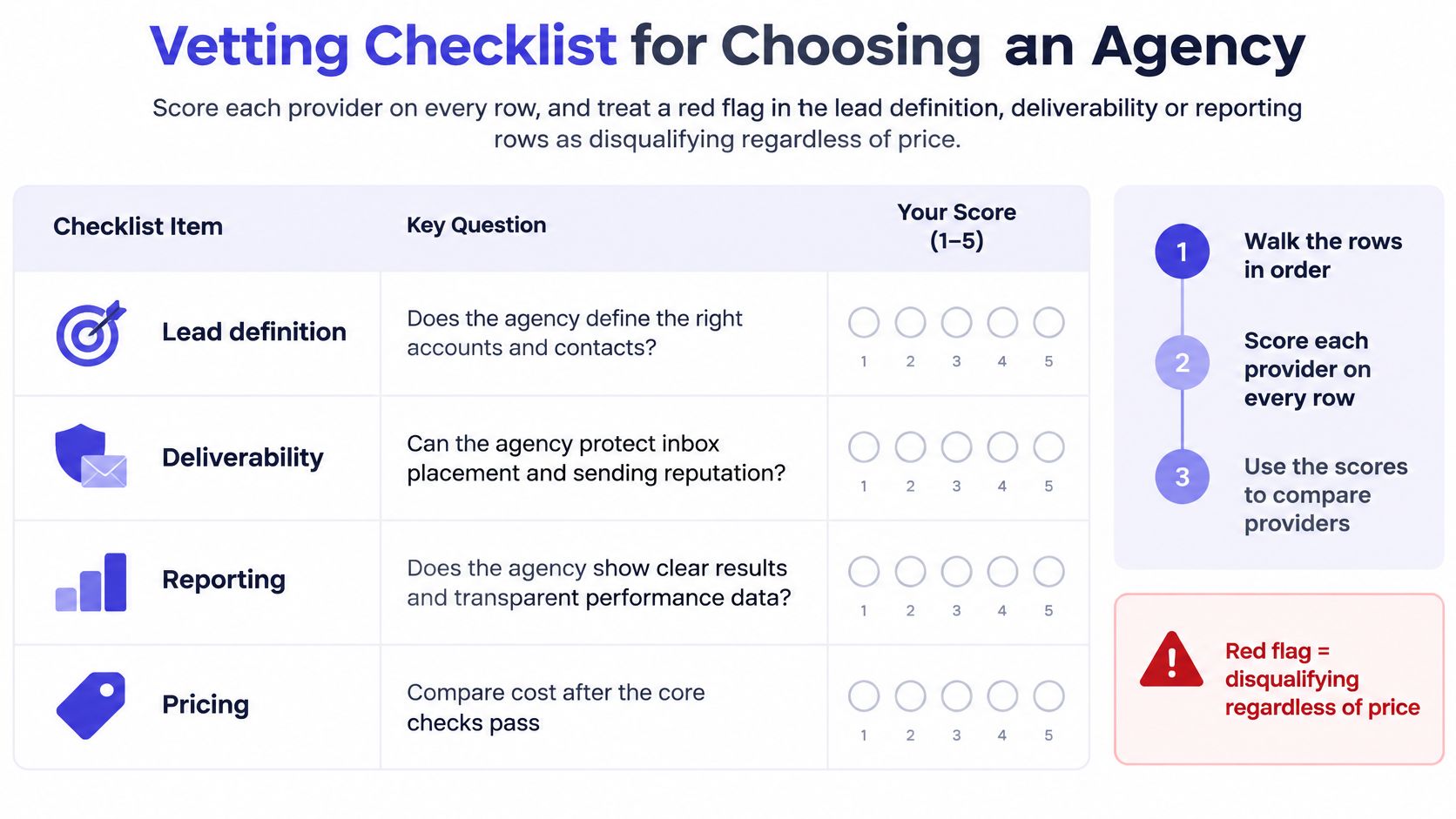
Agency Evaluation Criteria With Strong Answers and Red Flags
| Criterion | Strong answer | Red flag |
|---|---|---|
| Pricing basis | Payment tied to an accepted lead, with the definition in writing | Fixed retainer with no acceptance rules |
| Lead definition | Written schema and reason codes for every rejection | Any reply or booked meeting counts |
| Deliverability ownership | Dedicated domains and mailboxes, a named owner, complaint monitoring | One shared sending domain for all clients |
| Data sources | Named sources, enrichment timestamps, suppression lists | Proprietary database claims with no source detail |
| Reporting | Rejections, complaints, bounces, and pipeline by segment | Only volume and meetings booked |
| Contract terms | Cancellation terms stated in writing | Long lock-in with setup fees and no exit terms |
| Compliance | Opt-out in every email, physical address, unsubscribe sync | Unsubscribes handled by hand from a spreadsheet |
| CRM handoff | Lead records in the client CRM with source fields | Leads delivered as a spreadsheet attachment |
Classify pricing by the billed event before comparing providers. Check whether payment is due for a reply, a booked meeting, or a lead that meets agreed acceptance criteria.
Verify the Operation Behind the Proposal
Review the deliverability controls against the guidance in the previous section. Ask who monitors sending health, what evidence they review, and what action follows a warning. Authentication records alone do not show whether a campaign is being monitored or managed responsibly.
One provider's published terms illustrate a pay-per-result model: clients pay per qualified lead rather than a fixed retainer, and can reject leads that do not meet their standards. Its public offer also describes month-to-month engagements and a free discovery call with no credit card or commitment required. Confirm the acceptance criteria and rejection process in the agreement before relying on the advertised target of 60–90 qualified leads in 45 days. Co-founder Charlie Bennett handles operations, the tech stack, deliverability, data enrichment, and the systems that keep leads flowing into clients' calendars.
Treat testimonials as self-reported evidence. Ask for a relevant reference who can discuss lead acceptance and reporting, not only the number of meetings booked.
A redacted sample of rejected records can show whether the provider applies its schema consistently. Match each record to its supporting conversation and stated rejection reason, then check how the contract treats it for billing. If the provider cannot explain why a lead failed the agreed criteria, the reporting is not ready for performance-based billing.
Run a Pilot With Rejection Rules Written Down
A pilot should have a fixed evaluation window, a specific offer, and a tightly defined segment. Expanding several audiences at launch makes it harder to identify whether poor acceptance comes from account selection, messaging, or the offer itself.
The headline offer of 60 to 90 qualified leads in 45 days on a pay-per-result basis is a commercial target, not a forecast for every campaign. The pilot agreement should distinguish infrastructure deployment, active sending, and the period during which delivered leads can be reviewed.
The Written Pilot Agreement
Before launch, document the following:
- Acceptance schema: Required fields, evidence standards, exclusions, rejection reasons, and the client's review process.
- Primary metric: Accepted leads and qualified booked calls, with attendance and opportunity creation tracked separately rather than replaced by reply totals.
- Negative indicators: Bounce rate, available complaint signals by domain and mailbox, unsubscribe volume, rejection reasons, and revenue by segment.
- Pause rules: The conditions that stop a mailbox or segment, the person authorized to trigger the stop, and the evidence required before restarting.
A practical pause rule should intervene when complaints trend toward the provider's recommended limit, rather than waiting for a hard failure. Where mailbox-level complaint reporting isn't available, the operator should combine domain reporting with replies, opt-outs, bounces, and provider delivery errors instead of inventing precision.
The client should have authority to stop activity that threatens reputation. Payment incentives must not override that authority.
Attribute Influence Without Claiming Certainty
Buyers can encounter an outbound message and later research the company through an AI assistant without clicking the email. G2's AI search insight report reports that 71% of B2B software buyers use AI chatbots somewhere in software research. That finding concerns software buyers, not every service-business audience.
The practical response is broader observation, not automatic attribution. Track branded search, direct visits, account-level campaign exposure, and a CRM field recording how prospects heard about the company.
A later direct visit doesn't prove that outbound caused the opportunity. It can, however, explain why click totals alone don't describe the campaign's influence.
Signing condition: A month-to-month pilot is defensible only when rejection rights, pause authority, and reporting requirements are written down.
Reported results from another campaign shouldn't become the operating forecast. Continue only when the client accepts the pipeline, the economics support the spend, and the operator can preserve healthy sending conditions.
IronPeak Marketing offers managed cold email prospecting, dedicated sending infrastructure, and qualified pay-per-lead delivery. Visit IronPeak Marketing to book a free discovery call and assess the offer, target market, and qualification standards before agreeing to a pilot.