Lead Generation for SaaS: Plan the Pipeline
Lead generation for SaaS starts with funnel math, target accounts, inbox placement, and a qualification rule you can audit.
A median SaaS lead doesn't turn into a customer very often. The Strategnik B2B GTM metrics benchmark puts lead-to-customer conversion at only 2% to 3% at the median, with top-quartile companies above 5%. That single range changes how lead generation for SaaS should be planned. Raw contacts aren't the asset. An authenticated sending system and a written acceptance rule are the asset, because they decide how many of those contacts ever become meetings sales will work.
That framing matters for founders with defined offers and high lifetime value. A channel list hides the math. A staged funnel exposes it, account by account, domain by domain, and reply by reply.
SaaS Funnel Rates You Can Plan Against
At a 1.5% to 2.5% visitor-to-lead median, most traffic never becomes a contact, and every later stage shrinks the pool again. The Strategnik B2B GTM metrics benchmark publishes median rates for each stage, which gives a founder a planning baseline before any sending domain exists.
| Stage | Median rate | What it means for planning |
|---|---|---|
| Visitor to lead | 1.5% to 2.5% | A heavy traffic month still produces a thin contact pool |
| Lead to MQL | 25% to 35% | Fit filters remove most form fills and replies |
| MQL to SQL | 15% to 21% | Sales accepts only a minority of marketing leads |
| SQL to opportunity | 40% to 60% | A real deal still depends on timing and need |
| Opportunity to close | 15% to 25% | Late-stage deals still die on timing and budget |
| Lead to customer | 2% to 3% median, top quartile above 5% | Raw lead counts overstate customers |
| Referral, opportunity to close | 35% to 40% | Warm introductions close more often |
| Outbound or cold, opportunity to close | 10% to 15% | Cold needs more accepted meetings per deal |
Working backward from customers
Say a founder wants a set number of new customers in a quarter. The funnel sets the required opportunities first, then the required sales-qualified leads, then the accepted meetings that must feed them. If sales can't work that meeting volume, buying more contacts creates a queue, slower follow-up, and weaker conversion at every later stage.
The close-rate split by source sharpens that decision. Referral opportunities close far more often than cold opportunities, so outbound needs more accepted meetings to produce the same customer. Outbound still earns its budget, provided the effort is priced against cold close rates rather than warm ones.
Planning rule: Treat these bands as a baseline for volume, staffing, and qualification. Any single campaign can land outside them.
Four fields before credit
Volume math means little without a written acceptance rule. A lead shouldn't be credited, celebrated, or billed until four fields are true, and each field needs a plain pass or fail answer that a person handling replies can check without guessing.
- Company profile: The account matches the industry, size, and geography the offer serves.
- Buyer role: The contact owns, influences, or directly uses the budget area tied to the offer.
- Business need: The prospect has the problem the product solves, now or in a stated window.
- Meeting readiness: The prospect agrees to a sales conversation with a named next step.
A failed field can still justify a nurture track. It cannot justify calling the record qualified. That distinction protects the forecast and stops a large prospect pool from looking productive while it shrinks to almost nothing under real sales standards.
The last check is capacity.
Founders can sketch required volume from that table in minutes. Start with target customers, divide through the close and opportunity rates, then check whether sales has calendar space for the resulting meetings. If the calendar fails, reduce the target or tighten the segment. The domain purchase is the cheap part; the reputation behind it takes weeks of warming to build and one bad list to burn.
Target Accounts Worth a Sending Domain
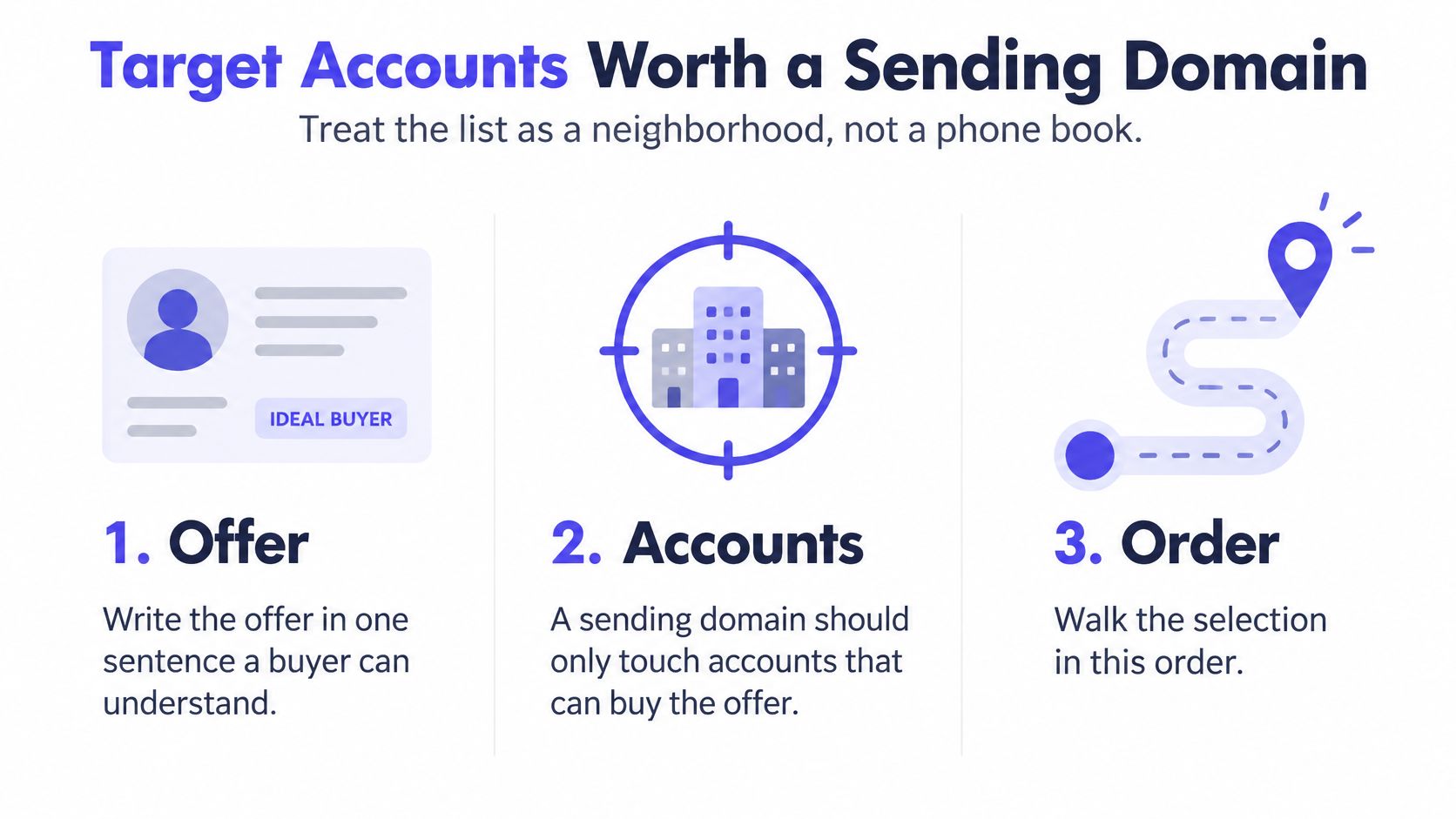
A sending domain has a reputation to lose. It should only touch accounts that can buy the offer, recognize the problem, and justify the price. A large list feels safe because it's large. In practice, weak fit produces ignores, deletes, and complaints, and complaints follow the domain into the next campaign.
Selection in order
- Write the offer in one sentence. A buyer should recognize the outcome, the buyer type, and the problem without a deck. If the sentence needs three clauses and a caveat, the segment will inherit that confusion.
- Set firmographic bounds. Define employee band, industry, and geography, then name who is out. Exclusions matter as much as inclusions because they stop enrichment from filling the list with near misses.
- Add a technology or operating signal. The stack, hiring pattern, service motion, or another observable trigger should show the problem can exist. A company without the operating context is a name, not a prospect.
- Name the buyer role. List the titles that own the pain and the titles that don't. Assistants, unrelated managers, and generic inboxes waste sends and distort reply data.
- Add timing and disqualifiers. Remove accounts with no budget owner, the wrong use case, a locked-in vendor, or a size that can't support the price. Disqualifiers belong in the build, not in a cleanup pass after launch.
Enrichment that removes rows
Enrichment isn't decoration. It fills missing fields through scraping, custom APIs, and records outside shared databases, then drops rows that fail a required field. A record without a verified role, a usable address, or the required signal shouldn't advance because the sequence has space.
That discipline is the difference between a researched lead generation list built for a specific offer and a purchased export. Buying a giant list and filtering later reverses the work. The sender pays for bad rows twice, first in data cost and then in domain reputation when the wrong people complain.
Treat the list as a neighborhood, not a phone book. Every address on it should have a reason to receive the message.
Ten-row test before warming
Before infrastructure is warmed, pull ten sample rows and apply the accept or reject test by hand. Check the company, role, signal, and disqualifiers exactly as sales will check them after a positive reply. If three of ten wouldn't merit a sales call, the segment isn't ready.
That small test catches vague offers and loose filters while they're cheap to fix. Rewrite the sentence, tighten the bounds, or change the signal, then sample again. A domain should be spent on a segment that already passed on paper.
Acquisition Channels and What They Return
A blended cost per lead hides what separates channels: the starting condition each motion assumes. Widelly's SaaS Marketing Benchmark Report 2025 reports a 3.2% median cold outbound-email reply rate for B2B SaaS in 2025, against a 14.8% median reply rate for warm or trigger-based emails. The gap comes mainly from the starting relationship, not the copy.
Cold email also spends something other channels never touch: domain reputation. Its real invoice arrives as dedicated domains, warming time, and list maintenance, so the reply rate only makes sense next to what the infrastructure costs to run.
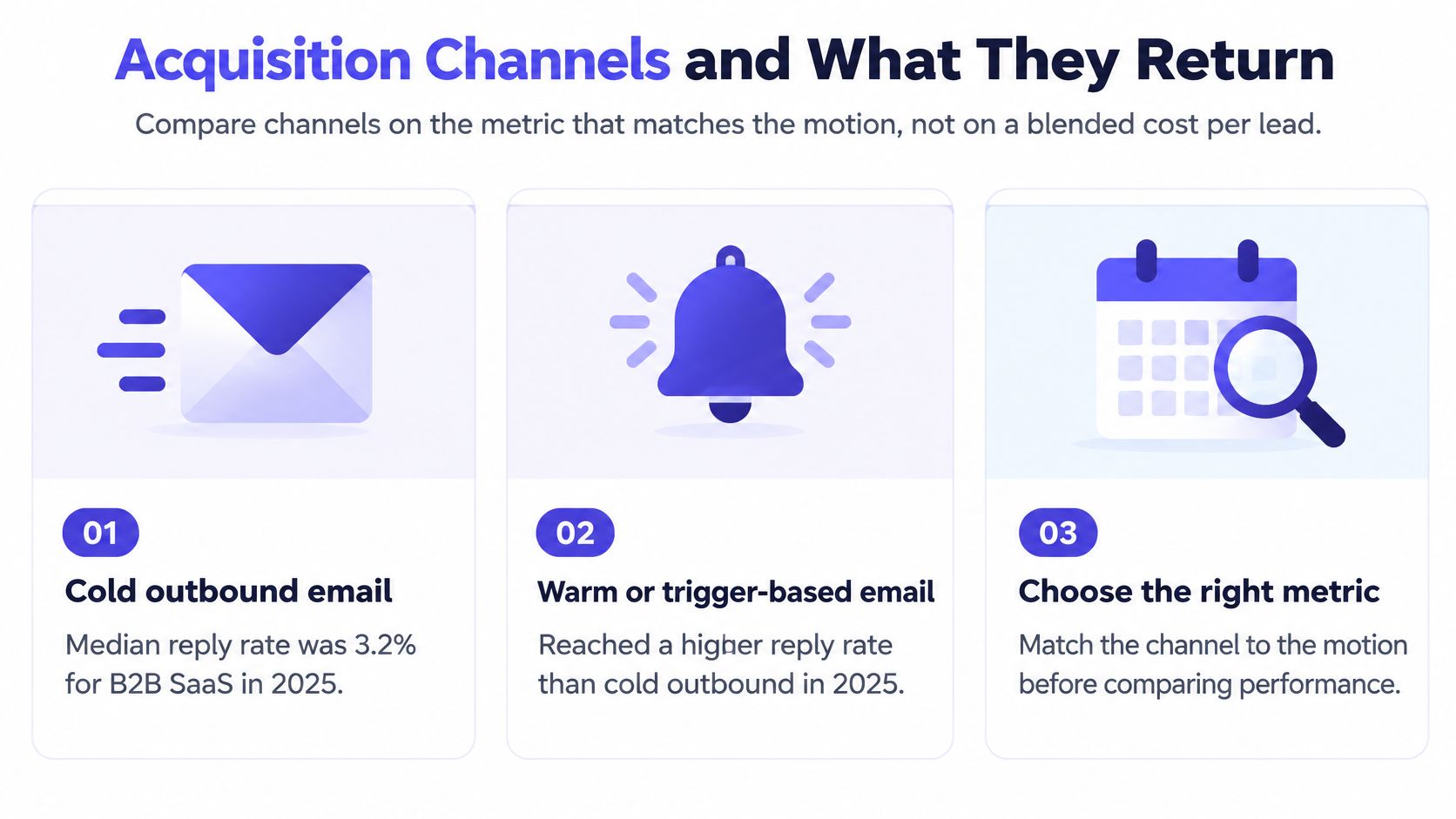
| Channel | Metric | Reported rate | Use it when |
|---|---|---|---|
| Cold outbound email | Median reply rate, 2025 SaaS | 3.2% | Offer, buyer, and sales capacity are already defined |
| Warm or trigger email | Median reply rate, 2025 | 14.8% | A real trigger or prior relationship exists |
| SaaS and technology email overall | Open, click, conversion | 32% open, 2.8% click, 1.8% conversion | Recipients already opted in to the sender |
| Referral | Opportunity to close | Strong close rates, lumpy volume | Customers will make introductions |
Matching channel to condition
Cold email fits when the offer is defined, lifetime value can pay for a low reply rate, and sales will work accepted meetings quickly. The sender chooses the accounts, the timing, and the written acceptance rule every contact has to pass. The price is weaker close rates than referrals and a sending domain that has to be protected. I treat it as a control channel first and a volume channel second.
Warm or trigger email fits when a real event exists: a role change, a stack signal, or a prior conversation that stalled. A manufactured trigger reads as cold mail to the recipient, and the reply data shows it quickly.
Referrals fit when customers will introduce peers with the same problem. They convert well and arrive in lumps, so they support a pipeline without letting a founder set a weekly meeting target. Paid inbound sits in a separate budget with its own creative, landing page, and conversion math. Judging it with cold reply rates produces a false winner.
The Sona figures in the nurture row describe broader email programs where recipients already gave permission, so they shouldn't set a cold campaign forecast. A nurture list holds permission that a cold sequence has to earn from strangers.
The operational distinction between lead generation and prospecting as separate motions matters most at this decision point. Skip cold outbound when the offer is still fuzzy, the buyer can't be named, or nobody will take the calls. Pick one primary channel and one supporting channel; running five spreads list building, copy, and reply handling so thin that no channel produces clean evidence. The channel can change. The acceptance rule each account passes before entering a sequence should stay fixed.
Inbox Placement Before the First Sequence
Outbound at this stage means authenticated sending governed by written limits. The records that prove a domain's identity and the complaint thresholds that define when to pause both get decided before the first sequence sends, because a strong first line cannot rescue mail that fails alignment or lands in Junk. Build the sending system, prove it with test messages, then argue about subject lines.
Authentication in build order
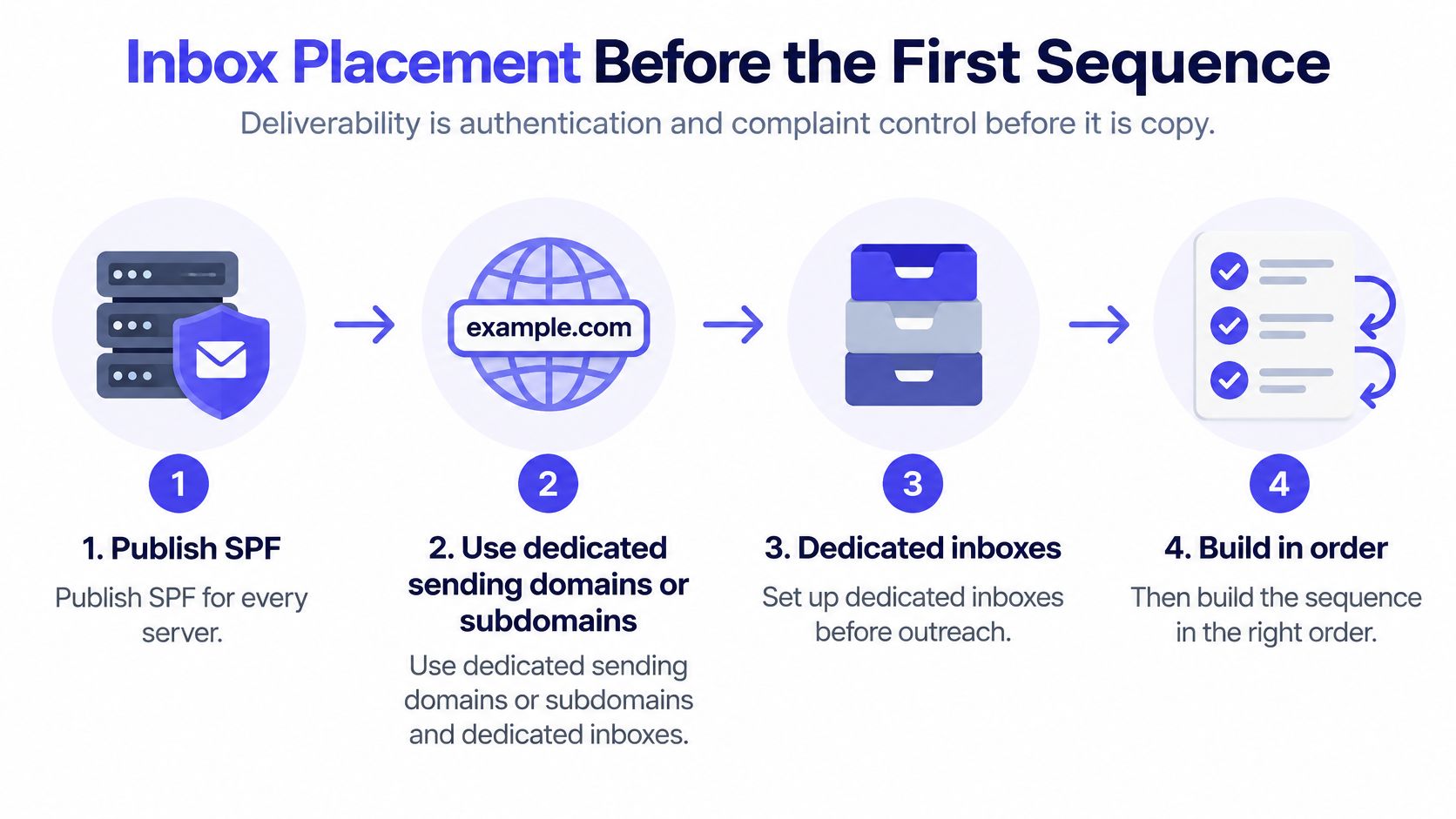
Use dedicated sending domains or subdomains and dedicated inboxes so campaign reputation stays separate from the primary corporate domain. Build in a fixed order.
- Publish SPF for every authorized provider. The record must cover each server allowed to send for that domain, with no orphaned sending path.
- Enable DKIM signing. Every message needs a valid cryptographic signature tied to the sending domain.
- Publish DMARC with reporting. Confirm alignment with the visible From domain before scaling, then read the reports instead of assuming the records work.
Google's sender guidance requires senders to publish SPF or DKIM, and DMARC evaluates whether authenticated mail aligns with the domain shown in the visible From header. That creates a trap: SPF or DKIM can pass on its own domain while DMARC alignment fails because the envelope sender or signing domain doesn't match the From domain. Google recommends aligning DMARC with both SPF and DKIM, even though one aligned mechanism can meet the basic requirement.
Infrastructure checks cover DNS-record validation, test messages to major mailbox providers, bounce monitoring, complaint suppression, and gradual volume increases. Warming can't compensate for malformed authentication. A warmed domain with bad alignment is still a misaligned domain, just one with more history.
Complaint thresholds are operating limits
Google's Gmail sender rules advise bulk senders to keep the user-reported spam rate below 0.1% and prevent it from reaching 0.3% or higher. Once the spam rate exceeds 0.3%, delivery support and mitigation options are unavailable. Gmail calculates the rate daily, and bulk senders can become eligible for mitigation after keeping spam rates below 0.3% for seven consecutive days.
Applied to 10,000 messages in a day, that ceiling means 30 recipients reported the mail as spam. The operating target sits under 10 reports at that volume, with a hard stop before 30. List quality, suppression handling, accurate targeting, and fast reply management decide inbox placement on the day mail sends.
| Control | Threshold | Source | If you miss it |
|---|---|---|---|
| Gmail spam-rate target | Below 0.1% | Google's Gmail sender rules | Reputation erodes before a hard block |
| Gmail spam-rate ceiling | 0.3% or higher | Google's Gmail sender rules | Mitigation support is unavailable |
| Complaints on 10,000 sends | 30 reports equals 0.3%, stay under 10 | Arithmetic on the Gmail ceiling | A bad list becomes a domain problem the same day |
| Outlook volume | More than 5,000 messages a day per domain | Microsoft's high-volume sender requirements | SPF, DKIM, and DMARC are required or mail hits Junk |
| Inbox math | 25 inboxes times 200 sends | Arithmetic on the Outlook threshold | Domain total is already 5,000 |
| CAN-SPAM opt-out | Link works 30 days, honor within 10 business days | FTC CAN-SPAM compliance guide | Queued follow-ups must be suppressed too |
Domain volume and opt-outs
Microsoft's high-volume sender requirements state that domains sending more than 5,000 messages per day to Outlook recipients need SPF, DKIM, and DMARC compliance. The threshold applies at the domain level, so splitting sends across 25 inboxes at 200 messages each still produces 5,000 messages from one domain. Track volume per domain and verify every sending path before ramp-up.
The FTC CAN-SPAM compliance guide requires that From, To, Reply-To, and routing information accurately identify the sender, and subject lines must reflect actual content. The opt-out mechanism must process requests for at least 30 days after sending, and requests must be honored within 10 business days. That means removing the person from queued follow-ups and future campaigns, since an unsubscribe link without a working suppression process fails the operational test.
Warm new domains in steps, watch bounces and complaints daily, and pause a segment that draws reports before it damages the rest. Treat suppression as a placement control: every removed address protects the remaining inboxes on the domain.
Qualification Rules That Protect the Pipeline
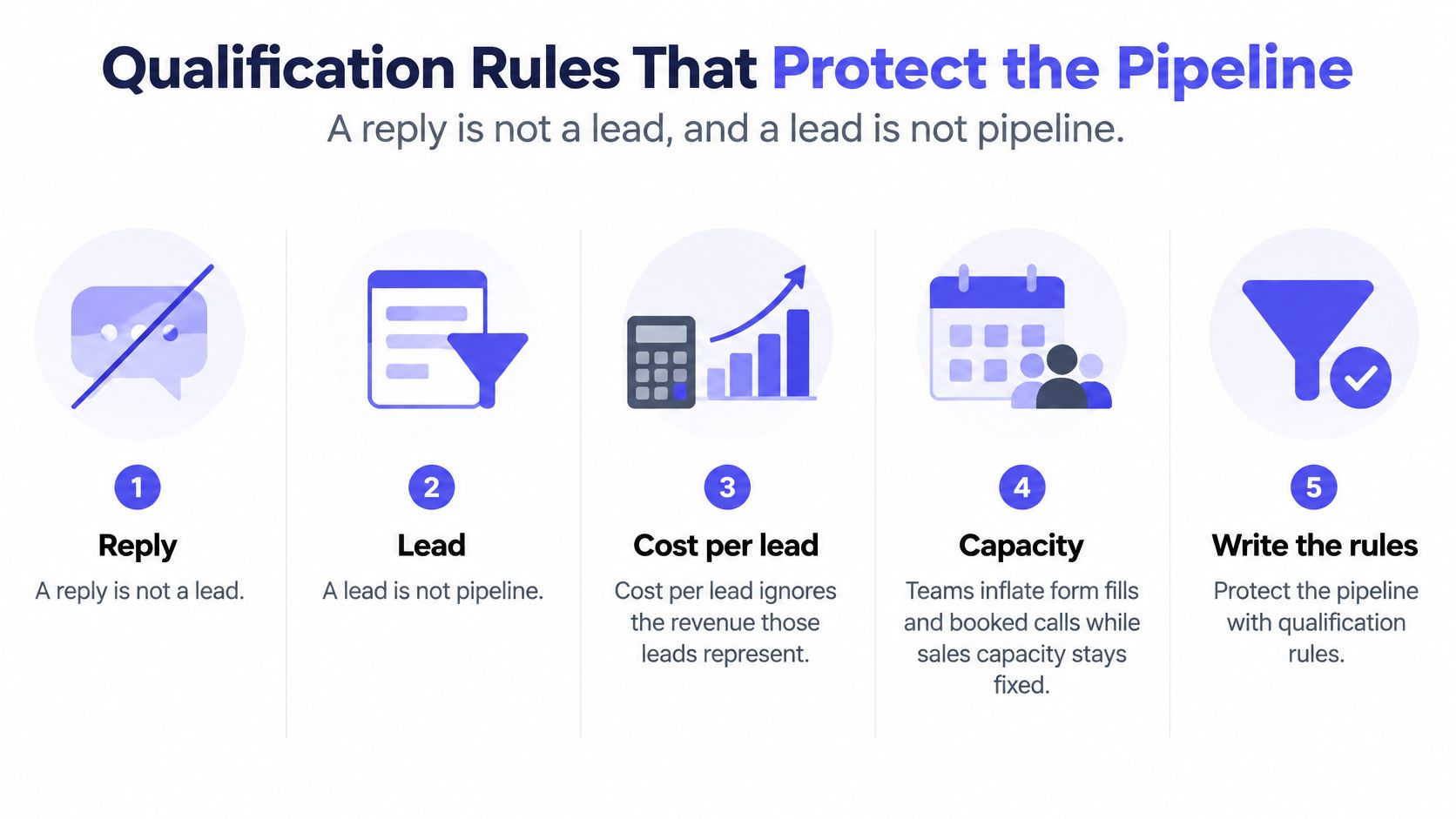
Authentication gets a message into the inbox. A written acceptance rule decides which replies get into the CRM. Treat that rule as part of the sending system: if a contact fails it, the contact never enters the pool, regardless of how clean the domain, how warm the inbox, or how strong the reply rate looks. The First Page Sage SaaS benchmarks report notes that cost per lead does not account for the revenue represented by those leads. That gap shows up in the calendar when form fills and booked calls rise while sales capacity stays fixed.
Write the schema before launch
Qualification cannot depend on whoever opens the inbox that day. Write the fields, the evidence required, and the rejection path before the first sequence sends.
The acceptance rule has four fields: company fit, role authority, active need, and meeting readiness. Company fit and active need come from the account and the signal. Role authority comes from the contact record. Meeting readiness comes from the reply itself.
The six-field evidence schema makes each of those testable:
- Employee band: The company is large enough to buy and use the product, and not so large that procurement makes the motion unworkable.
- Stack or use case: The account has the tools, process, or operating condition the offer improves.
- Authority: The contact can own the problem, bring in the owner, or directly evaluate the purchase.
- Problem urgency: The need is active, scheduled, or tied to a dated trigger.
- Buying timeframe: The prospect gives a window that sales can plan against.
- Explicit disqualifiers: Wrong geography, wrong segment, current customer, competitor, or a use case the product does not serve.
A buyer who has not requested a demo can still qualify when those fields are true and they will take a meeting. A buyer who replies after reading third-party proof or talking with peers still passes through the same rule. That consistency is what makes proper prospect research before outreach commercially useful. Research creates the fields to verify, and qualification decides whether the reply earned a handoff.
If company, role, need, or meeting readiness fails, the lead is not accepted. It should not be billed, counted, or handed to sales as pipeline.
Measure cohorts, not opens
Report each cohort forward in fixed columns. Start with delivered mail, then replies, positive replies, booked meetings, accepted qualified leads, opportunities, and closed revenue. Separating those stages shows whether a campaign failed at targeting, message fit, reply handling, or sales acceptance.
Opens don't answer any of those questions. Privacy features distort them, and a curious open from the wrong role has no pipeline value. Fewer accepted leads can outperform a larger lead count when calendar time and customer lifetime value are constrained, because sales spends hours on accounts that can close.
Attribution should follow an accepted opportunity. The first tracked click is a weak credit event. The practical credit question is simple: did the outreach influence a qualified buyer into an accepted sales process, and can the CRM show that path without inventing touchpoints?
The output should fit on one page. Hand that page to whoever runs the inbox, to sales, and to any outside sender. If all three cannot apply it the same way to the same reply, the rule is not written tightly enough.
A 10,000 Contact Campaign Worked in Stages
Consider a SaaS team with a pool of 10,000 contacts that already passed the account rules. Every row carries the required company profile, buyer role, signal, and a verified address, with each disqualifier removed before sending. That makes the pool earned through targeting and verification, so the campaign math starts from deliverable fit rather than volume.
The LeadSpot 2026 AI-driven demand generation benchmark report puts average B2B cold-email reply rates at 3.43%, down from 8.5% in 2019, with top performers above 10%, and reports lead-to-opportunity conversion of about 5.31% for specialized syndication versus 2.23% across general B2B programs, with leading performers near 9%. Use 3.43% as the reply-rate planning input, keep the 2019 figure out of the forecast, and apply the linked conversion band only after leads are accepted.
| Stage | Rate or input | Planning output |
|---|---|---|
| Delivered contacts | Targeted contacts that passed account rules | 10,000 |
| Replies | 3.43% average cold reply rate | About 343 |
| Positive replies | Example: 20% of replies, set from your inbox log | About 69 positives at that example share |
| Qualified accepted leads | Example: the share of 69 positives your written rule accepts | Positive replies times that pass rate |
| Opportunities | Linked benchmark band applied after acceptance | Accepted leads times the opportunity band |
What 343 replies really means
At 3.43%, 10,000 delivered contacts produce about 343 replies. Meetings come later, after reply handling removes automated responses, out-of-office messages, negative replies, unsubscribes, and people outside the offer. What remains is the working set that has to be sorted quickly and accurately.
The commercially useful unit is the qualified positive. The contact matches the firmographic criteria, has a relevant problem, and shows buying intent or agrees to a sales conversation. Everything before that point is activity. Everything after it can be handed to sales with evidence.
Campaign formula: Expected accepted leads equal delivered contacts times reply rate times positive-reply share times qualification rate.
Fill the blanks from the inbox
Positive-reply share and qualification rate have to come from the founder's own inbox and schema. No benchmark can know how many replies a specific offer will turn positive or how many positive replies will pass a specific rejection rule. A forecast with an example share is useful for sensitivity; a forecast with a borrowed market rate dressed as your own is not.
Once accepted leads exist, opportunity conversion still varies widely. The linked band shows why similar reply volume can yield very different pipeline when list quality, segmentation, offer relevance, and qualification rules change. A tighter account list can lift accepted-lead output even when raw replies stay flat, because fewer positives get rejected at handoff.
Stop the worked example at accepted leads and opportunity range. Closed revenue needs sales-cycle and win-rate inputs that a reply benchmark cannot supply. If an older plan still uses the 2019 reply expectation, cut expected replies first. Buying more data or adding inboxes to defend a stale rate only puts more domain reputation behind the same assumption.
Decide Whether Outbound Fits Your Offer
Outbound fits when four conditions hold at once. The offer is specific, the buyer can be named and listed, lifetime value can absorb a low reply rate, and someone will run the sales calls. It fails when the product changes every week, the segment keeps moving, or the calendar cannot take meetings. In that state, outbound produces replies the business cannot convert and calls that erode follow-up quality.
Build it or hire it on the same artifacts
- If the system is built in house, budget for domains, dedicated inboxes, warming time, enrichment, daily reply handling, and one named owner for suppression. That owner also controls complaint pauses and acceptance checks.
- If the system is hired out, require the same artifacts in writing: the acceptance rule, dedicated infrastructure off the main domain, and reporting from delivery through accepted qualified leads.
- Compare any quote against those artifacts, not against a promised cost per lead. A cheap lead that sales rejects costs calendar time and still leaves the pipeline empty.
The deciding question between the two paths is who owns suppression. An internal build needs one person accountable for the suppression list, complaint pauses, and the acceptance check before a lead reaches sales. A managed engagement needs the same ownership written into the contract, with rejection rights that keep unqualified leads off the invoice. Pay-per-result pricing puts the cost of a rejected lead on the vendor, which is exactly where it belongs.
IronPeak Marketing runs that managed version for B2B companies, agencies, and high-ticket service providers, deploying sending infrastructure in under 15 days and working toward 60 to 90 qualified leads in 45 days on a pay-per-qualified-lead basis.
IronPeak Marketing builds the system described here for B2B SaaS teams, covering dedicated domains and inboxes, enrichment, copy, reply handling, and qualified lead handoff on a pay-per-qualified-lead basis. Founders who want that operating model assessed against a specific offer and acceptance rule can visit IronPeak Marketing to start the conversation.