Business Buyer Process in 2026: The Five Stages
How the business buyer process works in five stages, from need recognition to post-purchase review, with buyer time data, evaluation criteria and checks.

A founder has pricing from several outbound providers, a calendar full of follow-ups, and no clear reason to choose one. Sales wants more opportunities. Finance wants a defensible cost. Whoever owns the sending domains wants assurance that the campaign won't damage email delivery.
That's the business buyer process: people deciding whether a problem deserves funding, then collecting enough evidence to approve a purchase without taking unacceptable risk. A booked demo is an activity inside that process, not proof that the buyer is ready to sign.
The Five Stages of the Business Buyer Process
The business buyer process has five practical stages: need recognition, research, evaluation, decision-making, and post-purchase review. Each stage should produce something the buyer can inspect, share, or approve. Progress means resolving a buying question, not merely completing another sales meeting.
Consider a building owner who notices water stains on a ceiling. The owner investigates roofers, compares written quotes, signs a contract, and checks the work after heavy rain. A persuasive quote doesn't establish that the roof was repaired properly, just as an impressive sales presentation doesn't establish that an outbound service will deliver commercially useful opportunities.
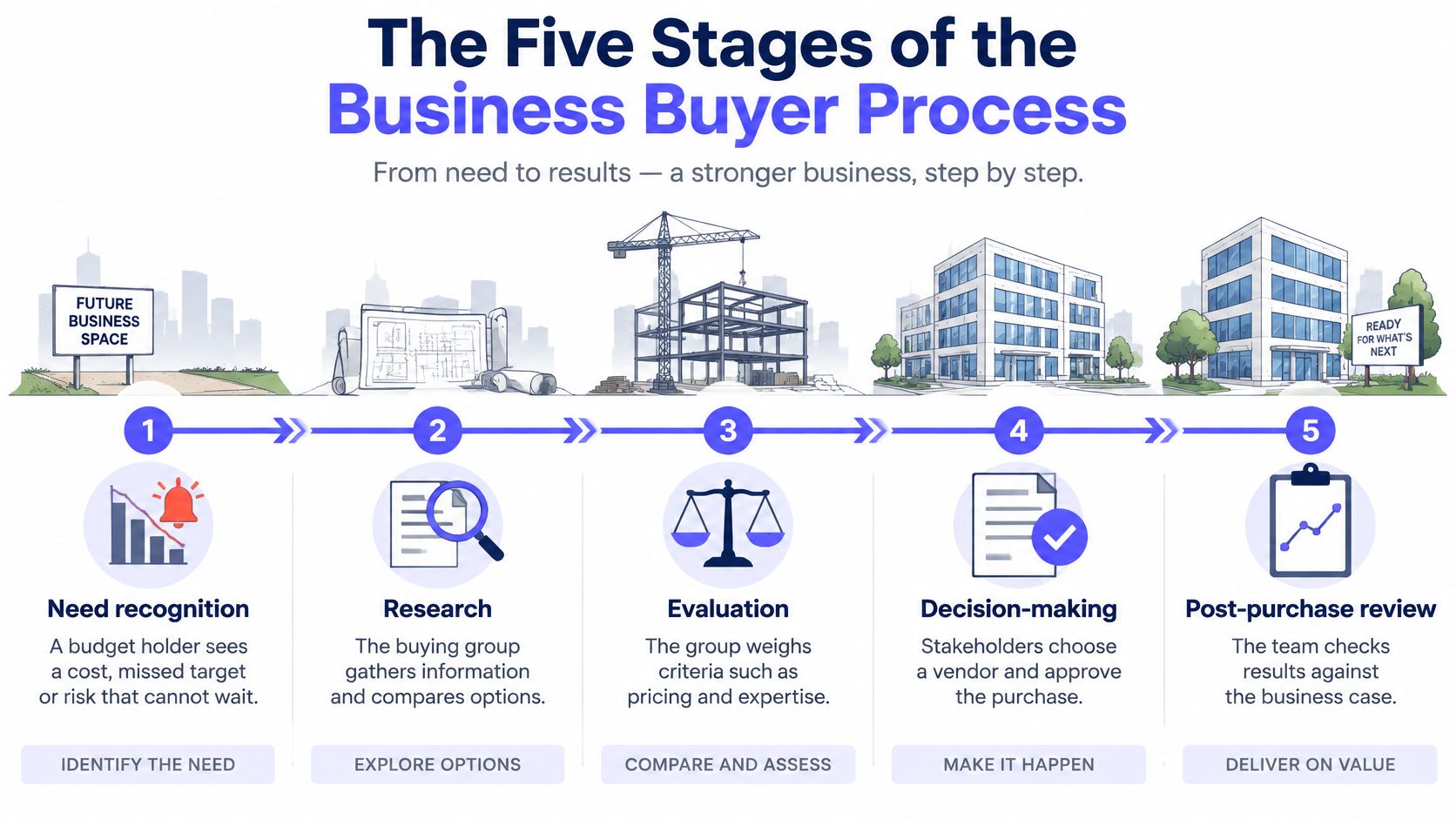
Business Buyer Process Stages, Outputs and Exit Signals
The following map is a working diagnostic, not a claim that every purchase follows an identical sequence. The shortlist size is a practical example rather than a measured market average.
| Stage | Buyer question | Typical output | Exit signal |
|---|---|---|---|
| Need recognition | Is this problem worth funding now? | Named problem with a stated business cost | Budget owner agrees to fix it |
| Research | What options exist and what do they cost? | Shortlist of two to four providers | Buyer names a preferred provider |
| Evaluation | Which option fits our requirements and risk? | Scored comparison and ROI case | Stakeholders accept one option |
| Decision-making | Who approves, and on what terms? | Approved budget and negotiated agreement | Contract is signed |
| Post-purchase review | Did the purchase deliver the promised result? | Results measured against the original business case | Renew, renegotiate or exit |
An exit signal is the condition that must be true before the buyer can responsibly proceed. A completed presentation isn't an exit signal for evaluation. Agreement among the people responsible for cost, implementation, and risk is a stronger one.
For an outbound purchase, the difference is concrete. A founder may like the proposed campaign while the sales manager still disputes the qualification criteria. Until both accept what counts as a useful opportunity, the purchase hasn't cleared evaluation.
Diagnose the Unresolved Question
Stages can overlap. A buyer comparing proposals may return to research when a technical evaluator identifies a data-handling concern or an executive introduces a different requirement.
For a supplier, the unresolved question is more useful than the contact's title. The same founder might investigate targeting options in the morning and approve spending in the afternoon. Recording only the title misses that change.
Practical rule: Assign a buying stage from the evidence still missing, not from the last sales activity completed.
This approach also separates preference from commitment. Naming a preferred provider can justify deeper evaluation, but it doesn't establish approved funding, acceptable terms, or implementation readiness.
How Buyers Spend Their Time Before Any Sales Call
A substantial part of buying happens outside supplier conversations. In 2024, 81% of B2B buyers had selected a preferred vendor before speaking with a sales representative, according to 6sense's B2B Buyer Experience Report.
A separate 2026 buyer-study summary reports 28 self-directed research touches before contacting sales, with 87% wanting pricing visible before contact. The sources differ in method, so those findings shouldn't be compared directly or treated as a single trend line.
Share of Total B2B Buying Time by Activity
In research with 750 B2B buyers, Gartner's buyer-enablement report puts independent online and offline research at a combined 45% of total buying time, compared with 17% spent meeting potential suppliers. The table presents its activity breakdown, including the conditional share available to an individual representative.
| Activity | Share of total buying time |
|---|---|
| Researching independently online | 27% |
| Researching independently offline | 18% |
| Meeting with the internal buying group | 22% |
| Meeting with potential suppliers | 17% |
| Time with one sales representative when comparing several suppliers | 5% to 6% |
The final row isn't an additional activity to add to the others. It describes how little of the overall process an individual salesperson may receive when buyers compare suppliers. Nor does the independent-research share prove that all that work happens before the first call.
Make Private Evaluation Possible
Consider a hypothetical founder comparing three providers. The founder reads their pricing explanations, checks relevant proof, and looks for information about qualification and implementation before contacting the strongest candidate. A generic request to book a discovery call leaves the founder with unanswered questions during that comparison.
Each activity suggests a specific seller task:
- Online research: Publish pricing logic, service boundaries, outcome definitions, and implementation requirements.
- Offline research: Give buyers concise material they can share with peers and colleagues.
- Internal alignment: Explain assumptions and trade-offs in a format that survives forwarding.
- Supplier meetings: Resolve the remaining uncertainty rather than repeat information already available.
This is why inbound and outbound lead generation shouldn't be treated as isolated systems. An outbound message can prompt investigation, but the destination must support a decision.
For cold email, that means matching the message's claim to the evidence on the destination page. If the email proposes better-qualified opportunities, the page should explain qualification, exclusions, and handoff. The operator's test is straightforward: what would a buyer find during independent research that makes this supplier worth a call?
Recognizing a Need and Assembling the Buying Group
Suppose a founder notices that pipeline coverage no longer supports the revenue plan. The sales team can't absorb more prospect research, and hiring would introduce management work before producing capacity. That's a trigger, but it isn't yet an approved purchase.
The founder should first define the business problem without prescribing the solution. Insufficient sales capacity, weak targeting, poor follow-up, and low demand require different interventions. Buying outbound before identifying the constraint risks paying to send more prospects into a broken sales process.

Separate Buying Jobs From Sales Stages
Gartner's B2B buying report describes six recurring buying jobs: problem identification, solution exploration, requirements building, supplier selection, validation, and consensus creation. It also reports enterprise buying groups of 5 to 11 stakeholders across approximately five business functions.
Those jobs explain why a contact's enthusiasm can coexist with an immature opportunity. The founder may have identified the problem and explored suppliers while finance hasn't validated the business case. Procurement may still need to establish acceptable terms.
In the hypothetical purchase, a useful sequence is to document the pipeline constraint, compare internal and external approaches, define qualification requirements, examine suppliers, validate their claims, and resolve disagreement. That sequence is a guide, not a requirement to complete every activity only once.
Change the Evidence for Each Role
A buying-group map should name actual people, their authority, and the evidence needed for approval.
- Economic buyer: Lead with the cost of the problem, expected benefit, and payback logic.
- Technical evaluator: Address integration, access permissions, security, and implementation dependencies early.
- Finance: Put ROI assumptions in writing, including the internal labor required after handoff.
- Procurement: Provide commercial terms, billing definitions, and an understandable exit process.
- Legal: Explain data handling, opt-out obligations, and responsibility for campaign compliance.
- End users: Describe workflow changes, ownership, and what happens when a reply reaches the sales team.
A founder doesn't need to manufacture a large committee for a small purchase. The point is to identify functions that can approve, block, or fail to implement the decision.
Prospect enrichment should support that map without pretending to establish intent. A verified role, employer, or company size can establish account fit, but it doesn't prove budget authority or willingness to change. Before outreach begins, the lead record should distinguish verified facts, inferred relevance, and unanswered buying questions.
Evaluation Criteria Buyers Weigh Most Heavily
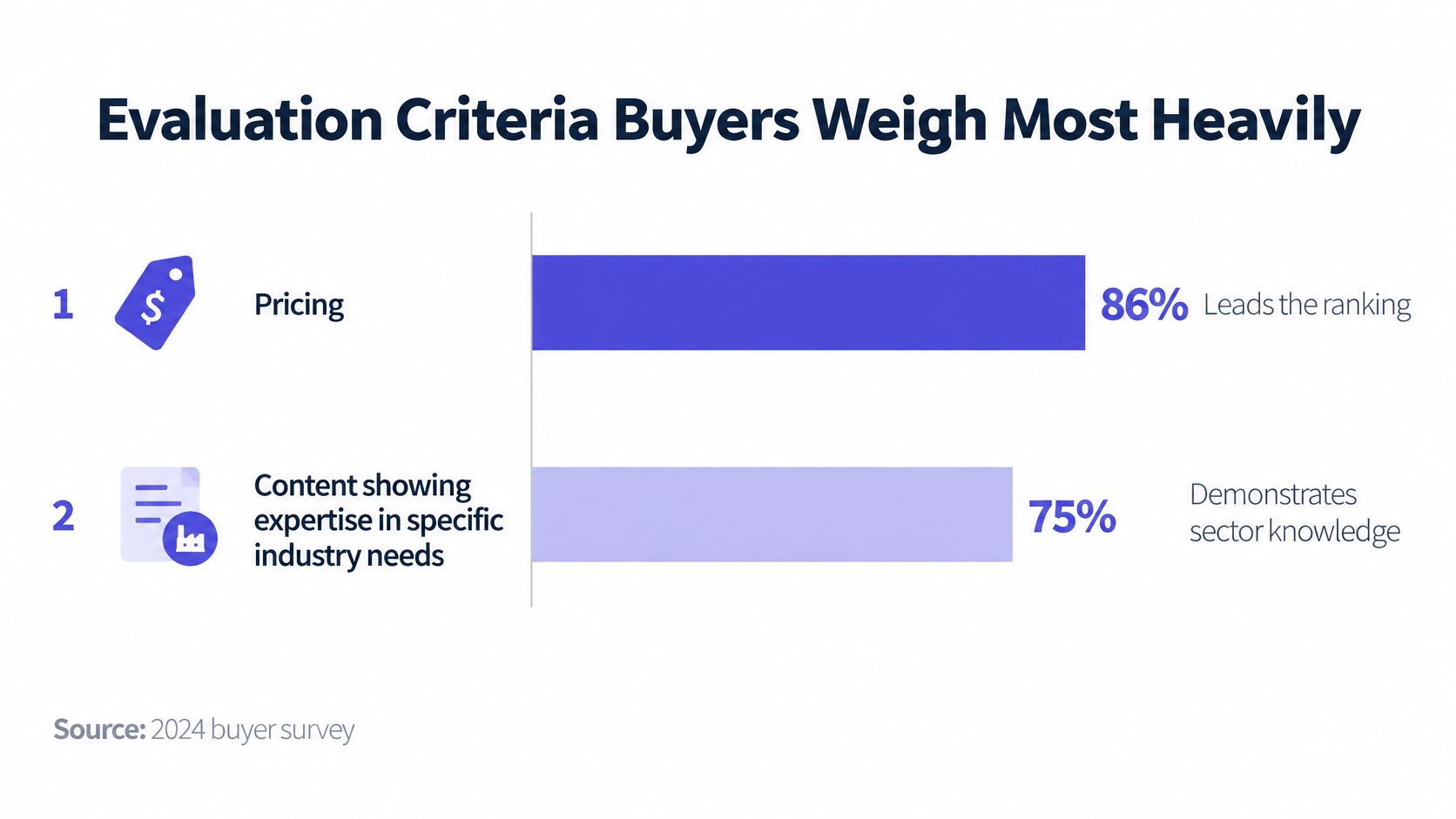
Price matters, but buyers also need evidence that the supplier understands their problem. The 2024 Demand Gen Report buyer survey ranks pricing at 86%, followed by content demonstrating expertise in specific industry needs at 75%, evidence of solving a pain point at 72%, and strong industry knowledge at 64%.
The same survey reports 41% conducting more detailed ROI analyses, 34% spending more time researching purchase decisions, and 33% relying more on peer recommendations and reviews. These findings describe reported evaluation behavior, not a formula that predicts which supplier will win.
Compare Evidence Rather Than Presentation Quality
A generic statement about generating pipeline gives the buyer little to validate. A stronger proposal connects a specific operational problem to economic impact, implementation work, and proof that supports the proposed approach.
For example, a staffing firm targeting employers needs more than a contact database. Its evaluation should establish how the campaign identifies relevant hiring demand, checks employer fit, routes interested replies, and excludes unsuitable contacts. Each element should connect to the firm's actual sales capacity.
A buyer evaluating a lead generation agency should distinguish the following:
| Evaluation area | Evidence to examine |
|---|---|
| Pricing | Billable event, exclusions, and total operating cost |
| Industry expertise | Relevant targeting logic and buying triggers |
| Problem fit | Clear connection between campaign activity and the business constraint |
| Implementation | Responsibilities, access requirements, and handoff workflow |
| Risk | Qualification disputes, suppression controls, and exit terms |
Stress-Test the Preferred Option
Consider an illustrative scorecard, not a market benchmark. A founder assigns weights across five criteria before reading proposals, scores each provider from 1 to 5, and calculates a weighted total.
The founder then increases the price weight by ten percentage points, reducing other weights so the total remains unchanged. If the preferred option changes, the decision is sensitive to price assumptions and deserves closer inspection. If it doesn't, the founder should still check whether the underlying scores have credible evidence.
A scorecard written after the pitches can become a record of preference rather than a test of it.
Missing evidence shouldn't automatically receive an average score. Mark it unresolved and request the relevant document, explanation, or demonstration. A polished presentation can't substitute for an explicit answer about what the buyer receives and what the buyer must still do internally.
Decision Mechanics and Outbound Risk Checks Before Signing
A list of valid email addresses isn't enough to approve an outbound campaign. Address verification doesn't establish sender authentication, inbox placement, appropriate targeting, or reliable suppression. The purchase needs operational checks as well as commercial approval.
A sensible approval sequence starts with the budget owner accepting scope, followed by procurement reviewing terms and legal examining data handling and opt-out responsibilities. A limited first campaign can then test agreed assumptions before wider rollout. That pilot should have a defined audience, owner, and stop condition.
Verify the Sending System
Since February 1, 2024, Google's sender guidelines require all senders to Gmail accounts to authenticate with SPF or DKIM, while bulk senders must use SPF, DKIM, and DMARC; Google advises keeping reported spam rates below 0.10% where possible and avoiding 0.30% or higher, which can affect access to delivery support or mitigation.
Google's sender FAQ also addresses authentication alignment, valid DNS, TLS, message formatting, and one-click unsubscribe for marketing and promotional messages, with unsubscribe requests honored within 48 hours. These are mailbox-provider requirements, not proof that an authenticated message will reach the inbox.
The FTC's CAN-SPAM compliance guide requires an opt-out mechanism that works for at least 30 days after sending, prompt handling of requests, a valid physical postal address, nondeceptive headers and subjects, and clear identification of commercial messages.
Outbound Due Diligence Checks Before Signing
| Check | Standard | Consequence if missing |
|---|---|---|
| SPF or DKIM authentication | Required for every sender to Gmail | Mail can be rejected or sent to spam |
| DMARC | Required for bulk senders, alongside SPF and DKIM | Bulk campaigns fail sender requirements |
| Spam rate in Postmaster Tools | Keep below 0.10%, never reach 0.30% | Domain can lose delivery support or mitigation |
| One-click unsubscribe | Required for applicable marketing messages | Unhonored requests create complaints and compliance risk |
| Opt-out window | Mechanism works for at least 30 days after send | Non-compliance with CAN-SPAM |
| Physical postal address | Included in every commercial message | Non-compliance with CAN-SPAM |
| Central suppression | Opt-outs apply across all sequences and inboxes | Opted-out contacts re-enter campaigns after a data refresh |
Domain warming should be a controlled ramp, not a fixed waiting period. Start new sending domains and inboxes at low daily volume. Increase only when available complaint reporting remains below the stated target and bounce behavior is stable; absent reporting isn't evidence of a healthy reputation.
Pause increases when complaints rise. Review the warming schedule, monitoring coverage, and pause conditions before signing, alongside written definitions of qualification and rejection rights.
IronPeak Marketing allows clients to reject unqualified leads without paying for them. The operating agreement should still make the applicable qualification criteria explicit. No purchase should proceed without written authentication status, suppression ownership, and a process preventing opted-out contacts from returning through enrichment or list refreshes.
Checking Results Against the Business Case After Purchase
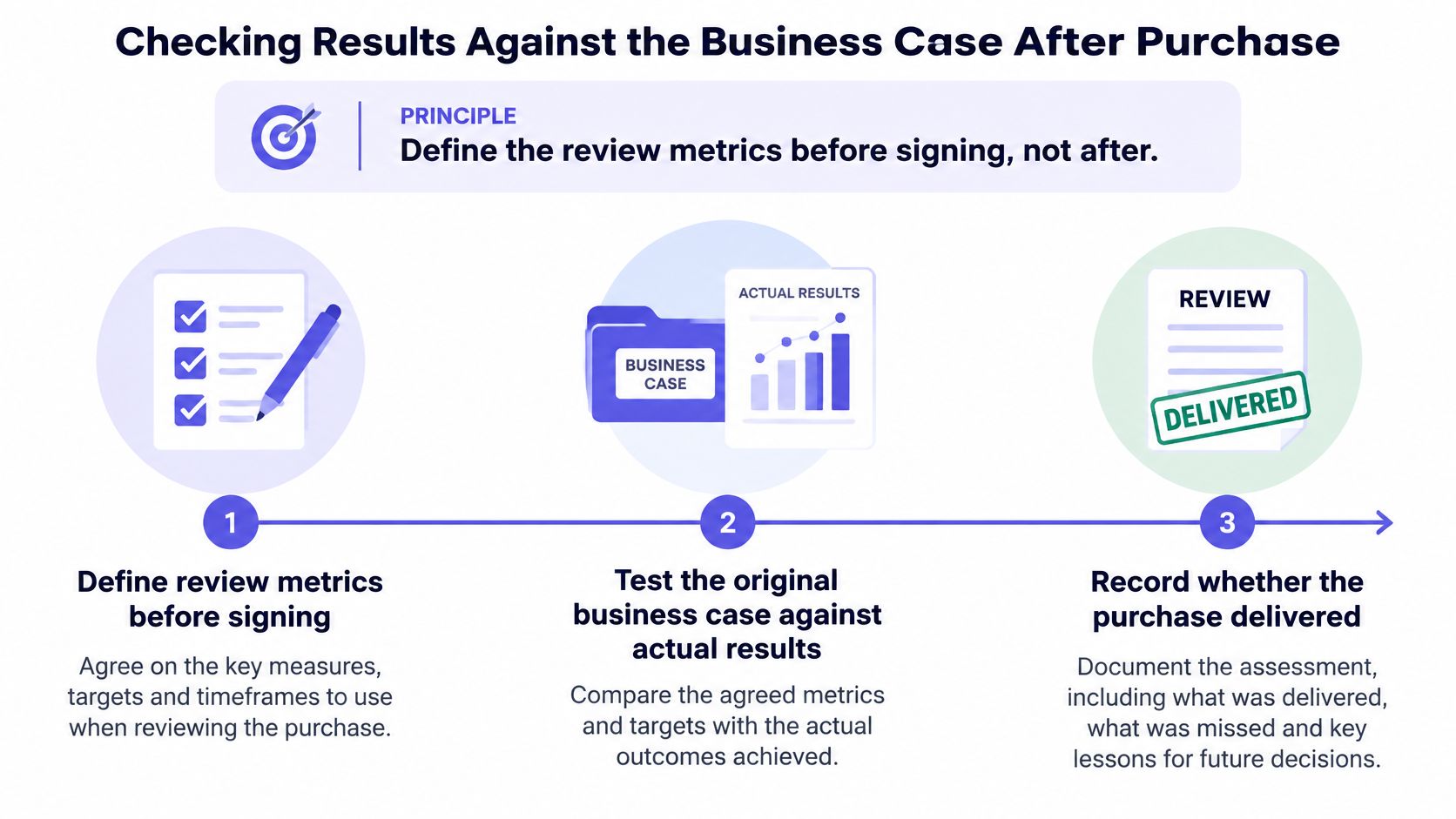
Define review metrics before signing, not after. Otherwise, the buyer and supplier can interpret the same campaign differently: one counts delivered records, another counts accepted opportunities, and the sales team counts conversations that happened.
The review should test the original business case against actual results. It shouldn't replace that case with whichever metric looks strongest after launch.
Establish a Review Routine
The following is a suggested operating schedule, not a claimed industry standard.
- Retrieve the business case. List the three to five metrics the purchase was intended to improve, along with their definitions.
- Schedule reviews at 30, 60, and 90 days. Assign an owner and specify which records must be available.
- Separate delivered from accepted volume. Record rejection reasons rather than treating every disputed record as the same failure.
- Compare accepted opportunities with meetings held. Check scheduling, attendance, response handling, and sales follow-up.
- Calculate cost per accepted opportunity. Include relevant operating costs and compare with the internal alternative on the same basis.
- Inspect opt-outs and complaints. Check counts alongside sending volume and campaign changes.
- Choose an action. Renew, renegotiate, or exit according to the agreed business case.
An operational client onboarding checklist helps establish the owners, definitions, and access permissions needed for that review. IronPeak Marketing's onboarding includes a 60-minute call to learn about the client's offer and target market.
Post-Purchase Review Metrics and What They Show
| Metric | How to calculate it | Question it answers |
|---|---|---|
| Rejection rate | Rejected records divided by delivered records | Does delivered volume match the agreed definition? |
| Acceptance-to-meeting ratio | Meetings held divided by accepted records | Are accepted opportunities real? |
| Cost per accepted opportunity | Total spend divided by accepted records | Is the purchase cheaper than the internal alternative? |
| Opt-out and complaint count | Opt-outs and complaints per campaign period | Is sender reputation holding? |
These metrics are diagnostic, not conclusive. A low meeting ratio can reflect weak qualification, but it can also reflect delayed follow-up or scheduling friction. Complaint counts need volume context, and low complaints alone don't establish inbox placement.
Read the Gap Before Assigning Blame
In an illustrative example, a campaign delivers 100 leads, the buyer rejects 18, accepts 82, and holds 9 meetings within the first 30 days. Those are hypothetical operating figures, not a client result.
The accepted-to-held gap requires inspection. Some contacts may be awaiting scheduling; others may have gone silent, been mishandled, or passed an acceptance rule that was too loose. Review timestamps and reasons at record level before changing targeting or disputing the entire campaign.
Review discipline: Separate supplier quality, buyer follow-up, and elapsed time before judging commercial value.
The findings should shape the next purchase's requirements. Post-purchase review feeds the next research stage with documented evidence rather than remembered impressions.
Run Your Next Purchase Through the Five Stages
The purchase under consideration this week should pass a written gate check. The purpose isn't more paperwork, but fewer unresolved assumptions entering a signed agreement.
- Name the need. Write the problem in a sentence, attach its monthly or annual cost, and identify the current buying stage.
- Map approval. List every stakeholder and the evidence each needs before signing off.
- Document the offer. Obtain pricing logic, the qualified-lead definition, and relevant proof in writing.
- Test the shortlist. Fix evaluation weights before reading pitches, then rerun the comparison with the price weight raised by ten percentage points.
- Verify operating controls. Record authentication status, one-click unsubscribe, central suppression, and rejection terms.
- Schedule accountability. Set suggested reviews at 30, 60, and 90 days, naming the metrics and owner for each.
Apply the Same Standard to Every Provider
Founders evaluating IronPeak Marketing should submit the same written questions used for the other providers on their shortlist. A satisfactory answer should resolve a buying question, identify an owner, or supply evidence that can be checked.
The decision rule is simple: if any gate can't be answered in writing, the purchase isn't ready to sign. A positive call can justify further evaluation, but it shouldn't replace missing operational or commercial evidence.
IronPeak Marketing provides managed B2B cold email outreach on a qualified pay-per-lead basis, connecting prospecting and campaign operations with the client's sales process. Visit IronPeak Marketing to arrange a free strategy session or discovery call, with no credit card required and no commitment, and bring the written gate check to assess whether the approach fits the business need.