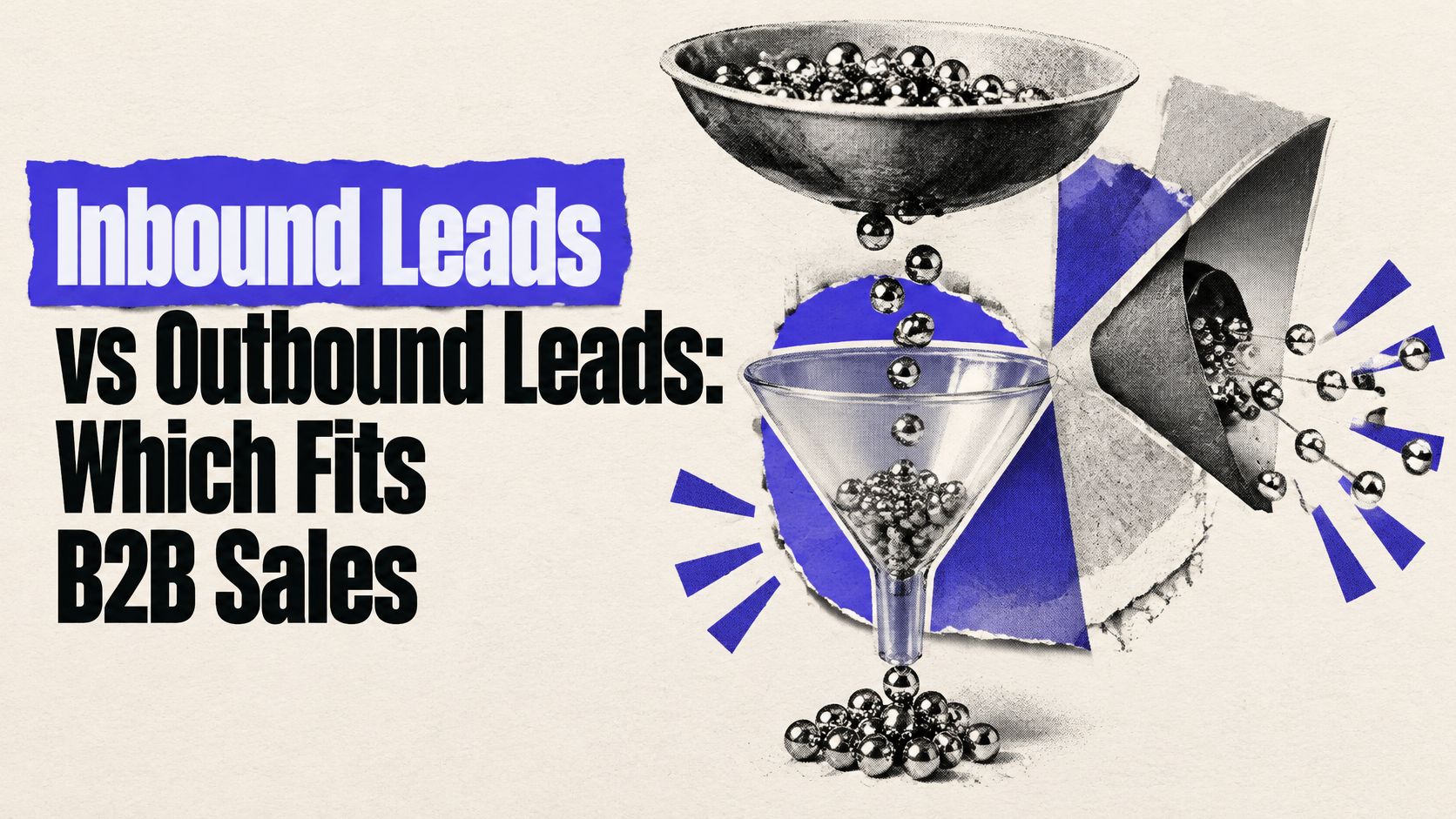
Inbound Leads vs Outbound Leads: Which Fits B2B Sales
Compare inbound leads vs outbound leads by source, buyer intent, cost, timing and deliverability, with fit guidance for B2B firms and agencies.
Only 4.82% of cold-call conversations resulted in a booked meeting in 2024, according to WHAM's first-party data reported in Cognism's State of Cold Calling Report 2025 and summarized by SHNO. That's a phone-channel benchmark, not a cold email benchmark, but it exposes the problem with comparing inbound leads vs outbound leads by activity alone. The useful question is how much accepted pipeline each channel produces per account reached, and whether the team can convert that pipeline profitably.
Inbound and Outbound Leads at a Glance
Inbound and outbound leads compared by channel profile
| Factor | Inbound leads | Outbound leads |
|---|---|---|
| Origin | Prospect searches, reads or requests contact | Operator reaches a named account or contact first |
| Buyer intent | Active, category-aware research | Often no current search, selected by fit |
| Typical timing | Arrives on the prospect's schedule | Set by campaign schedule and follow-up sequence |
| Speed to first contact | Minutes to hours matter | Set by sequence cadence |
| Volume control | Limited by in-market demand | Bounded by safe sending volume and list coverage |
| Cost structure | Content, SEO, paid media or referral effort | Data, infrastructure, copy and follow-up effort |
| Main risk | Demand may be thin or highly competitive | Deliverability problems and buyer resistance |
| Sales effort on arrival | Qualify and respond quickly | Qualify after earning a reply |
Intent and timing usually decide the choice. An inbound prospect has taken an action that signals some level of interest, and the job is to gauge how strong that signal is: a pricing-page visit carries more weight than a forwarded newsletter. An outbound contact begins with fit on paper, and the campaign has to earn the first real signal of demand.
That difference shapes the opening sales conversation. An inbound seller qualifies fit and maps the buying process. An outbound seller first has to justify the interruption, then qualify.
What each channel lets you control
Outbound gives the operator control over which companies, roles and timing to work. Follow-up sequences can raise the number of touches on an account, though the urgency still has to come from the prospect's situation.
Inbound runs the opposite constraint. Better pages and stronger distribution raise visibility among buyers already searching, and a specialist selling an unfamiliar service can publish excellent content and still reach too few buyers who know what to search for.
Practical rule: Existing search demand favors inbound. A clearly identifiable market that rarely searches favors outbound.
Cost and sales effort matter after that choice. Inbound requires production, maintenance and qualification of unsuitable inquiries. Outbound requires prospect sourcing, enrichment, authenticated infrastructure, reply handling and disciplined suppression.
Both channels produce raw responses. A downloaded resource and an outbound reply each need qualification before they count as pipeline, so the operator has to separate attention, interest and commercial fit before deciding which source deserves more budget.
Where Each Lead Comes From and Why Buyers Respond
Approximately two-thirds of B2B buyers chose remote human interaction or digital self-service across the sales process in 2022, and buyers used up to, sometimes more than, 10 channels during a purchase journey, according to McKinsey's sales transformation findings. The same findings reported that 76% considered speaking with a salesperson helpful when researching a new product or service, while 46% would purchase through a supplier's website if the process were available and efficient.
These preferences explain why inbound matters without making salespeople obsolete. Buyers can discover suppliers through search, comparison pages, educational content, webinars and product research. They can also reach a point where a website no longer answers the questions that determine the purchase.
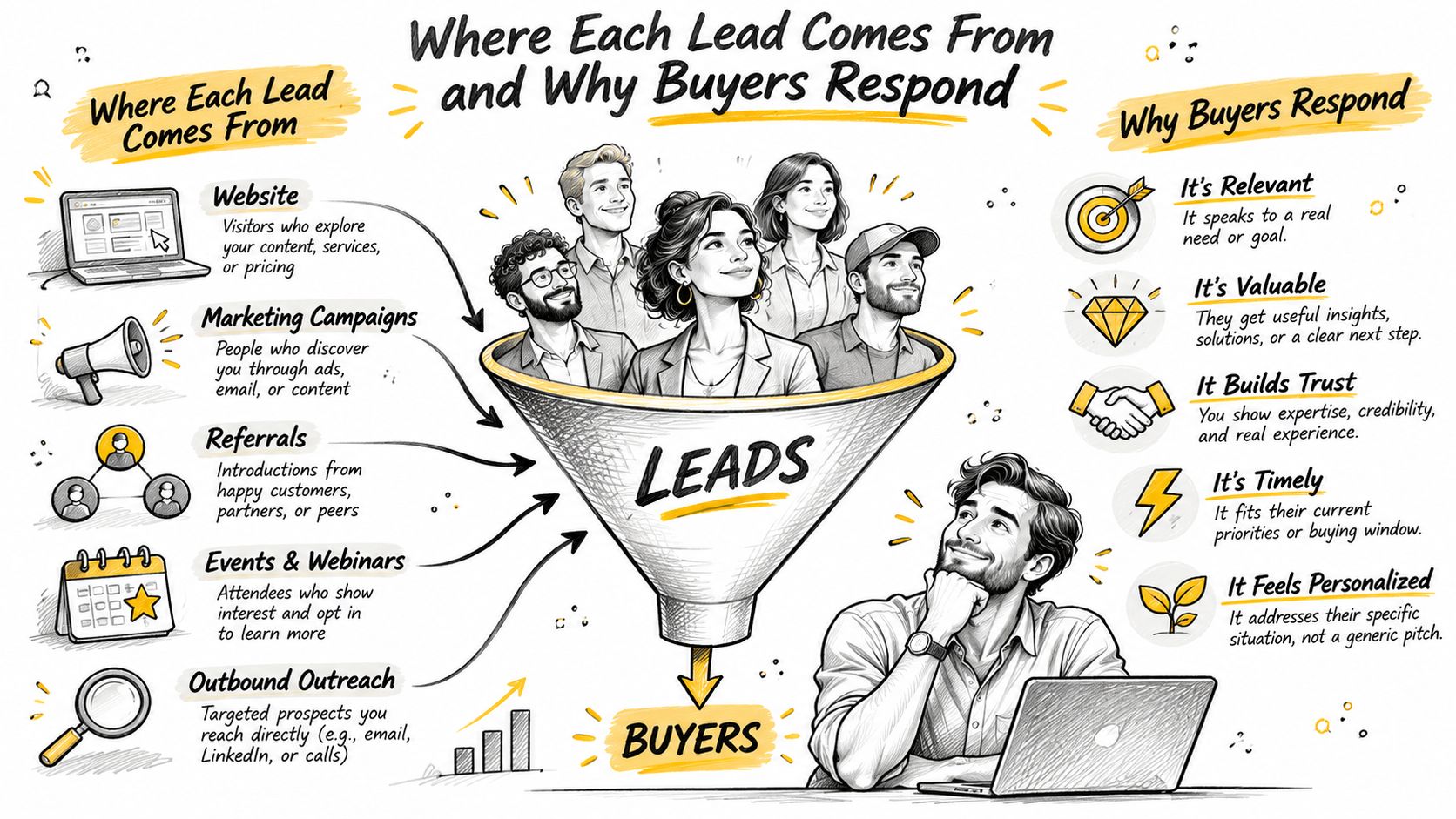
What earns a place on the shortlist
For a specialized service, useful inbound content makes the buying decision easier. A strong service page explains who the work suits, what delivery involves, what the client must provide and what would make the engagement unsuitable. Generic educational traffic isn't a substitute for those answers.
Outbound reaches the same buyer from another direction. A cold email can introduce an overlooked supplier or surface a problem the buyer hasn't prioritized. Its opening needs a credible business reason, such as a relevant hiring initiative, service expansion or operational change, rather than an unrelated personal detail.
B2B buyers spend only 17% of their buying time meeting potential suppliers, according to buyer research summarized by SHNO's B2B lead generation statistics. A cold email may therefore reach someone who has already begun forming a shortlist independently.
Inspect the buying path, not just the entry point
A practical pipeline review should examine the last ten closed deals as an audit sample, not a benchmark:
- Record the initiator. Mark whether the buyer found the company first or received an outbound approach.
- Identify evaluation assets. Note the service pages, comparisons, resources or proof used during the decision.
- Record human involvement. Establish whether a salesperson helped resolve scope, risk, implementation or commercial questions.
The review can reveal that inbound initiated the inquiry but sales did substantial decision support. It can also reveal that outbound started the relationship while website content made the supplier credible. Those are different contributions, and neither should disappear from channel reporting.
Conversion Economics and How to Measure Each Channel
A HockeyStack benchmark reports inbound deals converting to revenue at 28.07%, compared with 16.96% for outbound, roughly a 1.65x inbound advantage. Treat the gap as directional. Source mix, attribution rules, sales-cycle length and qualification definitions can all move it.
Inbound captures buyers who are already researching. Outbound approaches suitable accounts before they express intent. A higher conversion rate alone does not show that inbound could have reached the same accounts, or that outbound created poor opportunities.
Judge both channels on the same yardstick: accepted pipeline value per account reached.
Metrics to track separately for each channel
| Metric | Inbound | Outbound |
|---|---|---|
| Delivered contacts or visitors | Visitors to key pages and resources | Emails delivered and bounce rate |
| Lead acceptance rate | Accepted against written qualification criteria | Accepted against written qualification criteria |
| Meeting-booked rate | Booked calls from forms or requests | Positive replies turned into booked calls |
| Sales-qualified opportunity rate | Share of meetings that qualify | Share of meetings that qualify |
| Close rate | Closed deals by source | Closed deals by source |
| Customer acquisition cost | Content, SEO or media spend per won customer | Campaign and infrastructure spend per won customer |
| Payback horizon | Content and SEO payback over months | Speed and incremental pipeline within weeks |
| Outbound-to-inbound touches | Inbound leads whose first touch was outbound | Later site visits, branded search returns or direct inquiries |
Track revenue and accepted opportunity value alongside these rates. Keep denominators explicit: a meeting rate calculated from positive replies has a different base from one calculated from every website visitor, and mixing the two produces a comparison that looks precise and means little.
Use account-level economics
The core calculation is:
Accepted pipeline value per account reached = total accepted pipeline value ÷ distinct accounts reached in the measurement window.
For illustrative arithmetic only, 400 accounts reached producing 60,000 in accepted pipeline equals 150 per account reached. That is illustrative arithmetic rather than a forecast. Both channels need the same currency, valuation method, qualification standard and measurement window before the result means anything. The metric also cuts through raw lead counts: a channel can produce twice the leads and still return less accepted pipeline per account.
Inbound account identification will be incomplete. Anonymous visitors never qualify as known companies, and unidentified traffic still belongs in the cost calculation. Report identification coverage beside the account-level result, then reconcile accepted pipeline with won revenue.
Keep qualification and attribution consistent
Segment outbound by account fit, trigger, industry, seniority and offer relevance. A campaign aimed at a specific operational need produces different economics from a broad list, and blending them because both used email hides the difference.
For qualified-lead billing, written acceptance criteria should cover company size, geography, role authority, need, timing and duplicate status. A lead acquisition marketing framework should carry those criteria through to opportunity outcomes instead of ending at contact capture.
Preserve the originating campaign when recipients later inquire directly. Branded-search returns and website visits can support an outbound-to-inbound assessment where tracking permits, though aggregate traffic changes alone cannot prove that particular recipients converted.
A final inbound form submission shouldn't erase an earlier outbound introduction. Equally, an earlier email shouldn't receive credit for every later purchase.
Deliverability Rules That Cap Outbound Volume
Authentication and complaint rates set the ceiling for safe outbound volume. A campaign's sending status alone cannot establish inbox placement. Check authentication, recipient complaints and list quality before increasing volume.
Google's email sender guidelines require SPF or DKIM for all senders. Domains sending at least 5,000 messages daily to Gmail accounts must use SPF, DKIM and DMARC. Google's bulk-sender requirements have applied since February 2024. Google advises keeping spam rates below 0.10% and avoiding 0.30% or higher, and requires functioning one-click unsubscribe for marketing messages.
Microsoft's high-volume sender announcement sets stricter requirements from May 5, 2025 for domains sending more than 5,000 daily messages to Outlook.com, Hotmail.com or Live.com accounts: SPF and DKIM, DMARC with at least p=none, SPF or DKIM alignment with the visible From domain, and a clear opt-out.
Gmail and Outlook sender requirements for outbound
| Requirement | Gmail | Outlook.com, Hotmail and Live |
|---|---|---|
| Bulk sender threshold | At least 5,000 messages daily to Gmail accounts | More than 5,000 messages daily to the covered accounts |
| Authentication | SPF or DKIM for all; SPF, DKIM and DMARC for bulk | SPF and DKIM; DMARC with at least p=none |
| Alignment | Configure DMARC alignment for bulk sending | SPF or DKIM aligned with the visible From domain |
| Complaint control | Keep spam below 0.10%; avoid 0.30% or higher | Monitor complaints and suppress complaining recipients |
| Unsubscribe | One-click unsubscribe for marketing messages | Clear marketing opt-out |
| Enforcement | Bulk requirements from February 2024 | From May 5, 2025; Junk routing initially, possible later rejection |
Set up authentication before warming
Use this order:
- Authenticate each sending domain. Publish SPF and DKIM, then add DMARC at p=none.
- Confirm alignment. Check the visible From domain against the authenticated identity.
- Establish monitoring. Enroll eligible domains in Postmaster Tools and inspect authentication results.
- Connect suppression. Remove unsubscribes and complaining addresses from every active sequence.
- Begin warming. Start new domains at low daily volume with engaged recipients, then increase in stages over several weeks while checking bounces, spam reports and Junk placement.
Treat warming as a gradual increase governed by recipient signals. Pause increases when placement worsens, investigate data quality and relevance, and correct authentication issues before sending more. An email deliverability best-practices guide can help make these checks part of campaign setup and ongoing monitoring.
Enrichment should confirm current roles, company fit and usable contact records before launch. Keep complaint rates low through relevant targeting and prompt suppression of recipients who opt out or report spam.
Response Speed and Follow-Up Rules for Each Source
A five-minute response was associated with roughly 21 times greater qualification likelihood than a response after 30 minutes. Harvard Business Review research also found that contacting web-generated leads within one hour made meaningful conversation nearly seven times more likely than waiting another hour, and more than 60 times more likely than waiting at least 24 hours, according to Callingly's summary of speed-to-lead research.
These findings concern web inquiries. Cold recipients need a planned sequence instead of aggressive chasing. Inbound prospects have just shown interest; for outbound, the sequence should add relevant context, and a positive reply should reach a human promptly.
Put response handling into the operating routine
- Timestamp lead creation. Preserve creation, first delivery attempt, first human response, meeting booking, qualification and handoff times in the CRM.
- Route inbound immediately. Assign form fills and meeting requests to a named sales owner, with a backup for absences.
- Schedule outbound follow-ups. Each message should add useful context rather than repeat a meeting request.
- Classify replies. Separate positive, neutral, negative and out-of-office responses so automation handles them appropriately.
- Suppress opt-outs and complaints immediately. Stop the sequence and update the shared suppression record.
- Send positive replies to a human. Set a clear review window and coverage for absences.
- Report response bands. Track under five minutes, five to 60 minutes, one to 24 hours, and over 24 hours.
A lead management and CRM process should make ownership and handoffs visible. An automated acknowledgment is not a substantive human response, and assigning a task does not show that anyone handled it.
Separate lead quality from handling quality
Compare response times within similar sources and qualification segments. If slower handling accompanies weaker conversion, inspect routing and sales execution before rejecting the channel. Monthly averages can hide neglected inquiries behind a small number of fast replies.
The buyer still needs capacity for discovery, proposals and closing. Measure accepted pipeline value per account reached, alongside response time and qualification, so raw lead volume does not obscure whether a channel is producing worthwhile opportunities.
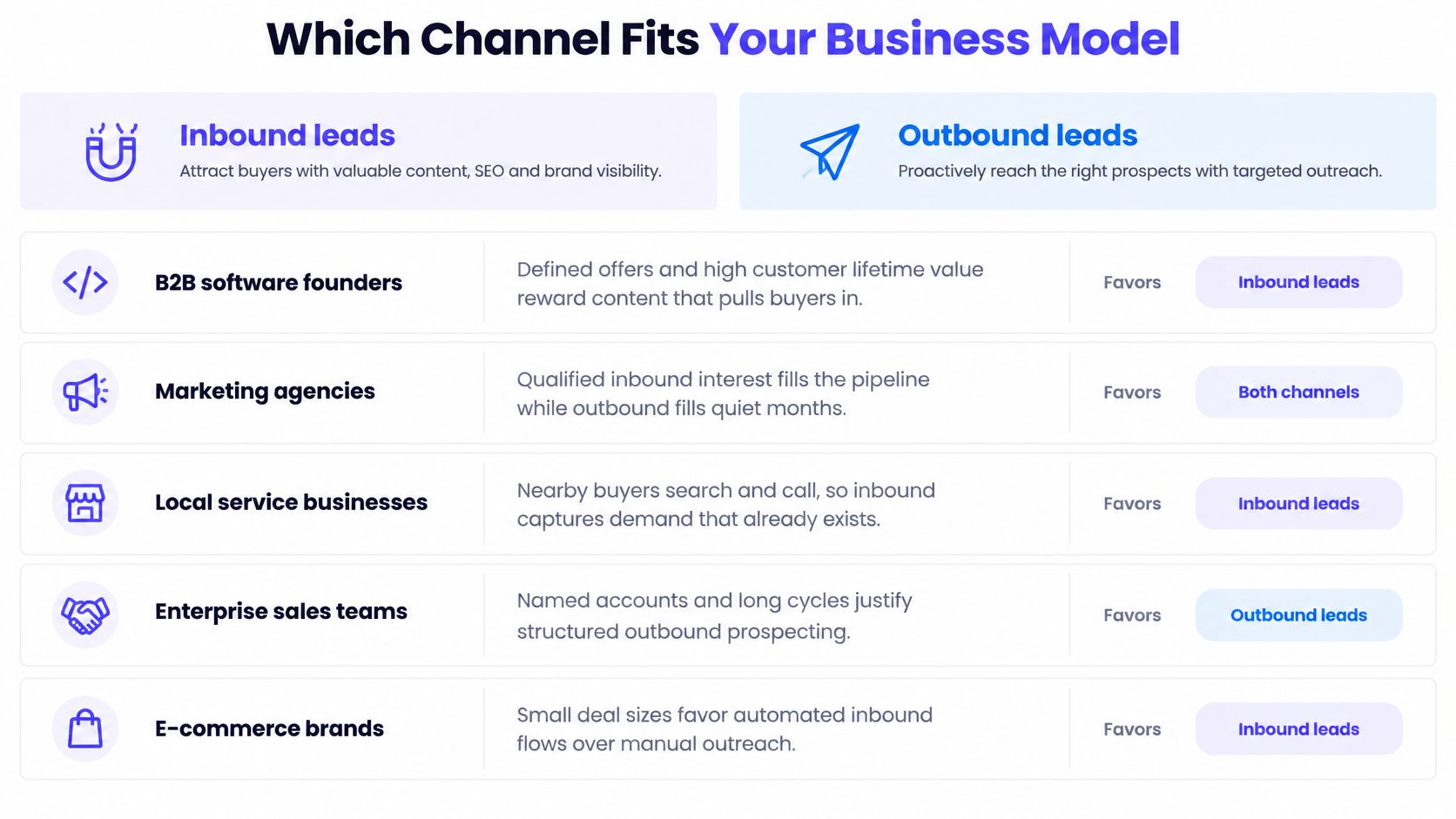
Which Channel Fits Your Business Model
The right channel depends on how buyers research your category, how narrowly you can define target accounts, and what a new customer is worth.
McKinsey's global B2B research found that 70% of decision-makers were willing to make fully self-service or remote purchases over $50,000, while 27% would spend more than $500,000 remotely. McKinsey's 2024 B2B sales findings put the share willing to spend above $500,000 through digital self-service or remote sales connections at 39%, up from 28% in 2022. Those results show that buyers will make large purchases remotely. They do not establish that an unsolicited email will be relevant or earn a response.
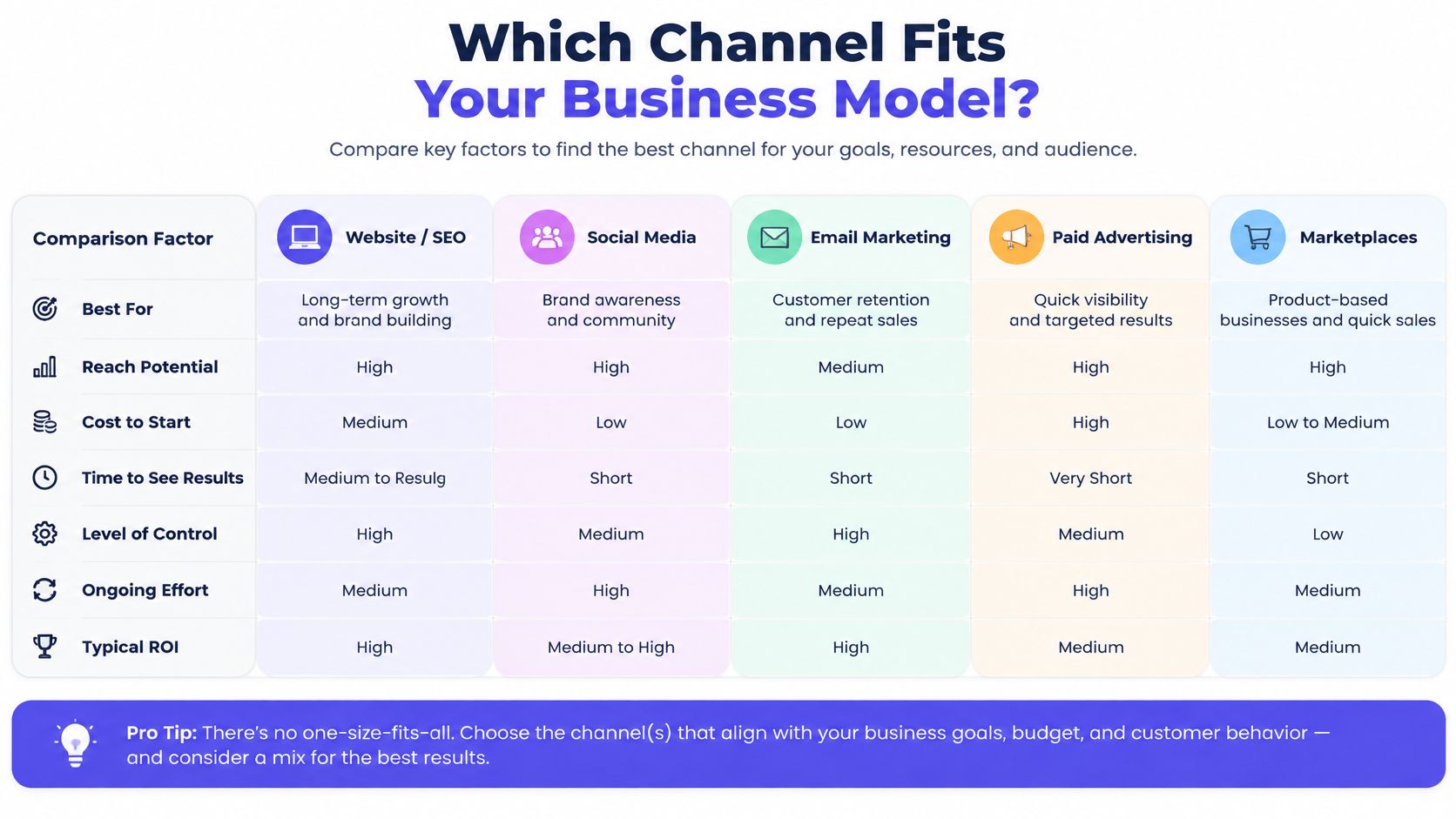
Match the source to the buying situation
| Business segment | Recommended starting emphasis | Decision rule |
|---|---|---|
| B2B software founders | Inbound for established categories; outbound for narrow enterprise targets | Defined offers and high lifetime value support buyer education plus selective account pursuit |
| Marketing agencies | Combined acquisition | Capture service searches while approaching accounts with a specific, relevant need |
| Staffing and recruitment firms | Outbound for employer acquisition | Target hiring demand, relevant functions and credible specialization rather than generic employer lists |
| Construction and trade businesses | Inbound locally; outbound for commercial accounts | Separate urgent service searches from planned procurement and facilities relationships |
| High-ticket consultants | Outbound supported by specialist content | Approach identifiable decision-makers when the problem is expensive but rarely searched in the consultant's terminology |
Treat these as starting points, not fixed allocations. An agency with strong search visibility may rely primarily on inbound. A software company serving an unfamiliar niche may need outbound to start relevant conversations.
Apply the deal-size and capacity tests
Give inbound more weight when buyers actively search the category and your content can help them assess the offer. When the buyer group is narrow or the offer is unfamiliar, outbound can test demand among specific accounts. Judge either channel by accepted pipeline value per account reached, not raw lead volume.
For a long, high-value sales cycle, the channels can serve different jobs. Outbound can identify relevant stakeholders; service pages, case material and comparisons can help those buyers evaluate the offer.
Capacity check: A channel isn't ready to scale if positive replies wait while the founder handles delivery.
IronPeak Marketing specializes in B2B companies, agencies and high-ticket service providers, where account selection and contract economics can support managed prospecting.
Run a Small Pilot Before You Commit Budget
A bounded pilot this quarter is more useful than committing to a channel based on its average lead price. The pilot needs a written acceptance standard, a fixed measurement window and enough sales capacity to handle the resulting conversations.
Define the pilot before launch
- Write qualification criteria. Cover company size, geography, role authority, need, timing and duplicate status. Specify what evidence makes a lead acceptable.
- Instrument both sources. Record acceptance, meetings, qualified opportunities, won revenue and acquisition cost using consistent definitions.
- Use a named outbound account list. Keep the segment stable during the test and review acceptance and meeting rates weekly.
- Audit human handling. Confirm that every positive reply reached an owner within the intended response band.
- Compare accepted pipeline per account reached. Include costs and downstream close rates rather than declaring a winner from raw lead totals.
Pay-per-qualified-lead billing adds a commercial control: a lead that fails the written criteria can be rejected without payment. It doesn't remove the need to inspect whether accepted leads become genuine opportunities.
Keep only demonstrable contributions
Keep the channel that produces accepted pipeline at an acceptable close rate. Retain both when they reach different accounts or make demonstrably distinct contributions to the same buying journey. If they reach the same accounts without measurable incremental value, move budget from the weaker source to the stronger one.
The decision should survive a revenue review, not merely produce a better-looking lead report.
IronPeak Marketing offers managed outbound with a headline offer of 60–90 qualified leads in 45 days on a pay-per-result basis, and clients can reject unqualified leads without paying for them. Visit IronPeak Marketing for a free strategy session or discovery call to assess whether targeted outbound belongs alongside existing inbound demand, with no credit card required and no commitment.