Lead Acquisition Marketing: Channels, Costs and Quality
Lead acquisition marketing compared: channels, cost per lead, inbox placement limits and how to judge lead quality before you buy.
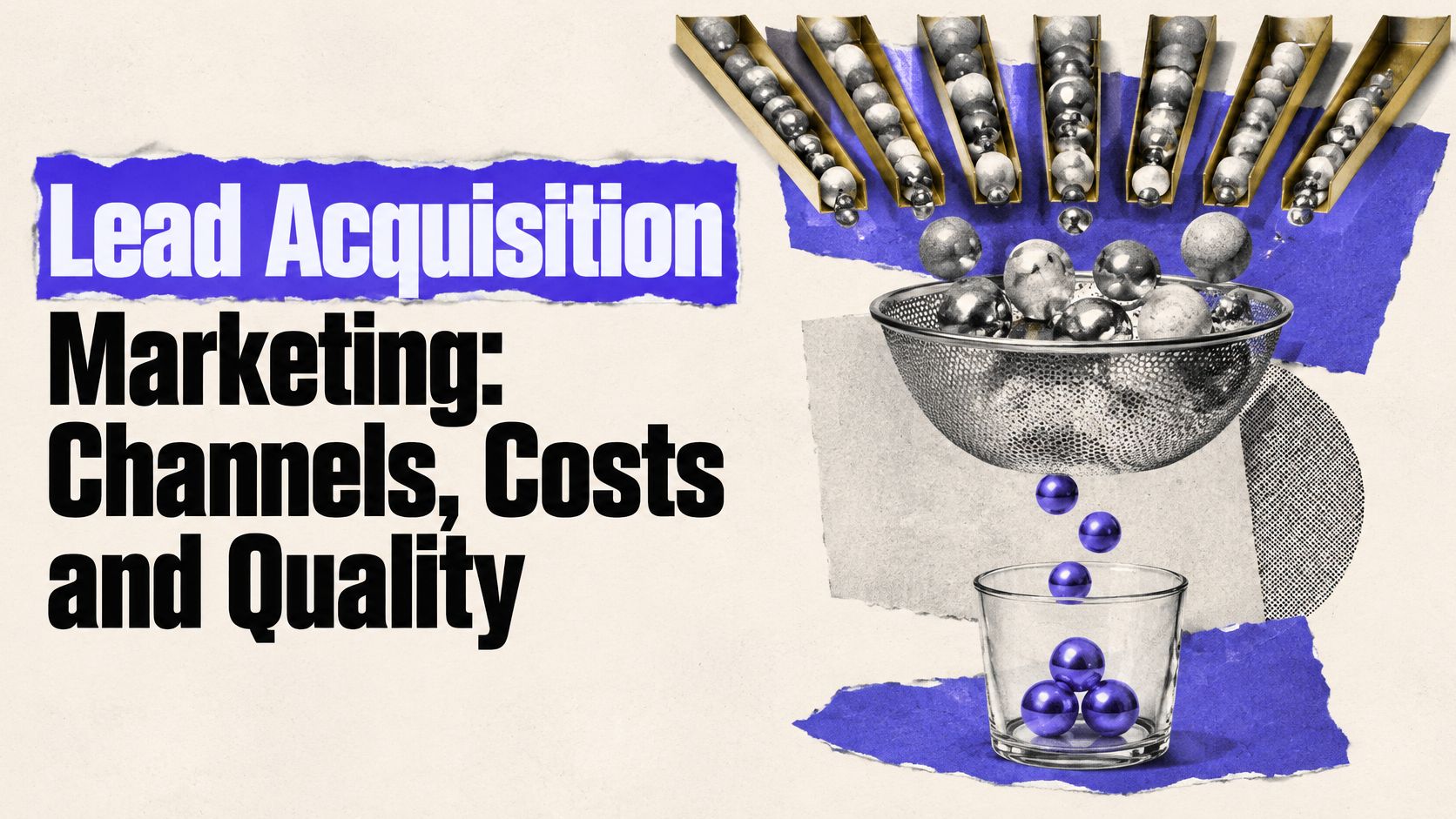
The popular advice is to get more leads. That advice is backwards. Lead acquisition marketing fails less often from low volume than from weak fit, poor inbox placement and slow follow-up. A campaign can produce replies every day and still produce no pipeline if those replies come from the wrong companies, land outside the inbox for most prospects, or sit unanswered while a competitor books the call.
Volume is an input. Accepted, qualified revenue is the output that matters. Founders with a defined offer need a channel they can control, a qualification standard written before launch, and measurements that separate a reply from an opportunity. Anything else is activity dressed up as growth.
Lead Acquisition Channels Compared Side by Side
Lead acquisition marketing is the work of generating sales conversations with prospects who fit a defined offer, through channels that can be measured and controlled. That definition excludes a lot of busywork. Traffic isn't a lead, a clicked ad isn't a conversation, and a downloaded list isn't pipeline.
The choice comes down to control. Outbound email and phone create volume on demand, but they depend on list quality, contact accuracy and deliverability. Referrals and content depend on relationships or time, so founders can't turn them on when the pipeline thins. Paid media sits in between, controllable by budget yet exposed to competitors bidding up the same clicks. The distinction between generating a lead and working a prospect is covered in the guide to lead generation versus prospecting, and it matters here because each channel below does a different part of that job.
Lead Acquisition Channels Compared on the Criteria That Decide the Choice
| Channel | Who controls volume | Time to first conversations | Cost pattern | Main failure point | Best fit |
|---|---|---|---|---|---|
| Outbound email | Volume set through list size and sending limits | Weeks, after domain warm-up | Low cost per send, plus tooling and list work | Inbox placement and list quality | B2B teams with a defined offer and buyer list |
| Outbound phone | Limited by dials and rep hours | Days, once a list is ready | Rep time per conversation | Contact accuracy and rep skill | High-ticket offers that need live conversation |
| Paid search and social ads | Budget sets volume | Days after launch | Cost per click rises with competition | Cheap clicks with weak fit | Buyers already searching for a solution |
| Referrals and partner introductions | Existing relationships | Unpredictable timing | Mostly time and relationship cost | Little control over timing | Firms with strong client networks |
| Content and organic search | Published output | Months | Writing, production and search expertise | Slow return on early effort | Categories with long research cycles |
| Events and trade shows | Event calendar | Set by event dates | Booth, travel and staff time | Weak lead capture and follow-up | Markets that gather in person |
| Managed outbound provider | Contract scope and list size | Weeks, after setup | Priced per qualified lead or per engagement | Fit of offer and targeting | Teams without an internal sales development function |
Paid clicks deserve a warning. Cheap clicks look efficient until competition raises the cost per click and the leads stop matching the offer, at which point the channel delivers volume the sales team rejects. A managed outbound provider is one more option in the table, priced per qualified lead or per engagement, and it's most useful for teams that don't have an internal sales development function to run lists, inboxes and follow-ups.
Practical rule: Shortlist two channels that match sales cycle length and deal size, then test them against accepted leads, not raw responses.
Targeting Buyers by Where They Are in Research
Targeting decides which replies are worth having, because prospects reach a vendor at different research stages. A founder treating every prospect as equally uninformed will bore the ones who have already compared options and confuse the ones who haven't named the problem yet.
That gap has widened. LoudFace's state of B2B SaaS marketing and AI search research reports that 94% of business buyers used AI during the buying process, 70% preferred a digital, self-service experience, and 69% wanted to validate AI-generated information with a sales representative. A prospect who used AI to build a shortlist has already compared you against alternatives, so outbound messaging has to survive review sites, peer content and AI answers before a rep ever replies. That last figure also hands outbound a job: offer to check the AI's homework rather than pitch cold.
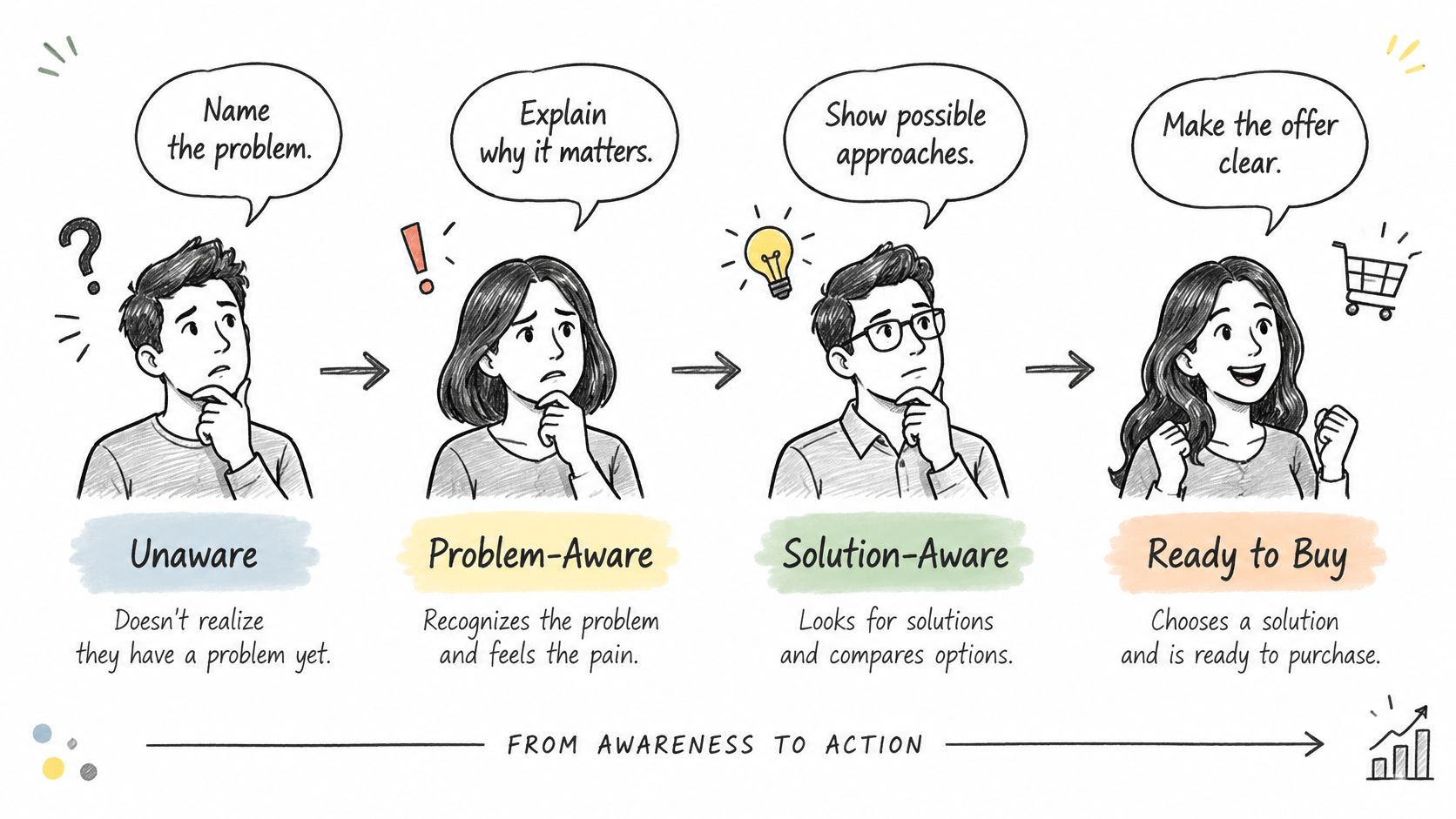
Four Research States and the Message Job for Each
- Unaware: Frame the problem in plain operational terms. Selling a solution to an unrecognized problem doesn't work.
- Category-aware: Position against the alternatives already under consideration, with a clear reason the offer differs.
- Shortlist-ready: Send concise, checkable proof. Specific delivery details beat broad claims.
- Actively validating: Offer references, implementation specifics and one clear next step.
Research state can be inferred, imperfectly, from signals such as hiring for roles the service supports, a recent change in the buying role, visits to comparison pages, and mentions on review sites or in peer content. The method behind gathering and checking those signals is covered in the overview of what prospect research involves. Treat every signal as a guess until results confirm it, and test each one against accepted-lead outcomes before scaling it.
For data sourcing, shared databases are common and often saturated, since every competitor mails the same records. Supplementing them with scraped company sites, enrichment from public records and API-based sourcing produces fresher records, and each record still needs verification before any send.
Say a staffing firm splits employers into two segments, those hiring for a role now and those posting the same role repeatedly. Each segment gets a different message, one about speed, one about a stalled search. After a few hundred contacts per segment, the firm compares shortlist inclusion, reply quality and progression into pipeline. Replies that stall before a qualified call count the same as silence for this decision. The segment producing accepted leads earns more volume; the other gets revised or cut.
How to Set Up Sending Infrastructure Before Volume
Infrastructure comes before copy, because inbox placement caps everything downstream. Validity's 2025 benchmark report reports average combined inbox placement of 83.6% for B2B senders using Office 365 and Google Apps. That means about 16.4% of messages land outside the inbox, so a campaign sending 10,000 messages could lose roughly 1,640 before copy or targeting gets judged. Validity attributes part of the B2B difficulty to lower consent standards and weaker engagement signals, which damage sender reputation over time.
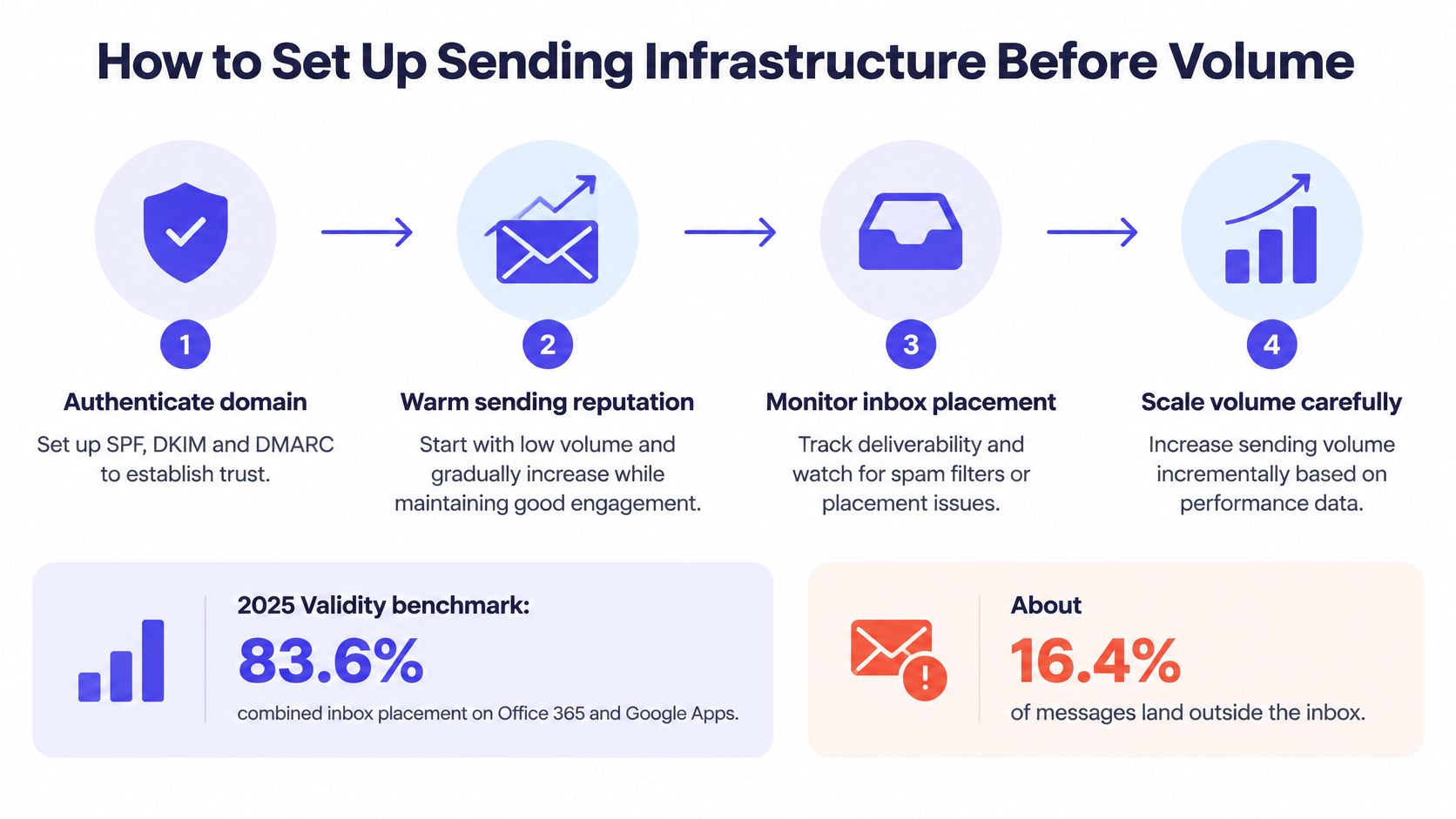
Setup Steps in Order
- Separate sending domains: Register distinct domains and inboxes for each client or campaign, never the main company domain, so outreach problems can't harm operational mail.
- SPF: Publish a record listing only the hosts authorized to send, so receivers can confirm the sender is legitimate.
- DKIM: Sign outgoing mail so the signature matches the visible From domain and message integrity can be verified.
- DMARC: Publish a record starting at p=none, with SPF or DKIM aligned to the From domain.
- Warm-up: Increase volume gradually with consistent engagement before any large send, since warming builds sender reputation rather than decorating a launch checklist.
- Suppression and unsubscribe: Maintain suppression lists and a functional one-click unsubscribe header on every campaign.
- Monitored ramp: Scale volume while watching bounce and complaint rates, and pause domains that deteriorate.
The compliance thresholds aren't optional detail. Google's sender guidelines advise keeping the spam rate in Postmaster Tools below 0.3%, recommend staying below 0.1%, and require bulk senders to authenticate with SPF, DKIM and DMARC. Google's bulk sender requirements apply from February 2024 to senders transmitting 5,000 or more messages per day to Gmail accounts, including RFC 8058 one-click unsubscribe headers for marketing messages. Microsoft's high-volume sender requirements cover domains sending more than 5,000 emails per day and require passing SPF and DKIM plus DMARC at p=none or stronger. The FTC's CAN-SPAM compliance guide requires accurate sender identity, a valid physical postal address, and opt-outs honored within 10 business days. Deeper operational detail sits in the guide to email deliverability best practices.
Sender Thresholds That Govern Inbox Placement
| Requirement | Threshold | Source |
|---|---|---|
| Gmail spam rate | Keep below 0.3% in Postmaster Tools, ideally below 0.1% | Google Postmaster Tools guidance |
| Gmail bulk sender volume | 5,000 or more messages per day | Google sender requirements from February 2024 |
| Microsoft high-volume senders | More than 5,000 emails per day, with SPF and DKIM passing and DMARC at p=none or stronger | Microsoft sender requirements |
| CAN-SPAM opt-out | Honor within 10 business days | FTC |
| B2B inbox placement benchmark | 83.6% average for Office 365 and Google Apps senders | Validity 2025 benchmark |
Warm-up and authentication are controls to baseline per domain and track over time. They aren't promises of a fixed inbox rate, and any provider quoting one without baselining the actual domains is guessing.
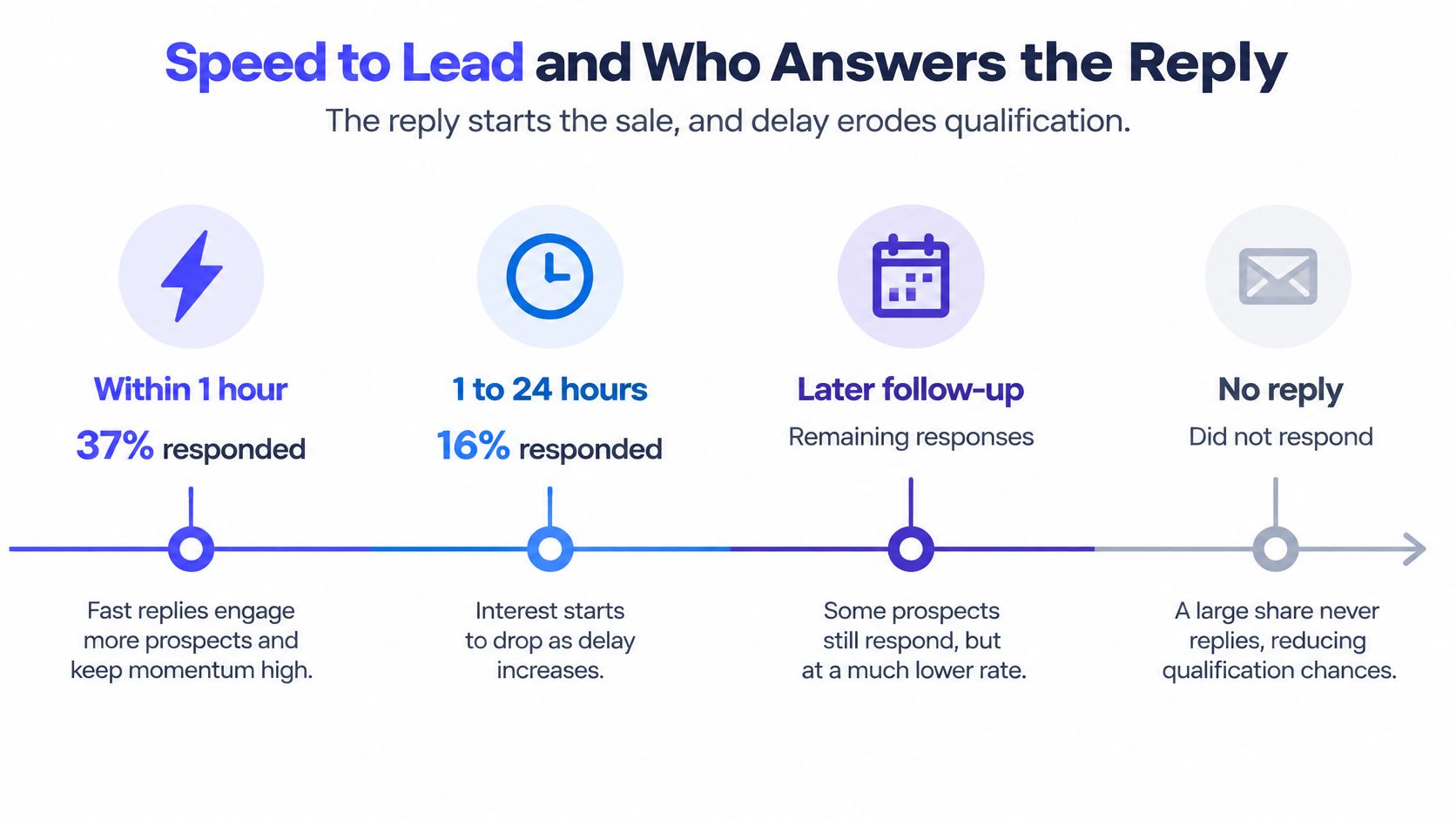
Speed to Lead and Who Answers the Reply
The reply starts the sale, and delay erodes qualification. A common failure looks like this: a positive reply lands in a shared inbox Monday morning, sits while the team works out who owns it, and gets an answer Tuesday afternoon. By then the prospect has booked a call with a faster vendor, and the infrastructure spend that produced the reply buys nothing.
A Harvard Business Review audit summarized in vida.io's speed to lead research overview submitted test leads to 2,241 U.S. companies and recorded that only 37% responded within one hour, 16% responded within one to 24 hours, 24% took more than 24 hours, and 23% never responded, while companies contacting a lead within one hour were nearly seven times as likely to qualify it as companies waiting one additional hour and more than 60 times as likely as companies waiting at least 24 hours. That audit covered inbound web leads rather than cold email replies, so the scale is directional for outbound. The direction holds either way: delayed handoff lets competing vendors engage first while the prospect's urgency cools.
Handoff Targets Worth Contracting
- Automatic routing: Each positive reply enters the CRM immediately with a named owner and a response clock running.
- A human answer in minutes: Someone replies within minutes during working hours, even if the full answer takes longer to prepare.
- Same-day follow-up: Silence after the first response triggers a follow-up before the day ends.
An in-house team can hit those targets, though it takes routing rules plus hiring, training and supervising a sales development function. A managed provider runs inbox management and follow-ups while the client runs sales conversations and closes deals. IronPeak Marketing handles daily inbox management and follow-ups after setup, and the client's team only attends the sales calls booked on its calendar. Under either model, the contract should name who owns each reply and how long it may wait.
If replies arrive but handoff is slow, the bottleneck sits in follow-up rather than sourcing. Fixing list quality won't repair a routing problem.
Reporting should show median response time, the share handled within five minutes and within one hour, and qualification rate by response-time band. Those numbers also protect a pay-per-qualified-lead arrangement, because they reveal whether weak results come from the outreach itself or from what happened after the prospect raised a hand.
Judging Lead Quality Before Counting Leads
Lead count is a weak measure. A lead can be valid, responsive and still produce no revenue, because the company is too small, the contact can't buy, or the timing is wrong. Counting such leads rewards the wrong behavior and hides the actual cost, which is sales time spent on conversations that were never going to close.
Quality depends on a qualification definition agreed with the client before launch, in writing. Without that agreement, every rejected lead becomes an argument and every report becomes negotiable.
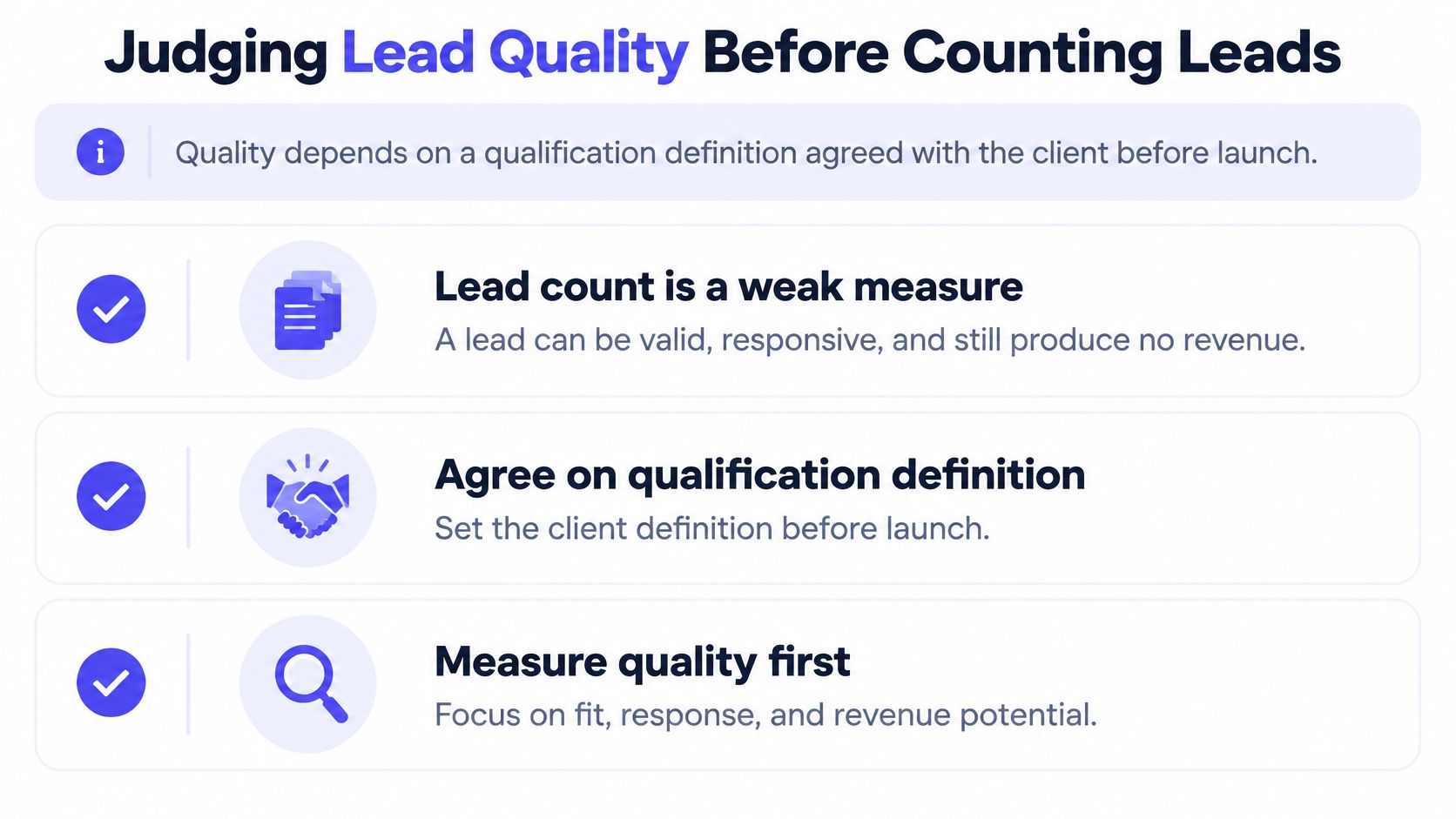
Qualification Checklist
- Firmographic fit: Company size, sector and location match the offer's proven buyer profile.
- Problem relevance: The prospect has the specific pain the offer solves, stated or clearly evidenced.
- Buying authority: The contact can approve the purchase or directly influence the decision.
- Timing: A budget, trigger event or active initiative exists in the recent period.
- Explicit next-step intent: The prospect agreed to a call or asked for specifics, rather than replying politely.
Attribution complicates the picture further. B2B marketing research from 6sense on the state of B2B marketing metrics in 2025 found attribution-model adoption at 92% among surveyed account-based marketing teams and 68% among legacy marketing teams, yet only 20% and 18% respectively reported using statistical modeling. Many teams still rely on first-touch, last-touch or multi-touch rules. Those rules can credit outbound for a deal that was already near purchase, or give it no credit when another channel touched the prospect later. Randomized holdouts and territory-level comparisons provide stronger evidence, because they compare exposed prospects against similar unexposed ones instead of arguing over touch order.
Consider two programs. One delivers 60 accepted leads with loose fit. Another delivers 25 high-fit accepted leads. The second program can easily produce more pipeline and more revenue per accepted lead, because sales time concentrates on buyers with authority, budget and timing. For high-ticket software, agencies, staffing firms and specialist services, that pattern is the norm rather than the exception.
After acceptance, tracking should cover opportunity creation, pipeline velocity, win rate and revenue per accepted lead. Rejected leads also need a written definition agreed in advance, so scoring stays fair to both sides and the provider can't bill for prospects the client never agreed to accept.
Response Rates and Cost per Qualified Lead
Replies are cheap to count and expensive to trust. What matters is how many survive qualification and turn into accepted leads, because a reply with no authority, budget or timing behind it still consumed staff time to answer.
The Direct Marketing Association's Response Rate Trends Report analyzed more than 1,500 campaigns conducted during 2004, 2005 and 2006 across 19 industries and seven media types. For lead generation campaigns, Chief Marketer's report on the 2006 findings recorded telephone at an average of 2.60% and email at 2.45%. A later study reported by Chief Marketer on the 2007 DMA results covered more than 1,600 campaigns collected since 2004 and recorded email at 4.09%, the highest response among six channels compared for lead generation.
Both sets are dated and cross-industry. Use them as a range and model your own list against them. Sender reputation, list quality, offer strength and market saturation can push a real campaign well above or below any published average, and the economics depend on targeting accuracy, sufficient volume, deliverability and follow-up.
Average Response Rates for Lead Generation Campaigns
| Channel | Average response rate | Study period | Sample |
|---|---|---|---|
| Outbound telephone, lead generation campaigns | 2.60% | 2004 to 2006 | Over 1,500 campaigns across 19 industries and seven media types |
| Email, lead generation campaigns | 2.45% | 2004 to 2006 | Same study and campaign set as telephone |
| Email, lead generation campaigns | 4.09% | 2007 study, data collected since 2004 | More than 1,600 campaigns compared across six channels |
Worked Example With Replaceable Inputs
Say a campaign sends 1,000 emails and hits the historical 2.45% average. That's about 24 replies. If 6 of those 24 match the offer and pass the qualification checklist, the campaign produced 6 qualified leads. Cost per qualified lead equals total program cost divided by qualified leads the client accepts. If total program cost is $1,800, the cost per accepted lead is $300.
Improve inbox placement or tighten reply handling and the same send produces more qualified leads, which is why both get measured as inputs rather than assumed. Total cost has to include every line, or the comparison against other channels is fiction:
- Data sourcing and verification: Cost per record, including enrichment and removal of invalid contacts.
- Sending infrastructure: Domains, mailboxes and warm-up tooling.
- Copywriting: Initial sequences plus revisions after reply analysis.
- Reply handling: Staff time spent qualifying, routing and following up.
- Provider fee: Any per-qualified-lead charge under a managed arrangement.
Cost per accepted lead only makes sense next to deal size and close rate. A $300 accepted lead is cheap for a high-ticket service with strong margins and expensive for a low-priced offer. From the first send, three numbers deserve tracking: responses, qualified replies and accepted leads. Everything else is diagnostic.
Pick a Channel Mix and Run a 45-Day Test
A disciplined test beats a year of scattered effort. Choose one primary channel and one test channel matched to sales cycle and deal size, then write the qualification definition before anything launches.
- Set baselines: Record expected response, qualified and accepted rates before the first send.
- Launch narrow: Run one offer to one buyer segment, so results point to a cause.
- Review at day 15: Check inbox placement and complaint data, then adjust copy or volume.
- Judge at day 45: Compare accepted leads and opportunities by segment.
- Scale selectively: Increase volume only on the segment with the best accepted-lead rate.
Provider evaluation needs direct questions. How is inbox placement measured, and which spam-rate thresholds get tracked. Who owns domain authentication and warm-up. How is a qualified lead defined, and who signs off on it. Who answers positive replies and how fast, since a positive reply that waits days for a response is spend without a sales call. Whether rejected leads are billed, and what the per-lead fee covers. Reporting should match internal reporting: delivered, inboxed, replied, positive-replied and accepted rates.
The qualification definition deserves the most attention on that list. "Interested" is not a qualification. Name the company size, role and situation that make a reply worth a sales call, and agree on who signs off before the first send. A provider can report strong reply volume while the calendar fills with calls that never become opportunities.
Before buying anything, one question needs an answer: which numbers will show the channel worked. Define the result that would make the team stop before the test starts.
IronPeak Marketing runs managed cold email campaigns for B2B companies, agencies and high-ticket service providers, covering dedicated sending infrastructure, prospect data, copy, inbox management and follow-ups on a pay-per-qualified-lead basis. Founders who want lead acquisition judged by accepted leads rather than reply volume can review the model and book an assessment at IronPeak Marketing.