Lead Generation Agency Models and How to Choose One
Compare lead generation agency service models, see how managed cold email works, and check deliverability, compliance and pipeline before you sign.
Most advice about picking a lead generation agency tells you to compare cost per lead, ask for a reply rate and check the case studies. That advice is backwards. Cost per lead is a price for an outcome you can't inspect, and a reply rate is a side effect of infrastructure you never see. Two providers quoting the same fee per qualified lead can be running completely different operations underneath it. One sends from domains built for your account, with SPF, DKIM and DMARC aligned and complaints watched daily. The other sends from a shared domain that has already absorbed three other clients' spam reports, and your campaign inherits the damage.
The checks that separate them are duller than the questions founders ask on sales calls. What matters is who owns the sending domains, how complaints get monitored, whether qualification rules exist as a document, and what reporting arrives each month. This guide judges a lead generation agency on its sending infrastructure, its compliance setup and how it measures pipeline, and it names the contract terms that prove each control is real.
Service Models a Lead Generation Agency Offers
A lead generation agency finds prospects that match your offer, runs outreach to them on your behalf, and passes qualified conversations to your sales team. That single definition covers five commercial models, and the model you pick decides more about your result than the agency's skill does.
The category is large enough to matter to budgets. In March 2025, 58.2% of US B2B enterprise marketers dedicated at least half their budget to lead generation, according to EMARKETER data reported by AxioBench. Spending at that level on a model you haven't examined is how six months disappear.
| Model | How it is paid | Who owns the sending infrastructure | Main risk | Best fit |
|---|---|---|---|---|
| In-house sales development team | Salaries, tools and management time | Your company | Hiring, training and supervision cost before the first meeting | Companies with enough outbound volume to keep one person busy full time |
| Monthly retainer agency | Fixed monthly fee | Set by contract, confirm before signing | Fee is paid whether or not leads qualify | Teams that want strategy and can judge lead quality themselves |
| Pay-per-lead managed service | Fee per accepted qualified lead | Provider builds custom domains and dedicated inboxes for the client | Qualification rules must be written down before launch | Founders and service firms with a defined offer and high customer lifetime value |
| Shared-database list purchase | One-time or subscription data fee | Your company | Stale or overlapping records and no control over sending reputation | Teams that already run their own sequences and reply handling |
| Paid search advertising | Cost per click | Ad platform | Cost per lead varies and lead quality can be poor | Buyers with high existing search demand for their category |
The retainer and the pay-per-lead rows are where buyers get confused. A retainer buys capacity and thinking. The fee is owed whether or not a single lead clears your bar, so the provider's incentive is to keep volume high and the calendar full. A pay-per-lead service moves that risk onto the provider, which is exactly why the qualification standard has to be nailed down before the first send. When "qualified" means "replied positively", you're paying for curiosity.
The other three rows fail for their own reasons. An internal hire needs a manager, a data budget and a year to reach competence. A purchased list hands you records without the sending reputation or the sequence logic. Paid search works only where demand already exists, and the cost per lead climbs as competitors bid the same keywords.
The test that settles most of it: ask who sends the email, whose domain collects the complaints, and who has the right to reject a lead. If all three answers sit with the provider, you're buying volume, not qualification.
How a Managed Outbound Campaign Runs Step by Step
A managed campaign runs in a fixed order. The first two steps decide whether the other five are worth running at all, and skipping either one is why outbound programs stall around week six.
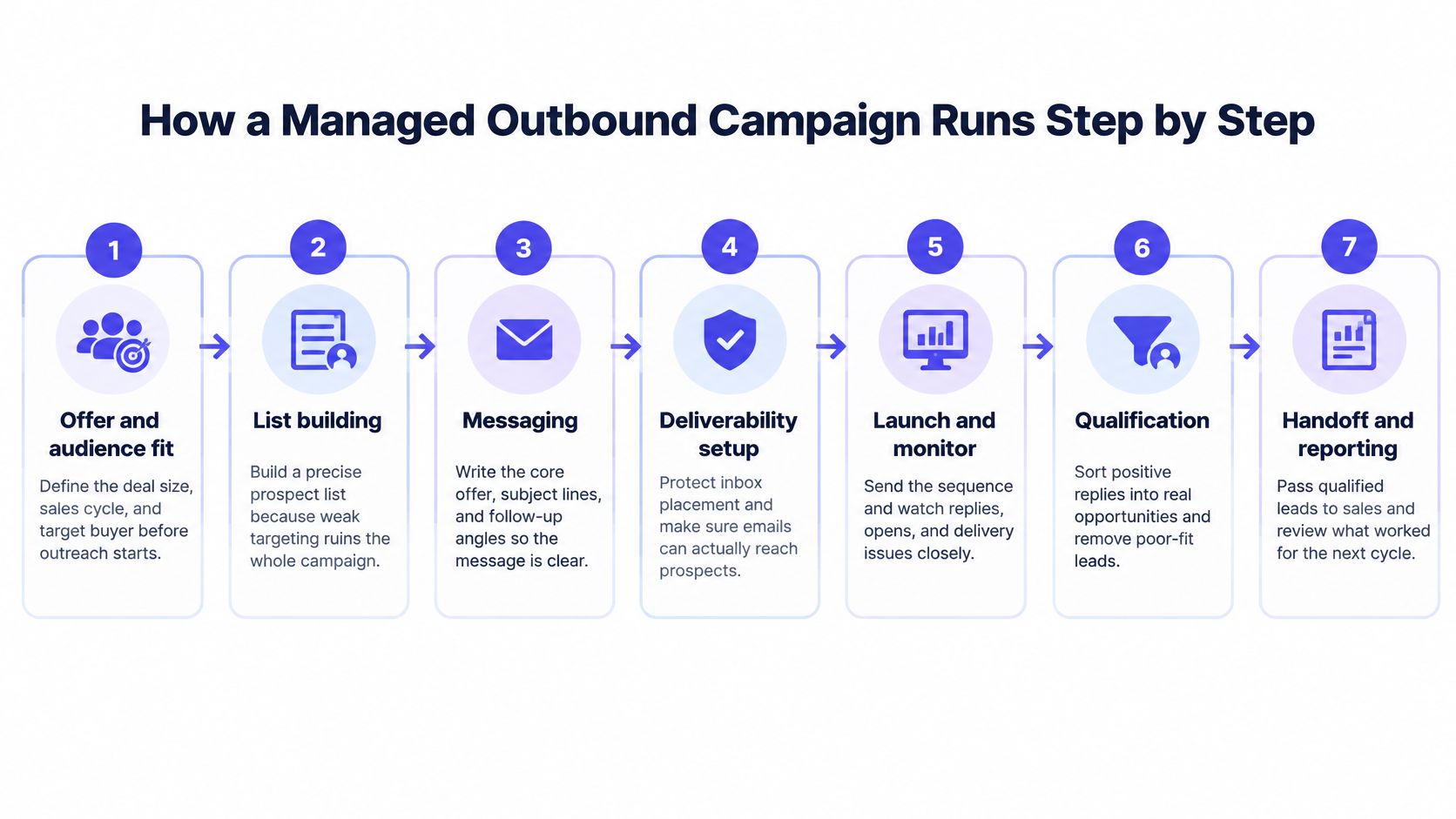
1. Assessment. Before a line of copy is written, the agency reviews your offer, your target market and how you acquire customers today, then decides whether cold email suits that market. IronPeak Marketing analyzes the prospect's current situation, target market and offer to decide whether its cold email system fits their growth goals. The usual mistake is launching where a closed deal is worth less than the cost of the outreach that found it. No amount of copy fixes unit economics.
2. Infrastructure. This means custom sending domains, dedicated inboxes, SPF, DKIM and DMARC records, tracking, and a warm-up period before volume climbs. Sending from your primary company domain is the slip that outlasts the contract, because every complaint lands on the domain that carries your invoices and password resets.
3. Prospect research. Records get sourced, deduplicated and enriched with firmographic and role data, plus a company-specific trigger such as a funding round, a new location or a job posting that signals a problem worth paying to solve. Each field keeps its source and the date it was checked. Accepting a database export without verifying role relevance is how a list looks clean and still burns a month.
4. Copy and sequence design. Copy is written for one offer and one segment, and every automated follow-up checks the shared suppression list before it sends. A delayed sequence that emails someone who already asked to be removed is a compliance failure, not an annoyance.
5. Sending and inbox management. Daily inbox health checks, complaint monitoring per domain, and reply triage so an interested prospect hears back the same day. Campaigns break when replies are the only number watched while complaints build up unseen.
6. Qualification and handoff. Replies get classified against written acceptance criteria, and qualified conversations move into your CRM and calendar. The failure mode is accepting leads that nobody defined as qualified before launch.
7. Reporting. Delivered volume, replies, qualification outcomes, disqualification reasons and rejected leads, kept live rather than monthly. A report showing only booked meetings hides the difference between a campaign that works and one that has already burned through its list.
Targeting quality has to be settled before message volume. RAIN Group's prospecting research, which surveyed 488 buyers representing $4.2 billion in purchases across 25 industries alongside 489 sellers involved in outbound prospecting, reports that only 5% of sellers consider sending bulk emails effective, while buyers prefer emails that pertain to their company and industry. That finding reorders the build. Define the ideal customer profile, verify firmographic and role fit, attach a company-specific trigger, then write.
A working model separates list quality from message quality by comparing positive-reply rates across tightly segmented cohorts. When one segment replies better at identical volume, capacity moves there rather than total volume going up. That is also what makes qualified pay-per-lead economics auditable: the acceptance criteria become explicit rules instead of a judgement made after a prospect answers.
The handoff carries its own economics. McKinsey's research into how business customers buy found that organizations improving customer-management and sales processes could achieve up to 20% more customer leads, 10% growth in first-time customers and a 20% reduction in the time between lead qualification and deal closing, according to McKinsey's analysis of B2B buying behavior. Speed between qualification and handoff is where that gain lives.
Deliverability Thresholds That Decide Whether Campaigns Reach Inboxes
A cold email campaign can produce positive replies and still damage the domain that carried it. Complaints accumulate at the domain level, not the campaign level, so a program judged only on replies can look healthy while future reach falls.
The baseline is worse than most buyers assume. Average inbox placement sits around 83%, meaning roughly one in six marketing emails never reaches the inbox, and global DMARC adoption among top domains moved from 29.1% in 2023 to 47.7% in 2025, according to MarTech's reporting on email identity and deliverability infrastructure. Placement is an infrastructure outcome, not a copywriting one.
What to check before volume rises
| Control | Gmail rule or threshold | What to verify before launch |
|---|---|---|
| Email authentication | SPF and DKIM must be used for messages to Gmail | Both records pass for every sending domain and inbox |
| DMARC record | Bulk senders must publish a DMARC record, even at p=none | Record exists on each sending domain |
| DNS records | Valid forward and reverse DNS for the sending domain | Reverse lookup matches the sending server |
| Transport and format | TLS and correctly formatted RFC 5322 messages | Sending platform enforces TLS and sends standards-compliant headers |
| User-reported spam rate | Keep below 0.1 percent | Daily complaint rate reviewed per domain |
| Mitigation threshold | 0.3 percent or higher removes access to delivery mitigation | Automatic pause when a domain approaches the limit |
| Recovery period | Seven consecutive days below 0.3 percent before eligibility returns | Sending volume restarts gradually after any breach |
The technical requirements are table stakes. Messages to Gmail need both SPF and DKIM, valid forward and reverse DNS, TLS transport and standards-compliant headers, and bulk senders must publish a DMARC record even when the policy is only p=none, per Gmail's sender guidelines. None of that is optional setup. It is the price of being deliverable at all.
The gap between 0.1% and 0.3% is where a domain gets burned. Gmail calculates the user-reported spam rate daily and advises keeping it under 0.1%. At 0.3% or higher, senders can lose access to delivery support and mitigation, and bulk senders need seven consecutive days below 0.3% before eligibility returns, according to Google's bulk sender requirements. Treat that week as the minimum wait, not a restart date.
Gmail defines a bulk sender as one sending more than 5,000 messages per day to Gmail addresses. Above that line, DMARC publishing, one-click unsubscribe and opt-out processing within two days all apply. The operating consequence is simple: pause campaigns on complaint rate rather than on reply or bounce rate, and track complaints per sending domain so one scorched inbox doesn't spread to the domain your business uses for invoices. For a fuller walkthrough of how delivery interacts with list quality, this guide to email delivery rate covers the mechanics.
Compliance Rules That Change by Recipient and Country
The rule that governs an email is set by the recipient's location and legal form, not by where the agency is based. A single campaign list can hold companies that need no consent and individuals who do.
| Recipient | US under CAN-SPAM | UK under PECR | What the workflow must do |
|---|---|---|---|
| Any commercial recipient | Clear opt-out method, honored within 10 business days, working for at least 30 days after sending | Opt-out must be honored and a valid contact address included | Shared suppression list checked before every send |
| Corporate subscriber (limited company, LLP, government body) | Same opt-out duties apply | Consent rule for electronic mail generally does not apply | Still apply data protection rules when personal data is used |
| Sole trader or some partnerships | Same opt-out duties apply | Treated as individuals, so specific consent or a valid soft opt-in is generally required | Classify legal entity type during enrichment |
| Plain-language reply such as 'remove me' | Must be treated as an opt-out | Must be treated as an opt-out | Route the reply to suppression automatically |
The US opt-out mechanics
Marketing messages need a clear and conspicuous explanation of how to stop future mail. The opt-out mechanism has to keep working for at least 30 days after the email is sent, requests must be honored within 10 business days, and the sender can't initiate further commercial email once the opt-out takes effect, as the FTC's CAN-SPAM compliance guide sets out.
In campaign mechanics, that means one suppression list shared across every inbox and sequence, not a separate unsubscribe file per mailbox. A prospect who replies "remove me" counts as opted out even without touching a link, and follow-up automation should check the suppression list before every send, because a queued step can otherwise fire after permission is withdrawn.
The UK subscriber split
UK rules turn on the type of subscriber. The consent rule for electronic mail doesn't apply to corporate subscribers such as limited companies, limited liability partnerships and government bodies, so unsolicited B2B email can generally reach them without prior consent. Sole traders and some partnerships are treated as individual subscribers and generally need specific consent or a valid soft opt-in, per the ICO's direct marketing guidance. Data protection duties still apply whenever the message carries personal data such as an employee's name or phone number.
That makes enrichment a compliance step, not a data-quality extra. Every record should be classified by legal entity type before it enters a sequence, with the business identity, source and lawful-basis assessment kept alongside it.
Measuring Pipeline Instead of Booked Meetings
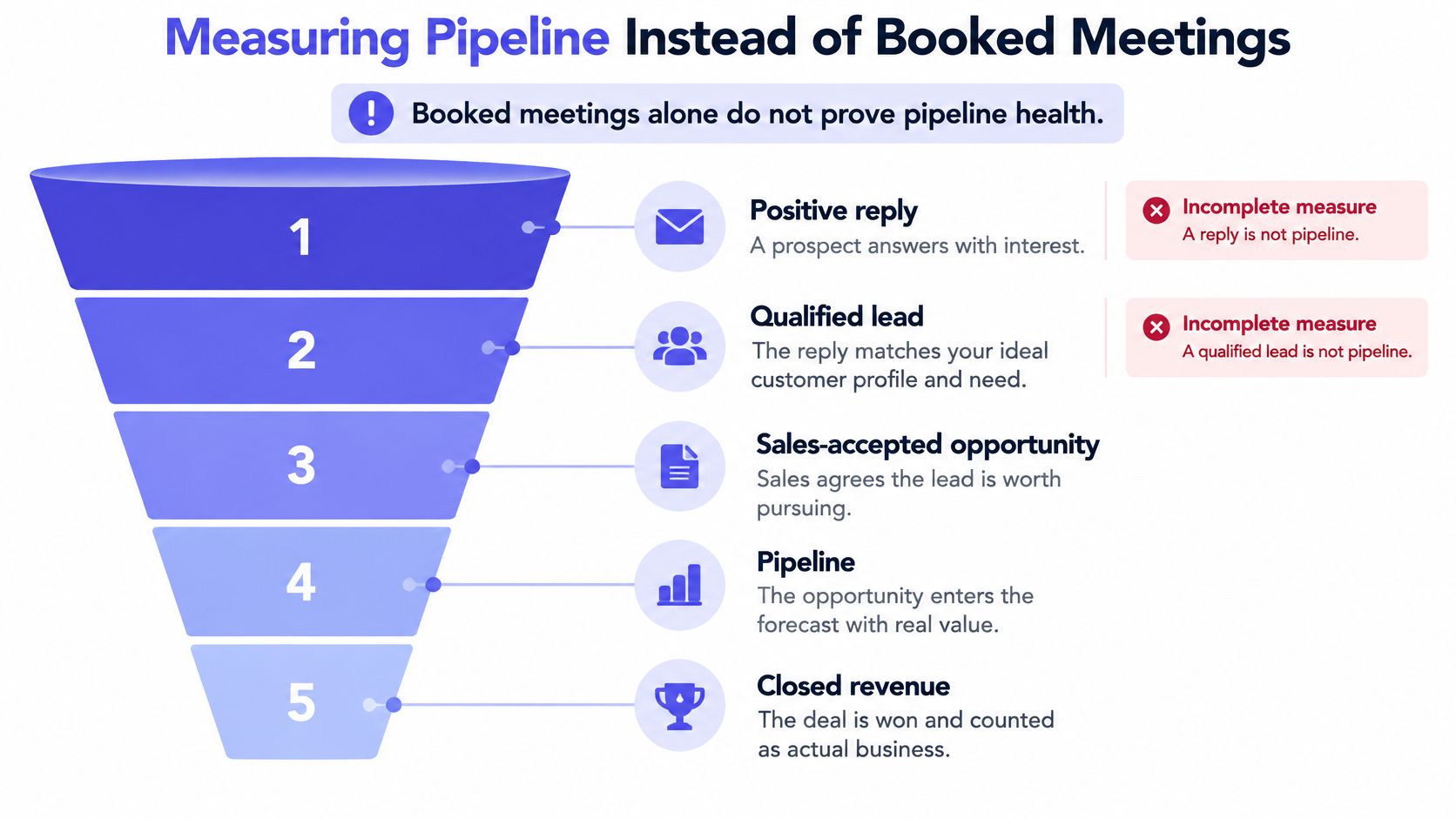
Booked meetings and accepted leads are both incomplete measures. A meeting can be booked with a company that will never buy, and a lead can be accepted because nobody wrote down what qualified means. The only honest scorecard runs from the reply to the revenue.
Five stages and who owns each
- Positive reply. The prospect answers with interest. The agency owns this stage, and it proves the message reached a human.
- Qualified lead. The reply matches the written criteria on company size, role, trigger and buying signal. The acceptance criteria decide, not the prospect's enthusiasm.
- Sales-accepted opportunity. Your sales team decides, using the criteria it agreed to before launch. The evidence is the acceptance note plus a written reason on everything rejected.
- Pipeline opportunity. The deal enters your forecast with a value and a close date in your CRM. Without a value attached, it isn't pipeline.
- Closed revenue. Won business attributed inside a window you fixed before launch, not one chosen afterwards.
Attribution is where these numbers get slippery. One analysis reports that traditional attribution tools capture only about 27% of the B2B buyer journey, with the other 73% happening in untracked AI conversations, private communities, referrals and direct searches, per MarketScale's analysis of how buyers form vendor shortlists. The same coverage cites 2025 buyer research finding the winning vendor was already on the buyer's initial shortlist 95% of the time.
That raises a question worth putting to any provider: does outbound create demand, or intercept demand that already exists? For a defined offer with a short sales cycle, interception is often enough and the numbers show up quickly. For a new category, expect a longer window before the effect is measurable, and say so in the contract.
The fields to request: disqualified reasons on every rejected lead, account-level engagement, opportunity progression through stages, influenced pipeline, and revenue attributed inside a stated window.
What a Qualified Lead Costs in Practice
The formula is total fee divided by accepted opportunities. Not replies, not meetings booked, not leads delivered. Everything upstream is an input cost.
Work through a hypothetical month. Say the fee is $4,000, the campaign delivers 4,000 first-touch emails, and the positive-reply rate is 1.5%. That's 60 replies. If 40% pass written qualification, you have 24 qualified leads. If your sales team accepts 15 of those 24 as opportunities, the cost per accepted opportunity is $4,000 divided by 15, or about $267.
Now run the same month with a deliverability problem that cuts delivered volume to 2,500 at identical rates. You get roughly 37 replies, 15 qualified leads and about 9 accepted opportunities, pushing the cost per accepted opportunity to roughly $445. The fee never moved. The output fell by 40%.
That asymmetry is why complaint control belongs in the contract rather than in a monthly review call. A provider's revenue is stable while your cost per opportunity swings on inbox placement, so the pause rules have to be written down and triggered by the provider, not negotiated after a bad month.
Replace the numbers above with your own quoted fee and your own measured rates before using the calculation to compare proposals, and see this breakdown of lead acquisition marketing for how the upstream stages feed the same math. Two proposals at different fees can invert once acceptance rates enter the model.
How to Judge Whether to Hire an Agency
Everything worth verifying can be checked before signing. Each of these questions maps to a specific risk, and a vague answer is itself the finding.
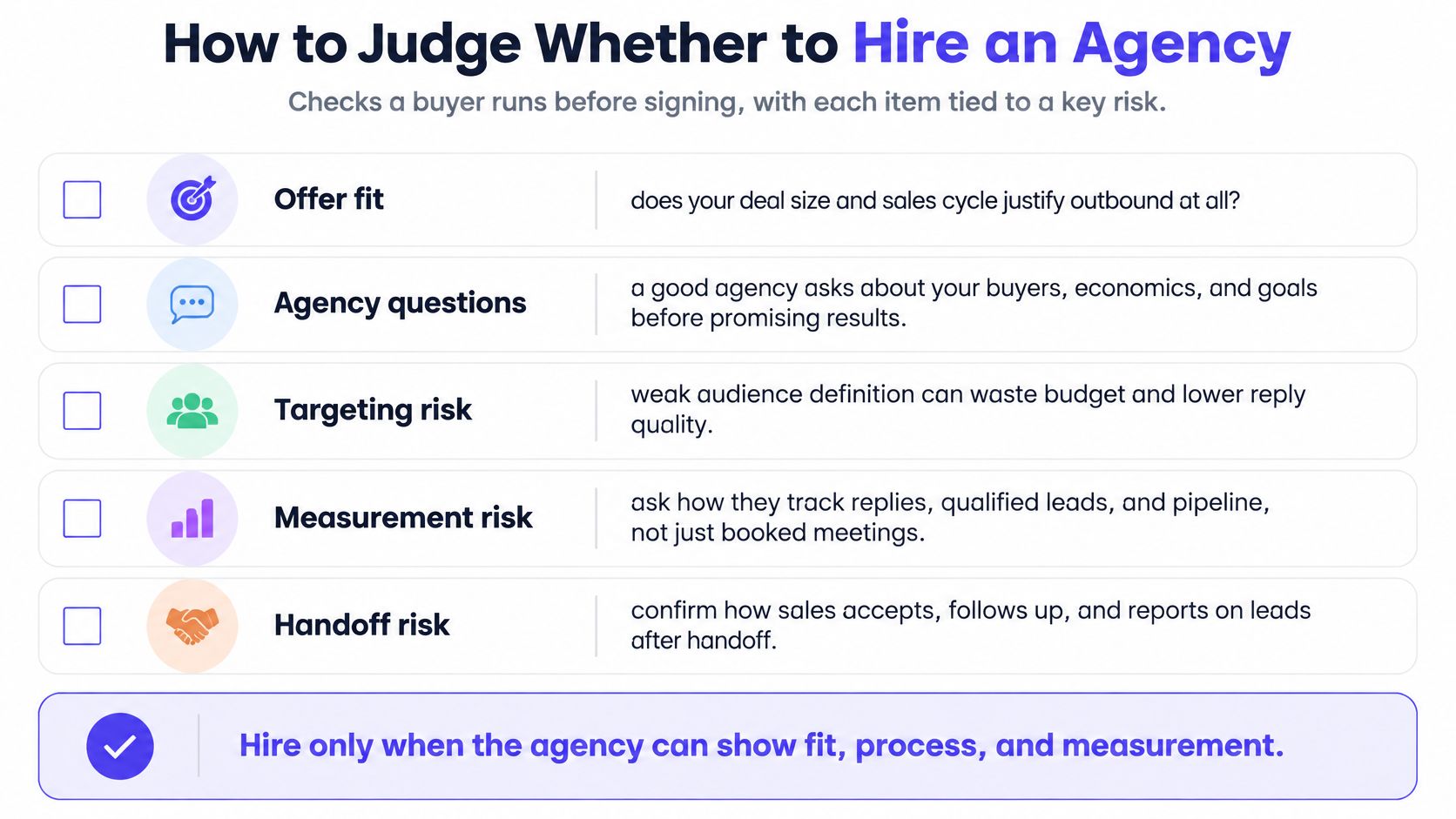
Seven questions to ask before signing
Does outbound fit the offer at all? Deal size, sales cycle, margin and customer lifetime value decide the answer. A good agency asks about all four before quoting a number. The risk is buying outbound for a product where one sale can't cover the cost of finding it.
Are the domains and inboxes dedicated to you? Ask whether the sending domains were built for your account or shared across clients, and whether you get admin access. A shared domain absorbs other clients' complaints, and your placement pays for their mistakes.
Can you export the contact list and the suppression list? You should be able to request both on the day you leave. The risk is renting a pipeline you can't take with you.
Are qualification rules a document, and can you reject a lead without paying? Ask for the acceptance criteria in writing and a rejection right in the contract. With IronPeak Marketing, clients pay per qualified lead rather than a fixed retainer and can reject leads that don't meet their standards without paying for those leads. Pay-per-lead pricing without a rejection right is a retainer with extra paperwork.
Who handles the conversation after the first meeting? Cold email shortens the path but doesn't replace the seller. McKinsey's study of more than 1,000 B2B buyers across four countries found that 76% said speaking with a salesperson was helpful when researching a new product or service, while only 46% would buy from a supplier's website when that option existed, per McKinsey's research on when B2B buyers want to go digital. Confirm who attends the calls and who follows up.
What is the term, and when can you stop? Month to month with cancellation at any time is a different commitment from a fixed multi-month contract. Ask what happens to build cost if you cancel in month two.
What happens to warm domains and inboxes at exit? IronPeak Marketing builds custom domains, dedicated inboxes, copy, data enrichment and tracking in under 15 days, manages the inboxes daily and includes CRM integration and lead handoff, with the client attending the sales calls booked on their calendar. Whatever provider you choose, get the exit terms in writing.
Confirm each answer by email or in the contract, not on a sales call. A proposal that promises pipeline but omits disqualification reasons, opportunity progression and influenced revenue hasn't committed to measurement at all.
Run a Paid Pilot Before You Sign a Longer Term
The decision is whether to commit to a longer engagement, and the way to answer it is a paid pilot with pass and fail rules agreed before launch. Use the first call to pressure-test the offer, the target market and the qualification criteria. If the provider won't engage with those three, the engagement is a copywriting purchase.
Pass and fail rules for the pilot
Write these down before the first email goes out and hold both sides to them.
- Complaint rate per sending domain, tracked daily and measured against the limit the mailbox provider publishes, with an automatic pause written into the agreement.
- Delivered volume and hard bounces per domain, reported separately so a drop in placement isn't mistaken for weak copy.
- Positive-reply rate by segment, compared across cohorts rather than blended into one flattering average.
- Qualified leads your sales team accepts, with a written reason on every rejection.
- Sales calls held, not booked, since attendance is the only proof of interest.
- A disqualification reason for every rejected lead, which tells you whether the list or the pitch was wrong.
Set the volume target from your own offer and market, then fix it before launch. A target borrowed from a provider's homepage tells you nothing about your pipeline. If you sell advisory work rather than a product, consulting lead generation applies the same pilot rules to a longer sales cycle.
The final rule is a single sentence. Continue only if the pilot passes on all three counts, deliverability, qualification and handoff. Stop if complaint rates breach the agreed threshold, or if the rejected leads show the target market itself is wrong, and don't let a strong reply count talk you out of either signal. A pilot that fails on infrastructure will fail at five times the volume. IronPeak Marketing starts with a free strategy session or discovery call, with no credit card required and no commitment, which is the right shape for that first conversation.
IronPeak Marketing runs managed B2B lead generation on cold email, with custom domains and dedicated inboxes built for each client, pay-per-result pricing tied to qualified leads and a target of 60 to 90 qualified leads in 45 days. If you want a partner judged on deliverability, written qualification rules and pipeline reporting rather than booked meetings, start at IronPeak Marketing and pressure-test the offer on a free strategy call.