Consulting Lead Generation: Channels and Outbound Setup
Compare consulting lead generation channels, buyer shortlists, cold email deliverability and lead handoff, with a 45-day test plan you can run.
In 2025, 94% of B2B buying groups ranked their preferred vendors before making first contact with a seller, according to 6sense's 2025 Buyer Experience Report. That number reframes the job. Outbound rarely introduces a firm to a buyer who has never considered it. More often it arrives while a shortlist already exists and a favorite already has an internal sponsor.
Two constraints decide most outcomes before a word of copy matters: whether the mail reaches the inbox at all, and how quickly a human answers when a buyer replies. A program that ignores both will produce the same flat result no matter how many subject lines get tested.
Consulting lead generation is the system that puts a firm in front of named buyers, keeps it visible through the decision, and converts attention into booked calls. Channel choice and sending infrastructure are the two levers inside that system, and both are measurable.
Consulting Lead Generation Channels Compared
Consulting lead generation channels compared
| Channel | Control Over Timing | Time to First Qualified Call | Main Cost Driver | Best Fit |
|---|---|---|---|---|
| Referrals and partner introductions | Low | Unpredictable | Relationship time | Practices with an existing network |
| Content and search | Medium | Several months | Writing and distribution time | Narrow, searchable problems |
| LinkedIn direct outreach | High | Days to weeks | Senior hours per week | Senior consultants testing a niche |
| Cold email, managed or in-house | High | Weeks, after domain warm-up | List quality and sending infrastructure | Defined offers with named buyers |
| Paid search and ads | High | Days | Cost per click and lead quality | Buyers with active search intent |
| Events and speaking | Low | Quarterly | Travel and event fees | Verticals with concentrated conferences |
| Marketplaces and directories | Low | Weeks to months, set by listing quality | Listing fees or commission | Low-touch service lines |
Treat each column as a constraint on the plan. Control over timing decides whether you can plan revenue around a channel. Time to first qualified call decides how long you fund it before judging it. The cost driver is the line item you manage every week, and best fit tells you where the channel stops working.
Referrals and partner introductions carry borrowed trust into every conversation, which is why an introduction from a happy client outperforms a cold touch on close rate. They are also the least schedulable channel in the table. The introduction arrives when a client decides to make it, which rarely lines up with an empty pipeline. The cost is relationship maintenance, real senior hours that never appear on an invoice.
The slower and less controllable channels
Content and search run on a different clock. A narrow, searchable problem, such as margin recovery for regional distributors, can rank and convert for years, and the first qualified call still takes several months. The cost driver is writing and distribution time, the line item firms underestimate most.
Paid search produces clicks within days. For high-ticket advisory work the leads tend to be weak, because someone typing a broad query is usually still researching. Events suit verticals with concentrated conferences, where one room holds most of the buyers you would want, though timing is quarterly at best. Marketplaces and directories earn their fees on low-touch service lines, where the listing does the qualifying.
The channels you can schedule
LinkedIn direct outreach and cold email both give high control over who gets contacted and when, which is why they absorb most outbound budgets. LinkedIn moves in days and bills in senior hours per week. Cold email scales further per unit of effort, and deliverability sets the ceiling before copy ever gets read. A single warmed inbox typically sends 20 to 30 cold emails a day before complaint and bounce rates start hurting placement, so reaching hundreds of named accounts per week means running several inboxes across several domains, each needing weeks of warm-up before volume is safe. For a wider view of how these fit a budget, see this guide to lead acquisition marketing.
The pairing rule: run one channel you control (cold email or LinkedIn) alongside one channel that runs on trust (referrals, events, partner introductions). The controllable channel fills the calendar this month. The relationship channel sets the ceiling next year.
Two questions decide the mix. How many named buyers can you reach in your market, meaning companies that fit a written profile and have an identifiable decision maker? And how many qualified calls do you need each month to hit the revenue target? A market with only 300 reachable buyers will exhaust a cold email list in a quarter and needs a relationship motion instead.
Work backward from revenue
Take a firm with a 60,000 monthly revenue target, a 12,000 average engagement and a 25% close rate on qualified calls. Illustrative figures only. It needs 5 won engagements a month, and at a 25% close rate that means 20 qualified calls. Then convert calls into outreach volume using your own historic booking rate. If 2 in 100 named buyers book a call, 20 calls require about 1,000 buyers entering a sequence each month. That volume has an infrastructure price too: spreading 1,000 first touches across the month at a safe daily cap per inbox implies a stack of warmed domains running before the first send. The volume math should pick the first channel.
How Consulting Buyers Find and Shortlist Firms
Consulting buyers move through recognizable stages. They recognize a problem, build a shortlist from referrals and search, research the firm's site and profiles before any contact, hold a first conversation, receive a proposal, then seek internal approval. Each stage filters differently, and most firms only build assets for the last two.
The path is wider than any single channel. McKinsey's B2B growth research found buyers use an average of 10 touchpoints across in-person, remote and digital channels, with interactions spread roughly evenly among the three, a pattern McKinsey calls the rule of thirds (McKinsey). A prospect can see an outbound email, read a case page, attend a remote meeting, then go back to independent research before anyone from your firm speaks with them.
That research layer is increasingly machine-assisted. Buyer research summarized by Forrester finds that 94% of business buyers use AI in their buying process, and 61% use private AI tools supplied by their organization. Some of your shortlist opportunities now happen inside a tool you can't observe and can't attribute.
The four stages a buyer works through, and where a firm usually loses visibility, look like this.
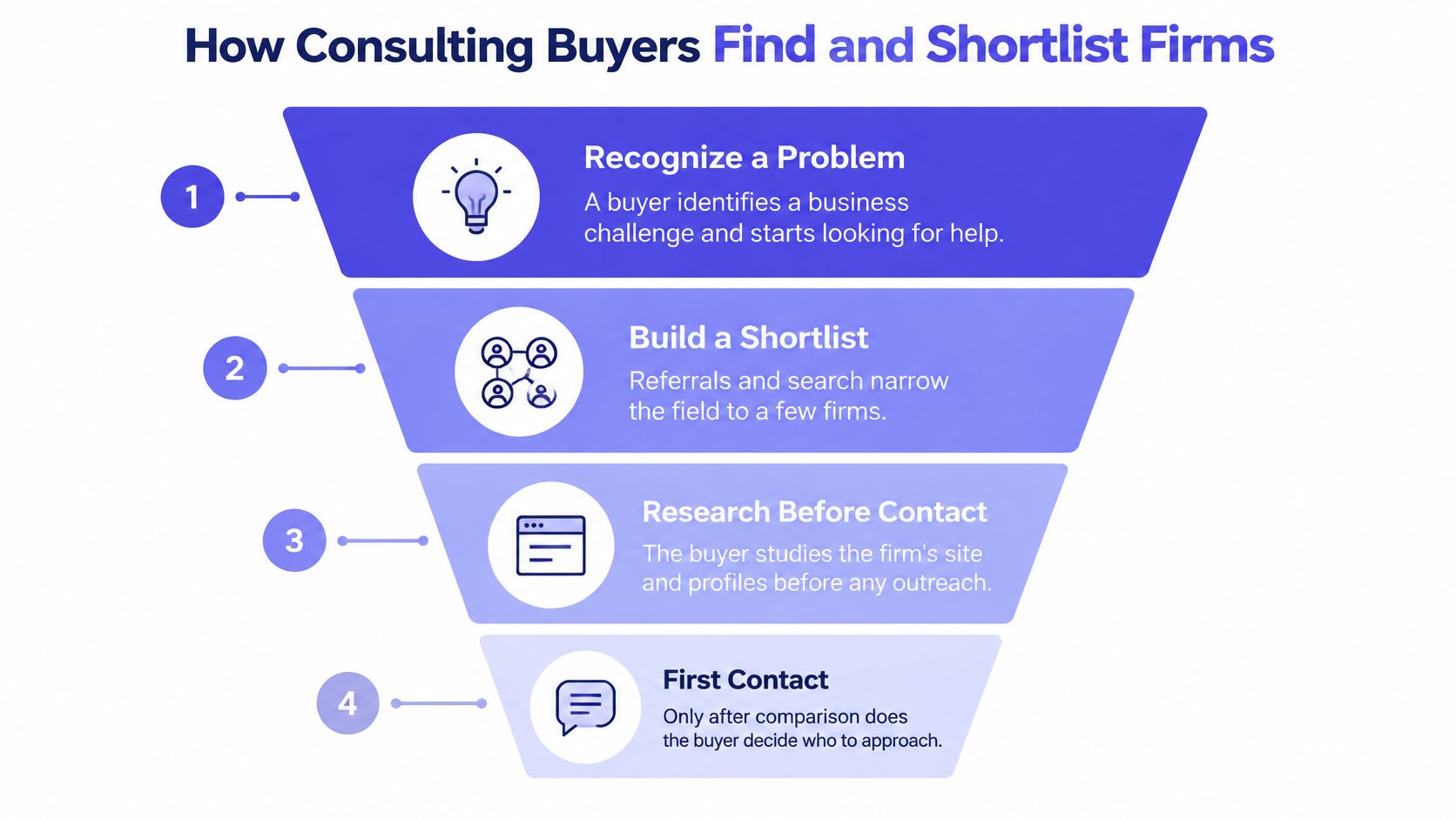
One cold email can do two things inside that path: start a conversation, and earn a look at your profile or a case page. It cannot carry the decision alone, because the buyer will compare you against two or three other names they can already see.
Judge a campaign by whether the right buyers meet your firm three or four times across the path, not by the reply rate on the first send. Replies measure one touchpoint. Shortlist inclusion measures the whole sequence.
A fractional operations consultant gets an email about inventory carrying costs. She checks the sender's LinkedIn profile, opens one case page, sees a peer mention the firm in a newsletter two days later, and replies eleven days after the original message. A program measuring reply rate on day one would have called that campaign dead. A program measuring coverage across ten touchpoints would have called it healthy.
Map your own buyer path this week. Write out the stages, list every place a buyer could encounter your firm, and mark the three touchpoints where your firm is currently absent. That gap list is the brief for the next quarter.
Positioning Your Firm Before the Process Starts
Preference often forms before anyone replies to an email. That's the part of the funnel most outbound programs never touch.

A 2024 survey of more than 300 senior executives in Europe, the United States and Australia found that 58% of management-consulting buyers had effectively chosen the winner before formal evaluation began, while 83% said firms were difficult to distinguish without research (2024 buyer journey survey). The same survey found 86% of consulting buyers said trust was as important as, or more important than, innovation. A generic capability statement that lands in week three is competing against a consensus that formed in week one.
For a smaller specialist firm without a brand or a large case-study library, the fix isn't more testimonials. It's publishing the things a buyer would need in order to defend choosing you in an internal meeting.
Five assets that create preference before the process
- A one-page diagnostic. Name the four or five questions you ask in the first call and what each answer changes about the recommendation. Buyers share this internally.
- A point-of-view article. Take one position on one named problem, with a reason a peer would disagree, and say why the peer is wrong.
- A fit statement. State who you serve, who you don't, and what disqualifies an engagement, such as a client who won't share transaction data or can't commit a decision inside eight weeks. Boundaries read as confidence.
- A client input list. Spell out the data, access and people hours you need. Buyers are buying execution risk reduction, and this document lowers it before the contract exists.
- A third-party profile audit. Make sure your site, directory listings, professional profiles and sales messaging describe the same offer, the same proof and the same numbers. AI tools and human buyers both synthesize those sources, and inconsistencies read as exaggeration.
Message test: if your outreach would still make sense with a competitor's logo on it, it's a capability statement, not a reason to prefer you.
An email that challenges one assumption beats one that lists services. Instead of "we help distributors improve operations," try: "Most distributors with two depots in the same metro fix routing before they consolidate. When the depots are more than 40 miles apart that order usually costs a year. If you're already past that question, ignore this." The message takes a position, names a cost, and gives the reader an easy exit.
Write a three-sentence fit statement, then check it against your last three lost deals. If at least one of those buyers would have self-selected out after reading it, the statement is doing real work.
Building a Prospect List That Fits Your Practice
The business universe is large and constantly refilled, so the work is narrowing the universe to fit your offer. Seasonally adjusted applications for Employer Identification Numbers ran at 450,041 in January 2024, drifted to 427,923 in May, and recovered to 436,016 in June, according to the U.S. Census Bureau's Business Formation Statistics. New firms create demand for accounting, recruiting, marketing, compliance and operations help, and established firms re-enter the market through expansion and vendor replacement.
Hold that number at arm's length. The Census Bureau counts requests for a tax ID through IRS Form SS-4. These are not confirmed operating companies and certainly not qualified buyers. They size the top of a U.S. funnel and nothing else, so a firm selling into Germany or into one metro area gets no signal from the series at all.
What the volume does confirm is competition for attention. Every qualified prospect sits on other vendors' lists too, and a trigger event that is six weeks old can describe an account that already picked a preferred firm. Filters exist to beat that clock.
| Criterion | Example Filter | Why It Matters |
|---|---|---|
| Industry | Mid-market SaaS, commercial electrical contractors | Pain points and budgets differ by sector |
| Company size | 20 to 200 employees | Determines whether the engagement fits the buyer's budget |
| Geography | Specific metro areas or countries you can serve | Affects travel, time zones and licensing |
| Trigger event | New funding round, new location, leadership change, hiring spike | Signals that a problem is active now |
| Buying role | CFO, COO, head of operations | Identifies who can approve and who influences |
| Technology in use | Specific software or platform | Reveals a gap or a dependency your work addresses |
| Exclusion rules | Existing clients, competitors, opted-out contacts | Prevents wasted outreach and compliance risk |
The narrowing sequence
- Define the ideal client from the offer. Start with what you deliver and who holds budget authority for it, then search for the firms that match.
- Apply firmographic filters. Industry, size and geography first, because they cut the universe fastest.
- Layer trigger events. A funding round, a new facility, a leadership change or a hiring spike all suggest a problem is live and a budget may be moving.
- Enrich each record with a verified role. Match by title and company, confirm the mailbox exists before the first send, and drop any record whose buying role stays unconfirmed.
- Map the buying committee. An economic buyer, a day-to-day owner and a skeptic can all sit inside one account, and one contact per account is a single point of failure.
- Verify and suppress. Remove opt-outs, current clients and anyone who asked not to be contacted again, and keep that suppression list shared across campaigns.
- Refresh monthly. Trigger events age quickly, and a list built once decays into bounces that drag down inbox placement on every later send.
A consultant starting with 1,000 candidate companies might cut to 320 after industry, size and trigger filters. Requiring a named finance or operations owner with a verified mailbox leaves 180 accounts. The other 820 rejections are where the discipline pays: record the reason each record failed, and next quarter you can re-run the trigger filter to see who became eligible. This B2B sales prospecting walkthrough covers the sourcing stage in detail.
Treat verification as deliverability insurance. Each bounced address lowers sender reputation, and low reputation is what turns a well-built list into spam folder placements that no amount of copy fixes.
Cold Email Infrastructure and Inbox Placement
Deliverability is an engineering constraint that copy cannot fix. The two largest consumer mailbox providers now publish hard thresholds, and crossing them changes what happens to your mail. For a consulting firm whose buyers form a shortlist before they ever reply, a message routed to Junk never enters the evaluation at all.
| Requirement | Gmail | Outlook.com |
|---|---|---|
| Volume that triggers requirements | About 5,000 or more messages a day to Gmail accounts | More than 5,000 messages a day |
| Authentication | SPF, DKIM and DMARC required; From domain must align with SPF or DKIM | SPF and DKIM must pass; DMARC at least p=none, aligned with SPF or DKIM |
| Spam complaint rate | Keep below 0.1%; 0.3% or higher risks filtering or rejection | Not stated in announced requirements |
| Unsubscribe | One-click unsubscribe for marketing mail | Not stated in announced requirements |
| Non-compliant mail | Filtering or rejection risk | Routed to Junk first |
The Gmail column reflects Google's sender guidelines, which set the roughly 5,000-messages-a-day trigger for senders reaching Gmail accounts and state that complaint rates at or above 0.3% risk filtering or rejection. Microsoft's stated requirements for high-volume Outlook.com senders are passing SPF, passing DKIM, and DMARC configured with at least a p=none policy, aligned with SPF or DKIM (Microsoft's sender requirements). Non-compliant messages go to Junk first.
What SPF, DKIM and DMARC actually check
SPF names the servers authorized to send for a domain. DKIM signs the message so the receiver can verify it was not altered in transit. DMARC then checks whether the domain in the visible From line matches the domain that authenticated. Google requires that alignment and allows a starting policy of p=none, so unauthenticated mail does not have to be rejected on day one.
Authentication failures are quiet. A domain can have SPF and DKIM published and still fail, because the sending provider is missing from the SPF record, DKIM signs with a different domain, or forwarding breaks alignment. Nothing bounces, the campaign underperforms, and the copy gets blamed. The only reliable test uses the exact From address the campaign sends from.
The setup order that holds
- Separate sending domains from the main company domain, so a reputation problem on outbound never touches proposals and invoices.
- Publish SPF, DKIM and DMARC records and validate them before launch.
- Send test messages from the exact From address the campaign uses, and check the authentication results, not just the inbox.
- Add one-click unsubscribe headers for promotional mail, with List-Unsubscribe and List-Unsubscribe-Post set to List-Unsubscribe=One-Click.
- Warm up gradually. Ramp volume over weeks and keep engagement stable at each step; slower time to full volume is the price of a sender reputation that survives scale.
- Watch complaint rates in Google Postmaster Tools, since a spam flag from a recipient is the strongest negative signal a sender can generate.
- Scale only while complaints stay low and replies hold. Volume is the last variable you change, never the first.
Complaint arithmetic rewards list quality over DNS settings. One complaint per 200 delivered messages produces a 0.5% complaint rate, past the Gmail ceiling in the table above. No amount of warmup rescues a list that irritates people, so the targeting work done before a single record reaches a sending domain is what keeps a sender under the thresholds. For the operational side of staying there, this guide to email deliverability best practices covers monitoring and list hygiene in detail.
Handling Replies and Handing Off Qualified Meetings
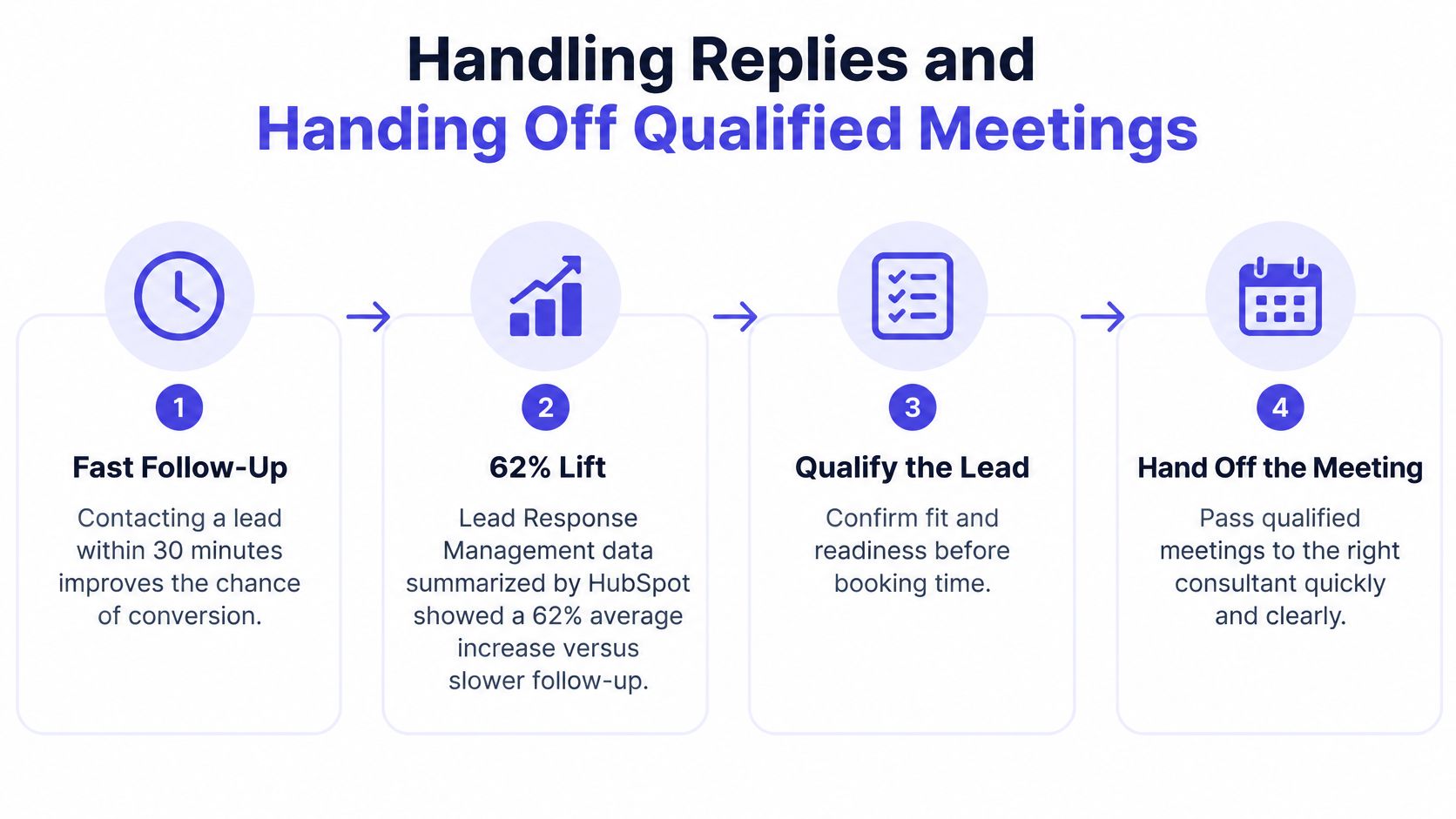
Reply speed is a revenue variable. A Lead Response Management study summarized by HubSpot found that contacting a lead within the first 30 minutes increased conversion rates by an average of 62% compared with slower follow-up, while contacting within an hour produced an average 36% improvement. The first two minutes were the most influential window of all.
Intent decays. A prospect who replies on Tuesday morning has the problem at the front of her mind. By Thursday she has a board meeting and a hiring problem, and your reply is now a cold restart.
Classify before you route
The biggest source of false pipeline is treating every reply as an opportunity. Four categories are enough.
- Positive: the prospect asks a question about scope, price, timing or availability. Route immediately and answer personally.
- Ambiguous: "interesting, not right now" or "send more info." These need a light, specific follow-up with a date attached, not a calendar invite.
- Unsubscribe or negative: suppress the contact at once across every campaign.
- Out of market: wrong geography, wrong size, or a vendor pitching you. Log the reason code and move on.
Then the workflow runs in a fixed order. Classify the reply. Create or update the CRM record in the same minute. Alert the assigned seller by name. Send a personalized reply or attempt a call within minutes for positive replies. Confirm the calendar invite with an agenda. Log the outcome with a reason code so next quarter's targeting improves.
Service level: every campaign needs a named owner and a maximum time to first reply, written down before launch. Without that, "we respond fast" means nothing on a Friday afternoon.
Most firms can't hold that standard with internal staff, because inbox monitoring competes with billable work. That's the case for a managed setup: after setup, leads start flowing automatically, and IronPeak Marketing handles the daily inbox management and follow-ups while the client attends only the sales calls booked on their calendar.
Choose Your Model and Run a 45-Day Test
Three models are common in practice, and they differ on four criteria: control over messaging and targeting, ramp time to the first qualified call, supervision load on your team, and cost predictability.
Founder-led outbound gives total control and the sharpest message, because the founder knows the offer. It also competes directly with delivery, so it often stalls once founders must split time between selling and client work. An in-house sales development hire gives control and a learning loop, but ramp time runs long, supervision lands on whoever manages that person, and cost is fixed whether or not the pipeline appears. A managed provider trades some message control for speed and a predictable cost, and its quality depends on how tightly the qualification definition is written.
The shortlist problem sits under all three. Buyers often have a preferred firm before your email arrives, so the model you choose is partly a bet on whether you can reach the right buyers early enough, place mail reliably, and answer while intent is still warm.
Write the definition before you sign
Define a qualified call in writing: buyer title, company size, geography, the problem discussed, and whether a budget owner was present. Then record two weeks of baseline activity. Then run one segment at a time for 45 days.
Count booked calls, show rate and cost per qualified call. Don't count replies, opens or "leads" delivered.
Take a provider promising 60 to 90 qualified leads in 45 days. A pay-per-result provider sells on that headline, and the stronger version of the model lets the client reject a lead that misses the definition and avoid paying for it. Apply the same discipline to anyone: count only the leads that meet your written definition, then divide total spend by that count. A program delivering 40 leads that meet a strict definition beats 90 that need re-qualifying internally.
Four questions for any provider: Who decides whether a lead meets the definition? Can you reject a lead and avoid paying for it? What infrastructure sends the mail, and which domains? What happens to a lead in the ten minutes after it replies?
Before signing anything, write a one-page ideal client profile, list 30 named buyers who fit it, and confirm your offer matches a trigger those buyers experience. Then ask any provider to assess fit against that written definition instead of against your website.
IronPeak Marketing runs managed cold email for B2B firms, agencies and high-ticket service providers, building dedicated sending infrastructure, researching and enriching the prospect list, writing the sequences and managing the inbox so replies get answered while intent is still warm. The work starts with an assessment of whether your offer and market fit the system, not with a list purchase. If the shortlist problem and the inbox placement problem both need fixing before next quarter, visit IronPeak Marketing to start that assessment.