Lead Generation in Digital Marketing: How It Works
Learn how lead generation in digital marketing works, from channel choice and prospect qualification to email deliverability and fast sales handoff.
More leads is the most common advice in this field, and it's the most expensive advice to follow. A business that doubles its form fills while keeping the same qualification rules, the same response time and the same sending setup doesn't double its pipeline. It doubles the number of records its sales team has to sift through, which is a different problem with a different cost.
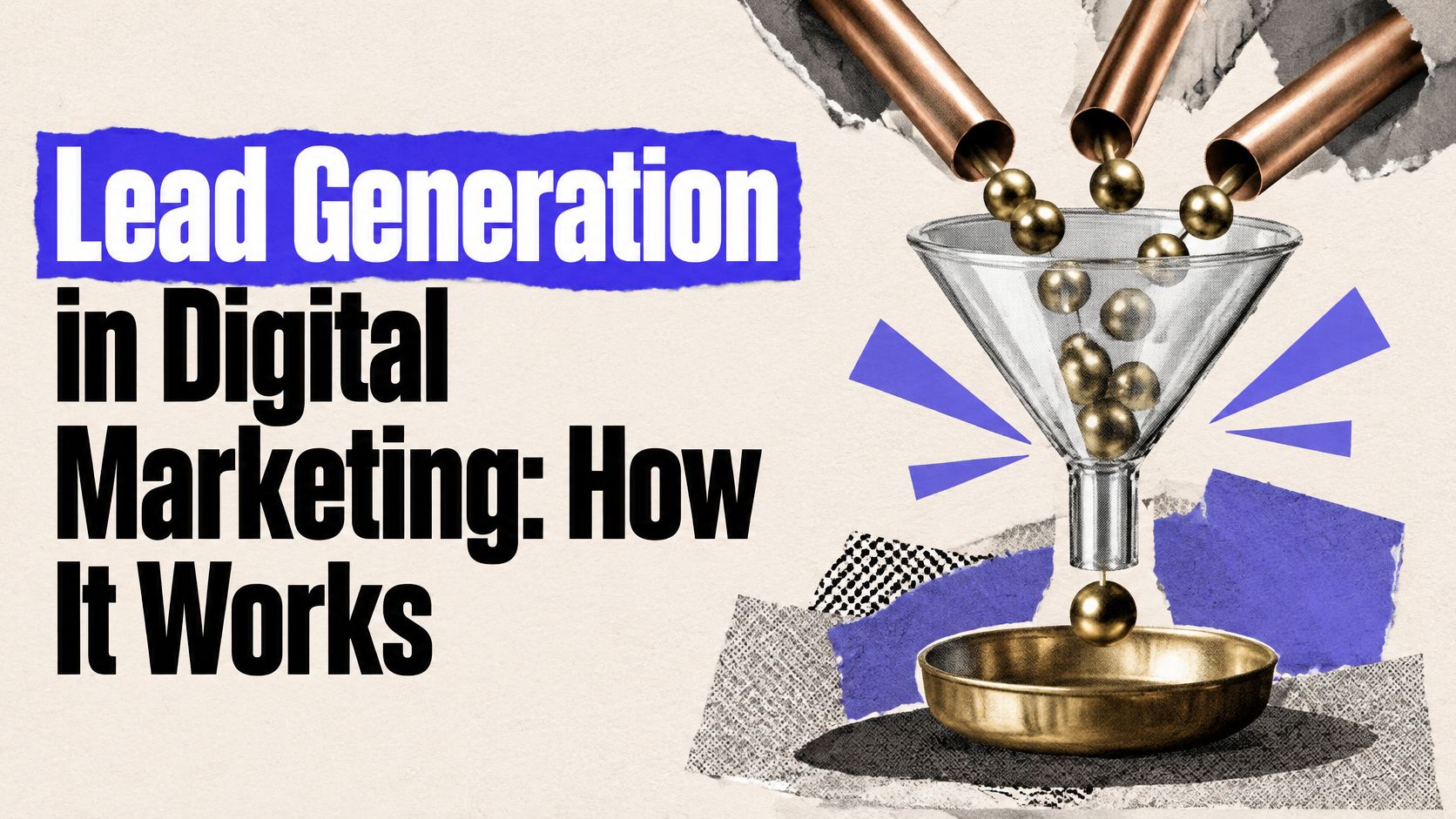
Lead generation in digital marketing works as one system with four stages and two hard constraints. The stages are attract, convert, qualify and hand off. The constraints are deliverability and response time, and they sit between the money leaving the account and the conversations landing on a calendar. Break either one and the spend still goes out, but very few of those prospects ever reach a sales call.
What follows treats lead generation as that system rather than a menu of channels. It walks the stages with a worked funnel, compares channels on quality instead of traffic, covers the sending thresholds that decide whether a cold email arrives at all, and sets out the handoff discipline that turns replies into accepted opportunities.
Lead Generation Stages and the Funnel
Channels differ in cost and reach, but each prospect must clear the same four checkpoints, and whichever checkpoint leaks is where the budget goes missing.
The Four Stages in Order
Attract is a reach problem, measured by visit rate. Traffic arrives from social posts, search content, cold email or paid ads, and the only question that matters here is whether the right companies are seeing the offer at all. Convert is where a stranger hands over something identifiable: a form fill, a lead-magnet download, a reply to an outreach email. Qualify tests fit and intent against criteria written down before launch, not invented in the moment. Hand off is the stage often left uninstrumented: a record in the CRM, a named owner, a slot on a calendar, and a timestamp.
| Stage | What Happens | Typical Channels | Metric to Track |
|---|---|---|---|
| Attract | Relevant companies notice the offer | Social promotion, search content, cold email, paid ads | Reach and visit rate |
| Convert | Prospect shares contact details or replies | Landing pages, lead magnets, replies to outreach | Conversion rate by source |
| Qualify | Fit and intent are checked against written criteria | Discovery questions, reply classification, scoring | Accepted-lead rate |
| Hand off | Qualified lead reaches a sales owner | CRM record, calendar booking, owner alert | Median first-response time |
The written criteria matter more than the scoring model. Fit means company size, industry, the contact's role, budget authority and whether the problem the offer solves is present. Intent means a stated need, a timeline and a willingness to talk. Teams that skip the written step end up qualifying on gut feel, and gut feel drifts toward whoever replied most enthusiastically rather than whoever can buy. A quiet reply from the right account is worth more than an eager reply from the wrong one.
A Worked Funnel With Illustrative Numbers
Say a service page takes 1,000 visits in a month. Forty visitors fill in a form, a 4% conversion rate. Follow-up brings 12 of those 40 into a conversation. Four become qualified calls. The page converted at 4%, the number this funnel is judged against, and the campaign still produced four calls worth having.
Now look at where the chain breaks. The page converts. The follow-up works. The expensive loss sits between the form fill and the first human response, and it's invisible in most reporting because the record already exists in the CRM. Forty form fills left sitting for a day produce fewer conversations than twenty answered within five minutes.
A lead is worth what it can do for the sales team, not how many records it adds to the CRM.
The HubSpot summary of 2025 B2B marketing research shows where effort tends to go. It reports that 16% of B2B marketers named lead generation as their primary marketing goal for 2024, and that 29% called lead generation the most important metric for content-strategy effectiveness. Landing pages were the most common mechanism, used by 44% of marketers to generate leads, against 34% focused on generating customers or direct purchases. Whatever mechanism brought the lead in, it still had to pass the same four checkpoints before it became pipeline.
Measure the Stages, Not Just the Intake
A business spending 2,000 dollars on traffic in a month might see 40 form fills and 4 qualified calls. That's 50 dollars per record and 500 dollars per qualified call. The 50 dollar figure is the one that gets reported, and it's the one that hides the decision, because it prices only the convert stage and ignores everything after it. Eight leads that produce six conversations beat forty that produce four, and only stage-level tracking exposes that gap.
That is why response time belongs in the funnel metrics rather than in the sales team's private opinion. If a stage has no owner, it has no metric, and it's the stage that leaks. The difference between lead generation and prospecting matters here: prospecting feeds the top of this funnel, while lead generation is accountable for all four stages.
Digital Channels Compared by Lead Quality
| Channel | Main Strength | Main Limit |
|---|---|---|
| Social media promotion | Reaches niche professional audiences | Low intent per visit |
| Email promotion | Direct access to known contacts | List quality decays quickly without maintenance |
| Search engine optimization | Intent-driven traffic that compounds over time | Slow to produce first results |
| Paid advertising | Immediate control of traffic volume | Lead quality depends on targeting and rising costs |
| Cold email outreach | Direct targeting of named buyers | Depends on sending infrastructure and deliverability |
Those channels get compared by the traffic they push toward landing pages, which understates email's reach. Email serves two different jobs: nurturing contacts the business already holds and reaching named buyers who never filled in a form. The first is list maintenance. The second is outbound, and it runs on sending infrastructure and deliverability rather than reach.
Adoption stopped being the bottleneck years ago. The Content Marketing Institute's B2B benchmarks put 89% of B2B marketers on organic social, 84% on company blogs, 71% on email newsletters, 63% on email and 55% each on in-person events and webinars, while 47% reported a martech stack lacking efficient lead-generation and nurturing processes, 84% struggled to integrate or correlate performance data across platforms and only 52% tracked lead quality at all. Distribution is solved. Measurement is where channel spend either turns into qualified conversations or disappears untracked.
How to Choose Between Them
Rank channels by the control they give you.
- Control over who sees the message. Cold email addresses named buyers at named companies. Social and search reach whoever the platform decides to show the post to.
- Speed to a real conversation. Paid ads and outbound can produce a reply today. Search content compounds, but the first meaningful traffic usually takes months.
- Dependence on owned data. An email list and a CRM are assets the business holds. A social following is rented reach.
- Cost per qualified lead. The only number that survives contact with a finance review.
A channel is only as good as the tracking that connects it to pipeline. Without that link, every channel looks equally promising and none can be defended when the budget gets cut.
Email Deliverability Limits for Outbound Campaigns
Deliverability is a precondition, not a technical extra. A cold email that fails authentication doesn't underperform. It doesn't arrive, and nobody on the sending side finds out.
| Requirement | Gmail | Outlook.com |
|---|---|---|
| Volume that triggers high-volume rules | About 5,000 messages a day | More than 5,000 emails a day |
| Authentication | SPF or DKIM required for all senders since February 2024; SPF, DKIM and DMARC required for bulk senders | SPF and DKIM must pass and a DMARC record must be published |
| DMARC alignment | Required for bulk senders | DMARC may start at p=none but must align with SPF or DKIM, preferably both |
| Complaint threshold | Keep user-reported spam below 0.1%; 0.3% or higher removes mitigations | No numeric complaint threshold published |
| Unsubscribe | One-click unsubscribe for marketing messages | Not listed among the published requirements |
| Enforcement timing | Authentication since February 2024; mitigation returns after seven consecutive days below 0.3% | Enforcement for noncompliant high-volume senders began in 2025 |
Gmail's sender rules put numbers on this. Senders delivering about 5,000 or more messages a day into Gmail accounts are treated as bulk senders and must authenticate, keep complaint rates low and offer an easy unsubscribe. Gmail recommends a user-reported spam rate below 0.1% and warns against letting it reach 0.3% or higher, a level that can remove delivery mitigations. Once a sender crosses that line, mitigations only return after the rate stays under it for seven consecutive days.
What a Complaint Rate Looks Like in Practice
A sending domain sitting at 0.12% for two consecutive days hasn't been punished yet. It has crossed the warning line while staying under the enforcement line, which is exactly the window where a pause is cheap. Cut the segment that complained, suppress the recipients who asked to be left alone, and drop volume until the rate is back under 0.1%.
Microsoft's requirements for high-volume Outlook.com senders follow the same shape. Domains sending more than 5,000 emails a day to Outlook.com accounts must pass SPF and DKIM and publish a DMARC record, and Microsoft announced that enforcement for noncompliant high-volume senders began in 2025.
Setup and Monitoring Steps
- Authenticate before the first send. Verify SPF, DKIM and DMARC on every sending domain, not just the primary one, and fix failures before volume goes out.
- Align the visible From domain with the authenticated identity. A mismatch passes the record check and still fails the delivery decision.
- Ramp volume gradually. A new domain jumping straight to full volume looks like what it is.
- Check complaint rates daily in the mailbox provider's postmaster tooling, because the metric moves faster than weekly reporting catches.
- Suppress negatives the same day. Any reply asking to stop should remove the contact from every sequence immediately.
- List every third-party sending tool in SPF. An unlisted provider breaks authentication on mail you thought was configured correctly.
Separate domains and dedicated inboxes isolate reputation between clients. They don't rescue a message that fails authentication, and they don't repair a list that keeps complaining. Once volume grows past a few thousand messages a day, the mechanics of improving email delivery rate matter more than any subject line test.
Qualifying Prospects and Validating Fit
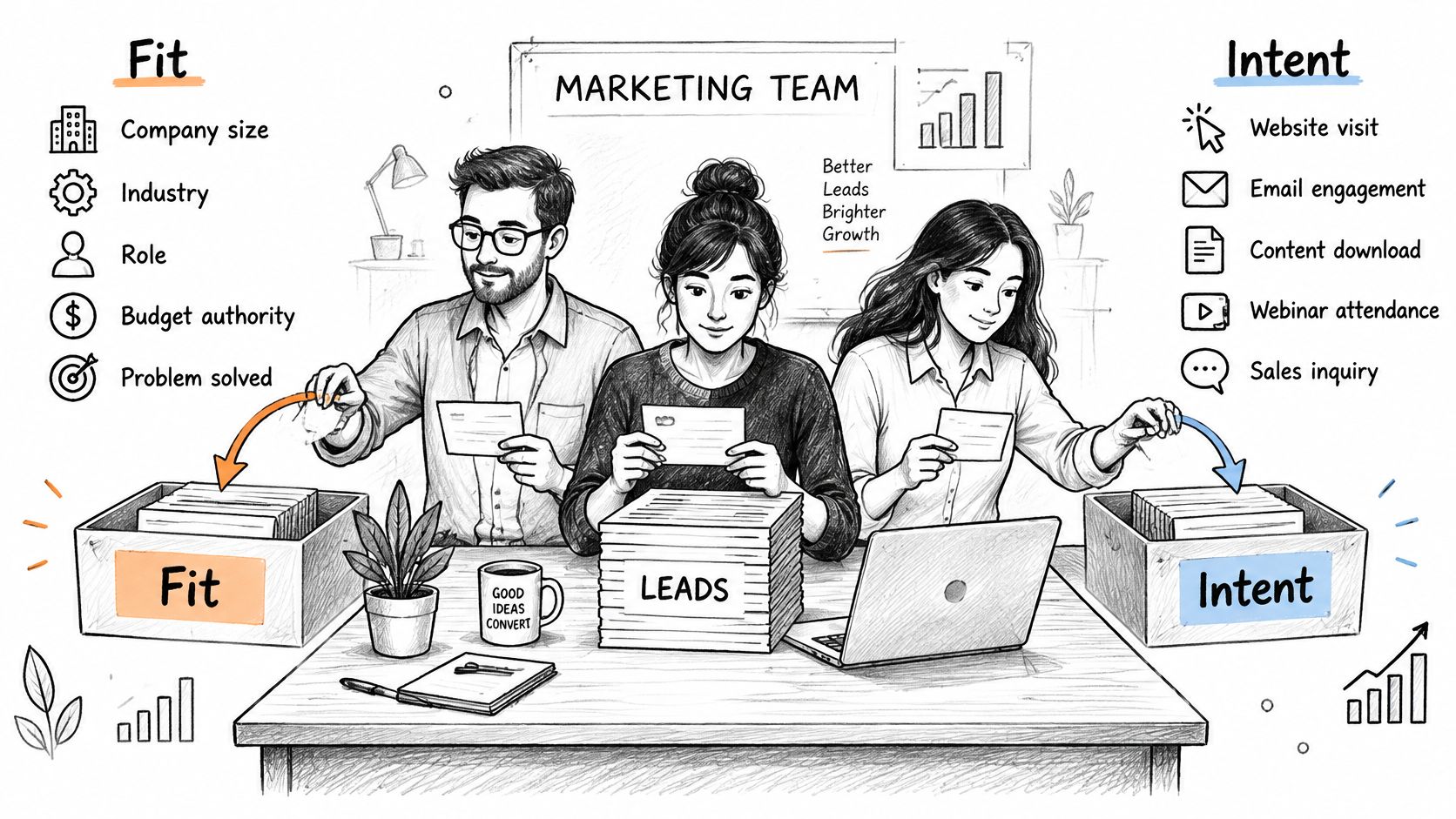
Most qualification frameworks only look at the buyer, and that's half the job. A prospect also has to be able to check the seller's claims without a call, and in a market where buyers arrive already researched, that check happens before anyone replies.
Fit is a property of the account: company size, industry, the contact's role, budget authority and whether the problem exists. Intent is a property of the moment: a stated need, a timeline, a question that reveals a live project. Score them separately. A lead that matches the target profile but shows no intent is a nurture contact, not a sales call, and pushing it to a rep wastes the rep's afternoon and the prospect's patience.
Gartner's survey of 645 B2B buyers explains why the seller's evidence matters as much as the buyer's profile. It found buyers used an average of seven information sources, that 45% used generative AI during a purchase, that 67% preferred a sales-rep-free experience, and that 69% turned to sales representatives to validate AI-generated insights. Buyers want to do the work alone and still want a human to confirm what they found.
That combination sets the asset list. Before a prospect books anything, four things should be findable without speaking to sales:
- A comparison page that puts the offer beside realistic alternatives, including doing nothing.
- Proof that can be checked independently, such as named customers, published figures or a live product.
- Technical documentation that answers implementation and migration questions.
- A buyer-specific ROI model the prospect can adjust with their own numbers.
On the first call, the rep should be ready to validate rather than introduce: which claims need evidence, how implementation runs, what the contract and exit terms are, and what happens if month one underdelivers. Getting the firmographic and role filters right on the account side is what makes that scored list usable, and this guide to prospect research tools covers where those filters come from.
How to Hand Off Qualified Leads Fast
Channel spend only converts when somebody answers the reply it produced. Benchmark research on lead response time found leads contacted within five minutes were 21 times more likely to qualify than those contacted after 30 minutes, and put the average B2B response time at 42 hours. The gap between five minutes and thirty minutes is large enough to decide the outcome on its own.
A positive reply lands at 9:00. One team answers at 9:04, while the details are fresh and the prospect is still at the desk. A second team picks it up at 14:30, after a meeting block, and finds the prospect already talking to two other vendors. Same lead, same offer, different outcome.
Deliverability work got that reply into the inbox. The handoff decides whether it becomes a conversation, and the procedure has six parts.
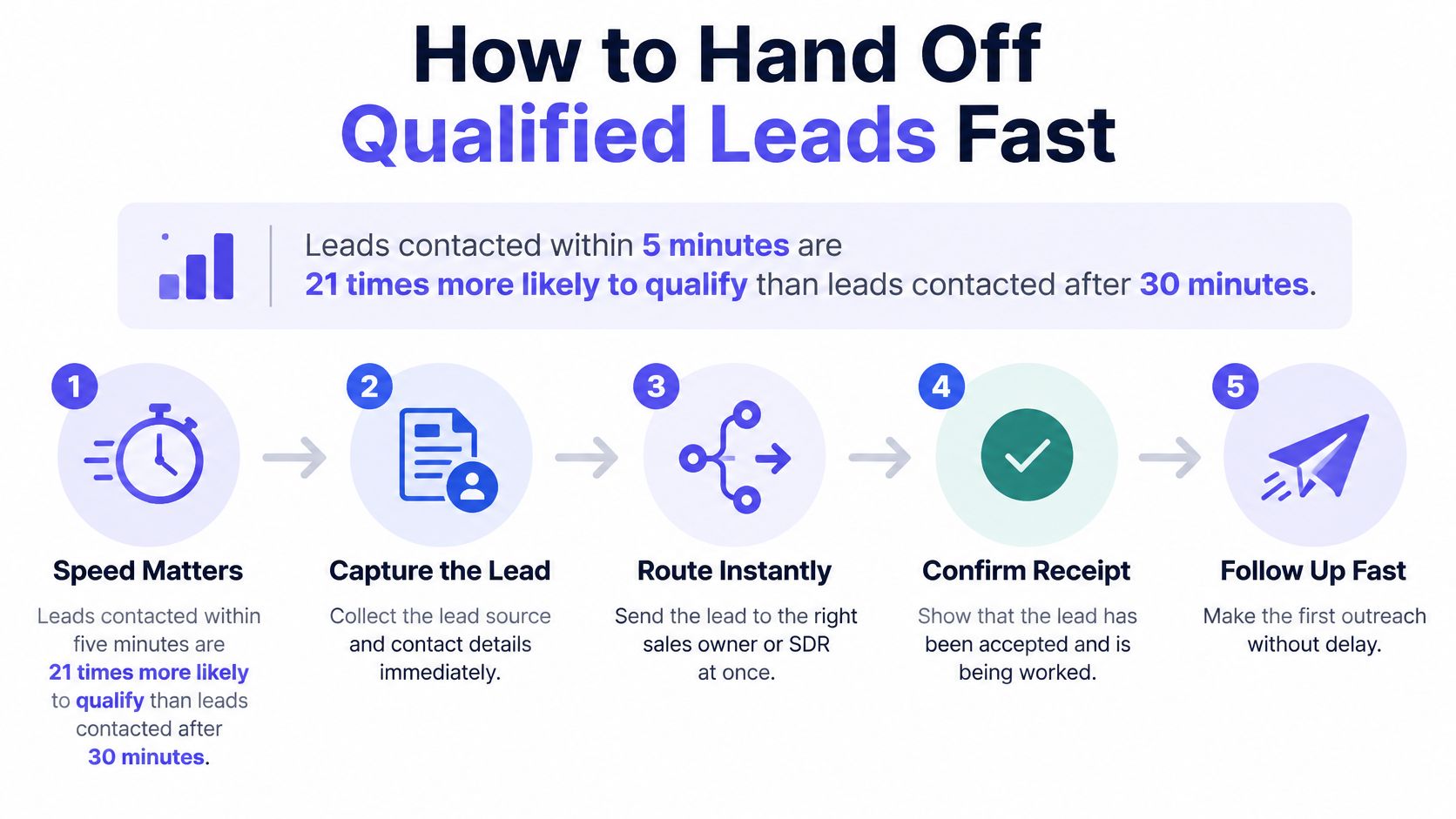
- Classify each reply within minutes as buying intent, objection, out of office or unsubscribe. Buying replies should never queue behind objections and opt-outs.
- Create the CRM record immediately, with source, campaign and timestamp. It makes the lead visible to the whole team before anyone responds, which is how handoffs stop depending on one person's memory.
- Route high-intent replies to a named owner who has an open slot. One owner per lead prevents the dropped handoff that two shared inboxes guarantee.
- Set an acknowledgment target such as ten minutes during business hours and log every instance against it. A target without a log is a slogan.
- Keep timestamped evidence of every handoff, because when a prospect says nobody answered, the timeline settles it.
- Review weekly the median first-response time alongside qualification rate, meeting rate and accepted-lead rate, so speed gets judged by the results it produces.
Treat the acknowledgment target as a testing threshold, not a promise. Start at ten minutes, then tighten or loosen it based on what the weekly review shows about qualification rates at different response speeds. A qualified reply that sits unanswered loses value by the hour, and no amount of upstream spend buys that time back.
Choose the Lead Generation Mix for Your Offer
Three questions decide the mix, and they're worth answering in order because a no on the third one makes the first two irrelevant.
- Does the offer carry enough value per customer, and is the buyer identifiable by name? Outbound only works when the target list can be built from firmographic and role data, and when one closed customer pays for a lot of outreach.
- Do prospects research before booking? If they do, build the comparison page, the proof and the technical material before spending on traffic. Sending buyers to a thin site just funds their education somewhere else.
- Can someone answer a positive reply within minutes during business hours? If not, fix the handoff before adding volume, or the new leads will decay faster.
One option in that mix is a managed provider. IronPeak Marketing runs cold email lead generation on a pay-per-result basis, beginning with an assessment of the offer, target market and current acquisition to decide whether outbound fits, then building domains, inboxes, copy, data enrichment and tracking in under 15 days. Its headline offer is 60 to 90 qualified leads in 45 days, and clients can reject leads that don't meet their qualification standard.
Questions worth asking any provider before signing:
- How is a qualified lead defined, in writing, and who applies the definition?
- Which leads can be rejected, and does rejection mean no payment?
- How are complaint rates and inbox placement monitored, and how often are they reported?
- Who answers replies, and what's the expected time to first response?
A provider that can't answer the first two in specific terms is selling activity rather than outcomes, and the funnel will leak in exactly the same place it did before.
IronPeak Marketing runs managed B2B lead generation on cold email, building the sending infrastructure, prospect data, copy and follow-up sequences that this funnel depends on, and the client only shows up to the sales calls. If the constraint in your business is deliverability or handoff speed rather than traffic, that's the layer the program works on. Visit IronPeak Marketing to see how an engagement gets scoped against your offer and market.