Client Onboarding Checklist: 8 Steps That Work
A practical client onboarding checklist for cold email operations, covering offer fit, deliverability, data, CRM handoff, and reporting.
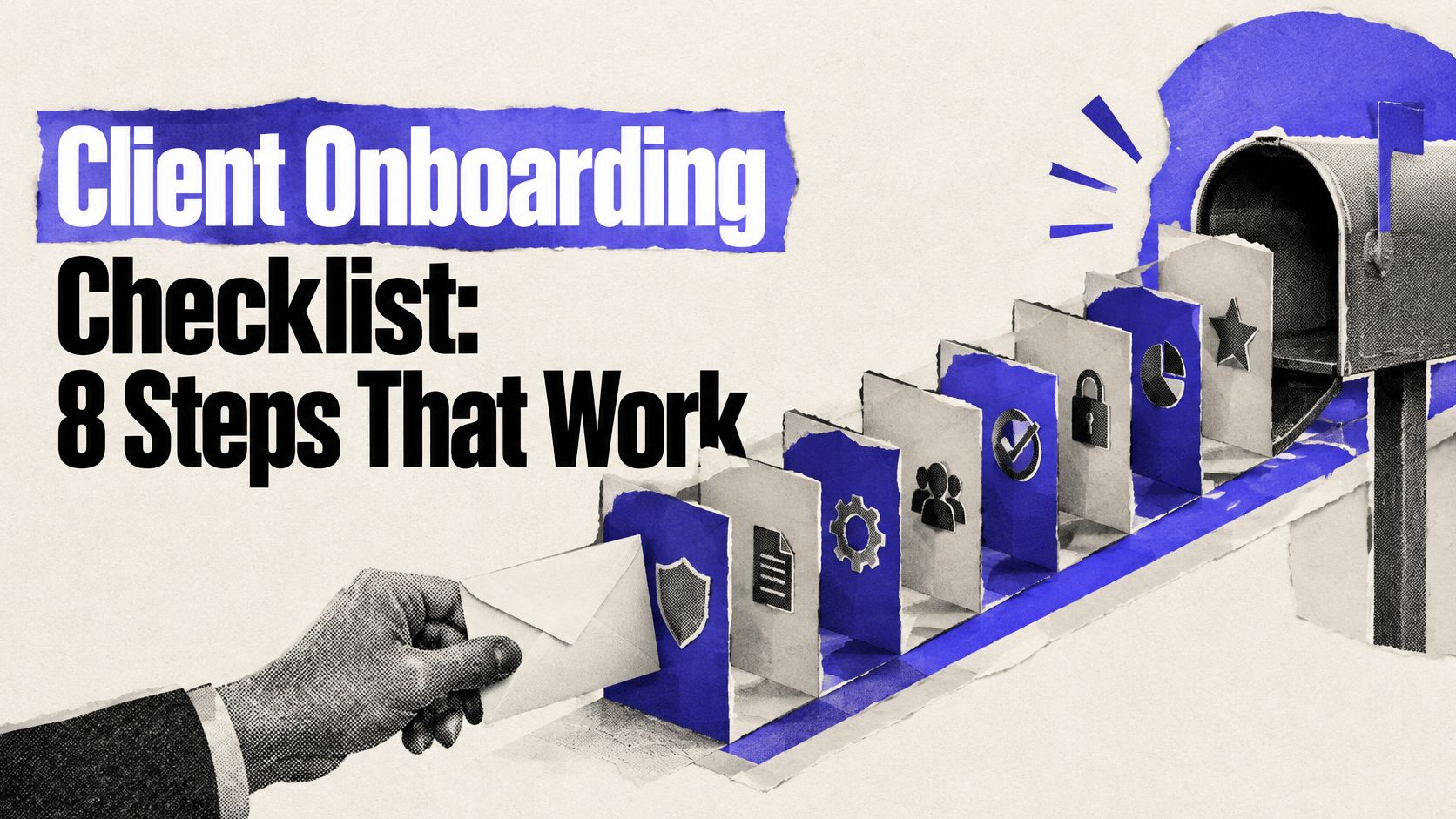
A completed onboarding form doesn't mean a cold email campaign is ready to send. In Rocketlane's 2024 State of Customer Onboarding report, 56% of customer onboarding professionals identified standardization and automation as their top goal. But automating a broken setup only makes mistakes happen faster.
Cold email campaigns can fail before copy gets a fair test. An unclear lead definition sends researchers after the wrong companies. An unverified list creates bounces. A new inbox pushed into campaign volume can struggle to reach buyers, regardless of how well the message reads.
A useful client onboarding checklist connects commercial expectations to sending mechanics. It records what qualifies as an opportunity, who approves prospect data, whether authentication passes, and who handles an interested reply. Every task needs an owner, a dependency, and evidence that it's complete.
Launch readiness means the operator can prove the campaign is ready, not simply confirm that setup tasks were checked off.
For B2B founders and high-ticket service providers, that distinction matters. Outbound needs to produce opportunities the sales team can work, without exposing the main business domain or creating arguments over lead quality. These onboarding steps establish those controls before live sending begins.
1. Campaign assessment and offer fit review
Cold email isn't automatically the right channel for an expensive offer. The buyer must be identifiable, reachable, and likely to recognize the problem from a short message. Strong contract value helps support acquisition costs, but it doesn't compensate for an offer nobody understands.
The assessment should examine the client's current acquisition channels, typical deal value, sales cycle, delivery capacity, and reasons buyers purchase. B2B software, agency retainers, staffing services, and commercial trades can fit when the operator can identify a specific buyer and a credible reason to contact them.

Test the offer against actual buying behavior
Recent closed deals are more useful than a polished positioning statement. The client should supply sales notes showing the original problem, the buying trigger, objections, and the role of the person who approved the purchase.
- Buyer access: Identify the person who owns the problem, not just the most senior title available.
- Commercial fit: Check whether expected deal economics can support managed prospecting and sales follow-up.
- Sales capacity: Confirm that someone can handle new conversations without neglecting existing opportunities.
- Market exclusions: Record unsuitable industries, territories, account types, and existing relationships.
For a staffing firm, the strongest starting segment might be employers advertising roles within its specialty. A broad list of business owners offers less context and makes relevant copy harder to write.
The exit condition is an approved campaign hypothesis: a defined offer, a reachable buyer, a buying trigger, and a reason that buyer would take a conversation. Infrastructure work should wait if those pieces remain unclear.
2. Qualified lead definition and commercial terms
A positive reply isn't necessarily a qualified lead. A prospect might want information while lacking the required role, company fit, project, or purchasing authority. Counting that response as a billable opportunity creates a commercial dispute that better copy won't resolve.
Qualification must be written as observable checks. The agreement should define the required company profile, acceptable buyer roles, minimum interest signal, exclusions, and evidence attached to each submission. It should also distinguish an interested contact from an accepted opportunity and a booked meeting.
Define acceptance before discussing volume
A commercial electrical contractor might accept a facilities manager with an active project inside its service area. A request for residential work outside that territory would fail qualification, even if the prospect enthusiastically requested a quote.
- Accepted lead: Meets the account criteria and expresses the agreed buying intent.
- Rejected lead: Fails a documented requirement, with the reason recorded against the submission.
- Deferred opportunity: Fits the market but lacks the required timing or readiness.
- Duplicate contact: Already exists in an excluded customer or opportunity record.
Commercial control: Lead rejection should follow the signed standard, not a new interpretation introduced after delivery.
Client-facing approval matters as much as internal documentation. HubSpot's customer onboarding checklist supports explicit approvals and clear expectations rather than relying on silent assumptions.
The terms should also cover billing triggers, duplicate handling, review ownership, cancellation, and domain and inbox ownership. A month-to-month arrangement still needs a clear exit process covering credentials, campaign records, suppression data, and any ongoing mailbox charges.
3. Dedicated domains, inboxes, and DNS authentication
Dedicated sending infrastructure separates outbound operations from everyday business email. It reduces direct exposure of the primary sending domain, but it doesn't make careless outreach safe. Recipients still associate the message with the company, and authentication doesn't excuse irrelevant targeting.
Each sending domain needs authorized DNS configuration and a real mailbox identity. SPF identifies permitted sending infrastructure, DKIM signs messages, and DMARC establishes authentication policy and alignment requirements.

Verify messages, not just published records
EasyDMARC's explanation of Outlook's high-volume sender requirements specifies SPF, DKIM, and DMARC for senders exceeding 5,000 messages per day to Outlook.com, Hotmail.com, and Live.com addresses, including a DMARC policy of at least p=none. Those requirements have a defined scope, but authentication belongs in the setup checklist regardless of planned campaign size.
The operator should inspect DNS with a record checker, then send test messages and inspect their authentication results. A published DKIM record isn't enough if the sending platform isn't signing mail correctly.
For example, a consultancy might configure dedicated outreach mailboxes correctly but leave the visible From domain misaligned. A DNS-only review could miss what a received-message inspection reveals.
The email deliverability best practices guide provides a practical framework for checking infrastructure alongside campaign behavior.
Record domain ownership, mailbox access, tracking-domain configuration, and every DNS change. Use recognizable brand identities rather than deceptive lookalike domains. Treat open tracking cautiously, and avoid adding tracking complexity unless it supports a useful decision.
4. Domain and inbox warming
A newly created mailbox isn't ready for unrestricted prospecting because authentication passes. Infrastructure readiness and reputation readiness are different checks. The onboarding schedule must allow controlled testing and a gradual increase in legitimate sending.
Warmup tools exchange messages and generate engagement between participating accounts. Those activities aren't proof that real prospect emails will reach the inbox, and artificial engagement shouldn't be treated as a substitute for wanted messages, accurate data, or provider-policy compliance.
Make the ramp conditional
The operator should document initial sending limits, review ownership, placement tests, and pause conditions. Limits should change according to observed delivery behavior, not just because a calendar date has arrived.
- Placement testing: Use seed accounts across major mailbox providers, while recognizing that seeds don't represent every recipient.
- Bounce review: Separate invalid-address failures from temporary delivery errors and authentication problems.
- Complaint monitoring: Investigate targeting and messaging before increasing volume.
- Pause authority: Name the person authorized to stop an inbox or campaign immediately.
Google's sender guidelines advise keeping user-reported spam rates below 0.1% and preventing them from reaching 0.3% or higher. Those are complaint-rate guardrails, not evidence that a campaign below them has earned permission to scale.
For example, a new inbox may pass seed testing while live prospect delivery produces repeated invalid-address errors. The correct response is to pause that traffic and inspect the list, not increase warmup activity.
A setup deadline isn't a requirement to send through unresolved delivery problems.
The campaign document should distinguish setup time from live campaign time. Client approval delays, DNS blockers, and paused sending should remain visible rather than disappearing into a single launch date.
5. Prospect data sourcing, enrichment, and list building
A hospital hiring revenue-cycle staff offers a concrete research signal for a healthcare consultant. The operator can inspect the organization, confirm that the service fits, identify the relevant operations leader, and enrich the record with a verified business address. That produces a reason for outreach, not just another row.
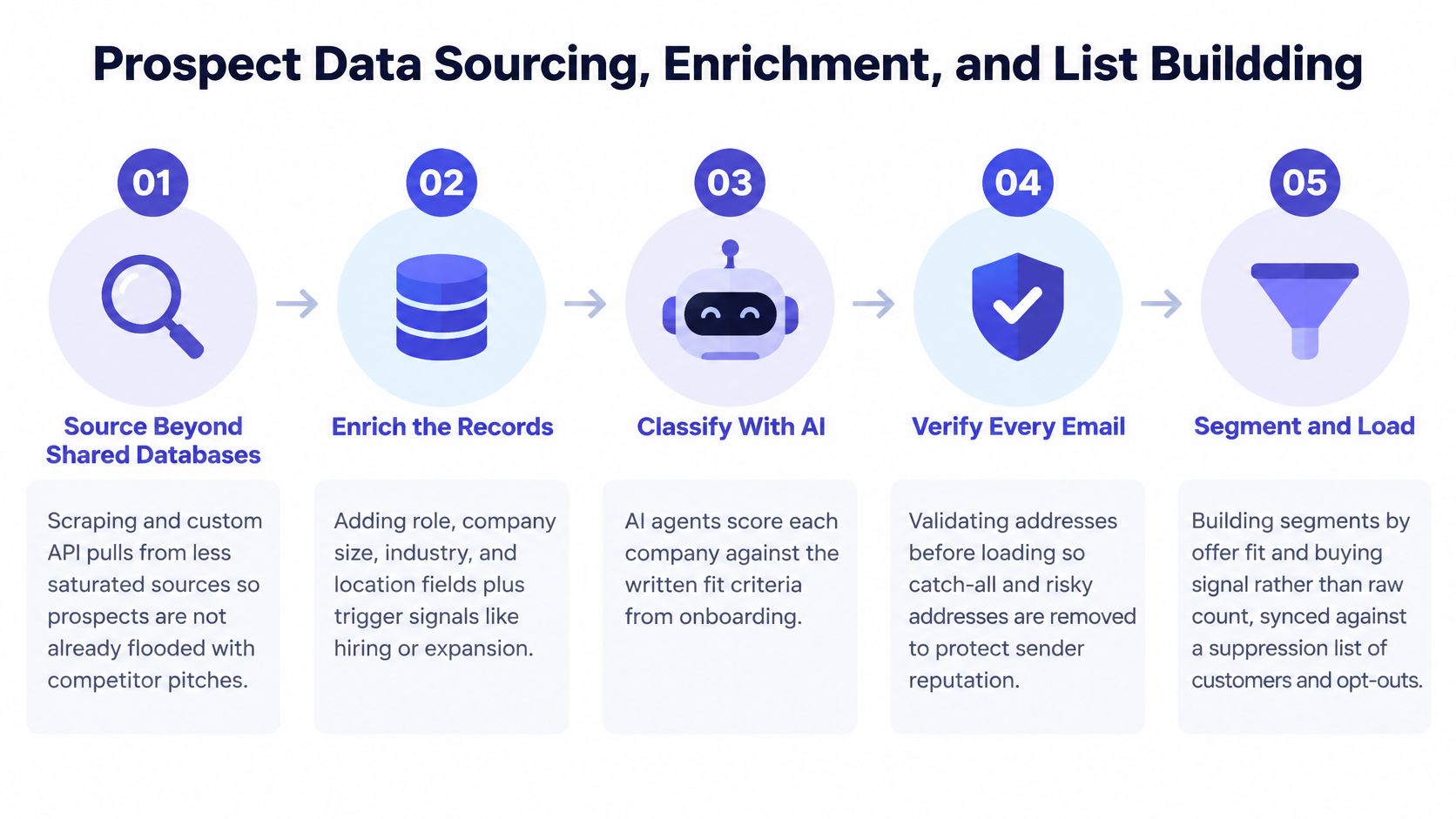
List building should follow the approved qualification standard. Shared databases can provide useful starting records, but source variety alone doesn't establish quality. A less-used source is still unsuitable if its contacts don't match the offer.
Keep evidence attached to the record
The sourcing workflow should preserve the source page, collection date, company classification, buying trigger, contact role, and verification status. The prospect lists guide explains how sourcing and segmentation connect to outbound execution.
- Enrichment: Add firmographic and contact information that supports qualification.
- AI classification: Use automated categorization as a draft decision, with human review for ambiguous companies.
- Verification: Check addresses before loading them into sending sequences.
- Suppression: Exclude customers, protected opportunities, duplicates, and opted-out contacts before activation.
Catch-all results shouldn't be treated as confirmed deliverable addresses. Excluding them from the main campaign sacrifices potential reach but avoids presenting uncertain records as verified contacts.
GUIDEcx's onboarding governance guidance highlights the importance of data provenance, access roles, human approvals, and a shared status record. Applied to outbound, that means documenting permitted data use, market-specific outreach requirements, retention rules, and deletion or transfer procedures.
Before activation, the client should approve a representative prospect sample. A correct title at the wrong company is still a targeting failure.
6. Copywriting, sequence design, and approval
The first message should make the offer understandable without requiring a presentation. It needs a relevant reason for contact, a credible explanation of the service, and a clear next step. Personalization should support relevance, not decorate a generic pitch.
For a staffing campaign, a verified vacancy can justify contacting a hiring manager. An invented claim about recruitment difficulties can't. If enrichment only confirms that the company is hiring, the copy must stay within that evidence.
Approve the full conversation
Client approval should cover subject lines, opening messages, follow-ups, personalization fields, and claims about capabilities or outcomes. Follow-ups should introduce useful context or a different angle rather than repeat a request for attention.
- Claim review: Retain supporting evidence for performance statements and client examples.
- Variable testing: Preview actual records to catch missing names, awkward grammar, and incorrect company references.
- Sequence controls: Stop automated follow-ups when a prospect replies or opts out.
- Identity review: Ensure the sender accurately represents the business initiating the message.
The FTC's CAN-SPAM compliance guide requires accurate sender information and a clear opt-out mechanism, which must operate for at least 30 days after sending; opt-out requests must be honored within 10 business days. These are specific US requirements, not a complete international outreach policy.
A suitable approval test is whether the client could defend every statement during a sales call. If the operator can't explain where a personalization detail came from, that detail shouldn't ship.
The final copy review must also test reply behavior. A prospect asking a question shouldn't receive an automated follow-up that acts as though no conversation has started.
7. CRM integration and lead handoff
A qualified reply sitting in an agency inbox isn't a completed handoff. Sales needs the conversation, the qualification evidence, and a clear next action. The CRM record should explain why the opportunity was accepted without forcing the salesperson to reconstruct the campaign.
For a commercial contractor, that might mean the prospect's role, property location, project description, requested timing, and original thread. A contact record containing only an email address and a positive-reply label leaves the sales team guessing.

Test the handoff before launch
The lead management and CRM guide provides context for connecting outreach records to sales ownership. Integration testing should include accepted leads, rejected submissions, duplicate contacts, and failed synchronization.
- Required fields: Contact, company, campaign source, qualification status, thread, and owner.
- Routing rules: Assigned salesperson, backup owner, and escalation route.
- Response commitment: A documented follow-up expectation matched to actual sales capacity.
- Failure alerts: Visible notifications when records fail to sync or remain unassigned.
Prolifiq's B2B onboarding guidance emphasizes time to first value, meaning the elapsed time until a meaningful business outcome rather than administrative completion. For outbound, an accepted qualified opportunity is a more useful milestone than a successful test email.
The operator owns qualification and contextual handoff. The client owns the sales conversation, closing, and delivery. A recurring review of accepted leads with no recorded activity makes that boundary measurable without blaming campaign performance for unworked opportunities.
8. Live reporting, reply handling, and optimization cadence
Total reply rate can look encouraging while the inbox fills with absences, objections, and unsubscribe requests. Positive replies, accepted qualified leads, and sales progression must remain separate measures. Otherwise, the operator can report activity while the client receives little usable pipeline.
Daily reply handling requires reading messages, classifying intent, answering appropriate questions, stopping sequences, and routing qualified conversations. Automated classification can assist, but ambiguous replies need human review before they become billing or sales decisions.
Diagnose before changing the campaign
A useful reporting view connects each stage of execution to the next.
- Delivery health: Authentication failures, bounces, complaint signals, and placement-test results.
- Audience response: Total replies, positive replies, objections, and opt-outs.
- Qualification: Submitted opportunities, accepted leads, rejected leads, and rejection reasons.
- Sales follow-through: Routed conversations, logged activity, booked meetings, and stalled records.
OnRamp's onboarding statistics overview identifies completion rate, time to first value, customer satisfaction, and early churn as core onboarding measures. In managed outbound, the practical application is to measure both setup completion and whether the client receives a usable opportunity.
Suppose a staffing segment generates interest but repeated rejections because employers need roles outside the firm's specialty. More sending won't fix that. The operator should tighten the segment and revise its approval sample.
Optimization discipline: Change the suspected cause, then observe the result before changing another major variable.
Quality reviews should have named owners, scheduled dates, and agreed intervention rules. Weak placement calls for infrastructure investigation. Good delivery with irrelevant replies points toward targeting or offer fit. Accepted leads without sales activity require a handoff review.
Onboarding steps at a glance
| Step | Main Goal | Key Inputs | Timing | Common Failure Point |
|---|---|---|---|---|
| Campaign assessment and offer fit review | Confirm cold email fits the offer and buyer | Offer, buyer personas, deal size, sales cycle, growth goals | Before infrastructure setup; adds a few days | Proceeding with a poor-fit offer or vague lead criteria |
| Qualified lead definition and commercial terms | Agree on billable lead standards and engagement terms | Qualification criteria, rejection process, cancellation and ownership terms | Before launch | Vague definitions causing billing disputes |
| Dedicated domains, inboxes, and DNS authentication | Protect the primary domain and prepare authenticated sending accounts | Sending domains, inboxes, SPF, DKIM, DMARC, tracking setup | Before warming and live sending | DNS errors or suspicious-looking domains |
| Domain and inbox warming | Build sending reputation before campaign volume ramps up | New inboxes, gradual send caps, bounce and complaint monitoring | Roughly two weeks before live volume | Sending too early from cold inboxes |
| Prospect data sourcing, enrichment, and list building | Build a verified list that matches the offer and buyer criteria | Contact data, firmographics, buying signals, fit criteria, suppression list | Before each campaign send | Poor-quality or unverified data damaging deliverability |
| Copywriting, sequence design, and approval | Create relevant messages and follow-ups for the target buyer | Offer details, buyer profile, enriched data, client-approved claims | Before launch | Generic or unsupported messaging, or delayed approval |
| CRM integration and lead handoff | Route qualified leads to sales with useful context | CRM fields, routing rules, qualification status, response expectations | Set up before or at launch; handoff is ongoing | Leads sitting untouched because ownership or routing is unclear |
| Live reporting, reply handling, and optimization cadence | Monitor performance, manage replies, and improve results | Deliverability and reply metrics, accepted leads, test log, lead target | Daily reply handling with weekly or biweekly reviews | Optimizing against total replies alone or changing too many variables at once |
Run the Checklist Before the First Send
A cold email campaign depends on decisions made before live outreach begins. The operator must confirm offer fit, write the qualification standard, authenticate dedicated infrastructure, prepare inboxes, verify prospect data, approve copy, test CRM routing, and establish reporting ownership. Skipping a gate doesn't remove the work. It moves the problem into a live campaign, where fixing it becomes more disruptive.
The client onboarding checklist should function as an operating record, not a welcome document. Each task needs an owner, a due date, an acceptance condition, and a visible blocker status. Client approvals should attach to the actual prospect sample, qualification document, or message version being launched.
Separate readiness from results
Authentication passing is a setup result. A live sequence is an execution milestone. An accepted qualified opportunity is a business outcome, and a booked meeting is a further sales event. Keeping those distinctions clear prevents either side from treating completed administration as delivered value.
The launch review should establish:
- Technical readiness: Authentication, mailbox access, suppression handling, and placement checks have been reviewed.
- Commercial readiness: Qualification, rejection, counting, and cancellation rules are documented.
- Sales readiness: Routing works, ownership is assigned, and follow-up expectations are realistic.
- Measurement readiness: Both sides understand the reporting definitions and intervention process.
IronPeak Marketing applies this approach through a 60-minute onboarding call covering the client's offer and target market. Its managed service deploys custom domains, dedicated inboxes, copy, data enrichment, and tracking systems in under 15 days, with CRM integration, lead handoff, daily inbox management, and automated follow-ups.
Billing is tied to qualified results, and clients can reject leads that miss the agreed standard without paying for them. Engagements operate month to month while dedicated infrastructure is built. Its headline target is 60 to 90 qualified leads in 45 days, with first booked meetings expected within the first 30 days of the campaign going live.
Those expectations make precise onboarding more important, not less. The agreement should identify when live sending starts, what counts as qualification, and how delays or rejections are recorded. A clear standard gives the operator something concrete to deliver and gives the client a defensible basis for acceptance.
IronPeak Marketing offers managed cold email infrastructure, prospect research, campaign execution, and qualified lead handoff. Founders and service providers seeking to put this client onboarding checklist into operation can visit IronPeak Marketing to book a free strategy session with no credit card required and no commitment.