Outbound Lead Gen: How the Process Works in 2026
Outbound lead gen explained: the funnel math, channel options, deliverability controls and when managed outreach fits a B2B growth plan in 2026.
Average B2B cold email reply rates fell to 3.43% in 2026 from 5.1% in 2025 and 8.5% in 2019, while average global inbox placement sits at 83.1%, according to reporting on AI and sales prospecting. Read those two numbers together. Messages are arriving, and fewer of them are worth answering.
That gap is where outbound lead gen gets decided. The delivery layer is engineering: domains, authentication, complaint rates, list hygiene. The funnel layer is arithmetic: delivered messages, replies, positive intent, qualified leads. Programs that stall usually repair the wrong layer. They buy more data when the domain is being filtered, or they warm new inboxes when the offer is aimed at the wrong role.
What Outbound Lead Gen Is and How the Funnel Works
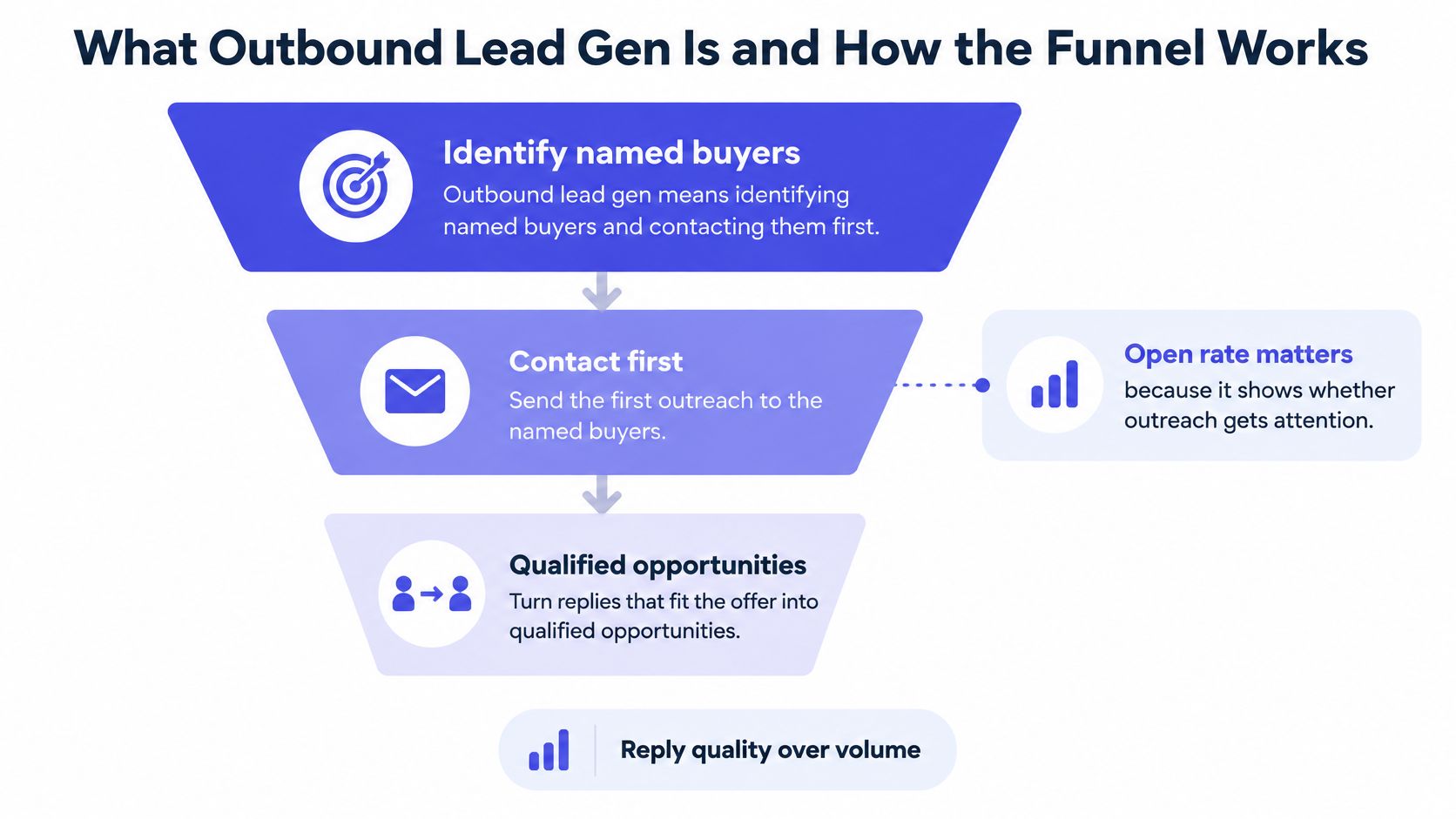
Outbound lead gen means identifying named buyers, contacting them first, and turning the replies that fit your offer into qualified opportunities. That definition contains no reference to list size or send volume. It starts with a decision about which accounts deserve outreach and ends with a person who meets written criteria and can take a call.
Open rate is the wrong scoreboard. It measures whether a subject line survived a filter and a glance, and it stops before any conversation exists. A program can lift open rate while qualified opportunities fall, because a sharper subject line on a worse list changes nothing that pays.
The four stages that decide output
The working model multiplies rather than adds: qualified leads = delivered messages × reply rate × positive-intent rate × qualification-pass rate. Each stage filters the one before it, so a weak stage late in the chain destroys a strong stage early in it.
A cold email sequence benchmark reports that campaigns using three email rounds produced the highest reply rate among the sequences compared, averaging 9%. That is a reply-rate measure, not a forecast, and it belongs to the sequences it measured. Replace it with your own baseline once market, list quality, offer, sender reputation and reply classification are held constant.
Start with 10,000 delivered messages at that 9%. You get about 900 replies. If 12% of those show relevant intent, that's 108 positive replies. If 35% of those meet the agreed qualification criteria, the campaign produced roughly 38 qualified leads.
| Funnel stage | Rate used | Count | What it tells you |
|---|---|---|---|
| Delivered messages | Starting count | 10,000 | Messages that reached an inbox |
| Unique replies | 9% | 900 | Benchmark for three-email sequences, not a forecast |
| Positive intent | 12% | 108 | Replies that show relevant interest |
| Qualified leads | 35% | 38 | Positive replies that meet the agreed criteria |
Better enrichment moves the last two stages even when total replies stay flat. A verified job title, a trigger event like a new hire or a funding round, and a role-specific opening line raise positive intent and qualification without adding a single send. That's why data quality beats sequence length once delivery is healthy.
Where a low number tells you what to fix
When output drops, the stage that broke tells you what to repair. Delivery short of the send file points at authentication, list hygiene and complaint rates. Replies that arrive without positive intent point at offer-market fit, message relevance and timing. Positive replies that fail qualification point at targeting, and at acceptance criteria nobody wrote down before the campaign started.
Fix the earliest broken stage first. Pouring more prospects into a funnel with a broken qualification stage produces more rejection reasons, not more revenue.
Practical rule: a reply only becomes a lead when it passes written criteria, and those criteria should exist before the first send.
Track the funnel by sequence step rather than as one campaign average. Log delivered messages per domain so infrastructure problems surface early. Count unique replies and positive replies separately, because a wave of "not now" replies looks like success in a combined number. Record qualified opportunities with the rejection reason attached. Report booked meetings and downstream conversion by step, so you can see which follow-up earned the reply.
Channels Compared and Where Digital Outreach Fits
| Channel | Who controls volume | Main constraint | Best use |
|---|---|---|---|
| Cold email | You, through domains and inboxes | Inbox placement and complaint rates | Scaled reach to named buyers |
| Cold calling | Rep hours | Rep hours and connection rates | Fast follow-up after a warm signal |
| LinkedIn outreach | Account limits and rep time | Account restrictions and rep time | Reaching decision-makers who ignore email |
| Paid search and ads | Budget | Cost per click and lead quality | Capturing buyers already searching |
| Referrals | Existing relationships | Unpredictable volume | High-trust introductions |
The table is a control map. Each channel hands volume control to someone different, and the constraint column is what caps it in practice, not what the sales deck claims.
Digital channels are where the decision already happens. Gartner's Future of Sales research projected that 80% of B2B sales interactions between suppliers and buyers would occur through digital channels by 2025, and found that buyers spend only 17% of their purchasing time meeting potential suppliers (Gartner). The rest of that time goes to websites, email, virtual meetings and independent research. A prospect often builds a shortlist before agreeing to a conversation, so a first touch has to survive a comparison rather than introduce a category.
Channel by channel, in operating terms
Cold email is the one channel where a single operator can raise or lower volume without a hiring decision. Domains and inboxes are the control surface, which means the ceiling is set by inbox placement and complaint rates rather than headcount. That ceiling is real. Once complaints climb, extra volume stops working and starts damaging the domain.
Cold calling is capped by rep hours and connection rates. It earns its keep as a follow-up after a signal, when the name already means something, and it burns hours as a cold first touch at volume.
LinkedIn outreach reaches buyers who ignore email, but account restrictions and rep time set daily volume. The platform decides how many messages leave per day, not the operator.
Paid search captures demand that already exists, and you pay for every click whether or not the lead qualifies. Referrals convert on high trust and arrive on no schedule at all.
Choosing a mix from three inputs
- Offer price and deal size: a high-ticket offer justifies slower, higher-touch channels because one closed deal covers months of activity.
- Customer lifetime value: if a customer is worth enough to absorb a costly qualified lead, paid channels and managed outreach both stay viable. If not, the math fails before the messaging does.
- Named buyer count: when only a few hundred companies fit the profile, list precision matters more than reach, and email plus phone beats broad advertising.
A channel mix is a math decision about how many named buyers exist and what one customer is worth, not a brand preference.
Outbound reaches buyers who would never search for the category, so it sits alongside paid and referral rather than replacing them. The operational consequence is that prospect data, email sequencing, landing pages, CRM handoff and reply management have to work as one system. A brilliant sequence pointed at a landing page that contradicts it wastes the reply you paid for.
Infrastructure That Keeps Messages in the Inbox
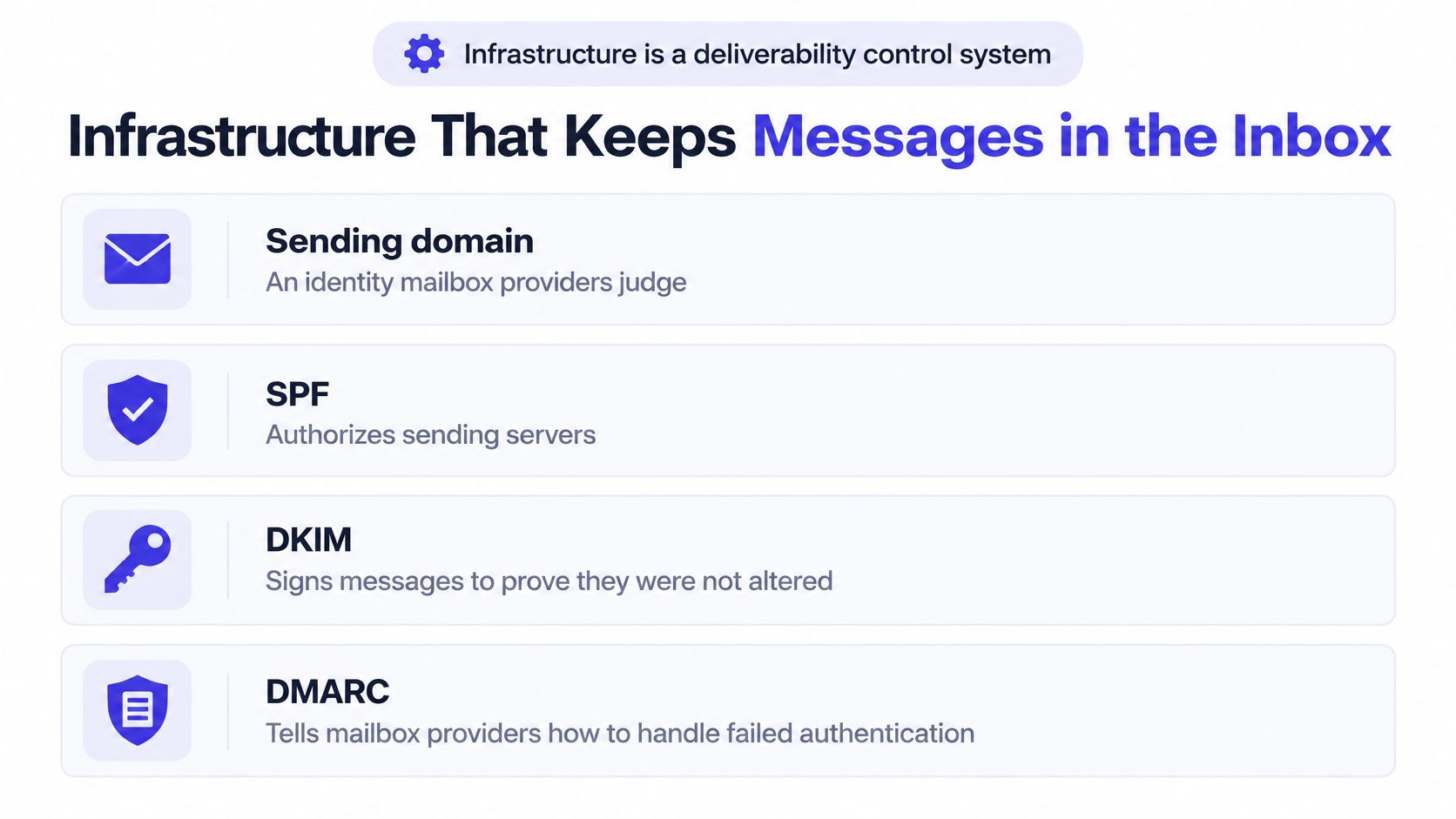
Deliverability sits underneath every funnel number in outbound. A sending domain is an identity that mailbox providers judge, and a domain that lands in spam produces zero replies from the same list and the same copy.
| Control | Requirement or threshold | Check before scaling |
|---|---|---|
| SPF and DKIM | At least one must pass for Gmail delivery | Verify both on every sending domain |
| Bulk sender rule (Google) | 5,000 or more messages a day to Gmail requires SPF, DKIM and DMARC | Count daily volume per domain |
| DMARC (Microsoft high-volume senders) | Published with at least p=none, aligned with SPF or DKIM | Confirm alignment in header tests |
| Spam complaint rate | Google bulk sender limit: under 0.1%, never reach 0.3% | Pause and investigate any upward movement |
| Unsubscribe | Visible and functional | Test that opt-outs propagate to every inbox and sequence |
Google requires every sender delivering to Gmail accounts to pass SPF or DKIM, defines bulk senders as those sending 5,000 or more messages a day, and requires bulk senders to keep spam complaints below 0.1% and never reach 0.3% as measured in Postmaster Tools (Google's sender guidelines). SPF authorizes sending servers, DKIM cryptographically signs each message, and DMARC aligns the visible From domain with the authenticated identity while giving the sender policy and reporting controls.
Microsoft applies the same 5,000 emails a day threshold to Outlook high-volume senders, requires DMARC configured with at least p=none and aligned with SPF or DKIM, and states that non-compliant messages may first be routed to Junk (Microsoft). Authentication proves the domain is who it says it is. That is the floor for delivery. Placement still depends on reputation, which accumulates from complaint rates, bounce rates and engagement across weeks of sends.
The setup order that avoids rework
- Publish SPF for every host that sends on the domain's behalf, so receiving servers can match the sending IP to an authorized list.
- Configure DKIM signing at the domain level, so a message altered in transit fails verification.
- Publish DMARC with a reporting address, starting at a monitoring policy and tightening once alignment is confirmed.
- Test headers at the receiving provider, not just in your own tooling. What your platform reports and what Gmail or Outlook sees are different pictures.
- Raise volume gradually, in steps small enough that a bounce or complaint spike is attributable to one change.
- Confirm unsubscribe events propagate to every inbox, sequence and CRM record, not just the mailbox that received the click.
Run the 0.1% line as an internal ceiling rather than a target. Once complaints reach 0.3%, Gmail routes bulk traffic to spam or rejects it outright, and senders above that line lose access to delivery mitigation. Investigate any upward move before scaling further, and separate domains by client so one poor list cannot contaminate an unrelated sending identity.
Warm-up is a schedule, not a switch
Start each new sending domain at a volume your own bounce and complaint data can defend, then raise it only when both stay flat across recent send days. Hold or step back the moment either rises. Reputation builds over weeks, so plan the ramp as a calendar with checkpoints rather than a burst you forget about.
Never change volume and list source in the same week. If placement moves, you will not know which change caused it. Suppression hygiene belongs in the same discipline, and this guide to clean email lists covers the ongoing maintenance side. A complaint rate drifting toward the ceiling is a signal to stop scaling and fix the list or the copy, because senders who spend their headroom tend to discover the limit from the other side.
Relevance and Opt-Out Rules That Protect Campaigns
The most expensive assumption in outbound is that more sends produce more leads. Buyers don't cooperate with that assumption.
In a Gartner survey of 632 B2B buyers fielded from August through September 2024, 73% said they actively avoid suppliers that send irrelevant outreach, 61% preferred an overall rep-free buying experience, and 69% saw inconsistencies between a company's website and what sellers told them (Gartner).
The first two numbers point at one failure: irrelevant contact is worse than no contact, because the buyer walks away instead of ignoring you. A campaign built on volume multiplies exposure to that reaction with every send. Accurate segmentation and offer-market matching are what move a prospect from quiet research into a real conversation.
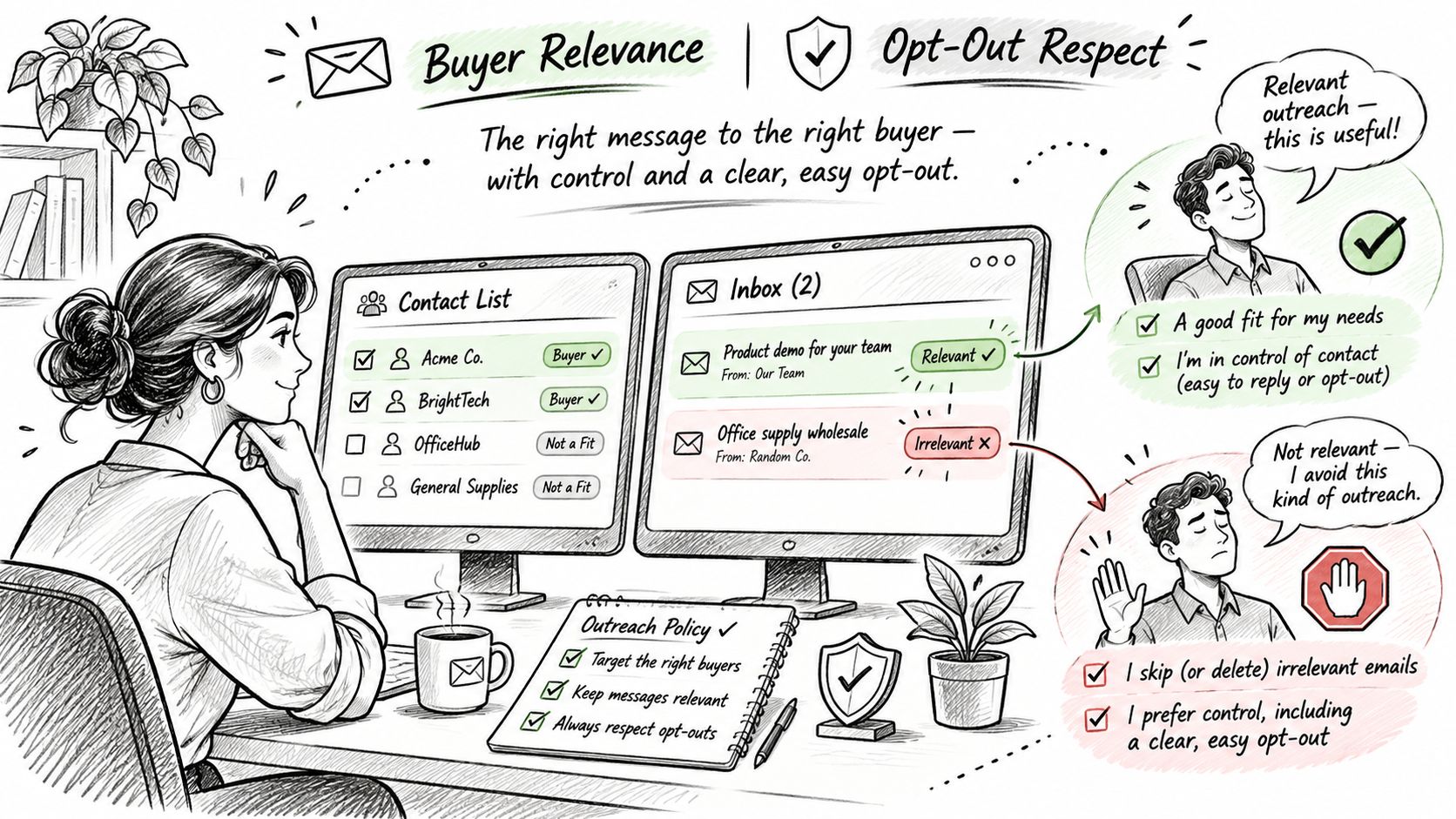
A message can land in the primary tab and still fail because the account, the timing, the trigger or the decision-maker is wrong. Deliverability earns the open; relevance earns the reply. Every send to a mismatched contact is a funnel stage that produces a complaint rather than a qualified lead, and enough of those sends drag the domains underneath you down.
The legal floor sits lower than the commercial bar, so meet both. The FTC's CAN-SPAM compliance guide requires every commercial email to carry a clear and conspicuous explanation of how to opt out, plus a functioning return email address or another internet-based mechanism for the request, and that mechanism must keep processing requests for at least 30 days after the message is sent while opt-outs must be honored within 10 business days (FTC).
A reply that says "remove me" blocks that address from future commercial messages, including follow-ups already scheduled in the sequence. The duty stays with the advertiser when an agency sends on their behalf, so outsourcing execution never outsources responsibility. Centralize suppression across every campaign, and check that a newly enriched list can't reintroduce a contact who already opted out.
The pre-send check
- Confirm the trigger or role fit for each contact, and drop the records where the only justification is that they match a job title filter. Start from real prospect research rather than a purchased field.
- Confirm the message matches the landing page. Different numbers, different offer terms or a different tone reads as the kind of website-to-seller inconsistency buyers already notice.
- Confirm the opt-out path works from the recipient's side, including reply-based requests.
- Check the suppression list against the send file, not the other way around.
- Confirm the sending domain's complaint rate is inside your internal ceiling before the sequence goes live.
Qualified Leads, Replies and What Happens Next
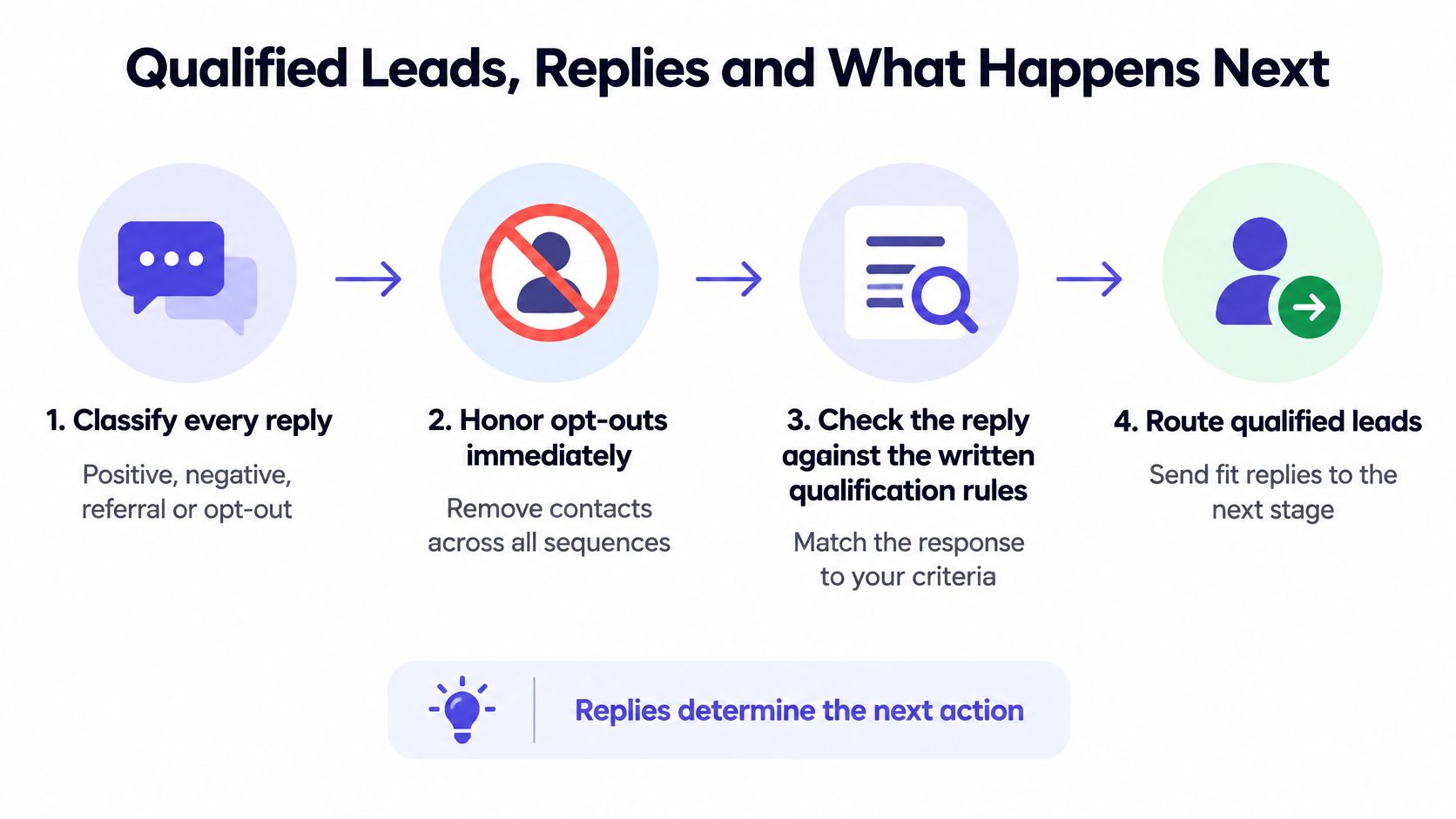
A positive reply starts the clock. Teams with no written reply-handling steps improvise once one arrives, and improvisation is where qualified leads get lost: the referral sits unread, the opt-out receives another scheduled follow-up, the good-fit contact waits days for an answer that should have taken an hour.
Reply handling, in order
- Classify every reply as positive, negative, referral or opt-out, and do it the same day.
- Honor opt-outs immediately across every sequence and inbox.
- Check the reply against the written qualification criteria. Fit is a yes or no against a document.
- Reject what doesn't qualify and log the reason. Rejection reasons are the cheapest research you get on targeting.
- Hand qualified leads to the CRM with segment, trigger and role attached, so the first sales call starts with context.
- Track the outcome by sequence step to see which follow-up produced the conversation.
Steps two and four are where managed programs and internal teams both get sloppy. An opt-out that lingers in a spreadsheet gets re-contacted by the next campaign, and that is how a domain earns complaints.
Why a qualified lead is not a near-term opportunity
Buyer behavior sets the expectation. More than 80% of B2B buyers know which product they want before research begins, 70% purchase their initially preferred solution, and younger decision-makers involve an average of 6.8 stakeholders against 3.5 among older executives (buyer research reported by Sales & Marketing).
The timeline runs longer than a quarterly pipeline model allows. A large share of leads take months to reach a decision and some take more than a year, so a contact who fits the account criteria perfectly can still be far from signing. Outbound often earns a place in the consideration set well before it earns a meeting.
That changes what has to be ready after the first reply. Keep customer references, implementation detail, ROI evidence and objection-specific material staged and current, because a prospect who is already comparing vendors will ask for all four in the first exchange. A reply that gets a generic brochure back is a reply that stops moving.
Pricing follows the same logic. Cost per qualified lead is the monthly fee divided by the accepted qualified leads that fee produced, and doubling the qualification pass rate halves that cost on the same spend. Report sales-ready opportunities and strategically qualified accounts as separate lines, so the price reflects which one is being bought, and so a slow committee decision doesn't get scored as a failed lead.
Measure the time from first reply to first substantive answer. That gap predicts more about close rate than reply volume does, and it shrinks fast once reply handling runs on written steps.
Managed Outreach Fit and Vendor Questions
Building outbound in-house means paying for capability before you know whether the channel works for your offer.
| Cost component | In-house team | Managed outreach |
|---|---|---|
| Hiring and training | You recruit, train and supervise reps | Provider staffs execution |
| Prospect data | You buy and maintain lists | Provider sources and enriches records |
| Sending infrastructure | You configure domains and inboxes | Provider deploys and monitors them |
| Inbox handling and follow-ups | Your reps, on top of selling | Provider handles daily inbox management |
| Time to first meeting | A quarter or more, after hiring and ramp | Under 15 days of setup, then sending starts |
| Cost model | Salaries and tooling, paid regardless of results | Provider dependent, from retainer to per-lead |
The table hides the part that hurts. Salaries, tooling and data are fixed costs that start before the first reply and continue through the weeks when the offer is still being tested. A rep spending two hours a day on inbox management and follow-ups isn't selling, and the cost of that split rarely shows up in a budget line.
Where each model wins
In-house wins when a long consultative sale needs a senior rep in every conversation, or when reaching the buyer depends on technical depth only your own team holds. It also wins when outreach volume is small and precision matters more than throughput.
Managed outreach moves execution, infrastructure and follow-up to a provider while the client keeps the sales conversations and the closing. It fits when the offer and the buyer are already clear, when customer lifetime value can absorb the cost of a qualified lead, and when enough named buyers exist that list quality becomes the variable that moves results.
Before committing either way, confirm five things. A defined offer with a named buyer. A customer lifetime value high enough to absorb the cost per qualified lead. A sales team that can take the calls that get booked. A one-page written list of acceptance criteria. A CRM where qualified leads will reliably land.
IronPeak Marketing runs a managed model built around that arrangement. The client attends only the sales calls booked on their calendar, onboarding begins with a 60-minute call covering the offer and target market, and a lead that fails the agreed criteria can be rejected without payment. Engagements run month to month, and infrastructure is live inside 15 days before campaigns start.
That structure only holds up if acceptance criteria are specific. "Good fit" is not a criterion. A named industry, a company size band, a role with budget influence and a stated reason the offer is relevant this quarter is a criterion, and it's what makes a rejection conversation possible without argument.
Questions to put to any provider in writing
- Who owns the sending domains and inboxes if the contract ends, and can they be transferred rather than rebuilt from zero.
- Who owns the suppression list, and whether it travels with the client or stays with the provider.
- Whether prospect data can be exported, including enrichment fields, in a format a CRM can ingest.
- How rejected leads are handled, including whether a rejection needs a stated reason and what happens to the fee.
- How reporting breaks down results by segment, trigger, role and sequence step, rather than one blended reply rate.
Anyone comparing providers should understand how a lead generation agency is priced and staffed before the first call, because the differences between offers usually sit in what happens after a reply, not in the copy.
Then write the criteria on one page, pick one segment for the first test, and set an internal complaint ceiling below the provider's hard limit. Everything after that is tuning against real data instead of guessing at what the market wants.
Outbound lead gen only pays when the deliverability layer and the funnel layer are built together, and IronPeak Marketing runs that whole stack as a managed service: custom domains and dedicated inboxes, prospect data collected and enriched through custom API access and AI agents, cold email copywriting, automated follow-up sequences, daily inbox management and CRM handoff. The commercial model is pay per qualified lead, so a lead that fails your acceptance criteria can be rejected without payment, and the client only attends the sales calls booked on their calendar. If you want the funnel in this article built for your own offer, visit IronPeak Marketing to see how the process works.