Lead Generation for Marketing Agencies: A 2026 Guide
Lead generation for marketing agencies explained: channels, deliverability limits, follow-up rules and the metrics that separate qualified leads from noise.
Your best clients came from referrals, a partnership, or one founder who happened to be in the right Slack group. That pipeline felt effortless until a quiet quarter arrived, the introductions dried up, and the calendar emptied out. So the agency bought a lead list, wrote a sequence, sent it from a domain registered on Monday, and wondered why nothing landed.
The offer usually isn't the problem. Outbound gets treated as a copywriting exercise when it's really a qualification and infrastructure system. What an agency can sell each month is capped by how much authenticated sending its domains can carry. What it can bill is capped by how tightly it defines a qualified lead.
Work those two constraints in order. Sending limits first, then acceptance rules, then channels and copy. Reverse the order and every underperforming campaign looks like a targeting failure when it's a deliverability issue.
Lead Generation Channels Agencies Compare First
No channel wins for every agency. The right choice falls out of three numbers: average contract value, how many qualified accounts exist in the target market, and how long the agency can wait for the first call. Preference without those numbers is how agencies spend a quarter's budget proving that a channel doesn't sell retainers.
| Channel | Cost model | Targeting control | Main weakness |
|---|---|---|---|
| Cold email outbound | Setup plus per-campaign or per-lead fees | High, by title, firmographic profile and trigger | Deliverability and list quality decide results |
| Paid search and social ads | Pay per click or impression | Medium, by keyword or audience settings | Spend rises before lead quality is proven |
| Referrals and partner introductions | Mostly relationship time | Low, the agency cannot choose who refers | Volume is unpredictable |
| Content and SEO | Production time and months to rank | Medium, by topic and search intent | Slow to produce qualified calls |
| LinkedIn direct outreach | Tool or seat cost plus manual time | High, but manual | Hard to scale without a team |
| Events and webinars | Ticket, travel and production cost | Low to medium | Attendance does not mean fit |
Cold email outbound is the only channel where the agency picks the account, the contact, the send date and the follow-up. That control is worth a lot when the target market is small and specific, and worth nothing if the sending domain isn't authenticated or the list is a database four other agencies already mailed this month.
Paid search and social reach buyers while they're already looking, which is why they feel safe. The bill arrives before the evidence does. Spend climbs for weeks before anyone knows whether those leads close at the contract values the agency needs to stay profitable.
Referrals convert because trust arrives pre-paid, but the agency can't choose who refers or when. Content and SEO compound in the other direction, producing qualified calls slowly and then steadily. LinkedIn outreach is precise and manual, and it stops producing the week the founder gets busy. Events buy face time, and a badge scan is not a qualification decision.
The comparison matters because buyers rarely move through one channel. McKinsey's B2B omnichannel research found the number of channels B2B customers use during the buying journey doubled from about 5 in 2016 to 10 or more by 2021, and 94% of respondents said the omnichannel model was at least as effective as the pre-pandemic approach. Budgets follow the same logic: in 2024, 69% of B2B marketers identified lead generation as a marketing activity likely to receive additional funding, while 51% ranked email marketing among their most effective lead-generation tactics, according to the 2024 B2B Marketing Benchmark Report from Endeavor Business Media.
Answer three questions before committing to any channel:
- What is the average contract value? Small deals need volume and tight fulfillment. Large deals can support account-based work and longer cycles.
- How many qualified accounts exist? Under a few hundred, precision beats reach and outbound is the natural fit.
- How long can the agency wait? If the answer is under 60 days, content is a credibility project, not a pipeline plan.
Deliverability Limits That Cap Your Campaign Volume
Sending volume is set by authentication, complaint rates and opt-out handling. Each is measurable before a campaign goes live, so the monthly ceiling on what an agency can send is a planning input decided in advance, not a surprise discovered after launch.
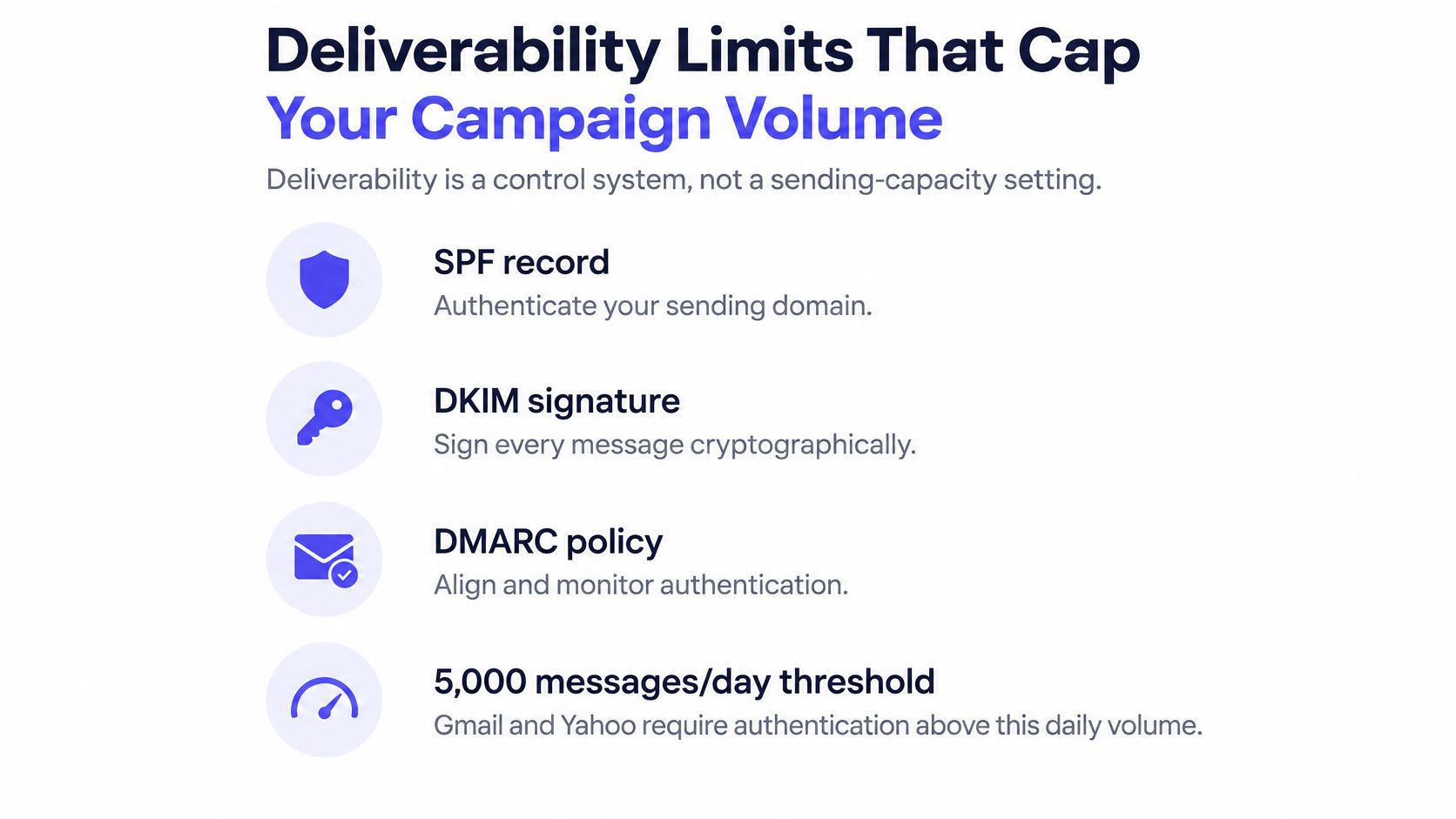
Google's rules are the clearest starting point. Since February 2024, senders reaching Gmail accounts have had to authenticate mail, keep unwanted messages low and offer an easy unsubscribe path. The Gmail sender guidelines recommend keeping the user-reported spam rate below 0.1% and preventing it from reaching 0.3% or higher. A sender above 0.3% can lose access to delivery mitigations, and bulk senders stay ineligible until the rate holds below 0.3% for seven consecutive days.
Volume is where most agencies trip first. Google's bulk sender requirements apply to senders delivering more than 5,000 messages a day to Gmail accounts: SPF, DKIM and DMARC in place, the visible From domain aligned with the SPF or DKIM domain, one-click unsubscribe on promotional mail, and a complaint rate read inside Postmaster Tools. Microsoft applies the same test on the Outlook side, requiring SPF, DKIM and DMARC of domains sending more than 5,000 emails a day, with DMARC configured at least at p=none and aligned, and Microsoft's high-volume sender guidance states non-compliant messages get routed to Junk first.
| Control | Threshold | Applies to |
|---|---|---|
| SPF, DKIM and DMARC authentication | Required above 5,000 messages per day | Bulk senders to Gmail |
| SPF, DKIM and DMARC authentication | Required above 5,000 emails per day | High-volume senders to Outlook |
| DMARC policy | At least p=none, aligned with SPF or DKIM | Outlook high-volume senders |
| User-reported spam rate target | Below 0.1% | All Gmail senders, per Google guidance |
| User-reported spam rate ceiling | 0.3% or higher loses delivery mitigations | Gmail senders |
| Bulk sender recovery | Seven consecutive days below 0.3% | Bulk senders to Gmail |
| Opt-out mechanism | Works for at least 30 days after send | Commercial email under CAN-SPAM |
| Opt-out processing | Honored within 10 business days | Commercial email under CAN-SPAM |
Complaint headroom is thinner than the ceiling implies. The gap between a healthy rate and a flagged one is a few tenths of a percentage point, so a campaign has very little room to absorb a bad list or a mistargeted segment. Validity's 2025 email deliverability benchmark report recommends best-in-class senders target below 0.1%, and it notes B2B deliverability is often harder than B2C because consent standards are typically lower and engagement is weaker.
The setup sequence that keeps a domain clean:
- Publish an SPF record that names the actual sending service. A record authorizing a provider you stopped using six months ago is worse than no record at all.
- Enable DKIM signing on every sending domain. One key per domain, rotated when the provider changes.
- Configure DMARC and confirm alignment. Start at p=none, read the reports, then tighten.
- Add a one-click unsubscribe path. Promotional mail needs it, and the request has to route into a suppression list, not a mailbox someone checks on Fridays.
- Read the authentication results in the message headers. A successful handoff to the receiving server says nothing about whether the message reached an inbox.
Domain separation is the other half of volume planning. Multiple inboxes on one domain share a single reputation, so a campaign that burns one inbox drags the rest down with it. Split volume across sending domains on purpose, and keep list hygiene ahead of volume targets, since cleaning an email list costs an afternoon while a damaged domain costs a quarter of pipeline.
Practical rule: when a domain trends toward the complaint ceiling, cut volume and narrow the targeting before touching the copy.
The maths on complaints is unforgiving. A domain that sends 1,000 messages and collects three complaints sits at exactly 0.3%, which is already the level Google identifies as materially harmful. Warm-up builds reputation over time, but it can't substitute for authentication, suppression or complaint control.
How an Outbound Campaign Runs From Research to Handoff
An outbound campaign behaves like an assembly line. Each station passes work to the next, and total output is set by the slowest station rather than the fastest one. A brilliant sequence running off a bad list produces the same result as a bad sequence running off a brilliant list: nothing.
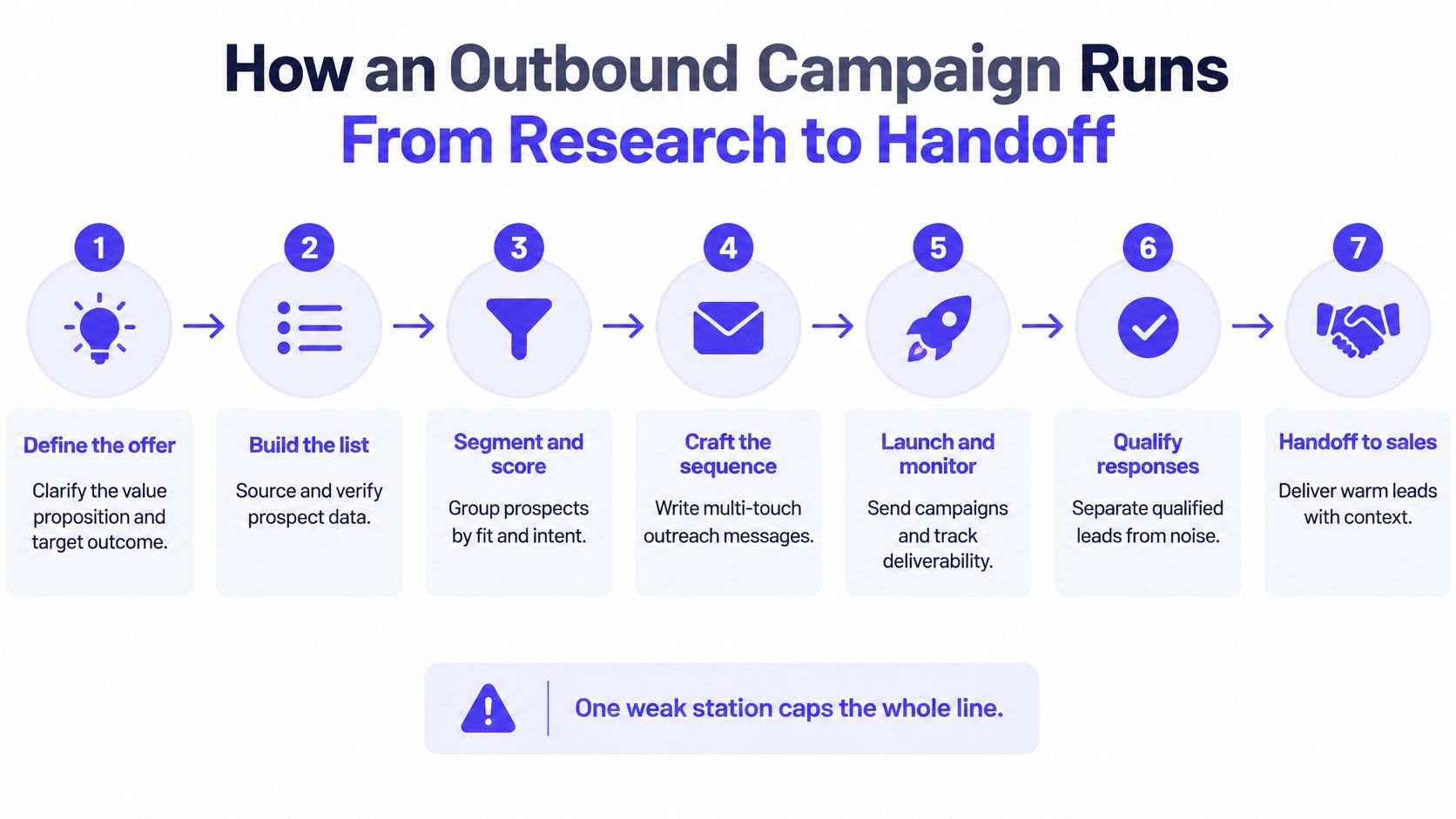
- Define the offer and the target account profile. One sentence per segment, written as a problem the buyer already knows they have. If the profile can't be filtered in a prospecting tool, it's a wish, not a segment.
- Build the list and enrich every record. Pull from sources beyond the shared databases everyone resells, then append role, company trigger and a live contact channel. Good prospect research tools help here, but only if the output is enriched enough to personalize a first line without guessing.
- Segment, score and clear the infrastructure gate. Group accounts by fit and intent, then confirm the sending domains, dedicated inboxes and warm-up clear the authentication and complaint limits described above. This gate sits before launch for a reason: infrastructure failures are cheap to fix on a Tuesday and expensive to fix mid-campaign.
- Write the sequence per segment. A message naming a specific problem beats a message describing a generic benefit every time. Keep the first email short enough to read on a phone and specific enough that a competitor couldn't send it verbatim.
- Launch and monitor. Fixed number of touches, fixed stop rules, daily checks on complaints, bounces and inbox placement.
- Qualify the responses. Replies get sorted the day they arrive into interested, referred, unsubscribed and unsuitable. A referral to the right colleague is a better outcome than a polite no.
- Hand off to sales. The CRM record carries role, stated problem, trigger, related stakeholders and the next step the prospect agreed to. Without those fields, the sales team starts the discovery from zero and the lead decays.
Take a hypothetical campaign to see where the line narrows:
| Stage | Count | Rate from prior stage |
|---|---|---|
| Contacts sequenced | 1,000 | Starting volume |
| Positive replies | 20 | 2.0% of contacts sequenced |
| Qualified leads | 12 | 60% of positive replies |
| Booked calls | 8 | 67% of qualified leads |
Read those rates as diagnostic instruments rather than scoreboard numbers. A 2.0% positive reply rate on a tight, well-targeted list suggests the offer and list are aligned. If the qualification rate falls to 30%, the list is letting through contacts who respond but can't buy. If qualified leads rarely book, the call to action is asking for too much too early. Fix the weakest station and re-run a small batch before scaling anything.
Qualifying Leads Against the Buying Group
A positive response from an operations manager feels like a win until the proposal goes quiet because the finance director never saw it. A reply only starts the qualification work. Single-threaded opportunities die slowly, and the agency usually blames the offer.
The structure of the buying group explains why. Gartner's analysis of B2B sales deals puts the median B2B buying group at six to 10 decision makers, each bringing four or five independently gathered information sources into the process, and a separate Gartner report describes enterprise buying groups that stretch wider still, pulling in stakeholders across several business functions. One responsive contact opens a door into the account; the decision still belongs to the whole group.
The Five Roles That Decide a Deal
- Economic buyer. Approves the budget and cares about commercial impact, payback and risk to the number they're accountable for.
- Operational owner. Lives with the work every day. Message to workflow risk, team capacity and what breaks if nothing changes.
- Technical evaluator. Wants integration detail, security evidence and a straight answer on data handling.
- Procurement or finance participant. Cares about cost clarity, contract terms and how quickly the engagement can start.
- Internal champion. Sells the decision when the agency isn't in the room, which means the handoff note has to arm them properly.
Write different messages for each function rather than one message with four paragraphs. An executive wants a number and a timeline. An operator wants to know what lands on their desk in week one. Sending the champion's internal-forward copy to the economic buyer wastes both of them.
The Acceptance Checklist
A lead is qualified when it clears five items:
- A stated business problem, in the prospect's own words, specific enough that it couldn't describe a different company.
- A named role, so the agency knows who this person is inside the buying group.
- A trigger, such as a hiring push, new contract or a system that has stopped working.
- A reachable decision path, meaning an introduction to the person who signs off, or a credible route to them.
- A next step the prospect agreed to, with a date attached.
A lead missing two or more items gets logged with the reason and rejected. That log is the most valuable file in the campaign, because rejection reasons tell the agency exactly where targeting or copy drifted. A cluster of "no decision path" rejections points at list construction. A cluster of "weak trigger" rejections points at the research step.
A responsive individual may lack authority or access to the rest of the group. Judge the opportunity on buying-context evidence; a friendly reply says nothing about who else has to agree.
Say a staffing firm's operations director replies asking about permanent placement support. A good handoff note records their role, the specific hiring gap, the trigger (a new client contract starting next quarter), the fact that their finance lead signs off above a threshold, and the call booked for Thursday. The sales team then knows to invite the finance lead into the second conversation instead of discovering that constraint at proposal stage.
Follow-Up Count and Opt-Out Obligations
More touches don't automatically produce more opportunities. A campaign that adds a fourth and fifth nudge can raise reply volume while pushing complaint rates toward the ceiling, which means it bought activity with reputation.
The buyer research cuts deeper. Reach Marketing's compilation of B2B lead generation benchmarks reports that 67% of B2B buyers prefer an experience without a sales representative, 94% of buying groups rank preferred vendors before contacting sales, and 77% ultimately purchase from the vendor they initially favored.
That reframes what a first email is for. It isn't to force a meeting. It's to earn a short answer from someone who has probably already formed a shortlist.
Two Follow-Ups, Then Stop
A sales-statistics compilation published by HubSpot cites Belkins research identifying two follow-up emails as the ideal number for optimal results in a B2B outreach campaign. An initial message plus two purposeful follow-ups is the working baseline. Each one should add a reason to respond, sharpen the business problem, or close the loop politely.
Stop the sequence the moment a recipient replies, opts out, or gets marked unsuitable. Then test the baseline against an alternative cadence while tracking qualified leads, complaints, bounces and positive responses side by side. Total reply count is a vanity measure that rises happily while a domain degrades.
The template library matters less than the stop rules. Even a strong set of B2B sales email templates fails when it runs indefinitely with no exit condition.
Opt-Out Rules That Travel With Every Campaign
Commercial email rules apply to business-to-business messages, not just consumer mail. The FTC's CAN-SPAM compliance guide states the law covers any message whose primary purpose is advertising or promoting a commercial product or service, with no B2B exception. Each message needs accurate header and routing information, a non-deceptive subject line, a valid physical postal address and a clear opt-out. That mechanism must stay capable of processing requests for at least 30 days after the message is sent, and requests must be honored within 10 business days.
In practice that means suppression has to propagate across every inbox, domain, sequence and client list. Someone who opted out of one campaign cannot safely stay active in another sequence run by the same sender. Delegating execution to an agency doesn't move the obligation either, because the rules attach to the sender's behavior.
Metrics That Separate Qualified Leads From Noise
Volume metrics are the easiest numbers to report and the least informative. A dashboard showing rising sends and rising replies can describe a campaign that's losing the ability to reach anyone.
Buyers of lead generation have already shifted their attention. HubSpot's 2026 State of Marketing, based on responses from more than 1,500 global marketers, found 40% identified lead quality or marketing-qualified leads as their most important success metric, while 93.8% said lead quality had improved over the previous 12 months. That's a market judging suppliers on relevance, not contact count.
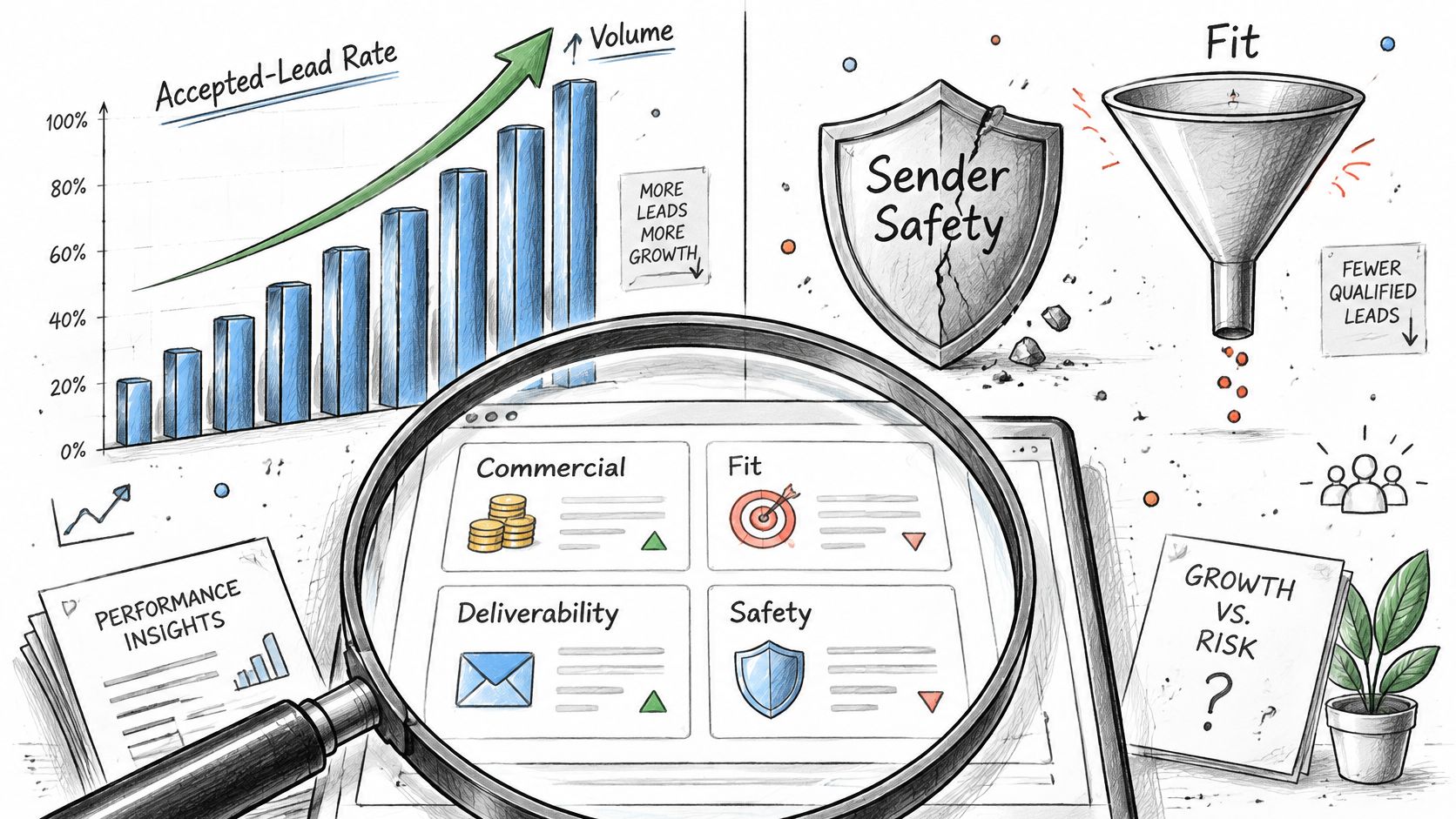
Track four groups, and keep them separate in the report:
- Commercial. Accepted-lead rate and accepted-lead-to-opportunity conversion. These two show whether the leads were real.
- Engagement. Positive response rate, read on its own rather than blended into total replies. "Not now" and "yes" are not the same signal.
- Safety. Complaint rate, bounce rate, unsubscribe rate, inbox placement tests and the health of each sending domain, read against the thresholds above.
- Attribution. CRM outcomes tagged back to the campaign and segment that produced them, so the next list gets built from evidence.
The pause rule: a campaign that breaches a safety threshold stops that day, however many replies it produced.
Rejection reasons feed the next round of targeting. A rising share of wrong-role rejections points at the list, because the filters are too loose. A rising share of no-problem rejections points at the copy, because the message is describing a category rather than a pain.
Take a hypothetical weekly review of one sending domain. It closes the week at a 0.25% complaint rate and a positive reply rate near 2%. The complaint rate sits under the ceiling but with almost no margin, so the decision is to cut daily volume and tighten the filter for a week before resuming. If the same domain had posted 0.05% complaints and a 0.4% positive reply rate, the decision flips to list and message work, because the infrastructure is healthy and the targeting is the bottleneck. Same meeting, opposite actions.
Choose Your Lead Generation Model This Quarter
The model decides more than the channel does. Whether the agency hires, retains or buys per result changes who absorbs the cost of a bad month, how predictable the spend is, and who gets to reject a lead that doesn't fit.
| Model | Who carries volume risk | Cost predictability | Control over lead acceptance |
|---|---|---|---|
| In-house sales development team | The agency | Fixed salaries plus tools | High, but slow to build |
| Monthly retainer with an agency | The agency | Fixed monthly fee | Depends on contract terms |
| Pay per qualified lead | Shared, since rejected leads are not billed | Scales with accepted leads | High, the agency rejects leads outside its standard |
An in-house team gives full control and takes months to recruit, train and supervise, with salaries due whether or not the list works. A retainer moves execution off the agency's plate but keeps the volume risk in place, since the fee is paid either way. Pay per qualified lead shifts the incentive, because the supplier only earns on accepted leads.
Whatever model the agency picks, the first quarter should follow five steps:
- Write the qualification criteria in the five buying-role terms, not in job titles.
- Choose one channel and one segment for a short test with a defined end date.
- Ask any provider for four things before signing: authentication setup, suppression process, rejection log and CRM handoff fields.
- Set stop rules for complaint rate, bounce rate and opt-out handling.
- Agree a review date tied to accepted-lead conversion, not to lead count.
Under pay-per-lead terms, check that the acceptance rules are written in the same five-role language used internally, so billing matches the standard applied. IronPeak Marketing is one provider selling outbound this way, on a pay-per-result basis with a stated target of 60 to 90 qualified leads in 45 days, and handoff fields and rejection rights are the parts worth testing against these criteria rather than the headline number.
The best model is the one whose failure modes are visible. If the agency can't see complaint rates, rejection reasons and lead-to-opportunity conversion, it isn't buying a pipeline. It's buying a report.
IronPeak Marketing runs managed cold email outbound for agencies and other B2B service businesses on a pay-per-result basis, targeting 60 to 90 qualified leads in 45 days with clients able to reject leads that fall outside the agreed qualification standards. The service covers domains, inboxes, copy, follow-ups and CRM handoff, so the team only shows up for booked calls. If the current pipeline depends on referral luck, visit IronPeak Marketing and compare its terms against the five criteria above.