Cold Email Template for Meeting: 7 Examples for 2026
Seven Cold Email Template for Meeting examples with personalization notes, follow-up timing, and guidance on when to send each one.
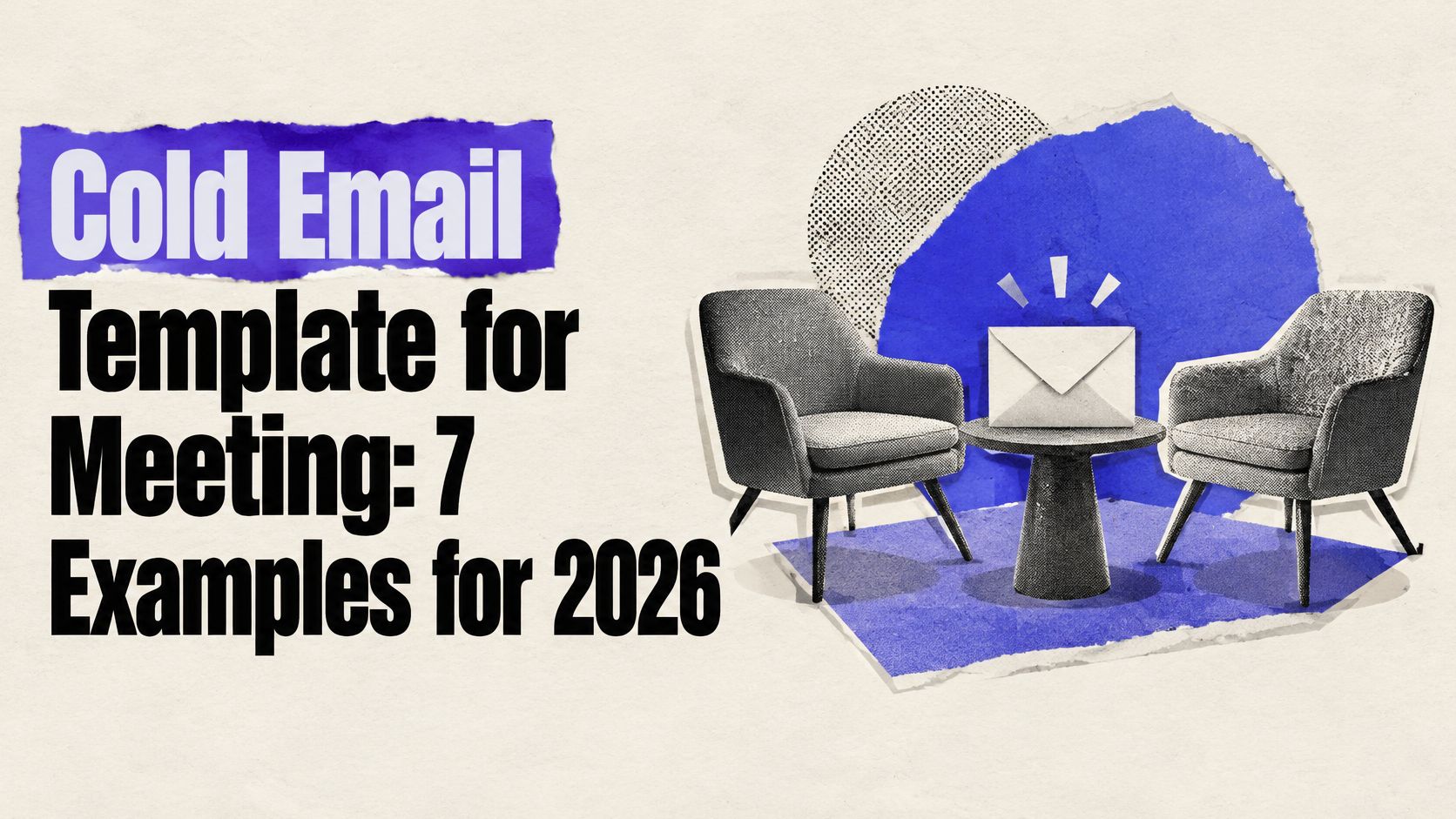
A founder rewrites the same cold email three times, sends it to a list nobody verified, and gets silence. The third rewrite was the best of the three. It also never had a real chance.
Reply rate on a cold email template for meeting is decided before the copy gets written. Four things set it: whether the list fits the offer, whether the trigger or problem is current, whether the sending domain reaches the inbox, and what happens in the hour after someone replies. Copy sits fifth. It matters, but it moves outcomes by points, not multiples.
Industry estimates cited by The Global Statistics put the global business-email population at approximately 1.86 billion users, with business email users growing about 2.7% annually in 2025. That scale explains why the channel still works and why every professional inbox is crowded.
Each template below is judged on the conditions that make it work or fail in a live sequence: list quality, trigger age, reply routing, and sending infrastructure. Each comes with the campaign decision it fits and the follow-up step that keeps it alive. Choose by those conditions, not by which paragraph reads best.
1. Two-Time-Slot Direct Ask
This is the default closing ask in most managed campaigns, and it survives cold traffic better than any open-ended request when the list is tight. It proposes two specific times and hands the prospect an exit.
Hi {{first_name}}, we help {{industry}} firms add qualified sales calls without hiring an SDR. Would Tuesday at 10:00 or Thursday at 14:00 work for a 15 minute call to see if it fits? If neither works, tell me a better window.
Two sentences carry the offer, one carries the ask. Length is the first filter. A 2024 Lemlist study covering more than 10,000 campaigns, reported in Gaidme's benchmark roundup, found that cold emails of approximately 120 words achieved a 52% booking rate, against 20% for emails of 300 words or more. A one-line offer plus a two-slot ask lands inside that range with room for a personalization line.
The image below shows the mechanic in one frame: two open slots on the prospect's side of the calendar, not a link.
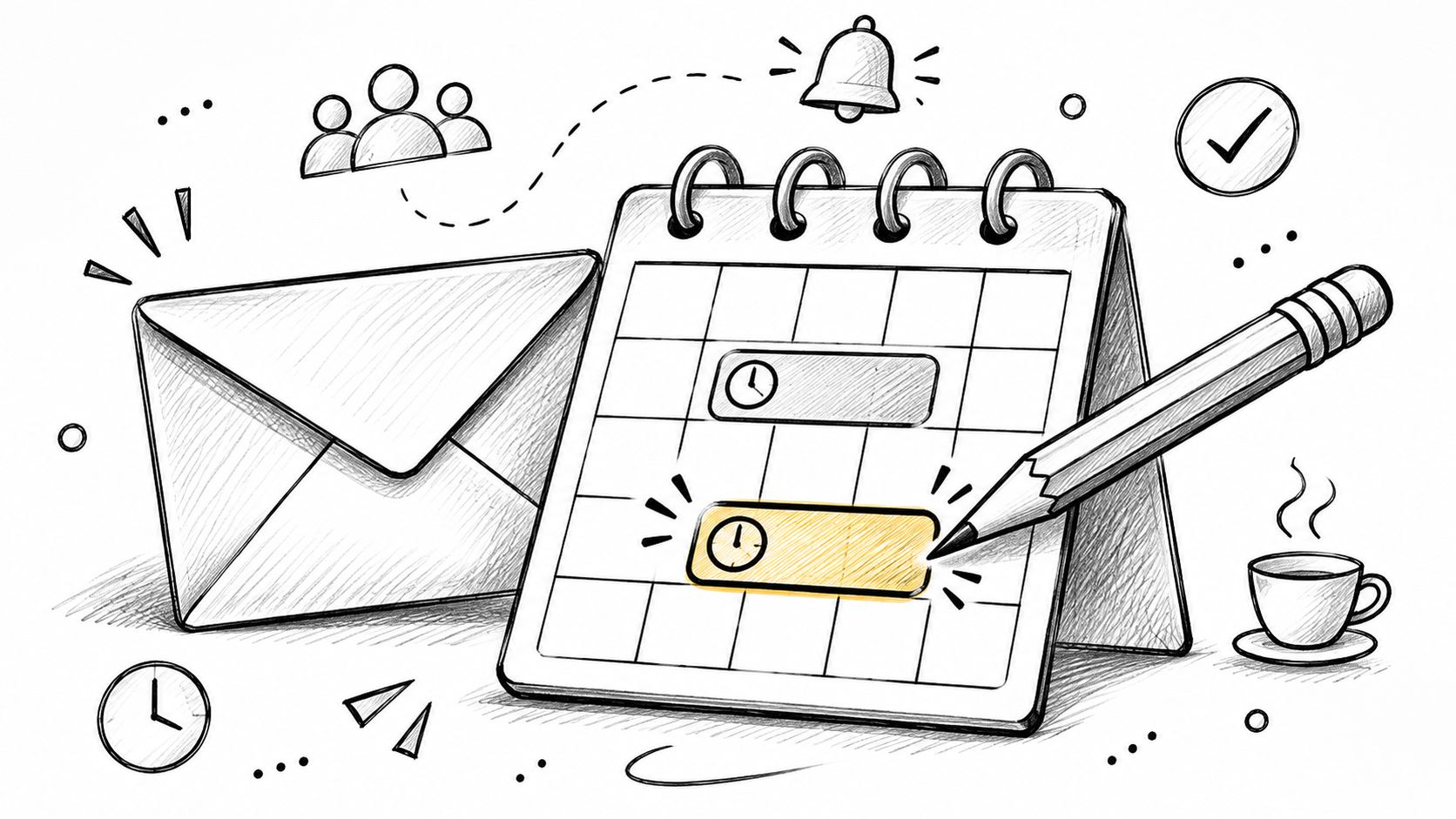
The ask only counts if the message lands
Silence may stem from the gateway rather than the copy. In 2023, independent deliverability benchmarks recorded approximately 85.7% global inbox placement, with Google Workspace placing about 91% of messages in the inbox against 77% for Microsoft 365, according to Gaidme's deliverability benchmarks. A domain with unaligned authentication is never testing the template on its full list.
Worked example. A staffing firm sends 400 first-touch emails to companies that posted operations roles in the past two weeks. Two hundred get the two-slot ask, two hundred get "let me know if you'd like to chat." Same offer, same list, same domain. The two-slot version usually books more calls because a yes costs the reader one word and a time, and nobody has to compose a sentence under pressure.
- Pull both slots from your own calendar. A time you can't hold turns a yes into a reschedule.
- State the time zone. A prospect two regions away reads 10:00 as their own.
- Keep links out of the first email. Calendar links belong in the reply, once interest exists.
- Compare the slot ask against an open-ended ask across two full sequences. One sequence isn't a test.
2. Permission-Based Opener
Senior buyers filter on line one. This structure stops the pitch before it starts and asks whether the subject is worth their time at all.
Hi {{first_name}}, is it worth sharing how a {{service}} firm added 4 to 6 qualified calls a month through a managed outbound system? If yes, I will send a two line summary and you can decide from there.
It converts the reader from a target into a decision maker. A yes costs a few seconds, not 15 minutes, which is why it lands with people who receive thirty cold emails before lunch. The reply data backs the order of operations. An analysis of more than 304,000 emails published by Make Automation found that an interest-based call to action generated 68% positive replies versus 41% for direct meeting requests.
A permission ask is not a substitute for a closing ask. It's the first step of a two-email chain, and the second email is where the calendar slot appears.
What a yes actually buys
A yes buys attention, not a meeting. Route the reply into a short second email that delivers the summary and then offers two times for a 15 minute call. Keep the calendar link out of it. The summary is the proof the permission request was honest, and the time slots are the close.
The permission line is where most of these emails win or lose, and how to write an email opening sentence covers the sentence-level mechanics that keep it short.
- Drop the words "relevant" and "interested" from the question. Both invite a polite no, because neither names a specific thing you'd send.
- Count yes-replies separately from bookings. A campaign with a healthy yes rate and no bookings has a follow-up problem, not a copy problem.
- Cap the summary at two lines. Anything longer turns the second email into the pitch the first one avoided.
- Segment by seniority. This template earns its keep with founders, partners and directors, and it underperforms on junior contacts who expect a straight ask.
Typical use case. A consultancy emails 300 marketing directors at mid-market firms. The permission version asks whether it's worth sending a two-line summary of how a firm added four to six calls a month. Roughly a third of replies are a version of "send it." Three-quarters of those request the summary and half of those accept a slot on the second touch.
3. Problem Question Opener
A question opener earns a reply by asking about a problem the prospect already carries, then offering a conversation if the answer is uncomfortable.
Hi {{first_name}}, with {{company}} hiring across {{region}} this quarter, are you finding that referrals cover enough of the backlog, or is outbound becoming necessary? If it is the latter, I can walk through how we build the pipeline. Open to a 15 minute call?
It works when the question is answerable in one line by the person who owns the problem. A 2024 Belkins benchmark summarized by OutreachBloom found that cold emails of 6 to 8 sentences achieved a 6.9% reply rate and a 42.67% open rate. That range fits one question, one supporting line, and one ask. It punishes the habit of stacking a second question on top.

Where the question has to come from
A question about inbound channel capacity fits a marketing agency. A question about recruiter load fits a staffing firm. A generic "how are you handling growth" fits nobody, because it could have been sent to any of the four thousand addresses on the list.
Working rule: if the person who owns the problem can't answer the question in one sentence, it's a survey, not an opener.
- Anchor the question in a verifiable signal. A job posting, a funding round, a visible hiring push, a new service line on the site.
- Limit each campaign to one or two problem angles. Batch review keeps the claims accurate and stops a writer from inventing a problem the segment doesn't have.
- Test against three real prospect profiles before sending to the full list. Print the email, read it as each of the three, and cut anything that reads wrong for one of them.
- Route negative answers to a different sequence. "We've solved it" replies are a signal, not a defeat, and a second email that respects the answer often reopens the thread a quarter later.
Typical use case. An agency sends to home service firms with 20 to 60 employees. The question asks whether inbound leads cover the shoulder seasons or whether paid and outbound have become necessary. Replies cluster into two groups, both useful, one for the pipeline and one for qualifying the offer.
4. Trigger Event Opener
Timing beats copy here. The trigger gives the prospect a reason to read that has nothing to do with the sender.
Hi {{first_name}}, I saw {{company}} posted four electrical technician roles this week. Filling those usually means a longer hiring cycle and more commercial bids going unanswered. Would a 15 minute call on how we source commercial account leads make sense?
This is one of the few structures where the research sets the reply rate more than the sentence does. The copy only has to connect the event to an outcome the prospect already feels.

The trigger window
Set a maximum trigger age, 14 days is a workable line, and drop records whose trigger has expired before the send. A job posting from six weeks ago has either been filled or has stopped being news, and the email then reads as stale research.
- Log the source URL on the contact record. Every claim in the email should be checkable before the call, and a CRM field makes that a two-second look rather than a rebuild.
- Use one trigger per email. Two events in one message reads like a dossier.
- Stay away from personal social posts and private employee information. Operators experience that as surveillance, and it produces complaints rather than replies.
Trigger data sits in the same enrichment layer as the contact record, and prospect research covers how to build that layer without buying the same saturated database every competitor uses.
Typical use case. A commercial cleaning company announces a new regional office. The email references the opening, notes that multi-site contracts usually mean new bid paperwork, and offers 15 minutes on how commercial accounts are sourced in that metro. The prospect can verify the event in four seconds, which is the point.
5. Value-First Teardown Offer
The deliverable does the work. A specific, short piece of analysis gives the prospect something to evaluate before agreeing to anything.
Hi {{first_name}}, I put together a one page review of how {{company}} describes its service on the homepage and in two recent LinkedIn posts. Happy to send it over. Would you like it before a 15 minute call, or should I send it after?
Order matters more than wording. A 2026 benchmark dataset covering 124,513 B2B contacts, published by Sales.co, recorded a 0.257% interested-response rate when the email offered to send something useful first, against 0.105% when it asked directly for a meeting. The resource offer roughly doubled the rate at which people expressed interest, on the same kind of list.

What counts as a real teardown
If the artifact takes more than 30 minutes to produce from a standard template, it won't survive volume. If it takes less than five, it reads as a mail merge and gets ignored.
- Cap the deliverable at one page. Two specific observations beat eight generic ones.
- Ask for a clear opt-in before sending the file. A reply that says "send it" is a qualified contact, and it's the reply you count.
- Keep attachments out of the first email. Attachments hurt deliverability and trigger filters.
- Track deliverable requests to meetings separately. A high request rate with a low booking rate means the teardown is interesting but not connected to a next step.
Worked example. A pricing consultant produces a one-page review of a prospect's proposal template and notes two lines where the pricing language is vague. The email offers the page before or after a call, without insisting on either. Half the recipients ask for it first, and a meaningful share of those accept a slot once they've read it.
6. Peer Reference Email
Peer proof is the most borrowed claim in cold email and the least verified. It works only when the sender can name the category and describe a real pattern inside it.
Hi {{first_name}}, we run outbound for a few specialty contractors in {{region}}. The common issue was that referral volume dropped in the slow months. Is that something {{company}} is seeing, and would a 15 minute call be useful to compare?
Belkins' 2024 analysis of 16.5 million cold emails, summarized by Prospeo, found an average meeting-booking rate of 1 to 2%. That's the honest baseline. A peer claim beats it only when the segment behind the sentence matches the list the email went to.
Build the list from the peer group
Write the segment definition down before the copy is drafted: industry, size band, service mix, region, and the problem that ties them together. The sentence and the segment are the same asset.
A peer claim only holds if the list was built from that peer group. If the segment line was written after the list was bought, the email is fiction with a case study attached.
- Describe only peer groups you've worked with. A borrowed category falls apart on the first call when the prospect asks who else.
- Never state results without written client approval. A number you can't defend becomes a liability the moment someone asks a follow-up question.
- Use the peer group as the buying filter. When the segment is defined first, the list vendor query and the email claim can't drift apart.
- Keep the claim in general terms. "Referral volume dropped in the slow months" is a pattern. "We grew one contractor by 40%" is a claim needing documentation.
Typical use case. A home services operator in mold remediation writes to other remediation firms in two states. The email describes the seasonal referral dip and asks whether they're seeing the same. Owners answer that question readily because it's about their business, and the call follows from the answer.
7. Breakup Email
The last touch in a sequence, and routinely the highest reply-per-send of the whole run. It works because the reader sees a clear end point and can act to keep the option open.
Hi {{first_name}}, I have not heard back, so I will stop sending emails after this one. If outbound is not a priority for {{company}} right now, just reply with no and I will close the loop. If it is, I can send two times for a 15 minute call.
Short, polite, no guilt. A guilt-based close produces replies and spam complaints in the same proportion, and complaints are the number that decides whether the domain keeps working.
Complaint rate is the real constraint
Google recommends keeping the user-reported spam rate below 0.10% and avoiding 0.30% or higher, and for senders delivering at least 5,000 messages per day to Gmail accounts it requires SPF, DKIM, a published DMARC record, and an easy unsubscribe, per Gmail's sender guidelines. Google also states that senders become eligible for delivery mitigations only after keeping spam rates below that ceiling for seven consecutive days, so a corrected list doesn't restore placement overnight, as Google's bulk sender enforcement documentation explains.
- Send the breakup only after earlier touches were delivered. A final email to dead addresses collects bounces, and bounces cost more than the extra reply is worth.
- Automate suppression on any reply, including a no. One manual removal that gets missed sends a fifth email to someone who asked you to stop.
- Review complaint rate per campaign, not per client. A problem in one sequence shouldn't contaminate every sending identity on the account.
- Mean it. Sending the breakup and continuing to mail anyway trains the recipient to ignore everything else from that domain.
The breakup closes a sequence that the earlier touches in B2B sales email templates have to set up, and it converts best when the prior emails carried a real offer rather than a reminder.
Typical use case. A four-touch sequence ends on day 18. Two of the first three touches were delivered but never opened, one reply said "not now." The breakup goes only to the delivered, non-responding remainder, and a share of those answer with a version of "send the times."
How the seven cold email templates differ in ask, research need, and main risk
| Item | Ask Type | Research Needed | Main Risk |
|---|---|---|---|
| Two-Time-Slot Direct Ask | Choose a meeting time | Prospect fit, offer clarity, and current availability | Can feel presumptuous; proposed times may go stale |
| Permission-Based Opener | Permission to share an offer | Specific outcome relevant to the prospect | Adds a follow-up step; generic wording gets ignored |
| Problem Question Opener | Answer a role-specific problem question and consider a meeting | Account-level research to verify the problem | Misreading the prospect damages credibility |
| Trigger Event Opener | Meet to discuss a timely business consequence | Recent, verifiable company trigger and source | Stale or inaccurate trigger undermines trust |
| Value-First Teardown Offer | Accept a useful deliverable, then consider a meeting | Prospect-specific input to create the deliverable | Time-intensive; prospects may take the free asset without booking |
| Peer Reference Email | Confirm whether a peer-group problem applies | Verified experience with the named peer segment | Vague or unsupported social proof weakens credibility |
| Breakup Email | Reply with a final yes, no, or meeting interest | Sequence history and reply-based suppression | Guilt-based language can trigger complaints and harm deliverability |
Pick the Template Your List Can Support This Week
Start with the list, not the copy. Pull every record that carries a trigger from the past 14 days, a verifiable problem signal, or a peer segment you can name from your own client base. Everything else goes into a separate, lower-priority send at lower volume. The templates above only perform when the record underneath them supports the claim in the email.
Then pick one opener and one closing ask, and pair them on purpose. A trigger opener pairs with the two-time-slot ask. A problem question pairs with the permission-based follow-up. A teardown offer pairs with the slot ask in the second email. Don't pair a permission opener with a breakup close in the same sequence. The first email promises a small step and the last one demands a decision, and the mismatch shows in the reply pattern.
Run both variants for two full sequences
Two sequences means two complete runs against two separate segments, with the same offer and comparable domain quality. Anything shorter measures luck, because a single send to 300 records tells you nothing about whether the ask or the list did the work.
- Authenticate before sending. Aligned SPF and DKIM, a published DMARC record, valid reverse DNS, TLS, and From-domain alignment.
- Count delivered, not sent. Opens are unreliable now that providers pre-fetch images and privacy features block pixels, so the denominator should be delivered email.
- Log replies by class. Positive, referral, objection, not now, unsubscribe. Each class gets a different next action, and lumping them together hides which template is working.
- Honor opt-outs the same day. Suppression should be automatic, not a task someone remembers on Friday.
Commercial email in the United States carries duties that sit inside the template rather than beside it. The FTC's CAN-SPAM compliance guide sets out the obligations: accurate header information and subject lines, a clear and conspicuous opt-out, a valid physical postal address, and identification of the message as an advertisement or solicitation. Those duties apply to individually written, tightly targeted B2B email, and opt-out requests have to be honored promptly.
Infrastructure is now a precondition rather than a footnote. Microsoft joined the tightening of sender requirements in 2025, as Twilio's email deliverability guide notes, which means a strong template on a weak domain is an untested template. IronPeak Marketing builds the domain and inbox layer first, spends about 15 days on infrastructure and warming before campaigns go live, and reviews the client's offer and market before any outreach starts.
A discovery call is the low-commitment way to test whether a campaign fits the market. It's also the step where the offer, the target segment, and the businesses the client wants to reach get examined before a template is written, which is the order this whole article argues for.
IronPeak Marketing builds dedicated sending domains, warms them, and handles the copy, follow-up and reply management that puts qualified meetings on a client's calendar, with a stated target of 60 to 90 qualified leads in 45 days. The model runs month to month on accepted leads, so a rejected prospect costs nothing, and each lead is reviewed before it counts. Visit IronPeak Marketing to book a no-commitment discovery call and put the offer and target market in front of the team before the first email is written.