7 Follow Up Sales Email Templates for B2B Outbound in 2026
Seven follow up sales email templates for B2B outbound, with send timing, personalization rules, and deliverability notes for each one.
A founder launches a campaign with a solid opening email, a defined offer, and a carefully selected prospect list. By day 10, the reply rate is flat. The copy looks reasonable, but the follow-ups arrive as disconnected messages, the sender domain is still warming, or every touch repeats the same request for a meeting.
Those problems need different fixes. Better wording won't repair broken threading, and more volume won't repair poor inbox placement. A useful follow up sales email belongs inside a system that checks delivery, stops automation when someone replies, and records what happens next.
Persistence still matters. Belkins' analysis of 7.5 million emails tracked during 2025 found that follow-ups generated 58.6% of all replies, according to the sales follow-up statistics summary. That measures replies, not qualified opportunities or revenue.
Operating principle: Every follow-up needs a reason to send, a condition that prevents sending, and a defined outcome in the CRM.
The templates below serve different positions and conditions within an outbound sequence. They aren't instructions to send every message to every prospect. The right choice depends on the account research, sender readiness, earlier delivery, and whether the recipient has already answered.
1. The Same-Thread Bump
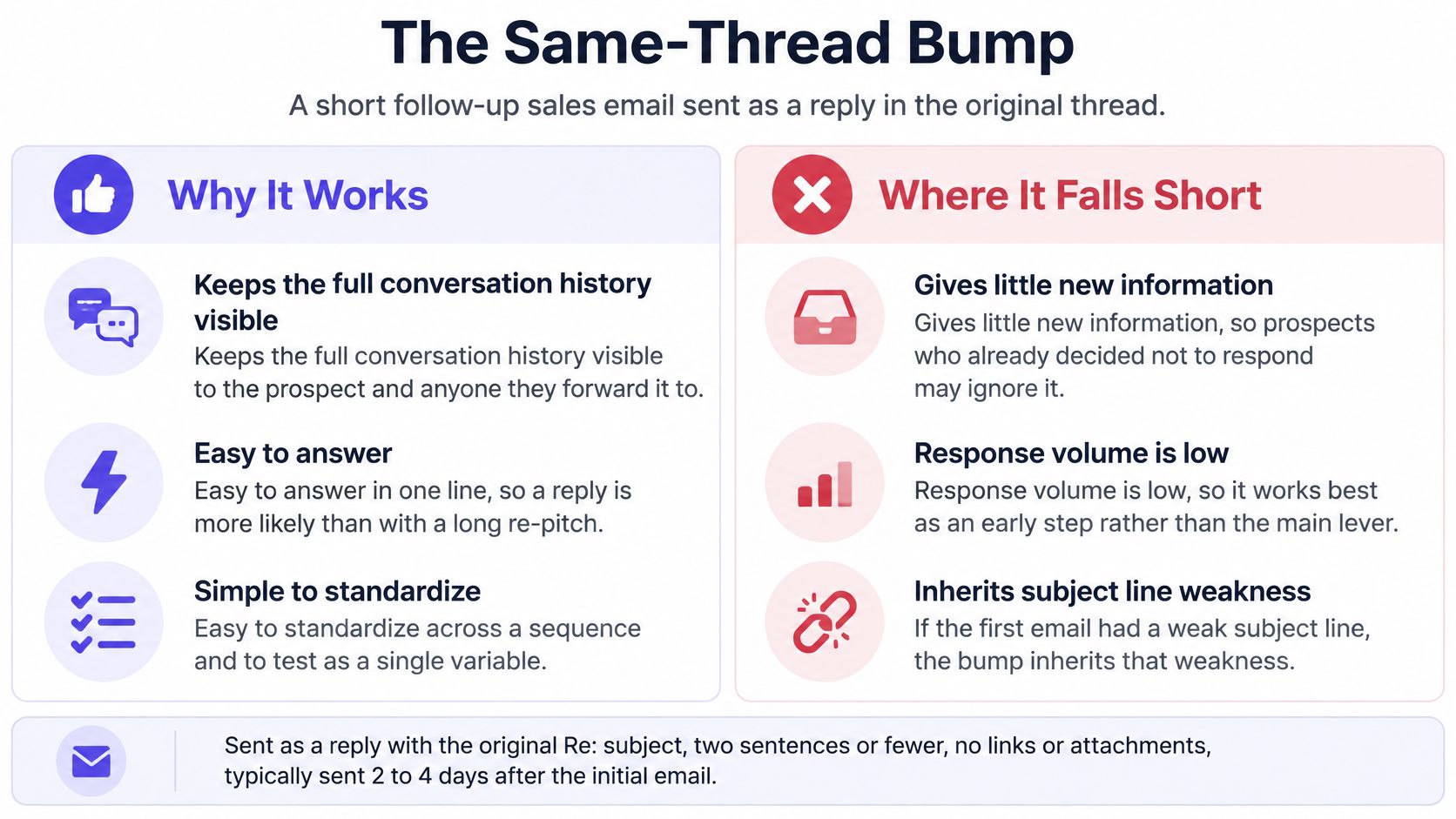
The same-thread bump preserves context without introducing another pitch. It belongs early in the sequence, after the opening message has had time to receive a response. A practical starting schedule is a first follow-up two to four days after the initial send.
Threading requires more than adding a reply prefix to the subject. The sending platform should preserve the original subject and populate the appropriate In-Reply-To and References headers using the original message identifier. A manufactured reply subject doesn't create a genuine conversation.
Worked example
For an agency prospect, a day-three reply to the original thread can read:
Bumping this in case it got buried. Is improving outbound pipeline on the agenda this quarter, or would closing the loop make more sense?
For a staffing firm contacting a regional employer, the equivalent question should name the open role already mentioned in the original email. A verified field-supervisor vacancy is a stronger reference than a generic question about hiring.
Thread continuity doesn't guarantee primary-inbox placement. It keeps the conversation readable, but authentication, sender reputation, recipient behavior, and message content still matter.
- Keep it plain: Leave links and attachments out of the bump, especially while establishing a new sender's reputation.
- Measure replies: Judge performance through positive responses and qualification, not image-based opens that mail clients may preload.
- Check sender readiness: Schedule the bump inside the sequence rather than relying on a manual reminder.
IronPeak Marketing describes an initial infrastructure setup period of approximately 15 days before campaigns begin. That preparation shouldn't be confused with proof of inbox placement. The cold email tips guide provides additional campaign preparation guidance.
2. The Value-Add Resource Follow-Up
A property manager doesn't need another calendar invitation to evaluate an after-hours maintenance service. A short operational checklist may be more useful, particularly when the recipient needs to forward the information to an operations colleague.
Put the useful material in the email body. A download gate, attachment, or crowded resource page adds work before the prospect can judge relevance. Keep the note short enough to read quickly on a phone, with a practical recommendation visible immediately.

Worked example
A commercial maintenance provider could send:
A useful check for after-hours maintenance coverage:
Confirm who acknowledges the request, who dispatches the technician, and where completion evidence gets recorded.
Those handoffs give property managers a clearer record when reviewing service quality before renewal. Does the current process keep acknowledgment, dispatch, and completion in the same system?
This example offers a decision aid without claiming an unsupported effect on renewal rates. For a software founder, the equivalent resource might map activation milestones, ownership of onboarding tasks, and the point where an account needs intervention.
Asset selection depends on enrichment quality. A prospect with a new commercial service page needs different material from a company recruiting an implementation manager. Store the observed signal and its source in the CRM before assigning the resource.
- Build by segment: Maintain reusable resources for each vertical, then tailor the introduction to a verified business detail.
- Support internal sharing: Explain the problem and recommendation without requiring the opening email for context.
- Classify the response: Separate resource requests, active interest, existing solutions, and poor-fit replies.
An acknowledgment isn't automatically a qualified lead. The next message should follow the recipient's answer rather than immediately replacing the resource with a meeting request.
3. The Breakup Email
A breakup email is a stop notice, not a pressure tactic. It states that outreach is ending and offers a simple way to decline, defer, or identify the correct owner. It belongs at the end of the selected sequence, regardless of its position in this list.
A benchmark covering 156,000 B2B sequences from 939 companies reported a 14% response rate for a final breakup message, compared with 9% for fourth-or-later attempts, in the follow-up response-rate benchmark. Those are response figures, not evidence that extra messages always create qualified meetings.
Worked example
For an electrical contractor targeting developers, a final send on day 14 might read:
This is the final follow-up about electrical support for commercial refurbishment projects.
If the timing is wrong, a reply with a preferred month is enough to schedule a later conversation. If it isn't relevant, a no will close the record. If another person manages electrical subcontractors, a name or title would help.
The campaign should mark an unanswered contact completed, remove pending sends, and record the completion date. Silence must not trigger automatic enrollment into another variation of the same pitch.
An opt-out needs broader handling. The FTC's CAN-SPAM compliance guide requires commercial emails to include accurate headers, nonmisleading subjects, a valid postal address, and a clear opt-out mechanism, with opt-outs honored within 10 business days.
Operationally, suppress opt-outs immediately across the client's campaigns. A late bounce or complaint deserves investigation, but neither proves that earlier messages failed delivery.
The B2B sales email templates guide offers additional wording patterns. Every deployed version still needs a working stop rule.

4. The Single-Question Follow-Up
A recruitment firm can learn more from a specific sourcing question than from another request to discuss hiring challenges. The answer should identify a current process, an owner, or a qualification condition.
Worked example
After verifying a live field-engineer vacancy, the follow-up could read:
The field-engineer opening is still listed on the careers page. Does the hiring team usually fill that role through referrals, job boards, or a recruitment partner?
For an agency targeting referral-dependent firms, an alternative is:
Are new sales conversations coming mainly from referrals, or does the business already have a repeatable acquisition channel outside introductions?
Each answer should change the next action. A recruitment-partner response may justify asking about supplier requirements. An internal-referrals response may reveal that external support isn't currently relevant. Neither answer warrants an automatic calendar link.
- Verify the premise: Check the live vacancy or service page before sending. Store the observation date so stale enrichment doesn't keep circulating.
- Keep the question narrow: Avoid combining acquisition channels, budgets, headcount, and meeting availability.
- Tag the answer: Use fields such as sourcing channel, existing provider, no current need, and owner unknown.
A short answer is useful only when the campaign operator knows what to do with it.
Reply classification should distinguish human answers from out-of-office notices and automated acknowledgments. Stop the cold sequence on a genuine reply, then route the conversation to an owner. An out-of-office message needs separate handling based on its return date and any stated contact restrictions.
IronPeak Marketing logs replies with their arrival dates before following up with relevant proof, offer details, and a booking path. That process connects the answer to the next action instead of treating every response as equivalent.
5. The Angle-Change Follow-Up
Change the business problem and keep the offer fixed. A software founder may ignore a pipeline-growth pitch because sales management capacity is the tighter constraint. The same outbound service can sit on that constraint.
The deliverable stays the same.
Nonresponse alone does not prove the original angle failed. Check delivery errors, inbox placement, list relevance, and whether the earlier messages sent before you rewrite.

Worked example
The opening email focused on generating pipeline. A later message, still on that thread, could read:
Another consideration is who manages outbound internally.
An internal SDR hire still needs prospect research, inbox oversight, coaching, and reply handling. Would a breakdown of those responsibilities help with comparing an internal hire against managed outbound?
The evaluation criterion shifts. Leave out salary savings and ramp-time claims the research does not support. For a construction service provider, the parallel move is from winning commercial accounts to keeping bid follow-up consistent in quieter periods.
Set the planned angle path at enrollment. Record the angle used at each step. Random edits mid-batch mix copy changes with audience differences, so you cannot tell which variable moved replies.
Warmup status and enrichment quality gate that second angle. A domain still warming should not carry a sharper problem to a cold list. If enrichment only guessed the constraint, the new frame reads as another pitch. A reply stops the remaining angles, and the contact leaves the cold sequence. No reply means the record should store which angles already ran, so a later campaign does not reopen the same problem.
After the edit, test the revised message across representative seed inboxes and check rendering. Seed placement is diagnostic, not a guarantee of prospect placement. Do not treat single words as universal spam triggers, and do not raise volume to offset weak responses.
6. The Referral Redirect Follow-Up
A title match isn't proof of purchasing responsibility. An operations director may understand a staffing shortage while a regional hiring manager controls supplier selection. The referral redirect tests ownership without demanding a meeting.
This template is useful when enrichment suggests a plausible contact but leaves the decision process unclear. It shouldn't become an excuse to send poorly researched emails across an organization.
Worked example
For a staffing firm pursuing employers with field vacancies:
Who handles recruitment partners for field roles at the company? If another person owns that process, a name and title would help direct the role-specific summary appropriately.
For a healthcare consultant, the request could identify the function rather than a presumed title:
Which person owns revenue operations and the review of outside consulting support? A short summary is available to forward internally if that's easier than arranging an introduction.
The forwardable summary should explain the relevant problem, scope of work, and reason for contact. Leave out inflated claims and material that assumes the new recipient has read the original sequence.
Keep the referral traceable
- Update the original record: Mark the contact as a redirect and stop the original sequence.
- Record the provenance: Save who supplied the referral, when it arrived, and what ownership they described.
- Enrich the new contact: Verify employment, role, business email, and the current account signal before sending.
- Separate the reporting: Track referred contacts distinctly so qualification isn't attributed to the original targeting alone.
A referral doesn't replace consent or another applicable lawful basis for contact. Suppression checks still apply, and an organization-wide refusal shouldn't be bypassed by contacting another employee. The new message should explain the referral accurately without implying an endorsement that wasn't given.
7. The Calendar-Anchored Follow-Up
A timing objection should create a dated task, not an indefinite nurture loop. Calendar-anchored follow-ups suit high-ticket services when evaluation depends on budget planning, a hiring push, or a known project cycle.
The date needs evidence. A prospect's stated planning window is stronger than an industry-wide assumption, and a conditional question is safer than presenting an unverified seasonal pattern as fact.
Worked example
For a construction company that has confirmed its bid season begins in late winter:
With bid planning starting in late winter, would a February follow-up about commercial bid-response support be useful?
For a consultant contacting a firm whose planning schedule remains unconfirmed:
If budget planning happens in the fourth quarter, would an early-October follow-up about the evaluation process be useful?
These messages ask permission to return at a relevant time. They don't invent urgency or require a meeting before the recipient is ready.
A self-serve option also belongs here. A scope summary, implementation outline, or qualification checklist can help the prospect prepare internally without accepting a call.
Scheduling rule: An agreed future date should remove the contact from active outreach until that date.
Record the agreed date, reason, owner, and original reply in the CRM. Confirm the arrangement in the same thread, then review scheduled recontacts monthly for changed roles, closed projects, and expired assumptions.
At recontact, refresh the account research and reference the agreement. Don't restart the original sequence unchanged. If the prospect requests a conversation, the cold email meeting template guide can support a clear next step.
Keep deferred, completed, and suppressed as distinct states. Deferred contacts have an agreed return point, completed contacts have finished the sequence, and suppressed contacts must remain excluded.
How the seven follow-up templates compare by timing, goal, and reply format
Timing tables tell you when to send. They don't tell you whether to send. That decision depends on the state of the thread, the quality of your research, and what the contact has done since the last touch. The table below compares the seven templates on the conditions that govern them: what must be true before the send, how the message sits in the thread, and what exits the contact from that branch of the sequence.
| Template | Precondition | Thread handling | Exit or stop rule |
|---|---|---|---|
| The Same-Thread Bump | Initial email delivered cleanly, no reply, no bounce | Same thread, original subject intact | Any reply pauses the sequence and routes to classification |
| The Value-Add Resource Follow-Up | Enrichment confirms the resource fits the prospect's role or current situation | Same thread, tied to the original angle | No engagement after the next planned touch moves the sequence forward |
| The Breakup Email | All planned touches sent with no genuine reply | Same thread, final message | Contact marked completed; no further sends without a documented new reason |
| The Single-Question Follow-Up | Research surfaced a specific fact worth asking about; skip it when enrichment is thin | Same thread, one question, no meeting link | Any answer counts as a reply and enters classification |
| The Angle-Change Follow-Up | Two unanswered touches on the first angle, plus evidence the second pain point fits the account | In-thread while the thread is alive; new thread only when the original is exhausted | No response to the second angle leads to the breakup, not a third angle |
| The Referral Redirect Follow-Up | Contact's role doesn't match the problem owner, or ownership is unclear | Same thread, brief ask with offer context | A referred name starts a new thread with that person; the original contact closes out |
| The Calendar-Anchored Follow-Up | Prospect said "not right now," or timing depends on a known business cycle | Agreement confirmed in the same thread | Contact leaves active outreach until the agreed date |
Two rows deserve extra attention because teams get them wrong most often. The single-question template fails when enrichment is weak: a question built on a generic guess reads as a mass send and can drag the whole thread's credibility down with it. If your data doesn't support a specific question, use the bump or the resource follow-up instead.
The angle change is the other misuse. Rotating angles every touch trains nothing and signals that the first message wasn't considered. Commit to one angle long enough to learn whether it lands, and treat the change as a test with a hypothesis behind it, not a fresh roll of the dice. When the second angle fails, the honest move is the breakup email, because a third pivot tells the prospect you're searching rather than serving.
Set the Sequence Up Before the First Send
A follow up sales email performs inside an operating system. Before launch, the campaign owner needs to confirm sender readiness, choose the message order, and define what happens after delivery, nonresponse, interest, referral, or refusal.
Warmup status alone is not enough. Run the authentication, DNS, TLS, and inbox placement checks covered in the sender-requirements section before enrolling a single prospect. One requirement belongs here because it shapes sequence design directly: Gmail's sender-guidelines FAQ requires applicable bulk marketing senders to honor unsubscribe requests within 48 hours, so your suppression process has to act on opt-outs faster than your next queued touch.
The pre-send operating checklist
- Confirm infrastructure: Check authentication results and delivery errors, and keep new enrollment within the sending capacity reserved for follow-ups. A sequence that queues seven touches per contact consumes far more volume than the initial send, so capacity planning has to account for the full cadence.
- Choose the sequence: Set the initial angle, early bump, useful follow-up, optional angle change, and final stop message. Use redirects and calendar follow-ups when contact conditions justify them rather than forcing every prospect through the same path.
- Define stop rules: Stop on genuine replies, hard bounces, complaints, and opt-outs. Check suppression before every queued send, not just at enrollment.
- Define recontact rules: Require an agreed date or a documented, relevant new reason. Finishing a sequence is not permission to recycle the contact into a fresh one the following week.
- Route every reply: Save the arrival date, classification tag, owner, qualification status, and next action in the CRM so nothing sits unanswered in a shared inbox.
Interested replies need a separate workflow from unanswered cold outreach. Assign ownership promptly, answer the actual question the prospect asked, and provide relevant proof before pushing for a meeting. The client handoff should include the conversation context so the client can act on the conversation without re-reading the thread.
For teams weighing managed execution against in-house sending, IronPeak Marketing advertises a target of 60 to 90 qualified leads in 45 days on a pay-per-result basis, with clients able to reject leads that do not fit their qualification standards. Treat any volume target as an outcome of fit, not a starting assumption: a campaign assessment should establish the target market, offer, current acquisition approach, and qualification criteria before infrastructure or sending volume expands. The templates and rules above give an in-house team the baseline for copy, classification, and stop logic either way.
IronPeak Marketing provides managed B2B cold email outreach, prospect research, dedicated email infrastructure, and reply management. For founders and service providers that want follow-ups connected to qualified-lead review rather than left as standalone copy, visit IronPeak Marketing to start with a campaign assessment.