What Is a Qualified Lead? Criteria, Examples and Scoring
Learn what is a qualified lead in B2B: the fit, need and timing criteria, BANT, and how to tell qualified leads from general prospects.
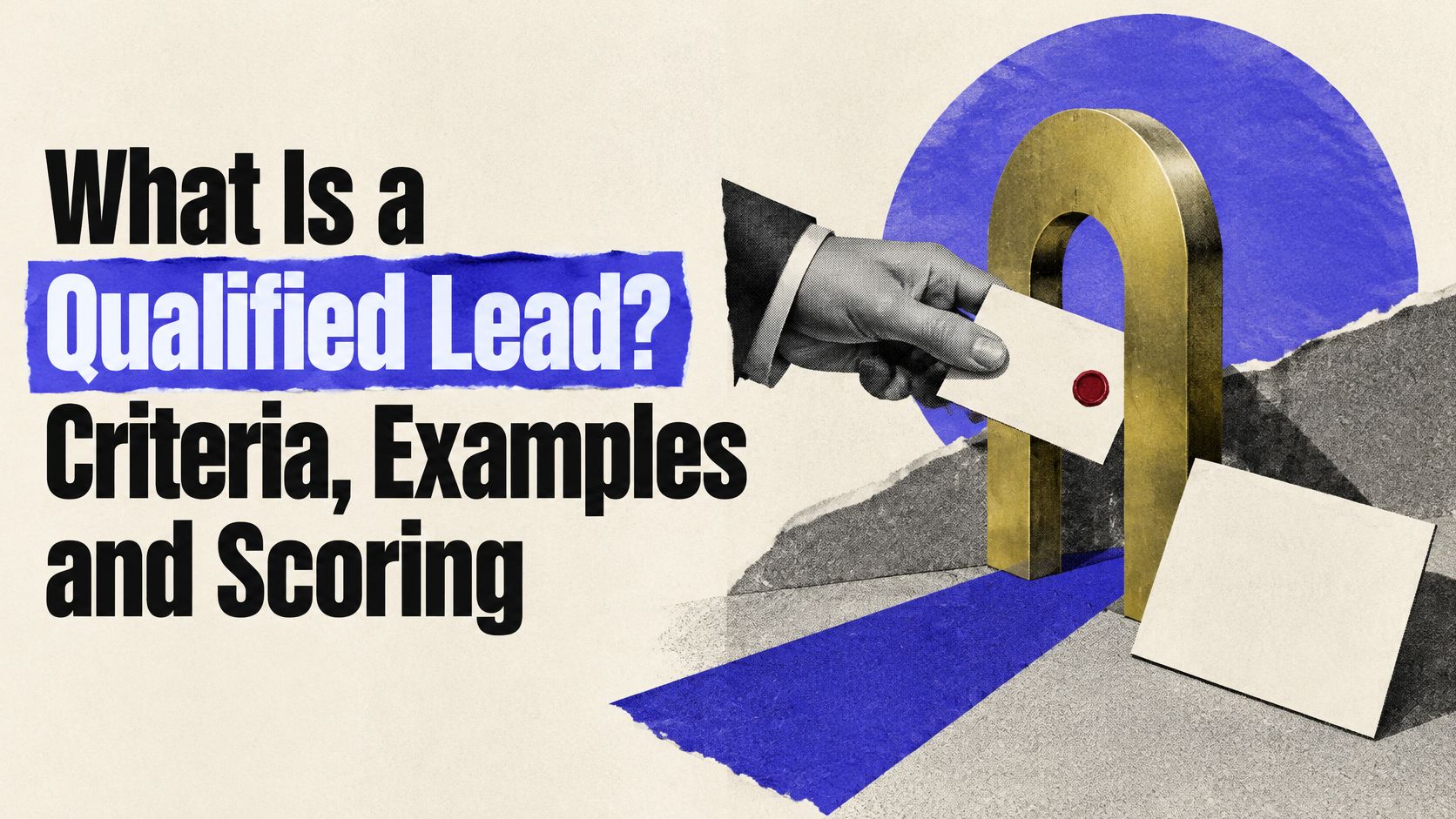
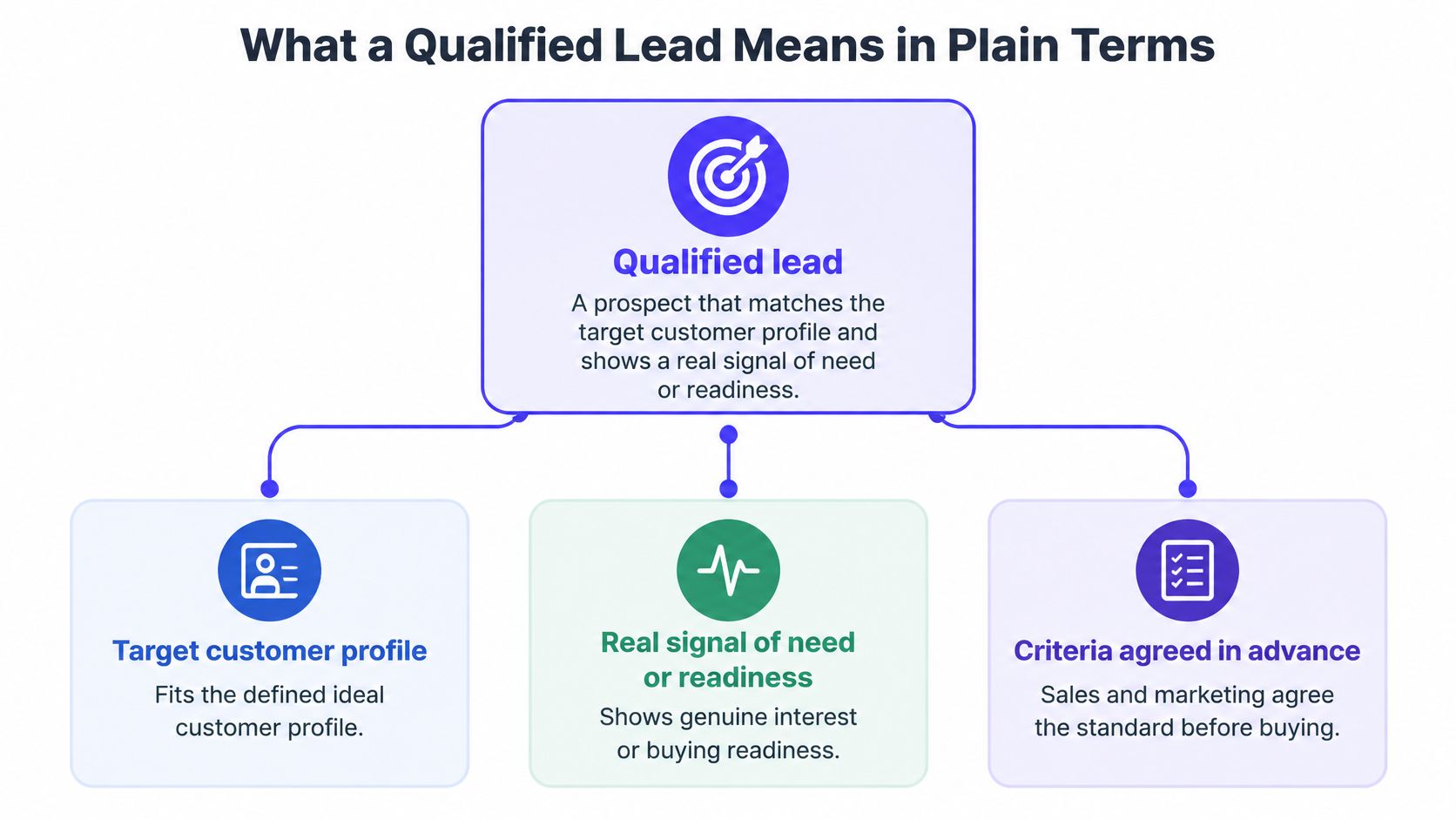
A qualified lead is a prospect that matches the target customer profile and shows a real signal of need or readiness. It also depends on a clear acceptance event agreed by both the provider and the buyer. So, what is a qualified lead in practical terms? It is a record that has crossed an agreed line, not a name sitting in a CRM with an optimistic label.
The situation most founders meet looks like this. A campaign has been running for three weeks, the reply folder holds a few dozen messages, and an invoice arrives for a number of “leads” that doesn't match the number of conversations the sales side wants to have. Nobody's lying. The two sides never wrote down what counts.
That gap is fixable in an afternoon, and it's cheaper to fix before the first send than after the first invoice. Treat the standard like a doorway: the provider knows what evidence lets a lead through, and the buyer knows what it is accepting. When both sides use that same doorway, handoffs, rejections and billing become much easier to judge.
What a Qualified Lead Means in Plain Terms
A qualified lead isn't any contact who has interacted with a company. Qualification is a staged judgment about whether a prospect fits the target customer profile and is likely enough to progress toward a purchase, as HubSpot's definition of a marketing-qualified lead explains. A marketing-qualified lead (MQL) has shown meaningful engagement with marketing activity. A sales-qualified lead (SQL) has been reviewed by sales, who judged the person or organization appropriate for direct engagement with a credible chance of conversion.
Where each record type stops
Every record on the path from a scraped row to an accepted opportunity stops at a different gate. Reading the ladder row by row shows why a long list of names and a short list of accepted opportunities aren't the same asset.
| Record type | Fit check | Intent evidence | What sales does next |
|---|---|---|---|
| Contact or scraped record | None | None | Nothing, kept for research only |
| Prospect | Matches ICP filters | None | Added to an outreach list |
| Marketing-qualified lead (MQL) | Matches ICP | Meaningful engagement with marketing activity | Reviewed by sales before any follow-up |
| Sales-qualified lead (SQL) | Matches ICP and role | Sales confirms need and a credible chance of conversion | Direct sales engagement |
| Qualified lead under an agreed standard | Matches ICP and role | Reply or agreed next step, recorded in the CRM | Accepted as an opportunity worth a sales conversation |
Fit and intent, together
Fit covers company size, industry, geography, job role and authority. Intent covers a request for information, a reply to outreach, a stated business problem, or willingness to discuss a solution. One without the other produces a record that looks busy and converts poorly: perfect firmographics with no response, or an enthusiastic reply from someone who can't buy.
An email open isn't intent. Neither is an out-of-office reply, a click tracked by an image proxy, or an enriched job title. Those are signals about delivery and data quality, not about a business problem.
Practical rule: pull the last ten closed deals and write down the fit evidence and the intent evidence each one had at the first conversation. That list becomes the acceptance standard, and it's grounded in deals rather than in optimism.
How Much Volume Is Lost Between Interest and Sales Readiness
Start with a hypothetical 100,000 website visitors. A B2B lead-quality benchmark synthesis reports an average funnel converting about 2.3% of visitors into leads, which gives roughly 2,300 leads. Of those leads, 31% become MQLs, about 713 records. Of those MQLs, 13% become SQLs, about 93 records, before any later opportunity or customer stage.
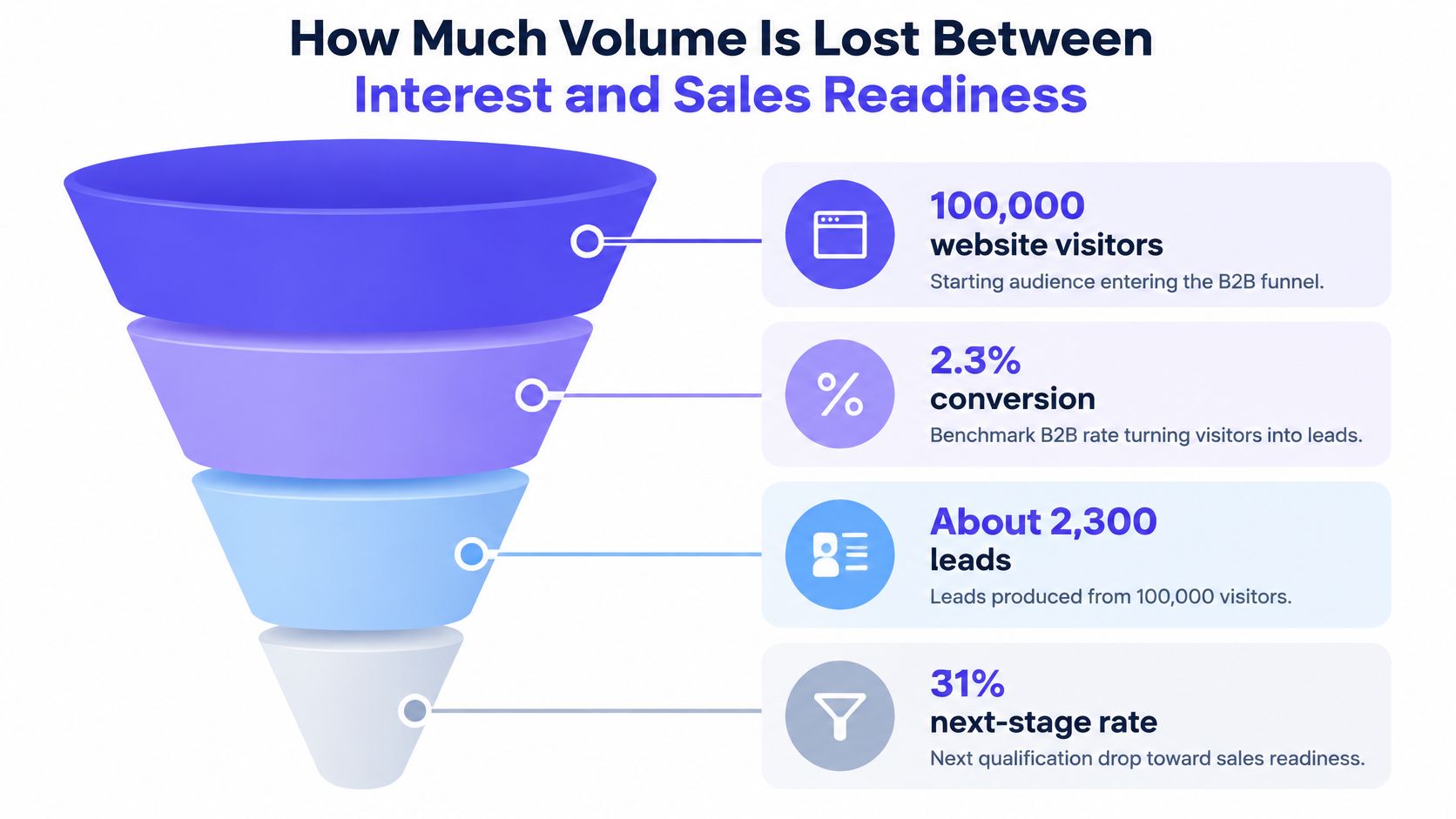
| Stage | Conversion rate | Volume from 100,000 visitors |
|---|---|---|
| Visitors to leads | 2.3% | About 2,300 leads |
| Leads to MQLs | 31% | About 713 MQLs |
| MQLs to SQLs | 13% | About 93 SQLs |
Roughly 87% of MQLs in that benchmark never reach SQL status. Treat that drop as a capacity filter. Marketing activity can create records quickly, but sales time is spent only after evidence shows a real business conversation. Rates move with market, offer, price, sales cycle and, most of all, with the definition each team writes down.
The same loss happens without a website visit. Cold email skips the visitor stage, but the drop between a contact record, a reply and a sales-ready conversation is just as steep. Take a hypothetical list of 5,000 contacts and assume, purely to show the arithmetic, that 50 people reply and 15 pass the fit and need checks. The deliverable is 15, not 5,000, and not 50.
The MQL-to-SQL handoff is where engagement gets tested against business need, authority, budget and timing. Outbound has the identical gate, it just runs on reply text instead of page views, which is why the comparison between inbound and outbound leads matters when setting targets. A qualified lead works like an accepted handoff: the provider shows the evidence, the buyer accepts or rejects it, and the decision becomes the billing record.
Pull last quarter's CRM fields now: lead source, stage entered, stage exited, rejection reason and owner. Count how many records moved from first reply to sales conversation, then calculate the rate from that count. Set next quarter's lead target from those rates, using a range rather than a single promise, because benchmarks vary by market and offer.
The Four Checks That Separate Fit From Readiness
Broader capture raises volume. Qualification protects sales capacity from contacts who cannot become opportunities. A qualified-lead glossary frames the checks as fit, need, engagement and buying readiness, and each one needs its own evidence field rather than a single score. Treat a qualified lead as a documented acceptance event agreed by both provider and buyer, not a CRM label. That definition makes the handoff clear, the rejection reason clear and the billing trigger clear.
| Check | Question to answer | Evidence to record |
|---|---|---|
| Firmographic fit | Does the company match size, industry, geography and technology? | Verified company domain, headcount band, industry tag |
| Role fit | Can this person approve, influence or route the purchase? | Confirmed job title and reporting line |
| Need and timing | Is there a business problem the offer solves, and a window to act? | Stated problem in the reply or call notes, plus a hiring push, funding event, technology change or stated deadline |
| Engagement | Did the prospect respond with real interest? | Reply text or booked call |
Hard fit is mandatory, one signal can be enough
Treat the fit conditions as pass or fail. A company outside the headcount band or the served geography does not get rescued by an enthusiastic reply, because the offer will not fit the account. Buying signals work differently. One credible trigger, a hiring push for roles the offer supports, a technology change or a stated deadline, can justify sending the reply for review.
Need and timing sit together because they answer one practical question: can this problem become a live opportunity soon? A prospect can mention a problem that sounds relevant and still have no reason to act now. A short reply that names a live hiring need, asks how the service works or requests the agency's terms carries more weight than interest with no business moment behind it.
Engagement has to be checked against readiness
Buyers do most of their work before they answer a vendor. The ConvergeHub Customer Trends Report 2025 reports that B2B buyers complete 57% to 70% of their research before contacting sales, and that only about 25% of marketing-generated leads are ready to move directly to sales.
That gap is why a reply needs context. Strong fit and genuine curiosity can exist without an active project, internal agreement or budget access. The reverse also happens. A brief reply to a cold email can matter more than repeated content downloads when it points to a problem this quarter. Readiness works like a gate with several hinges. Fit opens the first hinge, need opens the second, engagement opens the third and timing decides whether the door is open now.
Record the evidence behind each dimension separately. A single "qualified" checkbox hides which check actually passed.
A useful handoff note gives the receiving team the facts it can act on. For outbound, that means the company, contact, email address and job-ad link when a live role is involved. It also means the exact reply text that showed interest, plus the reason for any rejection. A reason such as a specific role fit or misfit turns a judgment call into a rule the next campaign can use. Keep the evidence next to the status, so acceptance and billing refer to the same event.
BANT and Other Frameworks Compared
BANT (Budget, Authority, Need, Timeline) is the familiar baseline, and it works well as a discovery checklist. Budget tests whether the purchase is economically feasible for the account. Authority identifies who can approve, influence or accurately route the deal. Need verifies that a real business problem exists, with consequences the buyer can name. Timeline asks whether action is plausible inside the sales cycle.
Used as a rigid four-box pass or fail score, it breaks in two directions. It overvalues prospects who understand their problem or hold budget yet show no intent, and it misses emerging demand that hasn't formed into a project yet.
| Framework | Best use | Strength | Main weakness |
|---|---|---|---|
| BANT | Discovery calls where deal size is known | Gives reps one question per dimension | Can overvalue prospects who understand the problem but lack intent |
| ICP scorecard | Building outbound lists before any reply | Sets hard-fit conditions and a threshold | Arbitrary unless the threshold is written down |
| Three-stage model | Pay-per-lead billing and handoff disputes | Separates outreach, discovery and opportunity | Needs both sides to document evidence for each stage |
Store fields, not verdicts
Whatever framework a team picks, the output should be observable fields: target-account fit, relevant role, stated problem, buying or evaluation window, and a scheduled or mutually agreed conversation. A rep reading those fields can reconstruct the judgment. A rep reading "score 72" can't.
An ICP scorecard suits list building, before any reply exists. Here's an illustrative version: a company must pass every hard-fit condition, then earns one point per verified buying signal such as a hiring push or a stated deadline, and a score of 2 or more enters the sequence. The number matters less than the fact that it's written into the document before the first send.
The three-stage model earns its place when money changes hands. Once a contract makes the client pay per accepted lead, the definition stops being a CRM label and becomes a billing event. Separating qualified for outreach, qualified for discovery and qualified opportunity gives both sides a shared ruler: every dispute about a lead gets settled by checking which stage the evidence reaches, measured against the business buyer process the client runs. That is what makes the definition usable in a handoff, a rejection or an invoice query, because each side can point at the same documented stage rather than argue about quality in the abstract.
Pick BANT for calls where deal size is known, an ICP scorecard for list building, and the three-stage model whenever a contract or an invoice depends on the definition.
A Worked Example of Accepting and Rejecting a Lead
Two scenarios cover most of the arguments that happen in a lead review channel. Walk through both slowly, because the reasoning behind each classification matters more than the label itself.
Scenario one, the matching company with no trigger
A software company matches the target employee band and uses the relevant technology. There's no identifiable business trigger, and the contact holds no purchasing role. As a B2B lead qualification framework guide points out, that record can be a valid prospect without automatically counting as a qualified lead.
The confusion here is natural, because fit feels like enough. It isn't. Fit answers "could this company ever buy," and qualification asks "is there evidence they are moving toward a decision now." Those are different questions, and mixing them up is how weak records end up on invoices.
Classification: prospect, not qualified. It moves up only when something changes, a named purchasing contact appears, a stated problem surfaces in a reply, or a hiring signal points at the offer. Until then it stays in the research pool, and nobody bills for it.
Scenario two, the pricing question with no problem
A contact replies asking about pricing. The message names no defined problem, no decision owner and no timeline. Curiosity about cost is real engagement, but it isn't an opportunity.
Think of it the way a bouncer reads a queue. Interest gets a person to the door. The reply's content decides whether they get inside.
Classification: qualified for discovery. The record should carry the gap discovery has to close, written plainly:
- Problem: not stated, needs a question about what prompted the reply
- Decision owner: unknown, needs confirmation of who signs
- Window: absent, needs a date or an event that forces action
The record every example must carry
Fit evidence (verified domain, headcount band, confirmed title), intent evidence (reply text or booked call), the stage reached, and the reason for any rejection. Four fields, filled in every time, including on the leads that get thrown out.
The rejection field is where teams often get lazy, so here is what a useful entry looks like in practice. When a client rejects a lead in Slack, the note should read like a rule, not a mood:
Rejected: wrong role. Contact is office manager,
purchasing sits with the operations director.
That single line does two jobs. It settles the billing question, because both sides can see the rejection is legitimate under the agreed standard. And it hands the campaign a targeting filter: office managers drop out of the list, operations directors move up it. A vague note like "not a fit" does neither, which is why the exact wording is worth the extra thirty seconds.
A rejection written as a rule improves the next batch of leads. A rejection written as a complaint improves nothing.
Writing an Acceptance Standard and Setting It Before Buying
A qualified lead works best as a documented acceptance event. Both sides agree on the evidence before outreach starts, then use that same evidence for handoff, rejection and billing. Directive's qualified-lead glossary reports that only 44% of companies have a formally agreed definition of a qualified lead between sales and marketing, and that organizations without a common definition show substantially weaker lead-to-sales-conversation performance.

Three stages on one page
Write the standard as three stages, each with its own evidence, validator, handoff clock and dispute rule. Think of the page as a small contract for decision making. It tells the provider what can be sent, tells the client what can be accepted, and tells both sides what happens when the answer is no.
- Qualified for outreach. The account passes every hard-fit condition and enters a sequence. Evidence: verified domain, headcount band, confirmed role. Validated by the provider before the send.
- Qualified for discovery. A confirmed problem and a named stakeholder. Evidence: the reply text or call notes quoting the problem, plus the person responsible. Validated by the client on review.
- Qualified opportunity. A mutually agreed next step recorded in the CRM. Evidence: a booked meeting or an explicit written agreement to one. This is the stage an invoice should attach to.
Handoff speed belongs in the same document. Fast follow-up keeps the conversation warm, so a long review window costs opportunities. Set the clock, name the owner, and route the notice somewhere people watch. Put the fields into lead management and the CRM rather than pasting them into a spreadsheet. A lead notice should include the company, contact, email address and job-ad link. In IronPeak Marketing's process, the client reviews the lead in Slack before accepting it. After approval, IronPeak sends an email introduction to the employer. In the Totlani & Partners campaign, accepted leads became billable when IronPeak introduced the client in the email thread.
Rejections need reasons
IronPeak Marketing agrees with the client on what counts as a qualified opportunity before the campaign runs. If a lead is not qualified, the client can reject it and does not pay for it. IronPeak asks clients to explain why they reject a lead, because a reason such as a specific role fit or misfit gives the campaign a rule it can use. "Not a fit" teaches nothing. "No operations director at companies under 50 staff" tightens the filter tomorrow.
A good rejection field makes the standard useful. It turns opinion into a pattern the next batch can follow. It also keeps billing simple, because the accepted lead, the introduction and the reason for any rejection can all be checked against the same record.
Compliance sits before qualification
Suppression runs before every send, not after someone complains. The FTC's CAN-SPAM compliance guide for business applies the rules to commercial email whether it is sent individually or in bulk, requires accurate From, To, Reply-To and routing information, subject lines that reflect the content, a clear opt-out mechanism that the sender honors, and a valid physical postal address. The sender stays responsible even when another company runs the email operation. A verified title never overrides a prior opt-out.
Deliverability has its own hard limits. Gmail's sender guidelines require bulk senders delivering more than 5,000 messages per day to Gmail accounts, starting February 1, 2024, to authenticate with SPF and DKIM, keep the user-reported spam rate below 0.1%, and never let it reach 0.3% or higher. Tight targeting and honest offer relevance help keep complaints down, which means qualification starts before the reply, at the moment a record is chosen for a sequence.
Draft the one-page standard this week, classify the last 20 leads or deals against it, and agree it with the provider or the sales team before outreach starts.
IronPeak Marketing runs managed cold email outbound, including dedicated domains and inboxes, domain warming, prospect research and daily inbox handling, on a pay-per-qualified-lead basis where rejected leads are not billed. The acceptance standard comes first. The team agrees what counts as a qualified opportunity with the client before a single message goes out, then hands accepted replies into the CRM with the fit and intent evidence attached. Founders and high-ticket service providers who want that standard written down before the campaign starts can visit IronPeak Marketing to see how the qualification and handoff process works.