B2B Sales Lead Generation: Building a Qualified Pipeline
B2B sales lead generation explained: channels, compliance rules, inbox placement thresholds and how to measure qualified leads, not just outreach volume.
88% of surveyed businesses reported using email for B2B lead generation in 2025, making it the most widely adopted channel in the Dux-Soup B2B Lead Generation Report 2025. That volume is also the problem. When nearly every competitor runs the same channel with the same tools, the campaigns that produce pipeline aren't the ones writing better subject lines. They're the ones that treat the reply as the start of a process rather than the finish line of outreach.
Sales teams often measure the wrong end of the pipe. Sends, opens and reply rates are easy to pull from a dashboard and tell you almost nothing about whether a buyer with authority and a live problem agreed to a conversation. The number that survives a finance review is accepted leads per delivered message, and every stage upstream either feeds it or leaks it.
Pipeline Stages and the Metric That Matters at Each
A cold email pipeline has five working parts, and accepted leads per delivered message is the number that keeps them honest. The reply is the start of the pipeline, not the end of outreach. Everything before it has to earn the response, and everything after it has to turn that response into a qualified handoff.
| Stage | What happens | Metric to track | Common failure |
|---|---|---|---|
| Targeting | Select accounts and contacts that match the offer | Share of records matching the ideal customer profile | Broad lists with stale or wrong contacts |
| Outreach | Deliver sequenced messages from authenticated sending domains | Inbox placement by mailbox provider | Sending from unwarmed or shared domains |
| Reply | Prospect responds or signals interest | Positive replies per delivered message | Replies treated as leads without a fit check |
| Qualification | Confirm industry, authority, problem fit and timing | Accepted leads per positive reply | Qualification rules that differ between provider and client |
| Handoff | Route the lead to a calendar or CRM owner | Minutes from reply to first human contact | Leads sitting unclaimed in a shared inbox |
The mistake that hides the weak stages
Platform dashboards export sends and opens by default, which is why they dominate weekly reviews. Those figures are useful for confirming activity, but they sit far upstream from revenue. A campaign can show steady delivery, a healthy open rate and a decent reply rate, then still fail if the client rejects replies that do not match the agreed qualification standard.
The practical fix is to make each stage answer one question. Targeting asks whether the records match the offer. Outreach asks whether the messages reached the inbox. Replies ask whether the message created enough relevance to get a response. Qualification asks whether that response reflects a real buyer with fit and timing. Handoff asks whether a person or calendar owner picked it up quickly enough to use the opening.
Diagnosis walkthrough
Pull four weeks of campaign data and score each stage against its own metric. A low profile match share means targeting is the constraint, and copy changes will not repair a list built around the wrong accounts. Placement well under benchmark points at the sending setup. Positive replies that convert to accepted leads at a poor rate signal a qualification standard the two sides define differently. Leads sitting unclaimed for hours are a routing failure.
Once the weak stage is clear, change that stage first and leave the rest of the campaign steady long enough to measure the effect. If accepted leads stall after placement improves, the next check is reply quality. If reply quality holds but conversations still do not start, the handoff is the likely break. The routing and ownership side of that work is covered in this guide to lead management and CRM.
Inbox Placement and Authentication Checks
Validity's 2025 benchmark reported 79.2% inbox placement at Gmail, 78.7% at Microsoft, 81.2% at Yahoo/AOL and 67.4% at Apple (Validity 2025 Benchmark Report). Those figures set the practical ceiling for every later metric. A buyer cannot reply to a message that never reached the inbox, and a qualified lead cannot enter the pipeline if the first touch sits in spam.
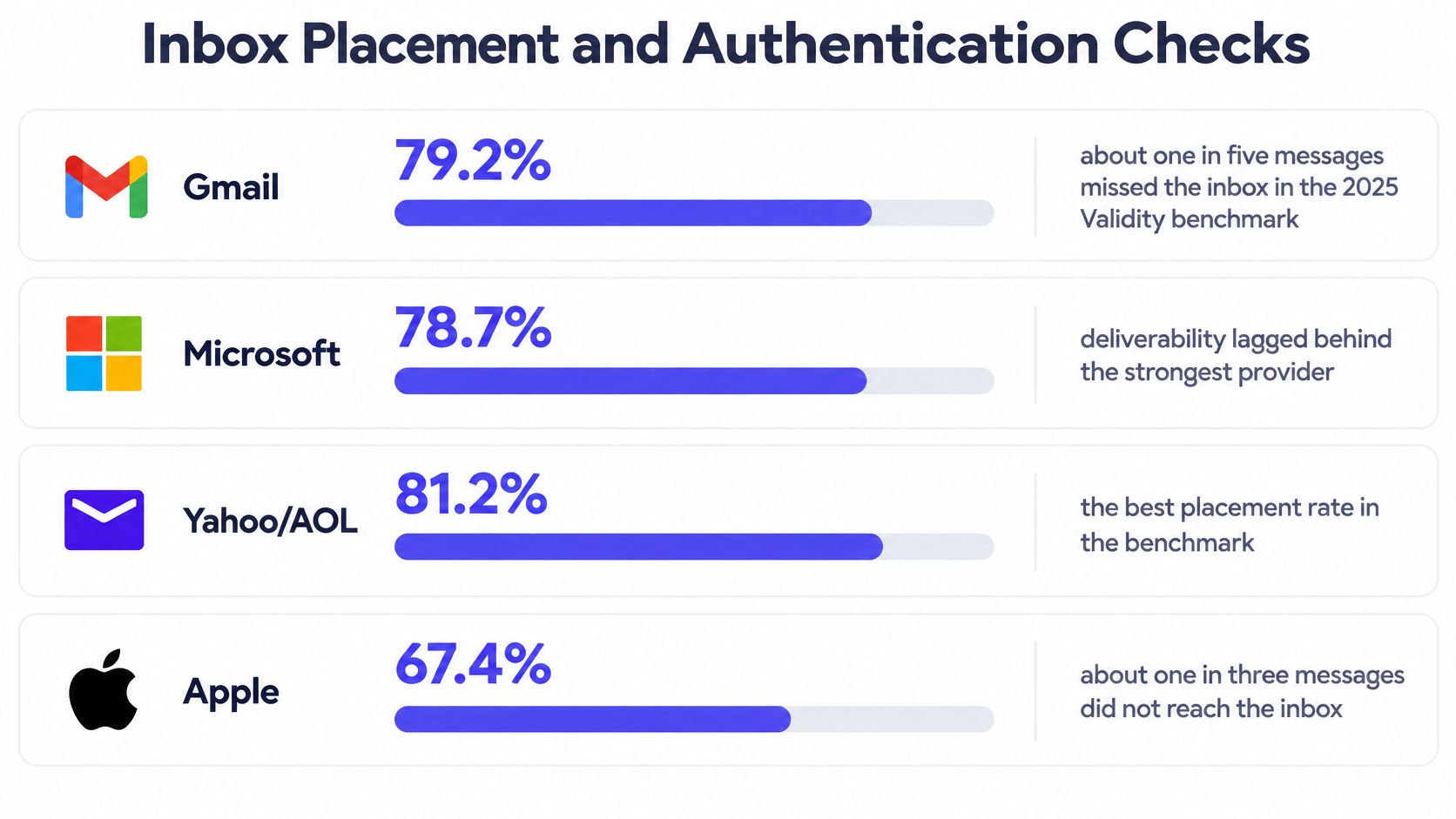
This is why the reply is the start of the pipeline, not the end of outreach. Placement, authentication and handoff speed all sit upstream of that reply. If one breaks, the campaign can look active while accepted leads per delivered message falls.
The chain from authentication to revenue
Run the arithmetic on a 1,000-message send. At 79.2% placement, about 792 messages reach an inbox. If authentication drifts and placement falls to 70%, about 700 arrive. The visible loss is 10% of sends, but the underlying loss is 10% of reply volume, 10% of qualified conversations and 10% of closed revenue, before copy or targeting are even in the conversation.
That is the trade-off with cold email infrastructure. Better targeting and sharper copy only matter after the message has a fair chance of reaching the inbox. A per-lead price that ignores placement is a price for messages that never arrived.
| Mailbox provider | Inbox placement | First check |
|---|---|---|
| Gmail | 79.2% | SPF or DKIM alignment and user-reported spam rate |
| Microsoft | 78.7% | Domain reputation and daily volume ramp |
| Yahoo/AOL | 81.2% | Complaint rate and list hygiene |
| Apple | 67.4% | Authentication and engagement signals |
What to fix, in order
- Align authentication to the visible From domain. SPF and DKIM should pass on the domain the recipient sees. Keep authentication tied to that domain so the receiving provider can connect the message to a sender with a clear reputation.
- Publish DMARC and read the reports. Published records often start in monitoring mode, which gives visibility without enforcement. Use the reports to confirm which sources send for the domain, then move toward enforcement when the stream is clean.
- Separate prospecting domains from the corporate domain. A reputation hit on an outreach domain should stay away from the address that carries invoices and client mail.
- Track placement by mailbox provider. Open rates hide where delivery fails. Measure Gmail, Microsoft, Yahoo/AOL and Apple separately, then fix the provider with the weakest placement.
- Use dedicated inboxes and raise volume gradually. Both reduce reputation swings, but neither rescues bad addresses, high complaint rates or weak engagement.
Google's Gmail sender guidelines set authentication as a precondition for sending to Gmail accounts. The detailed rules, thresholds and consequences belong in the sender-threshold section, where they can be applied as a compliance checklist.
Operating KPI: track qualified opportunities per delivered message, not leads per message sent. Delivery loss at the provider level changes acquisition economics directly, and every stage after placement should be measured against the messages that actually arrived.
Gmail and CAN-SPAM Sending Thresholds
Published sending rules work best when they sit inside the outbound system, close to the inbox, suppression log and handoff process. The practical risk is simple: a reply is the start of the pipeline, and a message that never reaches the inbox cannot become an accepted lead. Placement, opt-out handling and lead acceptance all need owners, timestamps and thresholds.
| Requirement | Threshold | Consequence if missed |
|---|---|---|
| User-reported spam rate for Gmail | Keep below 0.10%, never reach 0.30% | Google can respond with failures or spam-folder placement (Google bulk sender guidelines) |
| One-click unsubscribe for promotional mail | Requests honored within 48 hours | Reduced inbox placement (Google bulk sender guidelines) |
| CAN-SPAM opt-out | Mechanism open at least 30 days, requests honored within 10 business days | Sender cannot keep emailing after the deadline (FTC CAN-SPAM compliance guide) |
Thresholds belong in the send workflow
Google's thresholds turn complaint rate and unsubscribe handling into send controls. Bulk senders are expected to offer one-click unsubscribe for promotional mail and honor requests within 48 hours. User-reported spam rate should stay below 0.10%, with 0.30% as the level that removes eligibility for mitigation (Google bulk sender guidelines).
That means the suppression log needs a named owner before volume rises. The operator who owns it should remove opted-out contacts before every sequence step, not only before the first touch. A practical handoff check is to verify that the suppression export was applied to the exact list scheduled for the next send. If that check fails, the send stops. This protects placement and keeps reporting honest, because accepted leads per delivered message becomes meaningless when undelivered or opted-out contacts stay in the denominator.
The opt-out clock
The CAN-SPAM Act sets the US rules for commercial email. Messages need a clear and conspicuous explanation of how to opt out, plus a functioning return address or another internet-based mechanism that can receive requests. That mechanism has to stay capable of receiving them for at least 30 days after the message is sent, and requests must be honored within 10 business days. After that deadline, the sender cannot keep emailing the recipient (FTC CAN-SPAM compliance guide).
Here is where the pipeline breaks. A follow-up step goes out to a list that still contains three people who opted out the previous week. They were suppressed for the first email and nothing else. The fix is a daily suppression run against every active sequence, with the person who owns the inbox also owning the opt-out queue.
For outsourced B2B lead generation, the client should still see the operating record: who approved the list, who applied suppression, when the unsubscribe queue was checked and when the lead was accepted. IronPeak Marketing's pay-per-result model makes that handoff concrete. In the Totlani & Partners campaign, accepted leads became billable when IronPeak introduced the client in the email thread. That puts the threshold at the start of the sales conversation, where the reply becomes a tracked opportunity rather than a loose signal.
Buyer Timing and Response Speed
Gartner research found that only 17% of a typical B2B buyer's total purchasing time is spent meeting potential suppliers, while 45% goes to independent research, split between 27% online and 18% offline (B2B sales statistics summary). By the time a cold email lands, the buyer has usually already framed the problem and started forming a shortlist.

That reframes what the first message is for. A generic pitch arrives after the decision process has started and reads as noise. A message that names the specific problem the prospect is researching, offers one piece of evidence and gives a clear next step enters a process already in motion.
Five minutes is a control variable
Speed of handling decides what happens to the interest a reply represents. A synthesis of the InsideSales/Oldroyd Lead Response Management Study, covering more than 15,000 web leads and 100,000 call attempts, reports that contacting a lead within five minutes was associated with 100 times higher contact odds and 21 times higher qualification odds than waiting 30 minutes (lead response time benchmarks).
Intent decays for ordinary reasons. The prospect takes a meeting with a competitor, gets pulled into a fire, or loses the afternoon. Every hour between reply and human contact is an hour the problem gets reprioritized.
Routing rule: a positive reply should create a CRM record, assign an owner by territory or account, preserve the original message and qualification evidence, and trigger a human acknowledgment or call attempt, all inside the same five minutes where feasible.
Write the qualification standard before the first send
Disputes about lead quality almost always trace back to a standard that was never written down. Define five things in advance: target industry, role authority, problem fit, buying timeframe and minimum commercial value. Then a qualified lead means the same thing on both sides of the invoice.
Say a staffing firm runs outbound to employers. It qualifies a lead only when the prospect has an open role at an agreed salary band. When a prospect replies warmly but hiring volume is too low, the rejection reason logged is hiring volume, not "not interested." That log is what makes targeting improvable.
Automate the pause, not the conversation
Sequences should stop the moment a reply is ambiguous, a sensitive industry signal appears, or the prospect asks for evidence. Route those to a person. Automation earns its keep on volume and follow-up timing, not on the reply that decides whether there's a deal.
Targeting, Enrichment and List Hygiene
Work a list of 2,000 contacts. If 300 people have left their roles and 150 use domains that no longer resolve, removing them before the first send leaves 1,550 deliverable, relevant contacts. Measure bounce rate on that cleaned list. A rate taken from the raw file mostly shows how stale the source was, and it hides whether delivered mail is reaching accounts that can reply.
Score ICP fit before you trust that 1,550. The share of records that match role, company size, industry, and the problem the offer solves is the threshold that decides whether replies can become accepted leads. A low share means you are judging the campaign on a list that was never in range. Volume will not fix that.
Build, enrich, then remove
Build the list from accounts that match the written offer. Enrich each record with role, company, and sending-domain data, and treat current job title as a field you verify or flag. On the cleaned 1,550, a blank title or a title that conflicts with the company record stays flagged. I would hold that flag rather than send on a guess. An invented title produces a message the recipient can tell is wrong, and any reply starts a handoff into the wrong conversation.
A contact enters a sequence only when both the role and the account match the offer. Then remove records that bounce, have changed jobs, or show no sign of the problem the offer addresses.
Tighter hygiene cuts send volume and leaves part of the database unused. That is the trade-off against accepted leads per delivered message: fewer emails, and a higher chance that a positive reply clears the qualification bar and reaches the person who owns the account. Sourcing and validating those records, field by field, is covered in this guide to building prospect lists.
The same person who will judge the leads should sign off the list. That keeps the ICP threshold and the accepted-lead threshold aimed at the same accounts.
How to Build a Repeatable Outbound Pipeline
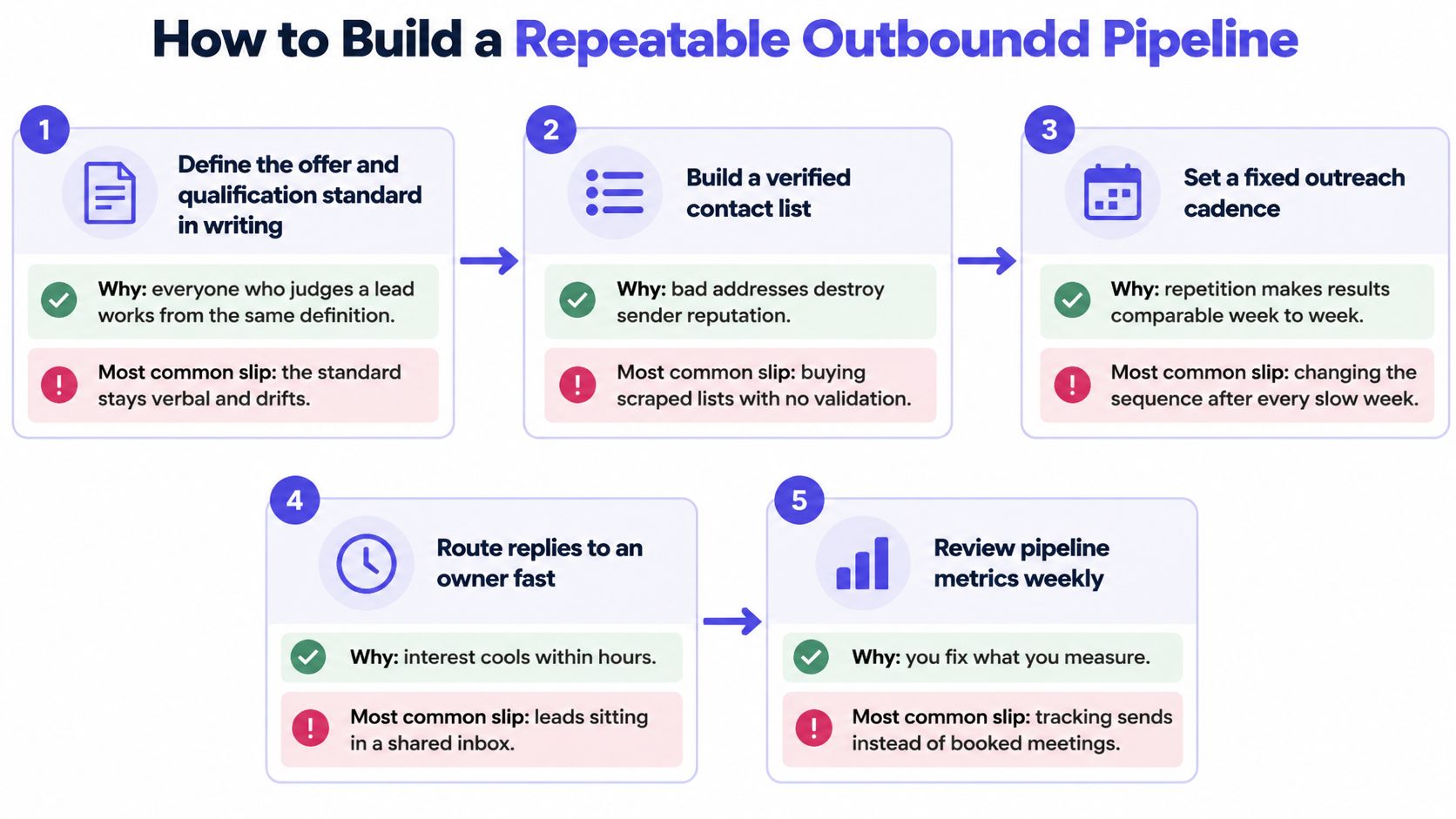
A repeatable outbound pipeline is a control system, not a pile of sequences. Treat the reply as the start of the pipeline. Every stage should have a threshold, an owner and a handoff rule, from inbox placement to accepted leads per delivered message.
The stages below assume the detailed work on qualification, list hygiene, sending setup, compliance and response speed is already defined. This is the operating layer that keeps those decisions from drifting once volume rises.
Run the pipeline as a weekly checklist
Lock the standard before volume changes. The person judging leads owns the written definition of qualified. If sales and outreach use different meanings, the same reply will be accepted in one inbox and rejected in another. Keep the standard beside the campaign, not in a separate document nobody opens.
Send only to records that still fit the offer. Role, account fit and live contact data should be checked before a message enters the sequence. The list rules and worked example are covered in the previous section, so the operating check is simpler here: every record needs a reason to exist, and every weak field needs a flag.
Confirm the sending setup before the next batch. The full authentication and placement work is covered earlier. At this stage, the checklist item is operational: no batch goes out while a domain, inbox or provider-level placement question is open. A paused send costs less than a week of damaged data.
Ramp in measured blocks. Increase volume only while complaint rate, placement by provider and replies stay explainable. A practical pattern is to move in small steps, hold each step long enough to read the numbers, then advance. If a provider slows, hold the current level until the cause is known. Speed is useful only when the pipeline can absorb the reply.
Keep one problem, one proof point and one next step per sequence. Copy should make the buyer's situation easy to recognise. Suppression still runs before every follow-up because opt-outs, role changes and live replies alter the list while the sequence is active.
Hand off positive replies fast. A reply needs a named owner, the original message, the qualification evidence and a clear next action. IronPeak Marketing's workflow sends an email introduction after the client approves a lead, and the Slack notice includes the company, contact, email address and job-ad link. That format reduces the time spent reconstructing context.
Log acceptance and rejection reasons at the handoff. Use fixed labels so the log can be compared week to week. Rejection reasons should point back to targeting, offer fit or timing, with the original message attached. A free-text note helps in the moment but weakens trend analysis.
Review on output, not activity. Track qualified leads per delivered message, acceptance rate, rejection reasons, placement by provider and handoff time. Sends, opens and replies explain movement, but they are not the final measure of the pipeline.
Use the log to decide what changes
The weekly review should produce one change, not five. If placement moved, hold copy and examine the sending setup. If handoff time slipped, fix ownership before adding volume. If accepted leads fell while replies held steady, compare the standard against the rejection log.
A useful rejection log has a small set of columns: lead name, company, sequence, reply date, reason code, owner, evidence and action taken. Reason codes should stay stable. "Wrong role", "no active need", "bad timing", "outside service area" and "duplicate" are enough to expose repeated errors without turning the log into a writing exercise.
The goal is a pipeline where each reply reaches a decision quickly, and each decision feeds the next campaign. When that loop is tight, more volume is a controlled choice. When it is loose, more volume only creates more unread replies and messier reporting.
Decide Whether to Build or Buy Your Outbound
91% of B2B marketers identified lead generation as their top priority in 2025, with organizations generating an average of 1,877 leads per month (Cirrus Insight lead-generation statistics). A priority that large is a resourcing decision, not a philosophical one.
A five-question go or no-go test
- Does the offer carry a high enough customer lifetime value to justify the cost of reaching a buyer who may take months to close?
- Can the market be identified by role and company size clearly enough to build a list against it?
- Can the contact data be verified before it enters a sequence, or will you be guessing at addresses?
- Can someone answer a positive reply within minutes, every working day, without exception?
- Will the team measure accepted leads rather than sends, including the ones it rejects?
Three or more no answers point at fixing the pipeline before adding volume. Building internally means recruiting, training and supervising a sales development team on top of owning domains, inboxes, enrichment and compliance. That's four functions before the first meeting is booked.
What to ask before signing anything
A managed provider covers campaign setup, prospect research, copywriting, follow-ups, inbox handling and CRM handoff, and bills per qualified lead with rejection rights when a lead fails the agreed standard. IronPeak Marketing runs managed B2B lead generation on that model, with clients paying per qualified lead rather than a fixed retainer.
Whoever the provider is, four answers belong in writing before the contract: how placement is measured by mailbox provider, how suppression runs before follow-ups, how rejection reasons are logged, and who owns sender compliance. A provider that can't answer those four isn't ready to be measured on accepted leads.
The next step is an audit, not a campaign. Score the current pipeline against the five stages in the first table, find the joint furthest below expectation, and check it against the thresholds before adding a single message of volume. That's the difference between buying more activity and buying pipeline, and it's the only comparison worth making. The full scope of what a managed engagement covers is set out in this guide to choosing a lead generation agency.
IronPeak Marketing runs managed B2B lead generation for B2B software founders, agencies, staffing firms and high-ticket service providers, covering prospect research, dedicated sending infrastructure, copywriting, follow-ups, inbox handling and CRM handoff, all billed per qualified lead rather than on a fixed retainer, with the right to reject leads that miss the agreed standard. If the audit above shows the weakest joint is targeting, infrastructure or handoff speed, that work can be run for you instead of built from scratch. Visit IronPeak Marketing to see how a qualified pay-per-lead engagement works and what the first 45 days look like.