B2B Lead Generation Strategy: A Practical Guide for 2026
Build a B2B lead generation strategy around audience, offers, channels, qualification and measurement, with deliverability limits that protect your domains.
The popular advice says pick a channel, build a bigger list, and send more follow-ups. That order is backwards. Volume exposes weak targeting, burns domains, and creates reports full of contacts sales won't accept. A sound B2B lead generation strategy works as an operating system first. Segments, qualification records, sending infrastructure, and accepted-pipeline reporting set the ceiling. Copy and volume only work inside those limits.
The Five Decisions Behind a B2B Lead Generation Strategy
Five decisions come before any list is built or sequence is written. Audience names the companies and roles with the problem, budget, and authority to act. Offer defines the single next step after a positive reply, such as a short diagnostic call or scoped trial, with one offer per segment.
Channels come third, based on where each segment already researches vendors. Qualification then sets acceptance criteria and rejection reasons a record can be checked against. Measurement closes the loop with accepted meetings, win rate, and time to close by segment, not opens or raw lead counts.
Why the order constrains everything else
Each decision limits the next one. A narrow audience makes a specific offer possible, that offer determines which channel fits, and the channel determines what evidence qualification can collect. Reversing the order usually produces generic messages sent to broad lists because the channel was chosen before the buyer was defined.
Buyer behavior supports that discipline. In a Gartner survey of 645 B2B buyers conducted from August through September 2025, buyers used an average of seven information sources during a purchase, and 45% had used generative AI, primarily to research vendors and products. The same survey found 70% preferred a completely digital, self-service buying experience, while 69% preferred validating AI-generated insights with a sales representative.
That combination matters. Prospects need material they can check on their own, plus access to a knowledgeable person when they want confirmation. Forcing every reply into an immediate sales call ignores how research happens.
Build for independent research first, then make the human conversation easy to reach when the buyer wants validation.
The system view also changes the target. IBM's overview of digital marketing supports treating lead generation as a measurable process that connects prospect data, messaging, engagement tracking, and sales workflow rather than a list of names. For founders still separating early research from sales-ready activity, the distinction in lead generation versus prospecting is useful. Lead volume is a weak target because it doesn't separate raw contacts from accepted opportunities.
Pick Segments and Offers Before Choosing Channels
Start with two to four segments where the problem, buying committee, and trigger differ. One message rarely fits a finance leader and an operations director at the same company. They own different budgets, feel different pain, and judge risk differently.
For each segment, write three lines before writing copy.
- The problem: State the operational cost in plain language, not the product category.
- The role with authority: Name who can approve a next step, not just who feels the pain.
- The observable trigger: Record the visible change that makes the problem urgent now.
Say a software founder sells to finance leaders at mid-market companies. One segment might be grouped by revenue band, another by whether the company runs its own month-end close. Triggers could include a new reporting requirement or a recent senior finance hire, and each segment gets different opening evidence.
That research discipline is where structured prospect research pays off, because the segment definition tells the researcher what to verify and what to ignore.
One offer per segment
The offer is the next step after a positive reply. It might be a 20 to 30 minute diagnostic call, a scoped audit, or a short trial. It shouldn't be a full demo by default.
A cold prospect asked for a full demo has to commit time, attention, and internal credibility. The same prospect may accept a short review of the current process because the cost of saying yes is lower and the value is clearer. Match the ask to the commitment a buyer will accept at that stage.
Test each offer by count, not opinion. Track how many positive replies reach the agreed next step, by segment. A segment that gets replies but no next steps has a message or offer problem, not a list problem. Record segment and offer on every lead record so later reporting can compare them without guesswork.
Define Qualification Fields Before You Write a Single Email
Qualification starts with the record a sales-ready lead must carry. If the fields aren't defined before outreach, every positive reply becomes an argument about whether it counts. That argument wastes sales time and makes campaign data useless.
Firmographic fields describe the company. They include industry, geography, employee count, revenue, and technology stack. Buying-context fields describe the moment. They include role authority, current provider or process, trigger event, problem severity, timing, and explicit fit with the offer.
Every field needs four controls.
- Source: Where the value came from.
- Timestamp: When it was collected or verified.
- Confidence score: How reliable the enrichment is.
- Validation rule: What value passes, fails, or needs review.
Enrichment below the minimum confidence threshold shouldn't launch into a sequence. Route it to manual review or suppression. Sending to a guessed role at a guessed company size doesn't create learning, it creates bounces, complaints, and rejected leads.
A worked rejection
Say a staffing firm targets regional employers with 50 to 200 staff. A company posting the same role repeatedly in one quarter shows a trigger, so it passes that check. A different company in the size band fails if its in-house team already covers the need and there's no review date, because the current-process field blocks it.
That rejection is useful data. It tells the team to stop sourcing lookalike companies with covered needs and spend research time on employers showing repeated hiring pressure instead.
| Field | What to record | Example | Reject when |
|---|---|---|---|
| Employee count | Band from a dated source | 50 to 200 staff | Outside the target band |
| Role authority | Job title and decision role | Operations director who signs off vendors | No influence over the purchase |
| Trigger event | Recent change that creates the need | Repeated hiring for the same role in one quarter | No trigger and no stated problem |
| Current process | Incumbent provider or internal method | In-house team that already covers the need | Need already covered with no review date |
| Confidence score | Score per field from the enrichment source | Above your minimum threshold | Below threshold, so route to review or suppress |
The priority is widely shared. LinkedIn's 2024 B2B benchmark reported that 37% of respondents considered building a high-quality pipeline their top priority for the following year. That priority can't be met by counting contacts.
Agree the criteria in writing before launch. Include target-account fit, decision-maker status, verified need, and the agreed next step. Then capture every acceptance and rejection reason in the CRM against source, segment, campaign, and message variant, so weak segments get cut and strong ones earn controlled scale.
Build Familiarity Before the First Email Lands
A first email can open a conversation. It cannot create demand that was never there. By the time it arrives, the buyer may already prefer another vendor.

The 6sense Buyer Experience Report 2026 found that 91.4% of B2B buying journeys had a preliminary winner identified before first contact, and that 84% of buyers were more likely to engage when they already recognized the sender's brand.
Recognition has to exist before the send. Against an incumbent, a clever subject line doesn't close that gap. The sender needs to be familiar and credible before the inbox becomes the battleground.
The small-firm familiarity playbook
Small firms can't outspend a category leader. They can out-specify one. Publish one piece of category-specific material per target segment, such as a teardown of a common workflow in that industry, and make it useful enough that a prospect can judge competence without a sales call.
Collect third-party proof next. Named client references, reviews, and industry listings give a cautious buyer something to verify independently. Keep the positioning consistent across the website and every public profile, because a prospect who checks three places and finds three different claims will trust none of them.
Then reference a known business event at the prospect company in the first line. A recent hire, expansion, or repeated job posting beats a first name and company merge tag, because it shows the message exists for a reason.
Practical rule: An opening line that could be sent to any company in the segment is merge-tag formatting. Personalization references something specific to that account.
This familiarity work runs in parallel with list building and domain warm-up, so the setup window stays productive instead of idle. Warming accounts leave traces: watch for branded search, direct visits from companies on the target account list, and repeat content engagement from the same domain. Those signals measure recognition rather than buying intent, and logging them against the account record lets a sequence start when recognition exists rather than on a fixed schedule.
For prospects with no awareness at all, fewer and better-timed contacts beat high-volume sequences. Six follow-ups to someone who has never heard of the sender mostly teach that person to ignore or report the mail, and each report pushes the sending domain toward the complaint thresholds the whole system depends on staying under. Timing outreach after a trigger, a content visit, or a referral mention gives the message context it can't manufacture on its own.
Match Each Channel to How Buyers Research
Pick channels by where each segment already researches. A cheap channel that buyers never see produces no pipeline, no matter how efficiently it runs. Each channel is one component in the system: it needs a specific input, controls a specific moment in the buying process, and carries a failure mode that caps the volume it can handle.
| Channel | Best fit | Buyer research pattern | Timing control | Main failure mode | Start requirement |
|---|---|---|---|---|---|
| Cold email to named accounts | Buyers with a defined problem and known roles | Opens a work inbox and scans for messages tied to an active problem | High | Deliverability loss from complaints | Authenticated domains, warm-up and verified contacts |
| LinkedIn outreach | Senior roles that respond to direct messages | Checks DMs and peer posts, then validates the sender by profile and history | High | Low response from unverified profiles | Verified role data and a credible sender profile |
| Paid search | Buyers already comparing vendors | Types problem and comparison queries during active evaluation | Medium | Cost per lead with mixed fit | Landing page and tracking that connect to the CRM |
| Referral and partner programs | Buyers who trust peer recommendations | Asks peers in communities and associations who they hired | Low | Slow and hard to scale | Named partners and a referral agreement |
| Content with inbound capture | Buyers researching independently | Reads category material and benchmarks before contacting vendors | Low to medium | Traffic without fit | Category content and a clear next step |
Read the table by failure mode, not by promise. Cold email gives timing control but punishes weak data through complaints. Paid search captures existing intent but pulls in buyers comparing several vendors at once, so its qualification rules should be stricter than the rules used for outbound.
Referral and partner channels work differently. They suit buyers who decide through peer conversations and communities outside tracked channels. The trade-off is control: a team can't schedule a referral the way it schedules a send, and scaling depends on partners staying motivated.
Two channels, one segment, different jobs
A commercial services firm selling maintenance contracts to property managers shows how this works. Those buyers ask each other who they use, often inside regional associations and peer groups, so a referral program with named partners is the primary channel. Cold email to named accounts plays support: the firm reaches specific property managers after a visible trigger, such as a new building contract or an expansion, and can reference the partner relationship in the opener.
The channels do different jobs. Referral lends credibility the firm can't manufacture on its own, while email reaches a named buyer at a chosen moment. Neither channel replaces the other, and judging each by the other's metric misreads both. Measure what each channel is for: the accepted leads the primary channel starts, and whether accounts touched by the support channel move faster than accounts that never saw it.
Assign one primary channel and one support channel per segment, then judge both against the same acceptance criteria.
Treat the pairing decision as system design. If a segment researches through peers, an outbound-only plan asks email to do a job it was never built for. If a segment researches alone in a search bar, a referral-only plan leaves the buyer's highest-intent moment unowned. Match the channel to the research behavior first, and let the pairing prove itself against the same qualification fields every other part of the system uses.
How to Set Up Sending Infrastructure Without Burning Domains
Infrastructure is a control system, not a capacity purchase. Adding inboxes doesn't create trust with mailbox providers. Authentication, complaint control, and disciplined volume do.
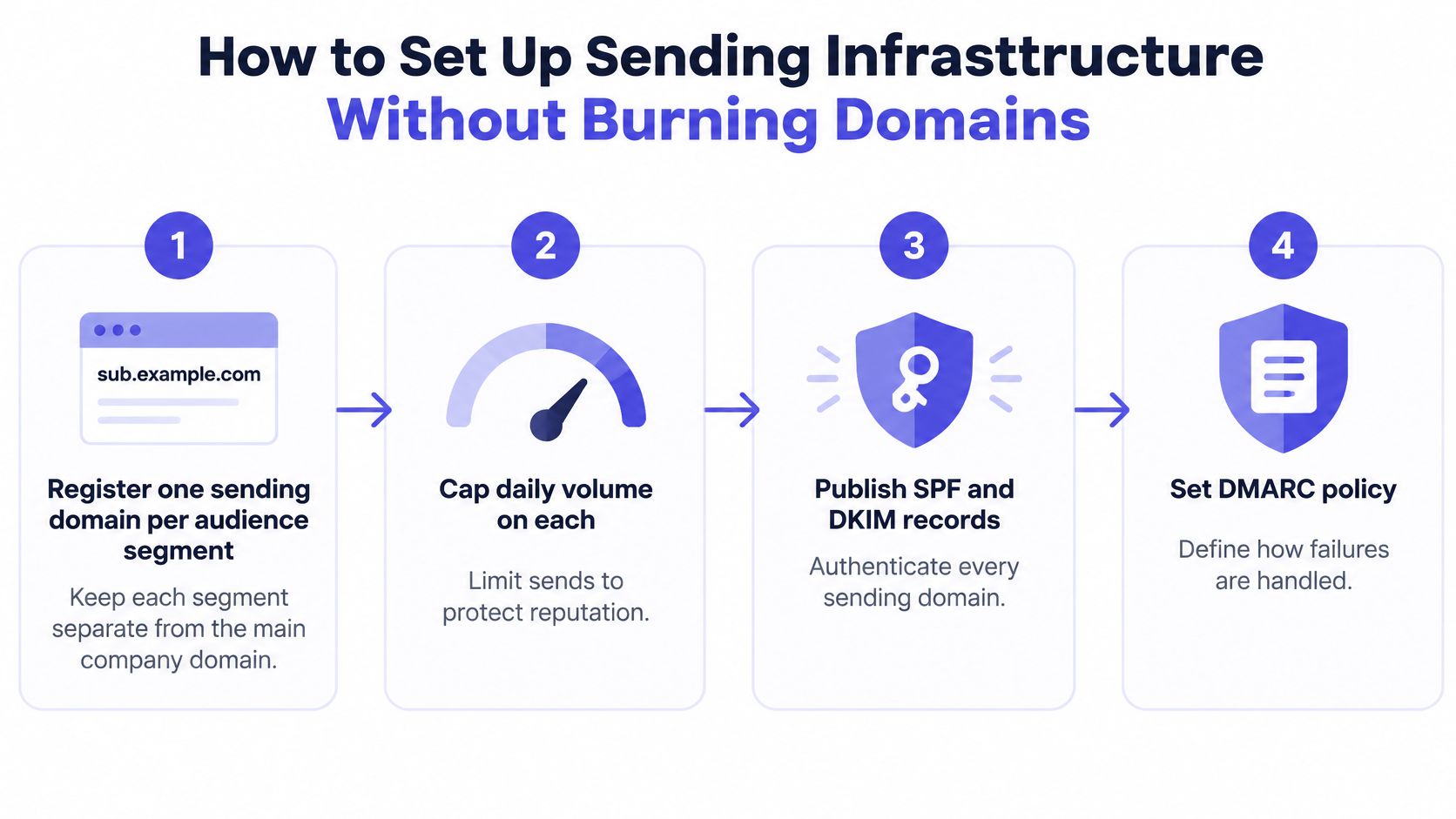
- Register one sending domain per audience segment, separate from the main company domain, and cap daily volume on each. Separation keeps a problem campaign from damaging the domain used for customers and operations.
- Publish SPF and DKIM for every domain, plus DMARC matched to the monitoring stage. Confirm the From address aligns with the authenticated domain before any send.
- Create dedicated inboxes and test reply handling. Replies must reach a monitored address, because an interested prospect or an opt-out request sitting unread is an operational failure.
- Warm by engagement and complaint rates, not a fixed calendar. Raise daily volume only when authentication passes consistently and complaints stay well below 0.1%.
- Check Google Postmaster Tools daily for each domain's spam rate and authentication status. Weekly checks let a bad segment run long enough to do real damage.
- Suppress every contact who objects, into one list shared across sequences, inboxes, domains, and future uploads. Enrichment must never reintroduce an opted-out contact.
- Pause a sequence when complaints approach 0.1%. Don't wait for the hard ceiling to act.
The arithmetic is unforgiving. Google's sender guidelines state senders should keep the user-reported spam rate below 0.1% and prevent it from reaching 0.3% or higher. A sequence of 1,000 messages with three spam complaints sits at 0.3%, so three complaints aren't harmless background noise.
| Spam complaint rate | Status | Action |
|---|---|---|
| Below 0.1% | Healthy | Continue, and raise volume only after authentication passes consistently |
| 0.1% to below 0.3% | Warning | Reduce volume, review the list source and suppress objectors |
| 0.3% or higher | Critical | Pause sending, since mitigations may be unavailable |
| Recovery after reaching 0.3% or higher | Seven consecutive days below 0.3% | Eligible for mitigation again |
The mechanism is direct. Inaccurate data and excessive follow-up create irrelevant messages, irrelevant messages draw complaints, and mailbox providers respond by moving later mail to spam or rejecting it. Teams troubleshooting placement should review common email delivery issues before rewriting copy. A healthy program lowers volume before it changes the copy.
Two compliance checks before the first send
Authentication differs by volume. Google's email sender requirements state all senders must use either SPF or DKIM, while bulk senders must use SPF, DKIM, and DMARC. Microsoft's high-volume sender requirements cover domains sending more than 5,000 messages per day to Outlook recipients, requiring SPF and DKIM passes plus DMARC with at least a p=none policy aligned with SPF or DKIM, and a valid From or Reply-To address that accepts replies. Non-compliant mail is first routed to Junk and may later be rejected.
Commercial content rules apply too. The FTC CAN-SPAM compliance guide requires commercial email to avoid false or misleading header information and deceptive subject lines, identify itself as an advertisement, include a valid physical postal address, and offer a clear opt-out. That opt-out must keep working for at least 30 days after sending and be honored within 10 business days.
Measure Accepted Pipeline Instead of Lead Counts
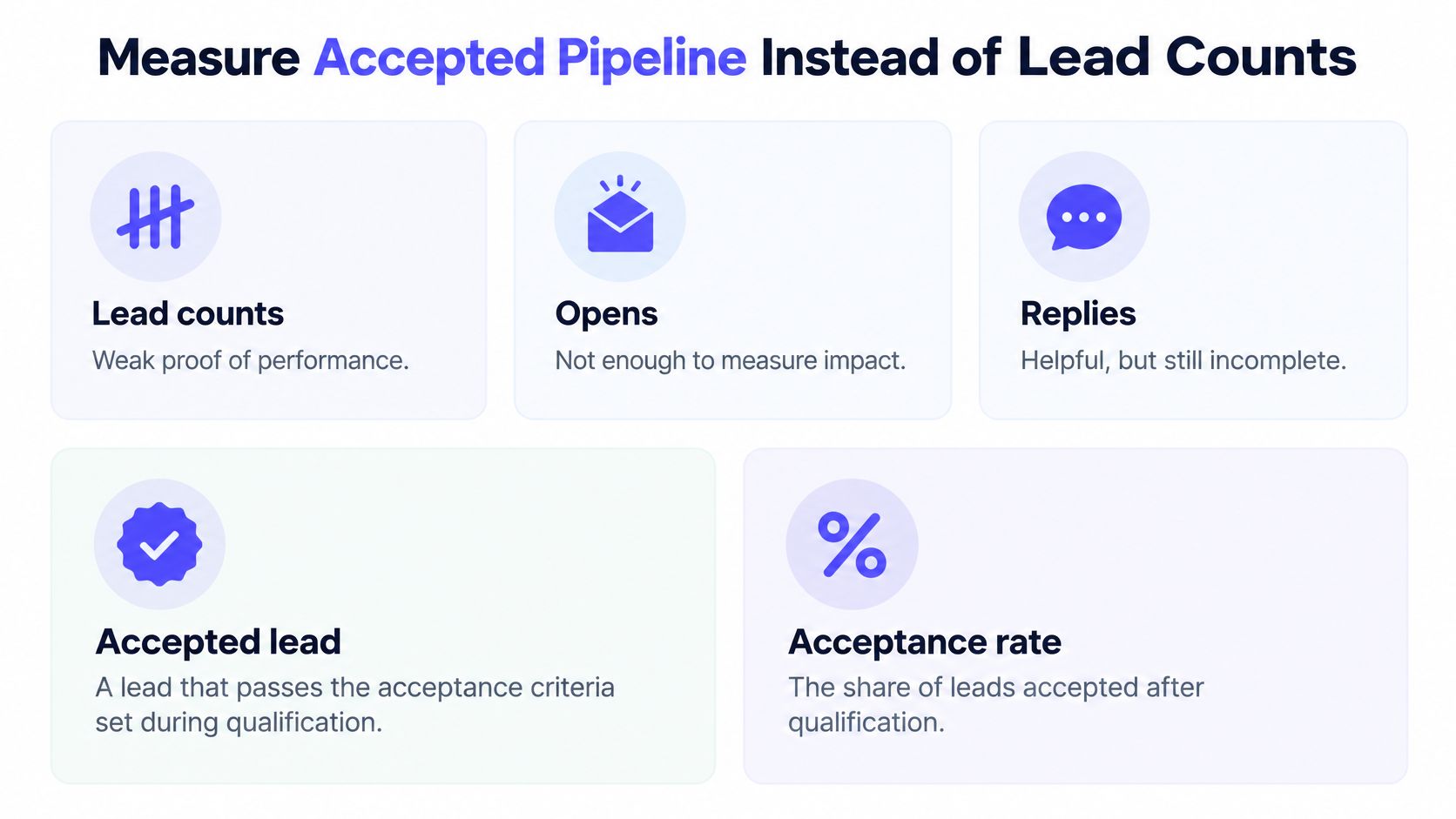
Lead counts, opens, and replies describe activity. They don't prove the program created business. A campaign can produce plenty of polite replies from people with no authority, no budget, and no active project.
An accepted lead is one that passes the acceptance criteria set during qualification. Report the acceptance rate by segment and message variant, because averages hide the segment that's wasting sales time. If one variant earns replies but fails acceptance, the copy is attracting the wrong response.
Attribution makes this harder. The 6sense 2025 marketing metrics research describes research estimating as much as 67% of B2B research occurs in a dark funnel of peer conversations, reviews, analyst reports, and professional communities. It also reports peer conversations and referrals influence 92% of purchase decisions.
Conventional tracking misses most of that. So the honest question isn't which touch gets credit. It's whether outbound sourced an opportunity or accelerated one already in motion.
Tag the origin, then compare outcomes
On the first call, ask structured discovery questions. How did the buyer first hear of the company, what triggered the project, and who else is being evaluated. Tag each accepted lead as sourced, accelerated, or unknown based on the answers.
Then compare win rate and time to close across the three groups. Accelerated deals that close faster still have value, but they're a different kind of value from sourced deals. Pricing and judging a program fairly depends on knowing the mix.
Here's a hypothetical example. A pilot produces 30 accepted leads, 12 meetings held, and 3 closed-won deals, but 20 of the 30 are tagged unknown. That result doesn't prove outbound worked or failed, it proves discovery data is too thin to credit anyone yet.
A high unknown rate is a measurement failure first and a channel verdict second.
Report by account cohort at 30, 60, and 90 days, covering sales progression and revenue. Cohort reporting stops a strong first week from hiding weak progression later, and it gives slower enterprise deals time to show movement without letting dead leads sit unchallenged.
Run a Bounded Pilot Before You Commit Budget
Start with a one-page pilot scope. On day one it names the target segment, the offer, the acceptance criteria, the reporting cadence, the complaint ceiling carried over from the sending infrastructure setup, and the rule for scaling. A field left blank is a dispute waiting to happen, so fill every field before the first email sends.
Give the pilot a fixed window long enough to cover domain setup, warm-up, and the first accepted leads. Agree the qualification standard in writing before billing starts, and review every rejected lead against it. Rejection reviews are where vague definitions get caught; a lead tagged with the wrong industry or the wrong seniority should cost the provider, not the client.
When a provider quotes a volume target, ask for the definition of qualified, a sample of rejected records, and the basis for the timing. A quoted target is a forecast, and the written acceptance criteria decide what you pay for. IronPeak Marketing's headline offer is 60 to 90 qualified leads in 45 days on a pay-per-result basis, and clients can reject leads that miss their qualification standard without paying for them. Terms like that still need the same written criteria and rejection rights as any other arrangement.
End the window with a clear scale-or-stop test.
- Scale only if the accepted-lead rate, meeting rate, and complaint rate all meet the criteria written on day one.
- Stop if complaints breach the ceiling or accepted leads stay below the agreed rate.
Finally, compare pilot cost against building the same capability in-house. Count the sending infrastructure, data enrichment, CRM integration, and staff hours accurately, including the deliverability monitoring that keeps domains healthy. A managed option that deploys custom domains, dedicated inboxes, copy, data enrichment, and tracking systems in under 15 days should be priced against that full internal build; a contact list subscription is the wrong baseline.
If the goal is a B2B lead generation strategy measured by accepted pipeline instead of activity, IronPeak Marketing builds the domains, inboxes, data enrichment, copy, and follow-up systems, then books qualified sales calls on the client's calendar on a pay-per-result basis. Visit IronPeak Marketing to review the qualification standard and pilot terms before committing budget.