What Is B2B Lead Generation? a Practical Guide for 2026
What is B2B lead generation? Learn the stages, channels, qualification rules and inbox limits that decide whether outbound books real sales calls.
What is B2B lead generation? The popular answer is volume: build a bigger list, add more inboxes, raise daily sending. That framing counts a scraped record as a lead, and it fails predictably. Push more contacts through weak infrastructure and bounce rates climb past the thresholds inbox providers enforce, complaints follow, and the replies that do arrive come from people who cannot buy. Sales inherits the sorting work.
A lead worth the word is a qualified opportunity measured at the account level: a buying unit whose contact fits the target market and shows enough intent to justify a sales conversation. Reaching it takes a control system. Targeting, enrichment, deliverability, reply handling, and qualification rules decide which contacts become opportunities and which consume time.
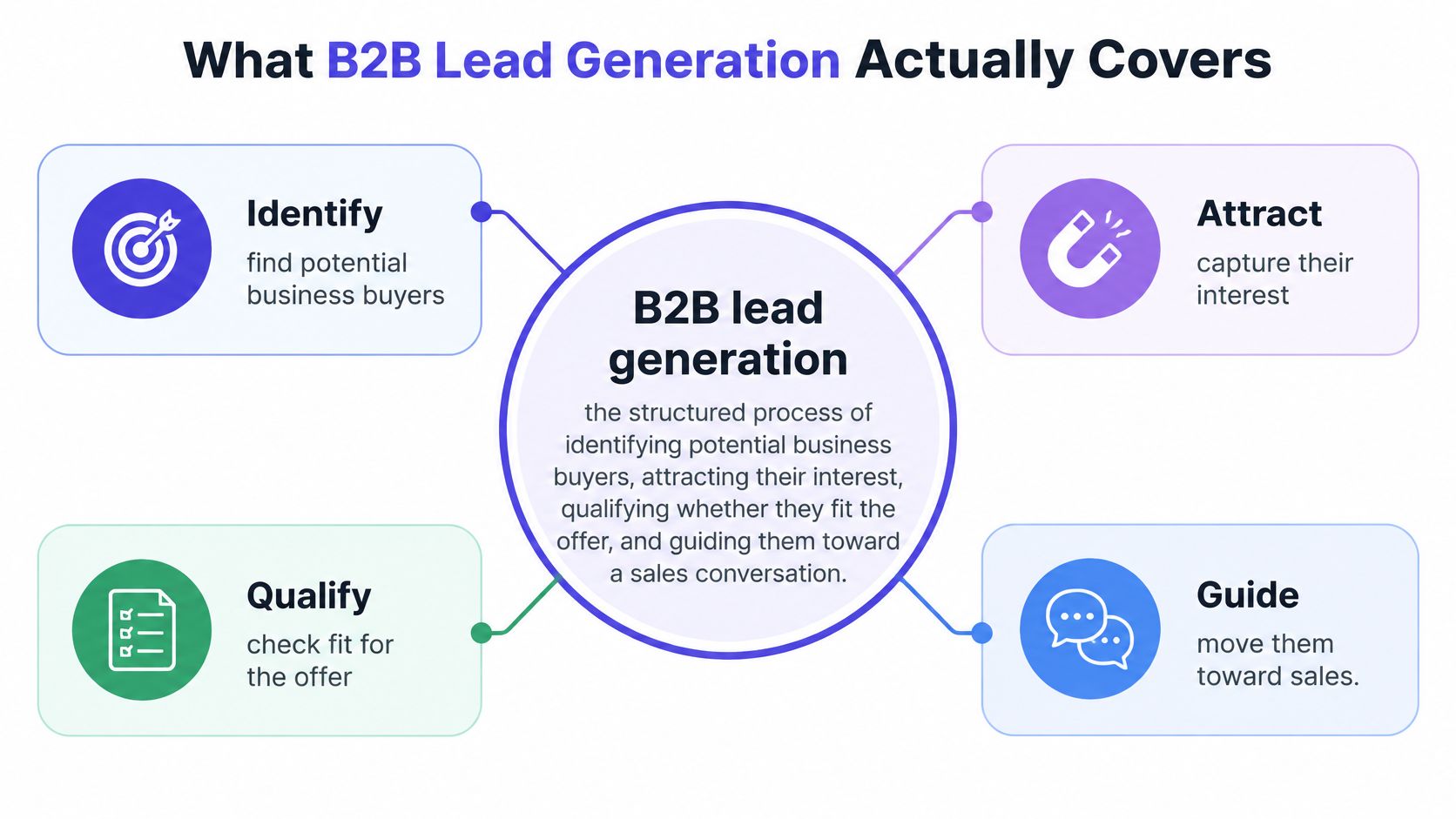
What B2B Lead Generation Actually Covers
A contact record and a qualified lead are two different things, and the work between them is what lead generation covers. A sourced name only becomes a lead after the account fits, the role is right, and a live problem gives the conversation a reason to happen.
Take a VP of operations at a regional logistics firm whose drivers keep missing delivery windows. That person has a relevant role, a fitting account, and a problem active right now, so a well-matched message can earn a sales call. The same job title at a company with no fleet issue is a lead candidate, and a raw volume count treats both identically. Qualification is what separates them.
Buyers have made that sorting work matter more. In a Gartner survey of 632 B2B buyers conducted in August and September 2024, 61% preferred an overall buying experience without a sales representative. The same research found 73% of B2B buyers actively avoid suppliers that send irrelevant outreach. It also found buyers still want seller input for contextual judgment, such as whether an offer fits their organization, while preferring digital self-service for general information and learning.
Relevance carries a second payoff. Irrelevant outreach generates ignores, deletes, and spam complaints, and those signals drag down inbox placement for every future send. Qualification protects the sending infrastructure as much as it protects the sales team's calendar.
What Counts as a Qualified Lead
A qualified B2B lead is a potential buyer at an account that matches the target market, with enough relevance or commercial intent to justify a sales conversation. A correct email address alone does not meet that bar. The operator has to connect the prospect's company, role, business problem, timing, and likely buying requirements to a message worth answering.
Lead generation therefore includes work many teams file under administration:
- Prospect research: Confirm the company fits and the contact holds a relevant role.
- Personalization: Tie the message to a specific problem or operating context.
- Response handling: Read replies, answer objections, and route interest quickly.
- Qualification rules: Apply written pass and fail criteria before handoff.
- CRM handoff: Transfer the contact with context, not just a name and a booked time.
Pipeline test: For each supposed lead, can the team name the person's role, the business problem, and the reason they would talk now?
A no on any point means the record stays a lead candidate that still needs verification.
The Stages From Target List to Sales Opportunity
A funnel works only when each stage has a pass rule. A record shouldn't move forward because it's been sitting in a sequence. It moves because identity, account fit, need, and readiness have been progressively validated.
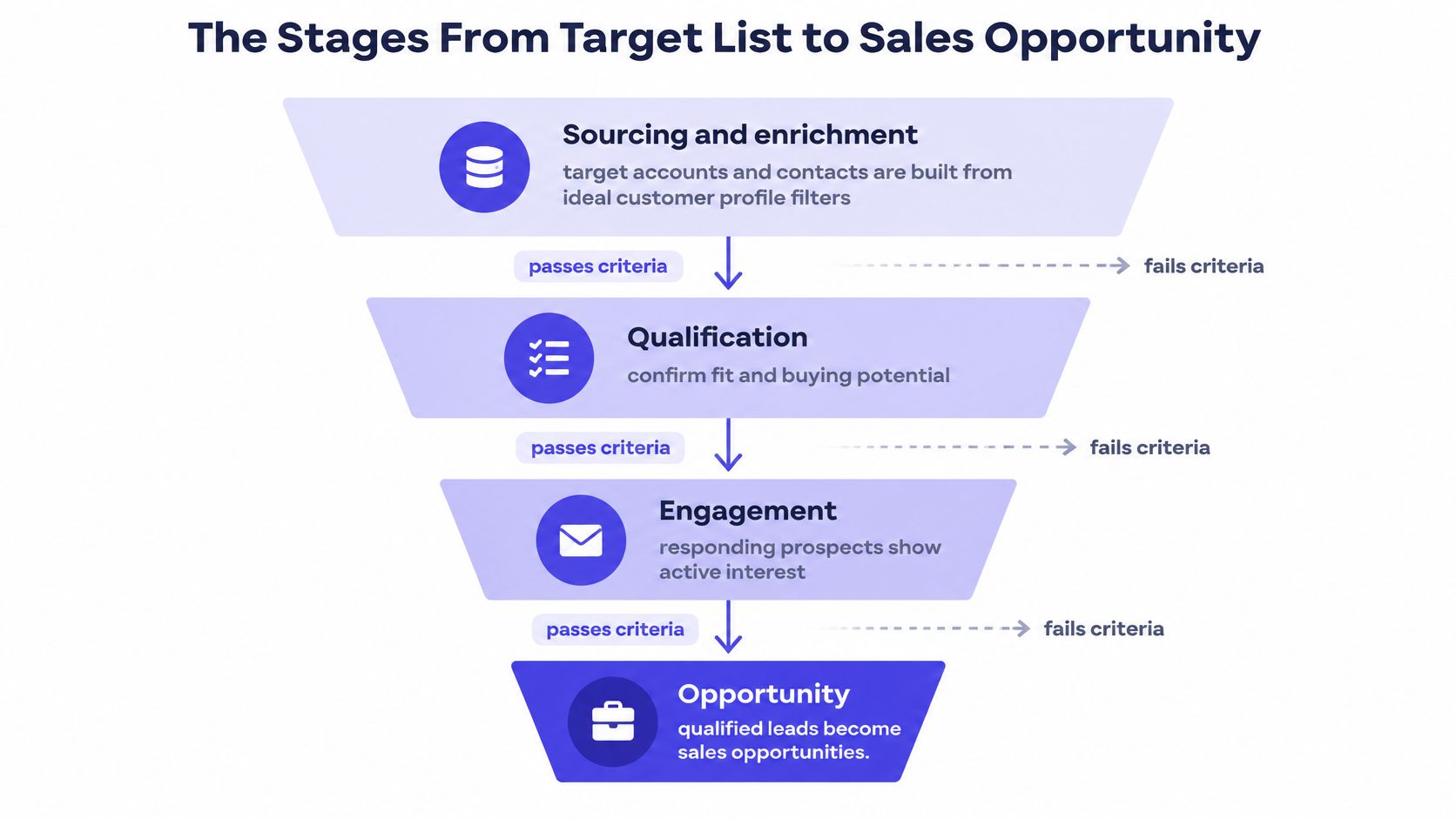
Work starts with sourcing and enrichment. Target accounts and contacts are built from ideal customer profile filters, then checked for valid email, correct role, and company type. Building that pool is the job covered by a properly constructed lead generation list, not a bulk export sorted by industry alone.
The Planning Math
The funnel benchmark data lists approximate conversion rates of 31% from lead to marketing-qualified lead, 13% from MQL to sales-qualified lead or accepted lead, and 47% from SQL or sales-accepted lead to opportunity. Starting with 10,000 sourced records, that's about 3,100 MQLs, about 403 SQLs, and roughly 189 opportunities. Actual performance varies by market, offer, channel, and definition, so those figures are planning benchmarks, not guarantees.
| Stage | What Happens | Pass Criterion | Planning Benchmark |
|---|---|---|---|
| Sourcing and enrichment | Build verified contacts for ideal accounts | Valid email, correct role, company type classified | 10,000 records as the starting pool |
| Lead to MQL | Contact shows an interest or fit signal | Matches firmographic and role criteria | 31% (about 3,100 MQLs) |
| MQL to SQL | Stated need and timing are confirmed | Need, authority and timeframe confirmed | 13% (about 403 SQLs) |
| SQL to opportunity | Sales conversation is accepted and scoped | Accepted by sales with a next step booked | 47% (about 189 opportunities) |
Notice what the math exposes. Doubling the starting list doesn't just double opportunities. It doubles the verification, sending, reply handling, and rejection work in between. Weak sourcing multiplies that workload faster than it multiplies revenue.
Closing the Loop
Stronger account selection and contact enrichment raise the chance that outreach reaches a relevant buyer. Sharper qualification stops sales teams from spending time on non-buyers. CRM feedback then does the compounding work. Accepted and rejected leads should update exclusion rules, targeting criteria, and sequence logic.
Check the ratio at each stage before adding volume. A stage that's leaking doesn't need more records fed into it.
For high-LTV software, agencies, staffing firms, and commercial service providers, that closed loop is the difference between a campaign and a system. Pay-per-qualified-lead pricing only means something when the qualification standards behind each stage are documented, auditable, and consistently applied.
Why Replies Mislead
Say an operations manager replies with genuine interest. The problem is real, the timing sounds reasonable, and a meeting gets booked. Then it stalls. The operations manager can't approve spend, and the finance lead who signs off never saw the email. The reply was real. The lead, as counted, was not.

Research on modern buying describes journeys lasting about 211 days and involving more than five stakeholders, with buyers spending only around 17% of evaluation time speaking with potential suppliers, according to research on the B2B buyer's journey. Most evaluation happens privately, inside the account, without the seller present.
Contact Fit Is Not Account Fit
Contact qualification answers whether this person is relevant. Account qualification answers whether the company has a problem, a timeframe, and a credible path to internal approval. Those are different questions, and conflating them inflates pipeline while hiding the bottleneck, which is committee alignment.
A buying group typically includes distinct roles:
- Economic buyer: Controls budget and approves the purchase.
- Technical evaluator: Judges whether the offer works in their environment.
- Day-to-day user: Feels the problem most directly and often replies first.
- Blocker: Prefers the current approach or carries risk if the change fails.
The person who replies is frequently the user. That's useful access, but it isn't approval. The operator's job is to map who else has to agree and record the business problem and timing at the account level, then supply follow-up material the contact can forward internally for people who'd rather research than take meetings.
Checklist Before a Reply Counts
Before any reply is counted as a lead, it should clear six checks. Firmographic fit comes first. Second, a verified business problem, stated in the prospect's own terms. Third, evidence of buying stage, not just politeness. Fourth, an appropriate contact role or a named route to the right role. Fifth, a documented next step. Sixth, a recorded reason for every rejection, so failed records improve the next list instead of disappearing.
Fewer leads with account-level evidence, stakeholder access, and a path to approval will usually outperform a larger pile of replies that die in committee. Volume of replies is an activity metric. Account intent is the commercial one.
Channels That Feed a B2B Lead Program
Channels are routes into the same funnel. Each one delivers a different kind of contact at a different cost, and each fails in a predictable way.
In Endeavor Business Media's 2024 Marketing Benchmark Report, the three most effective B2B lead-generation tactics reported by marketers were in-person events at 65%, website marketing at 55%, and email marketing at 51%. Those are self-reported effectiveness ratings, so they indicate where marketers see value rather than what a given program will produce. They also say nothing about cost per qualified opportunity or how much follow-up work each contact needs before it counts.
| Channel | Strength | Failure point |
|---|---|---|
| In-person events | High-intent conversations | Limited calendar and slow to scale |
| Website and inbound content | Buyers research on their own | Must be found first and slow to build traffic |
| Email marketing | Reaches known contacts at low cost | Depends on list quality and consent |
| LinkedIn and social outreach | Targets specific roles and titles | Reach limited by platform rules and audience fatigue |
| Paid search and display | Scales quickly | Lead quality falls when targeting is broad |
| Referrals | Warm introductions with high trust | Volume is unpredictable |
| Cold outbound | Operator controls targeting, timing and messaging | Depends on list quality, sending infrastructure and follow-up discipline |
The channel decides how much qualification work remains after first contact. A referral arrives with context already attached: the referrer has usually described the problem and the timing, so the first conversation confirms fit instead of discovering it. An event contact sits in the middle, because the rep heard the problem directly but a badge scan still produces names with no context behind them. A cold outbound reply starts furthest back, since the contact has to be checked for fit, role, and a real next step before the account counts. Three records can carry the same label in a CRM and need completely different amounts of work.
Cold outbound is the channel the operator controls directly. Targeting, timing, and messaging are all adjustable. The cost is discipline: list quality, sending infrastructure, and follow-up have to be maintained daily, or the channel degrades quickly.
Pick channels by follow-up capacity. My rule: run only as many channels as the team can work while contacts are still warm. One rep can handle referrals plus a single outbound motion. Spread that same rep across events, paid search, and social, and follow-up queues form where good conversations expire before anyone calls back.
Cold Email Mechanics That Protect Inbox Placement
Separate inboxes aren't enough. Inbox placement is decided by authentication, domain alignment, and complaint rates. An operator who treats infrastructure as a setup task instead of a daily control will eventually send technically valid email that nobody sees.
Where the Gmail Rules Start
Under Gmail's sender guidelines, senders sending 5,000 or more messages per day to Gmail accounts must authenticate outgoing email, avoid unwanted or unsolicited messages, and provide an easy unsubscribe method. Gmail recommends keeping the user-reported spam rate below 0.1% and preventing it from reaching 0.3% or higher. Since June 2024, bulk senders above 0.3% are ineligible for Gmail mitigation and must stay below 0.3% for seven consecutive days to regain eligibility. One-click unsubscribe is also required for commercial and promotional messages.
| Rule | Threshold | What It Requires |
|---|---|---|
| Bulk sending volume | 5,000 or more messages per day to Gmail | Authenticated mail with SPF, DKIM and a DMARC record |
| Spam complaint target | Below 0.1% user-reported spam | Monitor complaints per sending domain |
| Spam complaint ceiling | 0.3% or higher | Bulk senders lose mitigation eligibility |
| Recovery after exceeding 0.3% | Below 0.3% for seven consecutive days | Reduce volume and fix list or copy before scaling again |
| Promotional messages | Any volume | One-click unsubscribe and an easy opt-out path |
Those thresholds are tight. At high daily volume, a small number of complaints moves the rate. That's why list relevance is a deliverability issue, not just a conversion issue. Irrelevant recipients don't only ignore email. They report it.
Infrastructure That Supports the Thresholds
Every sending setup needs correctly configured SPF and DKIM, a DMARC record, and aligned sender domains. Dedicated sending domains should stay separate from the primary brand domain so outbound problems don't damage normal business email. New domains need a gradual warming period before volume rises, since a fresh domain sending at full volume on day one looks exactly like abuse.
Complaint monitoring has to happen per domain, not just per campaign, because one bad segment can drag down a domain that other campaigns depend on. Suppression of opted-out recipients must apply across every sequence, not just the one they replied to. Operators diagnosing placement drops should work through common email delivery issues methodically before touching copy.
A campaign can raise volume while complaints drift toward the ceiling, and placement will fall even though every individual email is technically valid.
The failure pattern is consistent. Volume goes up, targeting gets looser to feed it, complaints climb, and the operator responds by adding more domains instead of fixing the list. New domains buy time. They don't fix the cause.
Compliance Rules That Shape Your Outbound List
Compliance is a campaign mechanic, not a copywriting detail. It decides who can be emailed, what every message must contain, and how fast opt-outs have to take effect. Teams that treat it as legal fine print end up rebuilding lists mid-campaign.
United States Rules
For U.S. campaigns whose primary purpose is commercial, the CAN-SPAM Act requires accurate From, To, Reply-To, and routing information, a valid physical postal address in each message, and a clear method to stop future marketing. Under the FTC's CAN-SPAM Act compliance guide, the opt-out mechanism must keep working for at least 30 days after sending, and requests must be honored within 10 business days. The process can't charge a fee, ask for information beyond an email address, or force more than a reply email or one website page.
United Kingdom Rules
UK rules split by recipient type. The ICO's business-to-business marketing guidance states that PECR's electronic-mail rule does not apply to corporate subscribers such as limited companies, though a lawful data-protection basis, clear sender identification, and an opt-out are still required. Sole traders and some partnerships count as individual subscribers and generally need specific consent unless the soft opt-in applies. That soft opt-in depends on details collected during a sale or negotiation, similar products or services, and an opt-out offered at collection and in every later message.
Putting the Rules Into the Sequence
Three operational steps, in the order they happen. During enrichment, classify each record as a corporate or individual subscriber before the list loads, since that classification decides which rules apply to the send. Keep one persistent suppression list that every sequence references. Then gate step one inside the sequence tool on that check: when a record matches a suppressed address, the tool skips the send and flags the contact rather than queueing it. Stop future sends to every opted-out record before the next campaign launches, not when someone notices the reply.
Recipient type belongs in the qualification rules alongside role and company size. A sole trader who matches the ideal customer profile perfectly is still a different compliance category than a limited company at the same revenue.
Treating every business address as equivalent is how a deliverable list becomes a compliance failure. A sole trader emailed on a corporate-subscriber assumption doesn't just opt out. The complaint lands while the campaign is live, the list has to be pulled and reclassified record by record, and the qualified pipeline sitting behind those sends stalls with it.
Measuring Whether Lead Generation Works
Measure the program by qualified opportunities produced at the account level. A reply is a stage, not a result, and a lead exists only when an account meets the written qualification criteria and is moving toward a sales call.
Sourcing a good record and earning a reply means little if the reply sits unanswered while the prospect talks to someone else. Vida's audit of speed-to-lead performance covering 2,241 U.S. companies found only 37% responded to submitted leads within one hour, while 23% never responded. The same Vida summary cites an analysis of more than 1.25 million leads across 29 business-to-consumer and 13 business-to-business companies: contacting a lead within one hour made qualification nearly seven times more likely than waiting an additional hour, and more than 60 times more likely than waiting at least 24 hours. Routing, ownership, and response SLAs sit inside the lead generation system. Slow replies destroy value that sourcing and copy already paid for.
Six Metrics, Six Different Causes
List quality and execution quality have to be measured separately, or every problem gets blamed on the list.
| Metric | What It Reveals | Where a Weak Result Points |
|---|---|---|
| Valid contact rate | Share of records with a working address | Sourcing or enrichment |
| Positive reply rate | Share of sends that earn interested replies | Offer, copy or targeting |
| Qualified lead rate | Share of replies that meet written criteria | Qualification rules or audience fit |
| Response latency | Time from reply to first human response | Routing, ownership or staffing |
| Acceptance or rejection rate | Share of leads the buyer accepts | Gap between criteria and actual buyers |
| Opportunity conversion | Share of accepted leads that become opportunities | Sales follow-up or offer fit |
Each metric's denominator is the output of the stage above it, so a weak early number drags every later percentage down. Diagnose the chain in order and fix the first weak metric before touching anything downstream. A routing delay can look like an offer problem if you only watch the opportunity column.
Choosing Between an In-House Team and a Managed Service
The decision turns on who does the operating work and who sets the qualification standard. An in-house program needs people to source and enrich data, write sequences, monitor inboxes, reply inside the response window, enforce suppression lists, and feed outcomes back into the CRM. Each task carries salary, tooling, management time, and a failure mode that shows up later as missed replies or weak pipeline.
A managed service can take over prospect research, enrichment, sending infrastructure, inbox handling, follow-ups, and CRM handoff. The buyer still owns the sales conversation, closing, service delivery, and the definition of a qualified opportunity. Anyone comparing a managed B2B lead generation service should apply three checks first:
- Written definition: Is a qualified lead defined with observable criteria such as firmographic fit, decision-maker role, stated need, and agreed timeframe?
- Rejection rights: Can a lead that fails those criteria be rejected without payment?
- Raw reporting: Does the provider report operating metrics with raw counts on a regular schedule?
IronPeak Marketing offers a pay-per-result model where clients pay per qualified lead, a lead that misses the agreed criteria can be rejected without payment, and the client attends the sales calls booked on their calendar. Those terms help only when the qualification standard behind them is explicit enough to audit.
Compare both routes on cost per opportunity. A cheap lead that never reaches a sales conversation has no value. Write a one-page qualification standard, test it on the first 50 records, and use the result to choose the model with clearer ownership and cleaner unit economics. Teams that want managed delivery can review the service terms on the service overview and apply the same three checks.